Bond market sends shockwaves as yields top 5%, forcing investors to rethink playbook
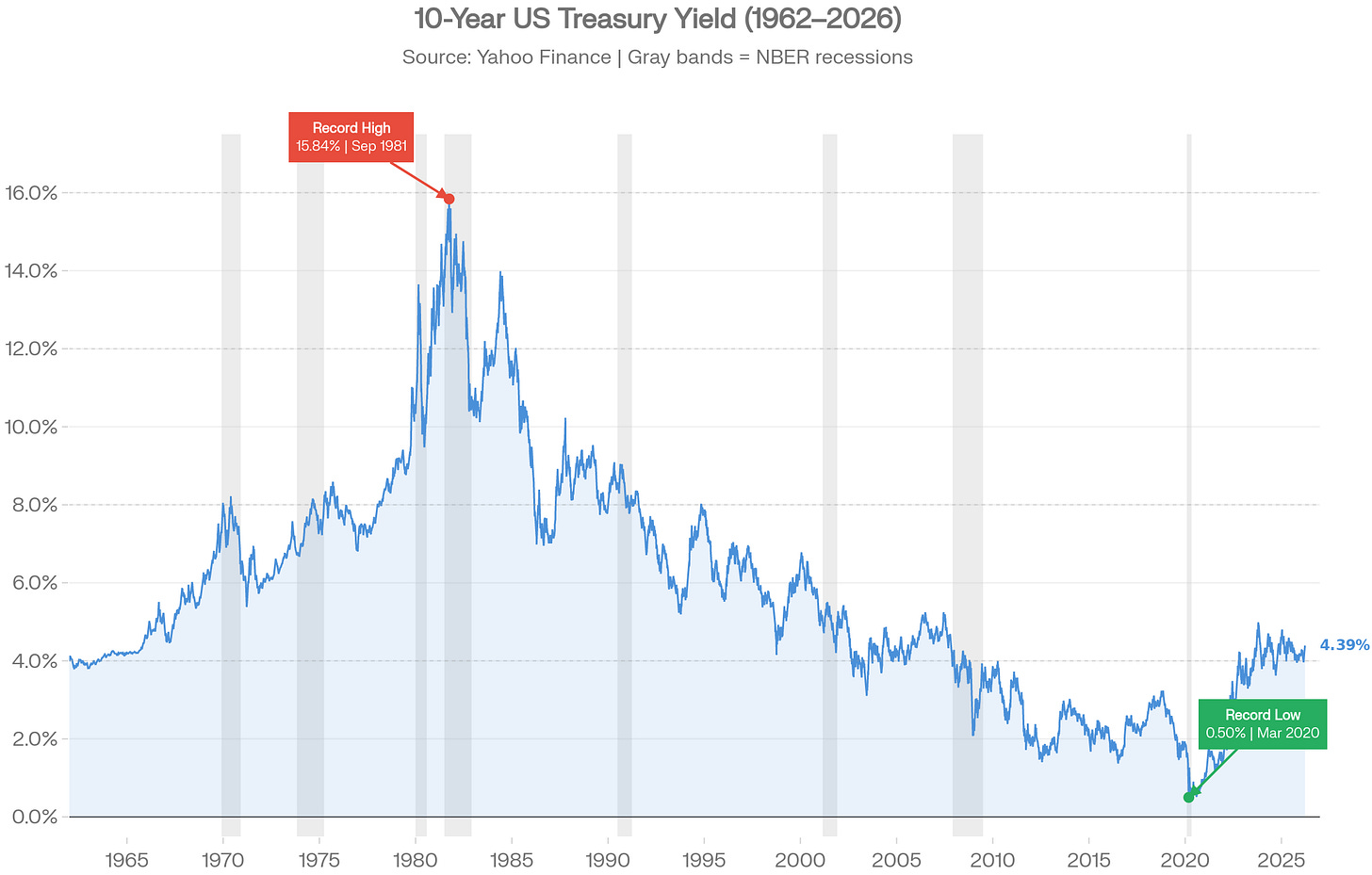
The gist
Bond yields have rocketed past 5% for the first time since 2007, rattling markets and forcing investors to rewrite their playbooks as inflation and fiscal risks come roaring back.
What to know
- Long-term U.S. Treasury yields just surged above 5%, fueled by a $38.5 trillion debt load, Fed bond buying, and inflation shocks from geopolitical strife like the Iran war.
- The bond market’s flashing recession signals—like a 26-month yield curve inversion and rising term premiums—have giants like Dalio and Buffett going defensive.
- Despite a flood of inflows into bond funds, risks loom large: 62% of fund managers expect 30-year yields to hit 6% by year-end, with credit cracks and volatility demanding tactical, inflation-savvy strategies.
Fiscal Dominance Reshapes Yields
Surging Treasury yields reflect a new era of fiscal dominance, as the Fed’s bond buying and ballooning U.S. debt force investors to demand higher compensation for mounting inflation and geopolitical risks.
The resurgence of long-term Treasury yields above 5%—a level not seen since 2007—reflects a profound regime shift in bond markets driven by intertwined structural forces. Central to this shift is the Federal Reserve's effective expansion of the money supply through resumed bond purchases, which, coupled with the US government's ballooning $38.5 trillion debt and nearly $1 trillion in annual interest payments, has eroded Fed independence and ushered in fiscal dominance. Investors, recognizing that the Fed is effectively the Treasury’s backstop, demand higher yields to compensate for the inflation risks embedded by these fiscal dynamics and monetary accommodation.
Geopolitical tensions, notably the Iran war and associated energy shocks, have exacerbated inflation fears, pushing the 30-year Treasury yield to 5.2% by mid-2026 and triggering a global bond sell-off with similar multi-decade highs in the UK and Japan. This convergence of persistent inflation pressures—driven heavily by energy costs accounting for roughly 40% of recent CPI surprises—and fiscal concerns has led investors to recalibrate expectations, factoring in sustained inflation, ongoing Fed rate hikes, and a structurally higher term premium to finance growing deficits.
A notable driver behind the elevated long-term yields is the sharp rise in real yields, which have surged from deeply negative territory during the pandemic to above 2% by late 2023, signaling a return to pre-crisis norms. This rise in real yields, more consequential than inflation expectations, reflects a complex market environment shaped by geopolitical risks and supply disruptions in the Gulf region, suggesting that even a de-escalation in tensions may not swiftly reverse the upward pressure on yields. Meanwhile, inflation hedging demand remains robust, as evidenced by the TIP-to-IEF ratio nearing recent highs, underscoring investor caution amid persistent uncertainty.
The structural elevation of long-term Treasury yields is tightening financial conditions and challenging traditional risk assets, particularly long-duration bonds and bond-proxy sectors such as utilities, real estate investment trusts, and healthcare. This tightening threatens to compress valuation multiples and heighten the risk of rapid, flow-driven de-risking events, effectively reintroducing market friction after years of relative ease. As investors grapple with this new environment, the bond market is undergoing a fundamental transformation that demands a reassessment of exposure to interest rate-sensitive sectors.


Bonds: The Economy’s Early Warning
With the bond market signaling distress long before stocks, Wall Street titans are shifting to cash as persistent yield curve inversions and rising term premiums flag deepening economic and fiscal cracks.
The bond market functions as the foundational 'operating system' of the global economy, with its vast $318 trillion size dwarfing the $135 trillion stock market and setting the tone for all asset classes. Elevated US 10-year Treasury yields persistently above 4%—the longest stretch since before the 2008 crisis—signal deep economic and fiscal stress that often goes unnoticed by retail investors focused on equities. Influential figures like Ray Dalio, who describes the situation as an 'economic heart attack,' and Warren Buffett, holding a record $381 billion in cash while selling equities, underscore how bond market dynamics serve as early, reliable barometers of economic distress and fiscal challenges.
Bond market indicators such as yield curve shapes, credit spreads, and breakeven inflation rates provide earlier and more nuanced signals of economic health and risk than equity markets. The inversion of the 2-year/10-year yield curve, lasting roughly 26-28 months from mid-2022 through late 2024, has historically preceded every US recession, while widening high-yield credit spreads act as a leading indicator of tightening financial conditions before stock markets react. Moreover, the ratio of credit spread changes relative to breakeven inflation shifts helps distinguish between duration-driven inflation concerns and emerging credit risk, with cross-Atlantic credit spread alignment currently signaling calm systemic conditions.
The term premium on 10-year Treasuries has rebounded to about 70 basis points, roughly halfway back to the historical median of 150bps seen pre-2008, reflecting a structural shift away from quantitative easing-era dynamics. This rise is driven by the Federal Reserve’s withdrawal as a major bond buyer, flattening foreign official demand, and inflation expectations that have re-anchored but with greater variance. Against a backdrop of structural deficits at full employment and ongoing Treasury supply pressures, the yield curve is expected to steepen as long-term yields reprice higher, signaling persistent fiscal and economic challenges ahead.
Professional institutional investors closely monitor bond market signals such as the 2-year yield, TIPS breakevens, credit spreads, and Treasury auction results, which often precede equity market movements and provide a critical edge over retail investors. This focus is evident in the current negative equity risk premium—where the risk-free Treasury yields exceed equity returns at a CAPE ratio of 37× and 10-year yields at 4.4%—prompting defensive positioning including long-duration Treasury outperformance amid generally rising equities. Such divergences between bond and equity signals frequently foreshadow market inflection points, underscoring the bond market’s role as the mother of all market signals.





Portfolio Strategies in Flux
Investors are abandoning long-duration bonds in favor of intermediate maturities and inflation hedges, as active management and diversification become essential in a volatile, high-yield environment.
As bond yields have risen sharply, investors and portfolio managers are recalibrating their strategies to navigate the new fixed income landscape. Early in 2026, there was a notable shift from long-duration Treasuries toward intermediate-term bonds, which offer a more balanced trade-off between income generation and duration risk, as highlighted in the March 28 analysis emphasizing active management and diversification across maturities and credit qualities. This approach is complemented by increasing allocations to high-quality corporate and municipal debt, providing steadier income streams without excessive interest rate sensitivity.
Market experts like Scott DiMaggio and Colin Martin underscore the importance of managing duration amid ongoing inflation concerns and yield volatility. DiMaggio points to a potential bond rally in the latter half of 2026 driven by growth worries and highlights the attractiveness of investment grade bonds yielding near 5%, while Martin advocates for simpler, agency mortgage-backed securities that balance yield and credit risk. Both emphasize the need for active duration adjustments and caution against long-duration bets that implicitly assume falling interest rates, which may not materialize given current fiscal and inflation dynamics.
Amid persistent inflation risks reminiscent of the 1970s, investors are increasingly diversifying into inflation-protected securities like TIPS, real assets, infrastructure, and hedge funds to seek inflation resilience and uncorrelated returns. JP Morgan’s May 2026 insights reveal that despite elevated cash holdings averaging 20%, there is growing recognition of the need to rebalance portfolios toward assets that can better withstand inflationary pressures. This sentiment is echoed by PIMCO’s Dan Ivascyn, who balances extending duration with inflation hedging, anticipating disinflationary forces from AI and geopolitical de-escalation to keep inflation generally in check over the medium term.
Investor behavior in mid-2026 reflects a cautious yet opportunistic stance as the fixed income market evolves. Voya’s Eric Stein and SIT’s Bryce Doty articulate a consensus that bond yields may rise in the near term before falling, prompting strategies that emphasize duration management and income-oriented assets such as two-year TIPS, municipal bonds, and selective high-yield corporates. BlackRock’s Steve Laipply notes a tripling in the proportion of bonds yielding above 4% since 2019, fueling a more nuanced approach to bond investing and driving industry fund flows up 40 to 50% year-over-year despite geopolitical uncertainties, signaling strong investor engagement with income opportunities in this higher yield regime.



Geopolitics Drives Rate Volatility
Energy shocks and global tensions are fueling multi-decade highs in yields and volatility, forcing investors to weigh inflation, policy divergence, and the end of ‘free money’ in their bond market calculus.
By early 2026, persistent inflationary pressures, particularly fueled by rising energy prices and geopolitical tensions such as the Middle East conflict and Iran war, have driven long-term U.S. Treasury yields to multi-decade highs, with the 30-year yield surpassing 5.2%, its highest since 2007. Scott DiMaggio and Ian Lincoln highlight how these supply shocks and geopolitical risks are not only elevating bond yields but also increasing market volatility and raising concerns about fiscal sustainability, as investors demand higher risk premiums amid fears of prolonged inflation and energy supply disruptions.
Divergent central bank policies add complexity to fixed income markets, as some overseas central banks are compelled to hike rates in response to inflation, while the Federal Reserve and Bank of Canada exhibit patience, potentially pausing or even lowering rates, supported by steady but subdued job growth averaging around 15,000 monthly new jobs. This divergence, noted by Scott DiMaggio and echoed by market strategists like Eric Stein and Bryce Doty, underscores the nuanced interplay between inflation, geopolitical risks, and monetary policy, which shapes investor expectations and bond market dynamics.
The fixed income landscape is undergoing a fundamental shift toward a 'higher for longer' interest rate regime, driven by structural factors including reshoring of manufacturing, geopolitical fragmentation, and sustained inflationary pressures beyond the pandemic era. As Charles Schwab strategists and multi-asset analysts emphasize, investors must navigate multiple competing macro regimes simultaneously, balancing real assets to hedge inflation against bonds to protect from growth scares, while recognizing that capital is no longer free and inflation is more susceptible to supply shocks, especially from energy disruptions in the Middle East.
Rising real yields, rather than just inflation expectations, have become the primary driver behind the surge in Treasury yields, signaling a broad repricing of sovereign risk to pre-crisis norms after a decade of suppressed real yields due to unconventional monetary policy. Analysts like Ian Lyngen and others point to the 10-year TIPS yield surpassing 2%, reflecting investor demand for inflation protection amid geopolitical uncertainties such as Gulf tensions and potential supply disruptions through the Strait of Hormuz, which could either exacerbate inflation-driven risk premiums or keep real yields elevated if economic growth remains resilient.






Yield Opportunities—And Pitfalls
Rising yields offer rare income potential but come with heightened duration and credit risks, prompting a shift toward shorter bonds, TIPS, and real assets to guard against inflation and volatility.
As long-term Treasury yields surpass 5% for the first time since 2007, investors are presented with a compelling income opportunity in fixed income, with about 60% of the bond universe now yielding above 4%, a stark increase from less than 20% in 2019. BlackRock’s Steve Laipply highlights this elevated yield environment as a renewed chance to capture attractive income, reflected in industry flows into bond funds rising 40 to 50% year-over-year. However, this opportunity comes with caution: duration risk is significant as 62% of fund managers expect 30-year yields to reach 6% by year-end, and private credit markets face vulnerabilities amid sustained high rates and slowing revenue growth, underscoring the need for selective exposure and risk management.
In response to persistent inflationary pressures and a structurally higher rate environment, advisors and asset managers advocate for diversified fixed income strategies that emphasize shorter-duration bonds and inflation-protected securities, such as TIPS. PIMCO’s Dan Ivascyn points to the 5-year Treasury note yielding about 4.2% as an optimal balance between income and duration risk, while the firm has increased portfolio duration and added TIPS to hedge inflation. This strategic pivot reflects a broader recognition that inflation is becoming embedded in the economy, driven by government spending and higher interest costs, necessitating portfolios that can withstand multiple inflation and growth scenarios influenced by geopolitical tensions and technological shifts.
Real assets such as gold, commodities, and select real estate types are increasingly viewed as essential complements to traditional fixed income and equity allocations for inflation hedging and portfolio resilience. Advisors like Sam Miller and J Scott emphasize the value of hard assets, with Scott calling real estate 'the best risk-adjusted investment on the planet' and urging broad diversification across asset classes, operators, and geographies to mitigate losses during economic turmoil. This approach aligns with JP Morgan’s recommendation to add infrastructure and hedge funds as uncorrelated strategies, recognizing that in an era of supply shocks and geopolitical fragmentation, real assets offer tangible protection against inflation’s persistence.
While the fixed income landscape offers attractive income opportunities, investors must navigate significant risks including duration exposure, credit vulnerabilities, and the potential for market reversals as rates are expected to rise near term before declining. Experts like Voya’s Eric Stein and SIT’s Bryce Doty caution that although rates will climb to tighten financial conditions, they may fall relatively quickly as economic demand responds, creating a tactical window for positioning in sectors like two-year TIPS, municipal bonds, and high-yield corporates. This evolving narrative demands vigilance and a shift from simplistic diversification to thematic, macro-driven strategies that balance inflation risks with disinflationary forces from AI and other structural changes.