Boomers hold the purse strings: america's generational wealth standoff deepens
The gist
America’s economic engine is stuck in a generational standoff, with Baby Boomers clutching over half the nation’s wealth while Millennials and Gen Z battle rising debt, late inheritances, and a barricaded housing market.
What to know
- The top 40% now control 85% of U.S. wealth, as Boomers’ assets balloon to $90 trillion while younger generations face stagnant wages and skyrocketing housing costs.
- Restrictive zoning, Boomer dominance in labor and real estate, and policy inertia have created a ‘Scarcity Tax’ on renters and stifled upward mobility for younger Americans.
- Boomers’ slow asset sales and increasing longevity are pushing inheritances—and hope for wealth transfer—deep into the 2030s and 2040s, worsening economic uncertainty for Millennials and Gen Z.
The K-Shaped Divide Deepens
America’s post-pandemic recovery split sharply along wealth lines, with asset owners enjoying soaring prosperity while the middle class and poor face mounting debt, squeezed consumption, and psychological despair.
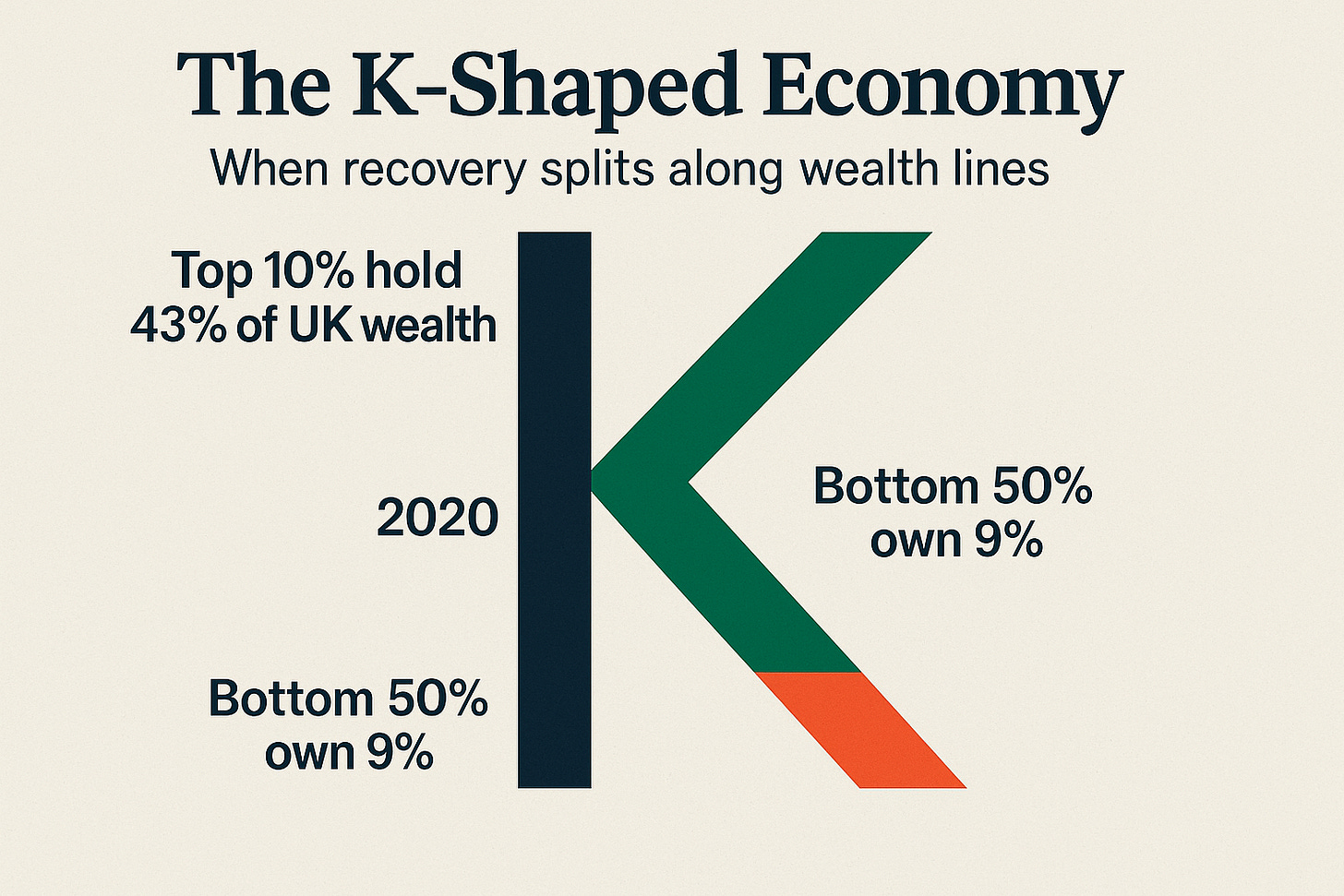
The post-pandemic recovery crystallized into what analysts have termed a K-shaped economy, where economic outcomes sharply diverged along wealth lines. One arm of the K soared with asset inflation and prosperity, driven by the top 40% controlling 85% of U.S. wealth and stock markets climbing over 90% in three years, while the other arm faced stagnant wages, mounting debt, and squeezed consumption, as evidenced by the poorest fifth in the UK spending 39% of their income on housing and the top 10% in the U.S. driving nearly half of all consumer spending. This bifurcation was not merely economic but psychological, with Peter Atwater describing a small group experiencing “intense certainty” contrasted against a “sea of despair” for the majority.
Wealth inequality, far exceeding income disparities, emerged as the primary driver of this K-shaped divide. In the UK, the wealth Gini coefficient reached 0.59 compared to an income Gini of 0.35, with financial wealth inequality even more extreme at 0.87. Similarly, in the U.S., growth in savings and wealth since 2019 has been substantial only for high-income households, while low-income groups saw limited gains, compounded by lower wage growth and disproportionate inflation impacts on essentials like housing and food. This triple threat of wealth concentration, wage stagnation, and inflation exposure has entrenched the divide, marking early indicators of the K-shaped recovery.
By early 2026, the K-shaped economy’s effects rippled beyond the extremes, with the middle class showing signs of strain, prompting some economists to describe an emerging E-shaped economy. Asset inflation in sectors like the auto industry—where new vehicle prices surged 40% since 2018—pushed lower-income buyers out, while consumer spending bifurcated: premium services like Delta’s first-class seats grew, whereas value-oriented businesses such as McDonald’s saw declines among lower-income patrons. Meanwhile, middle and upper-middle income households grappled with rising costs in housing, healthcare, and childcare despite six-figure incomes, revealing the widening fissures within the economic landscape.
The generational dimension of the K-shaped economy became increasingly apparent, with older generations, particularly Baby Boomers, disproportionately benefiting from asset inflation and favorable economic policies, while younger adults faced wage stagnation and diminished prospects. John Carter highlighted how Boomers profited from a generational Cantillon effect by accessing inflated money first, even as nearly half of adults under 30 lived with parents and rent delinquencies and credit card debt surged among younger and lower-income groups. This divide also manifested politically, with stark voting differences along age lines reflecting underlying economic fractures, underscoring the deepening rift between generations.





Broken Benchmarks, Rising Barriers
Decades of flawed economic metrics and entrenched policies have supercharged wealth concentration, turning housing and labor markets into engines of inequality that lock out younger generations.
For decades, a flawed economic benchmark has quietly distorted U.S. policy and market risk assessment, inflating asset prices and eroding middle-class wealth. Michael Green highlights how this broken benchmark rewired incentives, fueling passive investment flows that misprice risk and exacerbate systemic fragility. This dynamic directly contributed to a collapse in housing affordability, as asset inflation transformed homes into scarce, expensive commodities, deepening economic inequality and threatening future generations' financial stability.
Underlying these distortions is a fundamental shift in wealth dynamics, where capitalism’s natural tendency to concentrate wealth has been amplified by policy failures that flipped redistribution from supporting new entrants and social insurance to protecting entrenched winners. Physicist Ole Peters’ mathematical demonstration of wealth concentration underscores this systemic instability, with America operating under a 'Negative τ' regime for 40 years—extracting wealth from the middle class and repelling it from the center, thereby destabilizing the economic foundation that once sustained broad opportunity.
Structural barriers in housing and labor markets further entrench inequality, as restrictive zoning creates a 'Scarcity Tax' that transfers wealth from renters to property owners, while Baby Boomers’ prolonged dominance in the workforce and housing market suppresses younger generations’ economic prospects. Steven Ruggles’ research reveals how Boomers’ reluctance to retire or downsize has clogged family-sized homes and leadership roles, compounding generational divides and leaving institutions unprepared for transition, effectively strangling the economic mobility of millennials and Gen Z.
By early 2026, the convergence of ballooning national debt, regressive inflation, and skewed fiscal policies has intensified the wealth divide, disproportionately burdening younger and lower-income Americans. Despite nominal wage increases of 31% since 2020, real wages grew a mere 3.7%, while essential costs like rent and utilities surged by 14% to 56%. This inflation-driven erosion of purchasing power, coupled with the Cantillon Effect favoring older asset holders and unsustainable Social Security benefits skewed toward Baby Boomers, has cemented a Gilded Age-level inequality, with entrenched political power preserving the status quo and blocking reforms that could alleviate these systemic inequities.






Housing, Jobs, and Spending Gaps
A chronic housing shortage, career blockades, and diverging spending habits reveal how Boomers’ asset dominance and delayed turnover are shutting Millennials and Gen Z out of wealth-building opportunities.
The generational wealth divide starkly manifests in the housing market, where a chronic shortage of approximately 15 million homes—exacerbated by restrictive zoning and a builder focus on large, expensive homes—has driven prices and property taxes to soaring heights. Kevin Erdmann describes this as a 'Scarcity Tax' paid by renters to landlords, effectively transferring income from those unhedged to those who own property, leaving families earning $100,000 feeling financially strained despite nominal incomes. This dynamic is compounded by Baby Boomers holding a disproportionate share of family-sized homes, with older Americans capturing 64% of home value gains since 1989, while younger adults face declining homeownership rates and ballooning student debt that restricts their ability to enter the market.
Labor market challenges reflect and intensify the generational divide, as young white-collar workers grapple with a 'no-hire' economy influenced by AI adoption, rising student debt, and high living costs. Unemployment among teenagers and early-career adults has surged, with rates for young college graduates nearing highs unseen since 2016, while wage growth for low-paid workers has stalled after a brief boom, widening inequality. Although labor data has yet to fully capture these shifts, indicators like lower quit rates and fewer higher-paying job opportunities signal a career blockade that, while easing as Gen X enters executive roles, still hampers younger generations’ economic mobility.
Consumer behavior further reveals the wealth divide, with lower-income Americans increasingly depleting savings to manage inflation and soaring gas prices—cutting back on fuel purchases by 7% yet spending 12% more overall—while the national personal savings rate fell to 3.6% in March 2026, its lowest since the 2022 'revenge spending' surge. Meanwhile, seniors aged 65 and older have outpaced younger adults in spending growth, accounting for 22% of total US consumer spending in 2024 and nearly matching younger cohorts in non-financial expenditures. This spending power is underpinned by prolonged workforce participation and a financial asset advantage that has quadrupled relative to middle-aged adults since 1989, reinforcing delayed wealth transfers and shifting economic dynamics.
Delayed generational wealth transfers compound economic frustrations, as increased longevity means inheritances expected by millennials and younger adults are pushed into the 2030s and 2040s, often arriving after the critical years for financial support. The initial transfer typically occurs between spouses, with women inheriting and controlling assets for extended periods—a shift the financial industry is ill-prepared to address. This delay, coupled with younger adults’ tendency to live beyond their means in anticipation of inheritances, exacerbates financial insecurity amid stagnant career growth and housing affordability challenges, leaving many caught in a prolonged economic squeeze.




Generational Perceptions Collide
Boomers’ nostalgia for lower prices clashes with Gen Z’s economic optimism, fueling social resentment as rising costs, political inertia, and lifestyle gaps harden America’s generational fault lines.
By early 2026, a stark emotional and economic divide had crystallized between generations, rooted in differing perceptions of inflation and financial stability. Older Americans, particularly Baby Boomers and Gen X, experienced a sharp decline in consumer confidence despite inflation falling to 2.4% and wages rising, due largely to reference point bias—where they compare current prices to lower nominal prices from the past, making inflation feel like repeated personal losses. In contrast, younger generations such as Gen Z, who have no historical price anchors, perceive current costs as normal, fostering greater optimism about the economy even as they face mounting financial challenges.
This generational divergence extends beyond perceptions to tangible economic behaviors and social tensions. Older Americans maintain spending confidence and healthier lifestyle habits, supported by assets like paid-off homes and Social Security, while younger and lower-income Americans grapple with financial strain, increased debt reliance, and pessimism about job prospects and retirement readiness. For example, nearly half of adults under 30 live with parents, and rent delinquencies are rising, while wealthier households continue discretionary spending, as seen in Disney's strong bookings and record stock market highs. This bifurcation fuels social resentment, with younger generations viewing Boomers as 'guardians of the rot' who control Congress, institutions, and most wealth, exacerbating political and social divides.
The widening economic and emotional gap between generations has intensified political and social tensions, as government responses often seem disconnected from the lived realities of younger and struggling Americans. Despite historic lows in consumer sentiment—such as the University of Michigan’s April reading of 49.8, the lowest in 74 years—and warnings from figures like John Rogers and Kevin Hassett about economic fragility, political leaders continue to tout optimism. Meanwhile, intra-party conflicts, like the ousting of conservative Thomas Massie by Boomers defending the status quo, underscore how generational divides shape political dynamics and hinder reforms aimed at addressing wealth inequality and economic insecurity.
Addressing these generational divides requires policymakers to move beyond traditional economic indicators and tackle behavioral biases and structural inequities that fuel pessimism and social discord. As experts note, restoring consumer confidence hinges on understanding phenomena like reference point bias and implementing fair tax policies, reasonable interest rates, and wealth gap solutions. Without such measures, the emotional and financial strain on younger Americans—manifested in halted retirement savings, maxed-out overtime, and dipping into savings to cover essentials—will deepen, threatening both economic growth and social cohesion.


The Great Wealth Hold-Up
Boomers’ grip on $90 trillion of assets is tightening as longer lifespans and slowdowns in selling delay inheritances, leaving Millennials and Gen Z facing a prolonged wait for financial relief.
By early 2026, Baby Boomers continue to hold a commanding 51% share of the nation’s wealth, primarily through real estate and stock holdings valued at approximately $90 trillion, yet their asset liquidation has notably slowed as many choose multigenerational living arrangements to cope with affordability challenges. This reluctance to sell, driven by limited financial incentives and scarce buyers, contributes to an oversupply in housing inventory, further complicating the wealth transfer dynamics between generations.
While Millennials and Gen Z currently control a much smaller slice of the wealth pie, their share is gradually rising—Millennials’ household wealth share climbed from 4% in 1989 to 11% by 2025—reflecting increased savings rates and eventual inheritances. However, this upward trajectory is tempered by delayed homeownership, soaring house prices now five times median income, and a prolonged timeline for wealth transfer, with the bulk of Boomer inheritances projected to unfold between the 2030s and 2040s due to increased longevity and the median inheritance age hovering around 51 to 60.
The extended lifespans of Boomers not only delay wealth transfers but also shift asset control within families, as widows often inherit first and manage significant wealth for years, a transition the financial industry is ill-prepared to handle. This longevity-induced financial anxiety—exemplified by the 64% chance a 65-year-old couple will have a partner living past 90—fuels cautious spending and complicates Millennials’ financial planning, deepening the generational wealth divide and economic uncertainty.
These shifting wealth shares are reshaping economic stability and political landscapes, as Boomers’ entrenched financialized worldview and control over institutions amplify intergenerational tensions, evidenced by starkly divergent voting patterns between older and younger cohorts. Meanwhile, Treasury Secretary Scott Bessent’s 2026 '3-3-3' growth framework underscores a reliance on robust economic expansion—rather than tax hikes or benefit cuts—to manage the demographic pressures of 10,000 Boomers entering Social Security daily, highlighting the precarious balance between sustaining entitlement programs and addressing the widening generational wealth gap.