Brawls, backlash, and billion-dollar branding: UFC’s white house cage fight sparks fury over trump’s hypermasculine spectacle
The gist
Trump’s UFC Freedom 250 turned the White House South Lawn into a billion-dollar cage fight, fusing violent spectacle, hypermasculine patriotism, and political branding—leaving America more divided than ever.
What to know
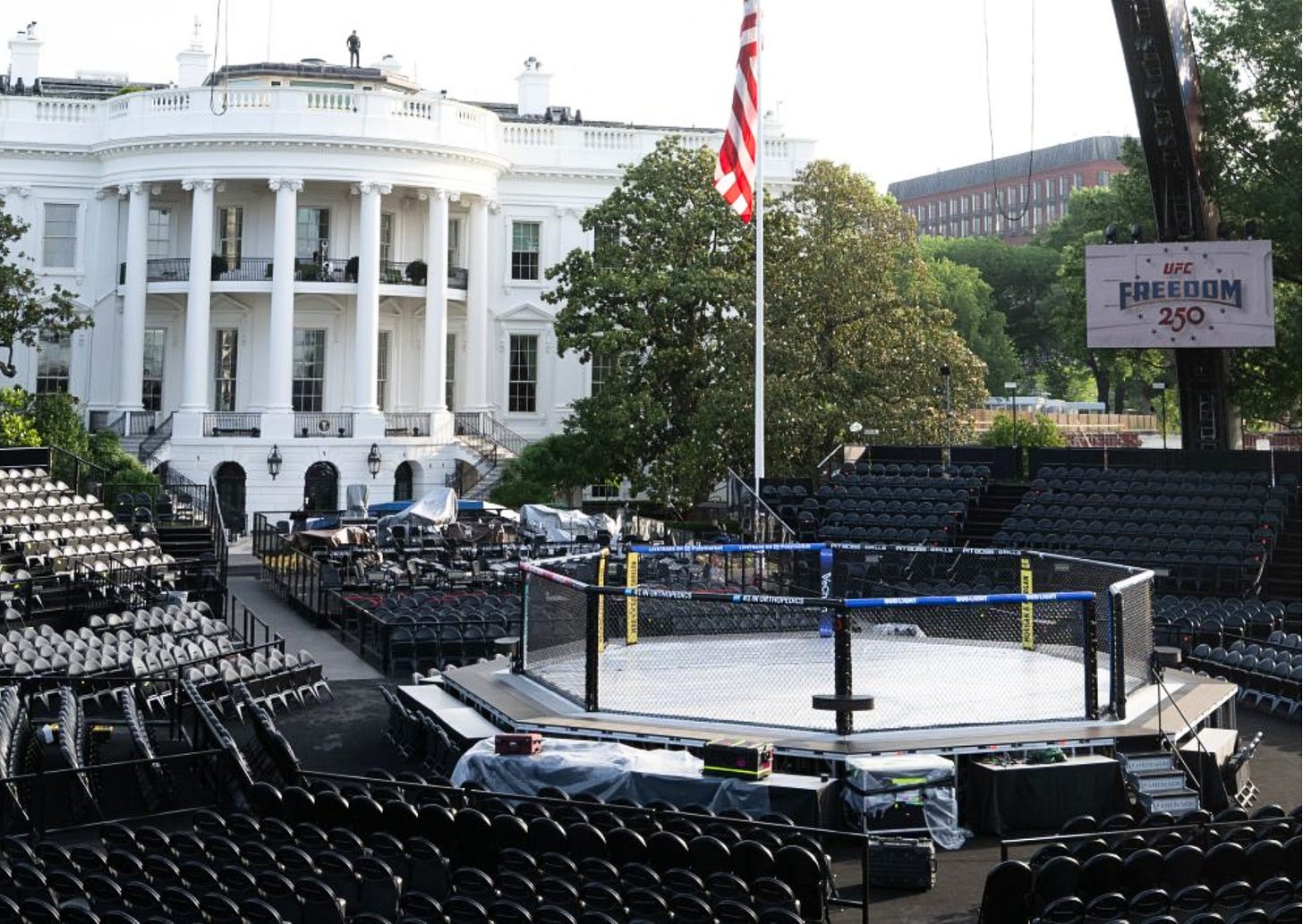
- On June 14, 2026, the White House South Lawn hosted UFC Freedom 250 in brutal 107-degree heat, transforming a ceremonial space into a combat arena for Trump’s 80th birthday and the U.S. 250th anniversary.
- The event drew fire for Trump family-linked crypto sponsorships, corporate backers like Bud Light and Paramount+, and regulatory loopholes that blurred public office with private gain.
- With $1 million in grounds damage, exclusive pay-per-view access, and backlash over aggressive symbolism, the spectacle sparked fierce debate about presidential stewardship and deepened national divides.
Masculinity as Political Theater
Transforming the White House South Lawn into a UFC battleground, Trump’s administration fused hypermasculine spectacle with patriotic pageantry to redefine presidential image-making and fill a cultural void in male role models.
The UFC Freedom 250 event on the White House South Lawn marked a stark departure from traditional presidential sporting events, replacing genteel pastimes like tennis and bowling with a hulking UFC cage and a combative 'blood sport' spectacle. This transformation of the South Lawn—from hosting family-friendly events such as the Easter Egg Roll to becoming an arena for violent, high-intensity fights—symbolizes a broader cultural and political shift under the Trump administration, emphasizing aggressive masculinity and spectacle as central to presidential image-making.
Staged as a grand spectacle akin to a world’s fair, the UFC event fused themes of masculinity, patriotism, and militaristic power to craft a narrative of American strength and dominance. With fighters parading through a Marine honor guard corridor, a military flyover, and thousands chanting “U-S-A,” the event blended violent UFC combat with traditional nationalist pageantry, underscoring President Trump’s personal brand of performative, dominant masculinity. Moments like Justin Gaethje’s walkout staring at the Declaration of Independence and Sean O’Malley’s knockout salute amplified this theatrical display of masculine bravado.
The UFC Freedom 250 also functioned as a politically charged spectacle that strategically filled a cultural void in masculine role models, a gap Democrats have struggled to address. By embracing a raw, aggressive form of patriotism intertwined with militaristic imagery and unambiguous physical dominance—evidenced by all seven fights ending in TKOs without judges—the event projected a vision of strength and decisiveness that resonates with a significant segment of the American public. This spectacle, attended by figures like Mark Zuckerberg and Lindsey Graham and streamed behind a Paramount+ paywall, highlighted the fusion of political power, commercial interests, and cultural symbolism in contemporary political image-making.
Echoing historical precedents such as Teddy Roosevelt’s White House boxing matches, the UFC event leveraged the longstanding tradition of blending combat sports with presidential image-making to reinforce a narrative of vigor and leadership. Positioned as a form of 'bread and circuses,' the event provided a diversion amid national challenges like war and economic pressures, using spectacle and cultural performance to bolster the administration’s popularity. Critics framed the event as a 'very American Trumpy celebration' of transparency and spectacle, highlighting the evolving role of celebrity politics where raw spectacle increasingly eclipses traditional endorsements.






Heat, Hazards, and High Stakes
Brutal 107-degree heat, unprecedented engineering challenges, and high-risk stunts turned the White House UFC event into a logistical and health gamble with no clear accounting of its true operational costs.
The extreme heat during the UFC Freedom 250 event posed serious health risks to fighters, with Washington D.C. temperatures reaching a heat index of 107 degrees Fahrenheit. The Arizona Department of Health Services warned that conditions like sunstroke, heat cramps, and heat exhaustion were likely, while heat stroke was a real possibility during prolonged physical exertion. Even UFC insiders expressed concern; commentator Joe Rogan admitted, 'I don’t like the idea of fighting outside at all,' underscoring the event’s departure from typical indoor venues and the heightened health dangers involved.
Staging the UFC event on the historic White House South Lawn demanded unprecedented logistical ingenuity due to strict preservation rules that prohibited digging, forcing engineers to anchor the colossal 600-ton steel arch by adding 40 tons of weight to each leg. This radical transformation of the traditionally ceremonial space, once reserved for picnics and the Easter Egg Roll, introduced complex operational challenges including converting the Indian Treaty Room into fighter locker rooms and orchestrating fighter entrances through the Oval Office under tight Secret Service supervision. The scale of the operation was immense, with 350 trucks thoroughly inspected before entering the grounds, reflecting the intricate balance between spectacle and security.
Beyond the physical infrastructure, the event’s health and comfort logistics sought to mitigate the harsh outdoor conditions by providing 'Four Seasons'-quality restrooms and complimentary food and drinks to the 4,000 invite-only guests, including military personnel who had to meet strict physical standards and cover their own travel expenses. However, the addition of a high-risk motorcycle stunt ramp and looming thunderstorms introduced further safety and weather-related uncertainties, complicating crowd control and security efforts. Questions also lingered over the true cost of these extensive security, traffic, and crowd management measures, with no clear public accounting for the additional operational expenses incurred.



Blurring Lines: Power and Profit
Trump family-linked crypto payouts, major brand alliances, and regulatory loopholes at UFC Freedom 250 exposed how presidential power was leveraged for private gain and political advantage.
The UFC Freedom 250 event became a lightning rod for conflict of interest concerns due to its deep entanglement with the Trump family’s business ventures, notably the use of World Liberty Financial’s USD1 stablecoin to pay fighter bonuses. This direct corporate sponsorship by a Trump-linked crypto company, coupled with Trump’s personal investment in UFC stock and the event’s staging on the White House lawn, blurred the lines between public office and private gain, prompting sharp criticism from figures like Senator Cory Booker who labeled the spectacle as "crass, corrupt, and cruel."
Major corporate sponsors such as Crypto.com, Bud Light, Monster Energy, and Paramount+ embraced the politically charged UFC event despite the inherent risks, signaling a notable shift toward overt political alignment. Bud Light’s prominent presence, despite its prior backlash from MAGA supporters, and Paramount+’s broadcast following a $111 billion merger approval, underscore how sponsorships were less about broad consumer appeal and more about currying favor with the Trump administration, even as only 16% of Americans found the event acceptable.
Legal and regulatory challenges surrounding the event revealed a pattern of circumventing governance norms, exemplified by the Kennedy Center’s superficial compliance with a court order to remove Trump’s name and the Justice Department’s dismissive defense that critics could simply "avert their gaze." These maneuvers reflect a broader Trump family modus operandi of exploiting loopholes and workarounds to maintain commercial and political advantage, undermining traditional checks on the use of public institutions for private branding.
The event’s sponsorship strategy deliberately targeted the UFC’s core demographic—young, ethnically diverse males who are more receptive to cryptocurrency—highlighting a calculated effort to normalize crypto payments and gambling partnerships within mainstream political spectacle. This alignment, however, was complicated by the UFC’s fraught brand positioning amid the debunked media narrative of a close Dana White-Trump alliance and controversies like the Eric Trump-Daniel Cormier DMs, which exposed the tangled intersections of politics, business interests, and media narratives in the digital age.




Spectacle, Division, and Paywalls
While the UFC event briefly unified some Americans through spectacle, its aggressive symbolism, partisan undertones, and exclusive access deepened cultural divides and highlighted the limits of political theater.
The Freedom 250 UFC event at the White House exemplified a calculated use of spectacle to bolster political image-making and momentarily unify a fractured nation. By staging a high-profile sporting event complete with iconic imagery and patriotic pageantry, the administration tapped into an underutilized strategy of leveraging large-scale parties and sports to create a shared sense of identity, as one guest observed, "big parties and sporting events are potentially the most underutilized political strategy." Despite ongoing crises like war and inflation, many Americans welcomed this 'bread and circuses' moment as a much-needed diversion, with one commentator admitting, "the bread and circuses... worked on me." This approach underscores how spectacle can temporarily elevate approval ratings and foster national cohesion amid adversity.
However, the event’s overt celebration of a hypermasculine and aggressive form of patriotism revealed deep political and cultural fissures, particularly highlighting a gap in Democratic symbolism around aspirational masculinity. Analysts noted that Republicans, including Trump, have filled this void with displays often tinged with violence and misogyny, reinforcing a divisive political image that appeals to a segment of America craving strong symbolic displays. As one expert put it, "If Democrats can't come up with some sort of symbolism or role models that demonstrate strength and service as masculinity, then the Republicans fill that hole with violence and misogyny." This dynamic complicates efforts toward genuine national unity by alienating broader audiences and entrenching partisan divides.
The event’s framing as a 'people’s event' starkly contrasted with its commercial exclusivity—being locked behind a Paramount paywall—exposing a disconnect between political image-making and authentic inclusivity. Critics highlighted how this tonally incoherent blend of patriotism and bloodlust, coupled with restricted access, risked alienating the very public it purported to celebrate, with one commentator wryly noting, "Nothing says the people like a paywall." This commercialization and exclusivity undermine the spectacle’s unifying potential, revealing tensions between spectacle as political theater and the realities of public engagement.
Beyond image-making, the event’s aftermath—marked by $1 million in damage to the White House South Lawn and the Ellipse, public backlash, and aggressive suppression of dissent—symbolizes a broader pattern of prioritizing personal vanity over stewardship of national symbols. The arrest of Olympic athlete David Hearn for inspecting damage and Trump’s deflection of blame onto 'Radical Left Lunatics' illustrate an authoritarian governance style that controls narratives to maintain political image. As José Andrés lamented, the degraded state of the White House grounds during the nation’s 250th anniversary became a 'perfect metaphor for what he’s turned our country into,' underscoring how spectacle-driven politics can deepen divisions and erode trust in democratic governance.