Broadcom’s AI chip boom faces investor jitters, supply snags
The gist
Broadcom’s AI chip revenue is exploding, but supply snags and investor nerves threaten to derail its breakneck ascent.
What to know
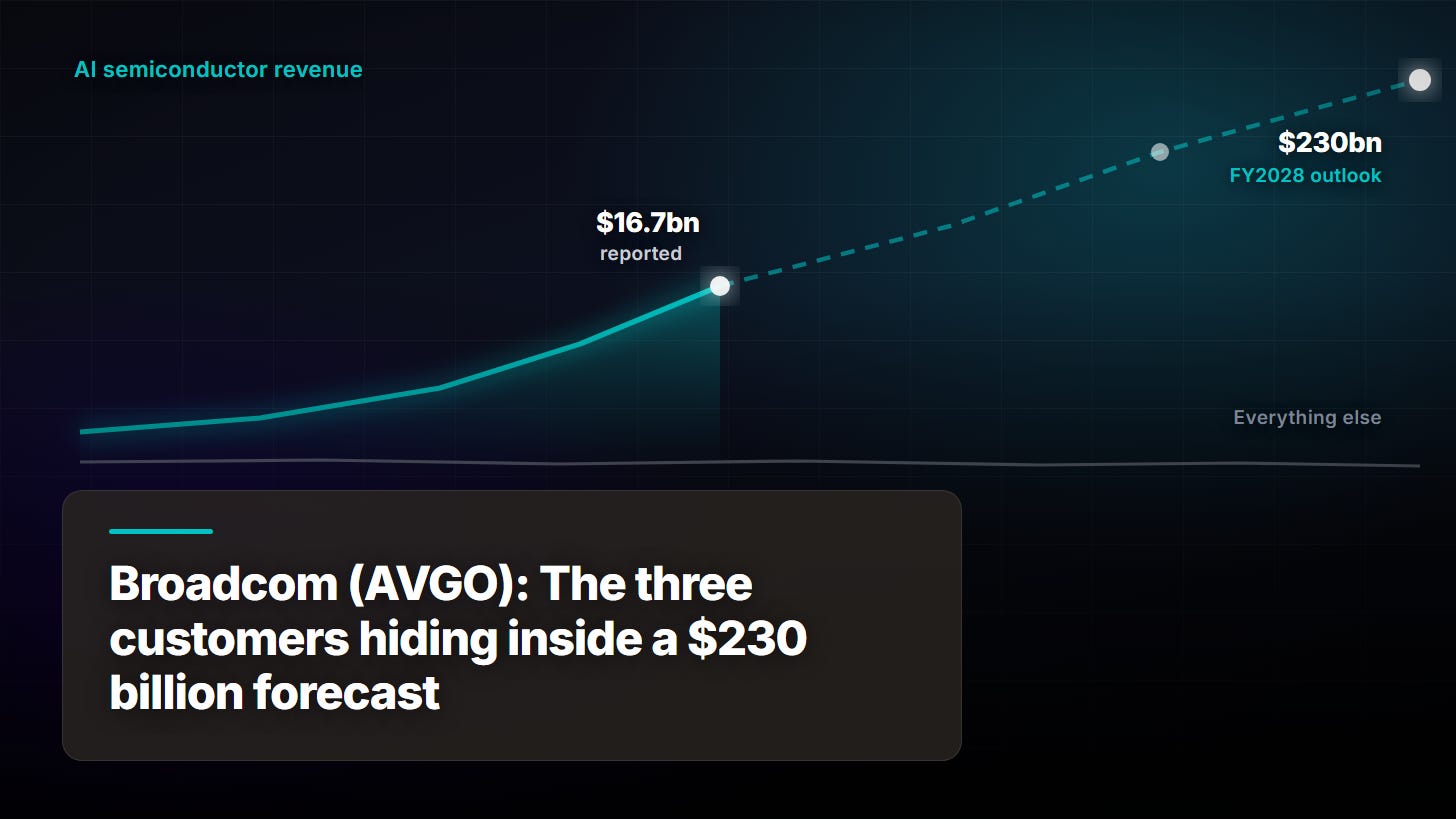
- AI chip sales soared 221% to $16.7 billion in Q3 2026, now making up 56% of Broadcom’s total revenue thanks to mega-customers like Alphabet, OpenAI, and Meta.
- CEO Hock Tan is forecasting AI revenue to rocket from $58 billion in 2026 to a jaw-dropping $230 billion by 2028, but supply chain bottlenecks—like laser and memory shortages—are slowing the pace.
- Despite blockbuster growth, Broadcom’s stock remains volatile as investors fret over high valuations, margin pressure, and heavy reliance on a handful of AI giants.
Custom Silicon Powers Surge
Broadcom’s explosive AI revenue growth is fueled by bespoke chips co-designed with tech giants, giving it a strategic edge over Nvidia and locking in long-term hyperscaler partnerships.
Broadcom's AI semiconductor revenue has skyrocketed by over 220% year-over-year, reaching $16.7 billion in Q3 2026 and now accounting for 56% of the company's total revenue. This explosive growth is fueled by major technology giants such as Alphabet, OpenAI, Meta, and Anthropic, whose demand for custom AI accelerators and networking silicon has transformed Broadcom into a dominant player in the AI infrastructure market.
CEO Hock Tan has dramatically raised Broadcom’s AI revenue targets, projecting a staggering $58 billion for fiscal 2026, doubling to $115 billion in 2027, and then doubling again to an ambitious $230 billion by 2028. This upward revision reflects not only the rapid adoption of Broadcom’s custom XPU accelerators—now comprising 73% of AI revenue—but also the company’s strategic partnerships with leading AI labs, positioning Broadcom as a cornerstone of the AI semiconductor ecosystem.
Broadcom’s AI growth is underpinned by its focus on custom silicon co-designed with key customers, such as the Jalapeño chip developed with OpenAI, which reportedly outperforms Nvidia’s offerings at less than half the cost. This bespoke approach, combined with networking products like the Tomahawk switch and Jericho router families, gives Broadcom a competitive edge over general-purpose GPUs and cements long-term design partnerships with hyperscalers and AI labs.


Supply Squeeze Threatens Ambitions
Critical shortages in lasers, memory, and infrastructure are choking Broadcom’s ability to scale AI chip production, forcing margin trade-offs and exposing the fragility of its supply chain.
Broadcom's rapid AI semiconductor growth is increasingly constrained by supply chain bottlenecks and infrastructure limitations that challenge its ability to scale production effectively. While management is aggressively investing in substrate manufacturing capacity—highlighted by the upcoming Singapore facility—and expanding optical component production to meet soaring demand, critical shortages such as lasers and high-bandwidth memory (HBM) persist, limiting throughput. Additionally, infrastructure hurdles including land, power availability, and data center readiness pose significant risks to fully deploying AI chips, with CEO Hock Tan emphasizing the importance of these factors in sustaining growth.
The shift toward custom AI chips, particularly XPUs that now constitute over half of Broadcom’s revenue mix, is driving a fundamental transformation in the company’s business model from high-margin software and chip design to a capital-intensive hardware integrator reliant on costly components like HBM. This transition has compressed gross margins from 77.1% to around 75%, with guidance trending down to 73%, as CFO Amie O’Toole notes margin dilution from the growing XPU share. Nevertheless, Broadcom has maintained strong operating margins—reaching a record 67.9%—through rigorous cost control and operational efficiency, even as operating expenses grow at a fraction of revenue expansion.
Broadcom’s ability to meet its ambitious AI revenue targets hinges not only on alleviating supply chain constraints but also on navigating the increasing complexity and fragmentation of custom silicon programs. Unlike the previous winner-take-all dynamic, AI chip deployments are now split across multiple vendors handling compute tiles, I/O, and networking, complicating financial modeling and operational execution. This fragmentation, combined with supply shortages in substrates, testing, and power components—as highlighted by industry leaders like Michael Dell—underscores the multifaceted challenges Broadcom faces in scaling AI infrastructure amid peak chip shortages forecasted for 2027.
To mitigate infrastructure bottlenecks and capital expenditure burdens, Broadcom has partnered with Blackstone and Apollo in a $35 billion XPV financing deal that supports over 20 gigawatts of AI computing capacity. This innovative financing approach enables Broadcom to expand AI infrastructure deployment without shouldering the full capital costs, addressing critical land, power, and construction constraints that could otherwise throttle growth. However, investor concerns linger about potential over-inventory and the risk of an AI bubble if data center readiness fails to keep pace with chip production, highlighting the delicate balance between supply expansion and demand realization.

Stock Jitters Amid Sky-High Growth
Despite record-breaking AI sales, Broadcom’s stock remains volatile as investors worry about customer concentration, competitive threats, and the sustainability of its rapid expansion.
Despite Broadcom's remarkable 221% surge in AI semiconductor revenue to $16.7 billion, the stock has struggled to gain traction in 2026, reflecting investor caution amid valuation debates. Trading at a forward P/E around 32 and a more modest 19 times next year's earnings due to expected growth in its custom chip business, the stock's performance underscores a market grappling with balancing strong long-term prospects against near-term uncertainties.
Investor sentiment has been notably sensitive to Broadcom's near-term guidance misses, with fiscal Q4 revenue forecasts of $34.8 billion falling just short of analyst expectations near $35 billion, triggering volatility including pre-market drops of about 3% and a 9.7% decline over three months. This cautious stance persists despite management's ambitious projections to double sales annually and reach $30 earnings per share by fiscal 2028, illustrating how slight shortfalls can overshadow robust growth narratives.
Concerns over customer concentration, particularly Broadcom’s reliance on AI giants Anthropic and OpenAI—both preparing IPOs—have heightened investor wariness about the sustainability of revenue growth. Coupled with intensifying competition from players like MediaTek and Marvell, and the fragmentation of custom silicon programs at key customers such as Google, these dynamics complicate revenue modeling and fuel skepticism, as analysts warn of systematic errors in market share estimates and the risk of valuation mispricing.
Nonetheless, Broadcom retains a reputation as a 'tech safety play' alongside Nvidia, buoyed by resilient demand and strategic partnerships, including a $30 billion chip agreement with Apple and a $1.5 billion investment in its Fort Collins plant. Analysts maintain bullish outlooks with some projecting over 50% upside if growth targets are met, supported by a multi-year backlog exceeding $179 billion and a 3-year PEG ratio of 0.48x, though they advise caution given margin pressures and supply chain constraints that temper enthusiasm.
Hardware Pivot, Financing Risks
Broadcom’s shift to capital-intensive custom hardware, backed by creative private equity financing, transforms its business model but raises new questions about margin compression and off-balance-sheet risks.
Broadcom is executing a bold strategic pivot towards a hardware-heavy AI infrastructure business model centered on custom AI silicon (XPUs) tailored for specific large language model workloads. This approach contrasts with Nvidia's general-purpose GPU strategy, as Broadcom focuses on delivering cost-efficient, purpose-built chips co-designed with major hyperscalers like OpenAI, Anthropic, Google, and Meta, enabling superior performance at roughly half the cost of competitors' GPUs. CEO Hock Tan emphasizes that designing chips around individual customer models allows Broadcom to optimize power efficiency and cost, positioning the company as a specialized AI engine provider for a select group of giant customers rather than a broadly accessible AI platform.
To support its ambitious AI revenue forecasts—projecting AI revenue to soar to $230 billion by fiscal 2028—Broadcom has innovated a financing model through its AI XPV platform, partnering with private equity giants Apollo and Blackstone to fund capital-intensive AI data center deployments. This platform has already closed a $35 billion tranche to finance Anthropic's initial gigawatt-scale TPU rollout, enabling Broadcom to recognize revenue upfront while mitigating direct capital expenditure. However, this circular financing strategy, where Broadcom acts as a guarantor or subprime lender to cash-burning AI labs, introduces potential off-balance-sheet risks and investor concerns about exposure if AI startups falter.
Broadcom’s evolving business model integrates custom AI silicon with complementary networking solutions and infrastructure software—exemplified by its VMware acquisition—transforming the company into a comprehensive AI infrastructure powerhouse. AI semiconductor revenue now accounts for 56% of total revenue, underscoring the shift towards hardware-heavy deployments. Yet, this transformation comes with structural margin compression due to the high cost of integrating expensive HBM memory with custom chips, a dynamic CEO Hock Tan highlights by urging investors to focus on operating margin rather than gross margin. Unlike Nvidia’s cyclical margin fluctuations, Broadcom’s margin decline signals a fundamental, long-term shift in its cost and revenue structure.
While Broadcom’s strategic partnerships with hyperscalers and AI foundry labs underpin a robust multi-year backlog exceeding $179 billion, signaling strong long-term demand, the company faces intensifying competition in the XPU segment and physical infrastructure constraints such as data center construction timelines and power availability. These bottlenecks could temper the pace of Broadcom’s AI silicon deployment despite triple-digit revenue growth. Moreover, investor optimism remains contingent on Broadcom’s ability to secure large-scale sales and maintain innovative financing arrangements amid concerns over valuation and balance sheet exposure, as the company navigates the complex dynamics of competing against market leader Nvidia.