Canada strikes back: trade war fuels nationalist surge
The gist
Canada and the U.S. are locked in an escalating trade war, fueling a nationalist surge north of the border and upending decades of economic partnership.
What to know
- After Trump floated a 50% tariff on Canadian auto goods, trade talks collapsed and both sides slapped steep tariffs on billions in goods.
- Ottawa hit back with tariffs on $20 billion of U.S. products, a C$7.5 billion aid package, and is eyeing deeper trade ties with China as public support for resistance surges.
- The trade war is raising costs for consumers and businesses, but some analysts say the rupture isn’t permanent, with 64% of Americans still viewing Canada as an ally.
Negotiations Collapse Amid Threats
Trade talks unraveled as Trump's 50% auto tariff threat and last-minute demands triggered a spiral of distrust and escalation.
By early September 2026, the break in U.S.-Canada trade ties was no longer theoretical but visible in the collapse of negotiations themselves. In the 2026-08-24 interview, the speaker asked, “how did we go from that to a complete breakdown in the talks?” and said that “late Friday… things came off the rails,” after “a few different things… injected… at the last minute,” while warning the dispute had “the makings of an all out trade war” and a “spiral of escalation” in which “things are going to get uglier before they get better.”
What made the rupture look durable rather than tactical was the form of U.S. pressure: the same interview said “President Trump is essentially saying he wants to put a 50% tariff rate on Canadian goods,” specifically “a 50% tariff on basically anything auto related coming in from Canada,” calling it “an enormous change” and “yet another bargaining tactic… meant to… put the fear in Canada.” That coercive posture was echoed in YouGov-linked reporting on September 2, whose headline read: “38% of Republicans label Canada ‘unfriendly’ as Trump imposes 50% tariffs and renames Lake Ontario to ‘Lake America’.”
Nationalism Surges Across Canada
U.S. pressure and provocative rhetoric have sparked a wave of Canadian pride, fueling political unity and public support for hardline retaliation.
Canadian nationalism hardened as the trade fight stopped looking like a policy dispute and started feeling like an assault on sovereignty. On The John Batchelor Show, Charles Burton said Trump-era rhetoric produced “a high degree of disdain” after claims that “Canada doesn’t need Canada, Canada needs the United States,” plus threats to “turn Canada into the 51st state” and even revisit the 1908 border treaty; he said even “the more recent one, the 10% tariff,” justified by U.S. complaints about forced-labor enforcement, reinforced the sense that Washington was acting in bad faith.
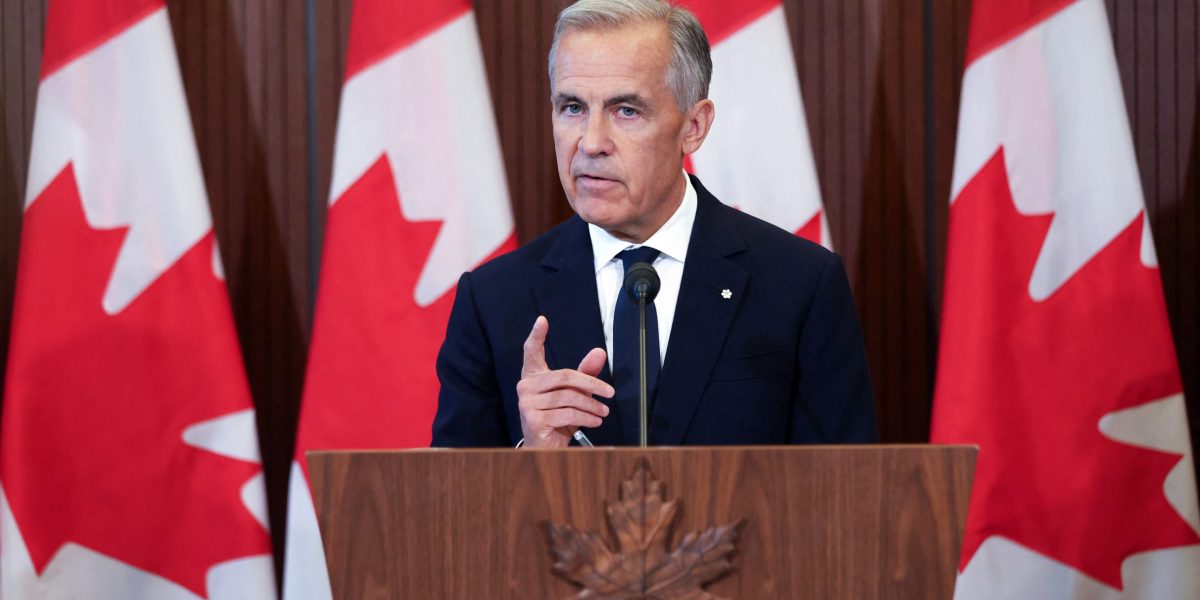
That loss of trust translated into a domestic political mood that rewarded resistance over accommodation. The Line framed the “summer of 2026” as one where Canadians were “checked out” after “half a year of tariffs,” and said Canadians remained “deeply conflicted about the economy,” with confidence still negative, while later commentary said “I never saw Canadian flags… two, three years ago” but now “there are so many Canadian flags from people’s windows… People are flying the maple leaf from their cars”; with “strong support for Carney is about 75%,” Ottawa answered by slapping tariffs on $20 billion in U.S. goods, launching a C$7.5 billion support package, and, as the article put it, looking “to probably free trade with China,” reviving the 2017 negotiations that failed under Justin Trudeau as a response to U.S. pressure.


China Gains as U.S. Fades
Ottawa's pivot to China is no longer hypothetical, with surging commodity exports and political momentum challenging North American trade norms.
Canadian discussion of China is shifting from abstract diversification to a practical fallback market as ties with Washington worsen. On The John Batchelor Show, Charles Burton said the dispute “resulted in a fifty percent tariff penalty on Canada” and that “Canada is rapidly diversifying its trade away from the United States, aligning closer with China and the European Union,” while another September analysis argued the real winner of the breakdown was China because Beijing was offering wider Canadian access to its market if Ottawa eased positions that cut against Chinese interests.
What makes the China turn look operational rather than rhetorical is that commentators now point to trade flows, political backing, and even legal risk around a deeper China opening. A September 24 analysis said “the Chinese… have started to very greatly increase its import of Canadian commodities… went up about 30% over the past half year,” while also warning that “if Canada violates a provision against free trade agreements with non market economies, which would be China… if Canada revives its 2017 attempt to establish free trade with China, then USMCA might” unravel; that debate is politically enabled by “Carney's refusal to engage further with the United States in trade talks,” with “support rates… upward of 80% of the population,” and “more than 60” approval for Carney.
Tariffs Hit Wallets and Industry
Retaliatory tariffs and support packages are driving up costs for consumers and businesses, straining supply chains and reshaping the auto sector.
Canada’s response shows the trade war is already imposing real costs. It “slaps retaliatory tariffs on US goods worth $20 billion US” and “announces 7.5 billion Canadian dollar support package for businesses and workers hit by tariffs,” while tariffs on US products “amount to a tax and raise costs for Canadian consumers.” The schedule is explicit: “counterterroriffs take effect September 8th on 700 US products,” turning the dispute into a sourcing and price shock. Canada’s dependence on the US market remains clear, even as China is “Canada's second largest export destination after the United States, making up almost 5% of total domestic goods exports,” and “China runs a trade surplus of close to $40 billion with Canada.”
The business strain is also visible in the U.S. response. The US enacted “a 50% tariff… on around $20 billion worth of Canadian goods across a number of categories,” and Canada answered with “retaliatory tariffs of 15 to 50% on over 700 American products,” while “Federal lender BDC to offer interest free loans of $2.5 million Canadian to up to $5 million” signals cash-flow pressure. In autos, the disruption can shift gains abroad, with BYD posting “pretty good… profit growth 30% yearonear” that “is expected to rise,” showing how the trade war can raise auto costs, disrupt supply chains, and impose losses on both Canadian and U.S. businesses and consumers.
Doubts Over Permanent Rupture
Skeptics argue the trade rupture is overstated, citing China's unreliable promises and legal, economic, and political limits on lasting decoupling.
The case against calling the rupture irreversible rests first on limits to the supposed China alternative. On The John Batchelor Show, Charles Burton dismissed Beijing’s courtship as “all promises and unrealized benefits,” recalling that “we had similar promises from Huintao to double trade within five years in 2005 and then in 2016 the” leadership again made expansion pledges that never materialized; he paired that skepticism with Gordon Chang’s note that China’s “National Bureau of Statistics reported that the Chinese economy grew only 4.3% in the second quarter,” making large new Canadian commodity demand far from assured.
A second reason some analysts resist fatalism is that both the tariff fight and public mood still look politically reversible. Fortune noted the Supreme Court already said the president “can’t invoke emergency powers” to impose tariffs, that the latest tariff move “only impacts 5% of Canadian imports,” and that Canada is “diversifying trade,” can “borrow money at 4.2% for 30 years” while “U.S. Treasury yields have risen to 5.3%,” as demand lifts its “oil, aluminum and fertilizer”; it also described Trump “just suspending tariffs on imports of up to 300,000 metric tons of ground beef,” while an Economist/YouGov poll found “64% of Americans still put Canada in the ally-or-friendly category.”