Cat bonds hold steady amid market softness, outshining reinsurance as investors chase uncorrelated yields
The gist
Catastrophe bonds are holding their ground—and even outshining traditional reinsurance—offering resilient, uncorrelated yields as market softness and competitive pressures reshape the risk transfer landscape.
What to know
- UCITS catastrophe bond funds delivered steady rolling 12-month returns around 10.4% by mid-2026, with higher-risk funds outperforming despite a softer market.
- Cat bond yields hit 9.42% in late May 2026—up ahead of hurricane season but still 14% below mid-2025 levels as reinsurance pricing slumps.
- With property catastrophe reinsurance renewals dropping 15–20%, investors are flocking to cat bonds for portfolio diversification, rapid recovery, and inflation-busting returns.
Cat Bond Returns Navigate Volatility
Shifting market dynamics and nuanced risk profiles drove subtle swings in UCITS cat bond fund performance, with higher-risk funds briefly outpacing lower-risk peers before softening returns exposed the sector's sensitivity to broader pricing trends.
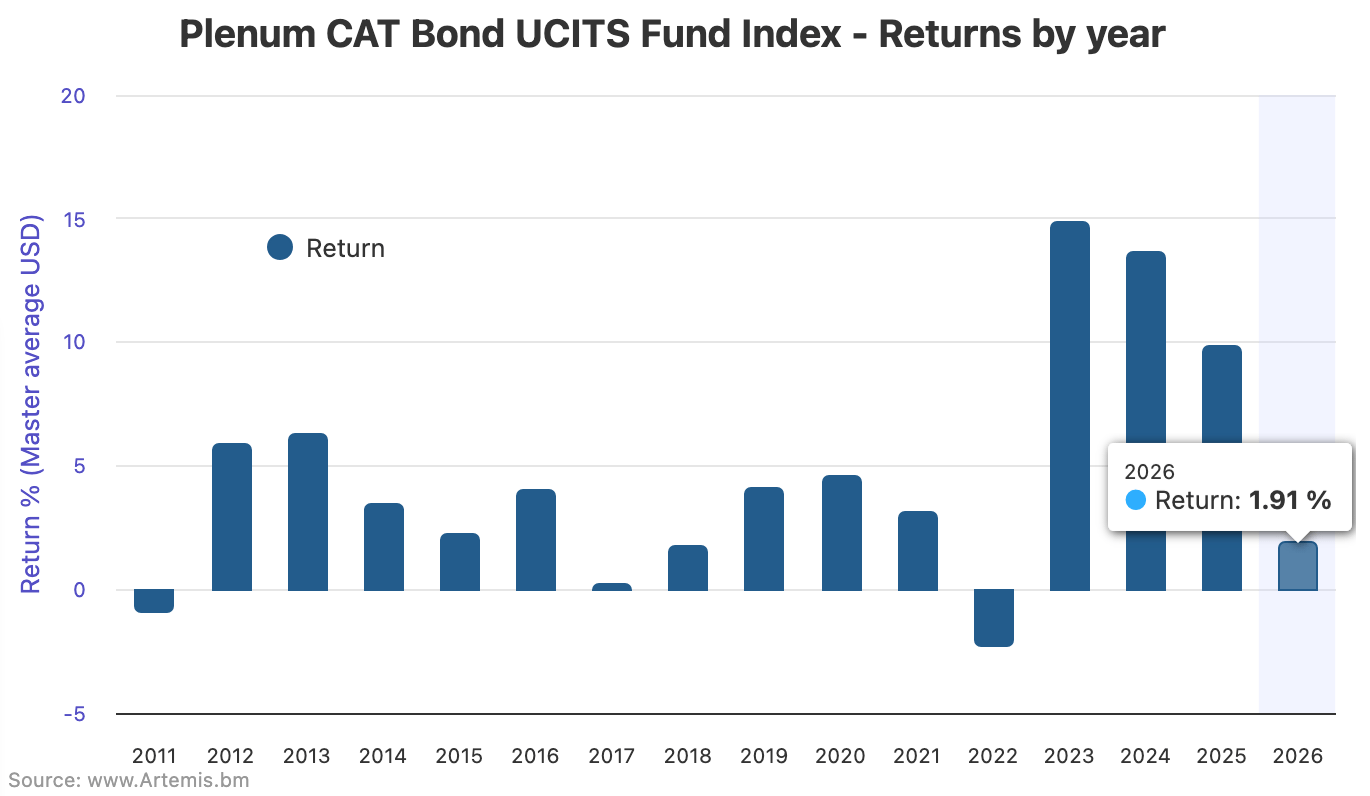
By early 2026, UCITS catastrophe bond funds demonstrated steady but modest positive returns, with the Plenum Index reporting a 0.35% average return in March that lifted the year-to-date return to 1.35%. However, the rolling 12-month return showed a slight dip to 10.23% by late March, reflecting market dynamics such as price softening, demand fluctuations, and capital supply shifts that subtly tempered overall performance.
Performance distinctions between lower-risk and higher-risk UCITS catastrophe bond funds fluctuated during this period. While March saw closely aligned monthly returns of 0.33% for lower-risk and 0.36% for higher-risk funds, higher-risk funds maintained a robust rolling 12-month return of 10.49%, outperforming their lower-risk counterparts who dipped into single-digit returns for the first time in years. Yet, from late March to early May, this trend briefly reversed as lower-risk funds edged out higher-risk ones with 0.65% versus 0.51% returns, illustrating the nuanced risk-return dynamics within the sector.
The absence of major catastrophe losses in early 2026 underpinned the steady performance of UCITS catastrophe bond funds, with expectations for stronger results in Q2 fueled by upcoming issuance and the US wind season. By May, funds had improved year-to-date returns to 1.91% and a rolling 12-month return of 10.37%, aided by spread widening and recovery in certain exposures. However, by May’s end, a slight performance decline to a 10.18% rolling return was noted, attributed to lower catastrophe bond pricing at issuance and soft reinsurance market conditions, underscoring the sensitivity of returns to broader market and pricing environments.
Despite these moderate fluctuations and a slight overall performance dip compared to the previous year, catastrophe bond funds retained their appeal to investors due to their relatively uncorrelated returns and positive premium accrual during this low-loss period. Notably, higher-risk funds outperformed lower-risk ones in May 2026, delivering 0.42% versus 0.24% returns and maintaining a superior twelve-month return of 10.42% compared to 9.92%, highlighting the ongoing investor appetite for risk-adjusted yield in a challenging market landscape.

Yields Rise, But Market Softens
Cat bond yields surged ahead of hurricane season, yet broader market softness and lower pricing at issuance kept overall returns in check despite higher risk premiums and incremental gains in collateral returns.
By mid-2026, catastrophe bond market yields have climbed steadily, reaching 9.42% in late May from 8.80% at the end of 2025, largely driven by the anticipated seasonal spread widening ahead of the US hurricane season. This rise is mirrored in the insurance risk spread (discount margin), which increased nearly 11% from 4.88% in November 2025 to 5.72% by May 20th, reflecting heightened risk premiums as the market braces for seasonal volatility. Plenum Investments highlights that while these seasonal factors push spreads wider through July, this trend is expected to reverse as hurricane activity intensifies.
Despite the recent uptick in yields and spreads, the catastrophe bond market is experiencing a notable year-over-year softening, with yields approximately 14% lower than in mid-2025. This broader market softness extends to traditional reinsurance pricing, where reduced spreads on new cat bond issuances—driven by easing reinsurance costs—are exerting downward pressure on overall market returns. Plenum Investments underscores that this dynamic results in lower pricing at issuance for catastrophe bonds, tempering the impact of seasonal spread widening.
The yield over expected loss metric for catastrophe bonds has risen by nearly 8.7% in 2026, reaching 7.03% by May 29th, supported by a slight increase in the risk-free collateral return to 3.70% and a modest rise in expected loss to 2.39%. This nuanced shift suggests that while investors demand higher compensation relative to expected losses amid evolving market conditions, the underlying risk-return balance remains influenced by incremental changes in collateral returns and loss expectations.
Reinsurance Prices Plummet
Traditional reinsurance saw rates tumble up to 20% in fiercely competitive markets, as cat bonds intensified rivalry and cedants chose to pocket savings instead of expanding coverage, prolonging the soft market.
By mid-2026, property catastrophe reinsurance renewals are witnessing steep price declines, with rates dropping between 15% and over 20%, particularly in the fiercely competitive US nationwide and Florida markets. This downward pressure is exacerbated by an over-capitalized reinsurance sector, where traditional capital growth outpaces that of insurance-linked securities, except for catastrophe bonds, resulting in incremental demand of $10 to $15 billion failing to stem the pricing slide.
Catastrophe bonds have emerged as a formidable rival to traditional reinsurers, offering longer-duration coverage and more attractive rates that intensify competition. Aeolus’s Dutt highlights that these bonds are 'more of a competitive threat than perhaps ever before,' reshaping the market dynamics and compelling reinsurers to contend with this evolving capital source.
Despite the enticing lower prices, cedants are largely opting to pocket the savings rather than expanding their reinsurance purchases, which dampens demand growth and sustains pricing pressure. This cautious behavior, combined with the absence of a significant loss event capable of wiping out roughly 20% of market capital—estimated at $135 billion—means the market remains soft, with meaningful hardening unlikely in the near term.
Reinsurance Shields Against Mega-Losses
S&P stress tests revealed that robust reinsurance and retrocession strategies are critical for insurers, slashing catastrophic exposures by nearly half and preserving capital buffers even under extreme climate scenarios.
By mid-2026, S&P Global Ratings' climate disaster stress tests underscored the indispensable role of reinsurance and retrocession in cushioning insurers against catastrophic losses. Their analysis revealed that while the top 50 insurers collectively face a staggering US$430 billion in gross exposure during a 1-in-250-year event, effective reinsurance strategies slash their net exposure to approximately US$225 billion, or 15% of capital, thereby stabilizing credit quality even under extreme scenarios.
The resilience of the largest insurers is further highlighted by their ability to retain an average 18% capital surplus post-catastrophe, with catastrophe risk constituting about 70% of this remaining buffer. This robust capital positioning, coupled with disciplined risk management and comprehensive reinsurance coverage, enables most global insurers to withstand the escalating frequency and severity of climate-related disasters, affirming the strength of their credit quality amid mounting climate risks.
Discipline Fuels Cat Bond Evolution
Rigorous risk management and structural innovation have made catastrophe bonds essential to reinsurance programs, driving market sophistication and attracting new entrants amid converging valuations and heightened investor scrutiny.
Discipline and diversification remain foundational to successful catastrophe bond management, as emphasized by Francois Divet of BNP Paribas Asset Management. Strong ILS managers maintain strict drawdown limits and avoid chasing yield late in the cycle, while diversifying portfolios across perils, regions, structural layers, and trigger types to mitigate downside risk. Despite these efforts, systemic tail risk persists, underscoring the need for careful exposure management, particularly in dominant US hurricane and earthquake risks where BNP Paribas targets an expected loss of 2–2.5% at the fund level.
By mid-2026, catastrophe bonds have evolved into structurally integral components of reinsurance programs, notably influencing the Florida renewals where they played a pivotal role in price discovery and capacity provision. Adam Schwebach of Gallagher Re highlights that about 20% of limits placed participated alongside the Florida Hurricane Catastrophe Fund, signaling investor willingness to engage in riskier tranches and enhancing insurers’ flexibility. This structural shift, coupled with widespread adoption of cascading and aggregate protections, marks a maturation in cat bond market sophistication and diversification benefits.
The convergence of cat bond pricing with traditional reinsurance, as observed by Schwebach, has expanded market optionality for buyers and encouraged new entrants like Olympus Insurance and Mangrove Property Insurance, reflecting growing confidence and diversification in the Florida cat bond market. This trend is further reinforced by the normalization of relative valuations between industry-loss-linked and indemnity bonds reported by Icosa Investments, which stresses the renewed importance of granular single-name analysis considering trigger types, sponsor quality, and model assumptions to optimize portfolio construction.
Emerging diversifiers beyond the traditional US hurricane and earthquake risks are gaining prominence due to their increasingly competitive premiums, as noted by Icosa Investments. Secondary perils such as European windstorms, North American wildfires, severe convective storms, and Japanese risks offer enhanced portfolio diversification but come with heightened uncertainties related to model assumptions, claims inflation, and local vulnerabilities. Investors must therefore balance the allure of higher spreads with cautious assessment of these real risks to effectively reduce concentration and systemic exposure.
Cat Bonds Prove Their Diversification Power
Catastrophe bonds delivered uncorrelated returns and rapid recovery during global shocks, cementing their status as inflation-resistant, risk-remote stabilizers in investor portfolios despite persistent macro volatility.
By mid-2026, Neuberger Berman underscores a growing investor appetite for catastrophe bonds as genuine portfolio diversifiers amid persistent macroeconomic uncertainty and risk-asset volatility. This demand is bolstered by the asset class’s demonstrated resilience and uncorrelated returns during recent global shocks, such as the February Middle East conflict when the Swiss Re Cat Bond Index gained 0.8% while the S&P 500 and Corporate High Yield indices fell by 5.0% and 1.2%, respectively. Such performance cements catastrophe bonds’ role as a stabilizing force within diversified portfolios.
The catastrophe bond market’s structural mechanisms effectively mitigate inflation and interest rate risks, sustaining its appeal even as 2026 unfolds without expected rate declines. Neuberger Berman highlights features like annual resets, indemnity cedants’ inflation projections, and inflation-linked industry index deals that help maintain attractive spreads relative to fixed income alternatives. This robust risk management framework reassures investors that catastrophe bonds can offer compelling risk-adjusted returns despite macroeconomic headwinds.
Investor confidence in catastrophe bonds is further reinforced by their rapid recovery and limited drawdowns following major catastrophe events. For instance, after the record-insured-loss California wildfires in January 2025, the Swiss Re Total Return index experienced a modest -0.96% drawdown but rebounded to its high watermark by March. This swift rebound exemplifies the risk-remoteness and resilience that attract investors seeking stable diversification amid volatile market conditions.