CDU crisis deepens as AfD surge triggers party rethink
The gist
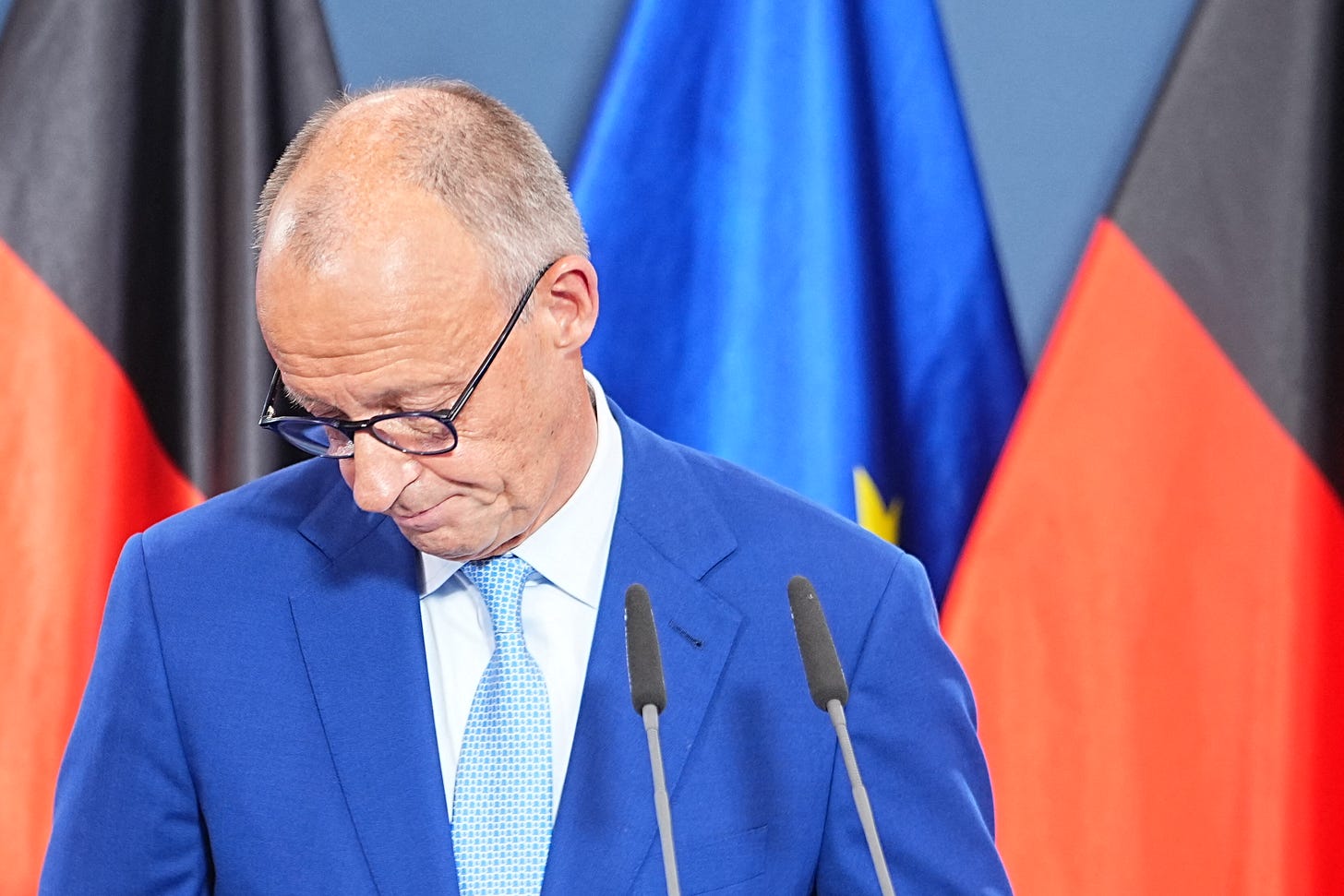
The CDU is reeling after historic state election losses handed the AfD a commanding lead, forcing Friedrich Merz into a high-stakes struggle to keep his party—and Germany’s coalition—afloat.
What to know
- The AfD crushed the CDU in Saxony-Anhalt with 43.8% to 17.2%, stripping Merz’s party of regional authority and bargaining power.
- Merz is now squeezed between an SPD demanding softer reforms and a restless conservative base, with every policy move risking coalition chaos—or fueling the far right.
- Years of frustration over housing, migration, and weak growth have eroded trust in the center, with Berlin’s youth swinging hard left and mainstream parties left scrambling for relevance.
CDU's Regional Collapse Exposed
Losing Saxony-Anhalt and failing to enter Mecklenburg’s parliament has stripped the CDU of both influence and credibility, making the AfD the new conservative benchmark even without formal power.
What changed first was the CDU’s raw bargaining weight: in early September 2026, the AfD won Saxony-Anhalt with 43.8% while the CDU took just 17.2%, a gap so wide it turned a competitive conservative flank into a visibly subordinate one. That is why Военное дело described the result as “a serious blow” to Friedrich Merz’s party: not because the AfD suddenly entered government, but because the CDU emerged from a major state contest with less regional authority, fewer proof points of electoral strength, and therefore less leverage in every argument that follows.
The second shift was agenda power. In Mecklenburg-Vorpommern, the CDU failed to clear the 5% threshold to enter parliament for the first time, a result Merz called a “disaster,” while the AfD finished first even though other parties still ruled out governing with it; that combination matters because exclusion from office did not prevent the far right from becoming the reference point everyone else had to answer. Once the AfD can top the poll and the CDU can disappear from a Landtag, the balance changes even without any transfer of formal governing power.


Merz Trapped by Coalition Tensions
Every CDU policy shift now risks alienating either coalition partners or the party’s conservative base, turning internal disagreements into a public test of Merz’s control.
What changed mechanically is not just that Merz faces louder criticism, but that every move now has to survive two incompatible veto points inside the same governing setup. As The John Batchelor Show put it, the SPD is telling him to “change course” and dilute reforms, while Merz insists the economy cannot be restarted without more radical change; at the same time, he is pleading with his own side for patience, even as doubts grow that conservatives will wait for pension, health and welfare changes to show results.
That is why coalition arithmetic also narrows the CDU’s room to confront the AfD: any harder line risks worsening coalition strain, while any softer line risks looking weak to Merz’s base and to voters before the next tests. The John Batchelor Show stressed “two important elections coming up in two weeks time, one in Berlin… and one in Mecklenburg…,” with the CDU governing Berlin but “the chances are that a left wing party may actually become” first there, while GEMIŠT captured Merz’s demand for discipline in the phrase “ha jó voltam nektek 2025-ben...,” a sign that even holding his own camp together now depends on coalition compliance.



Mainstream Parties Hollowed Out
Long-term voter disillusionment over daily struggles and generational divides has left Germany’s traditional parties weakened, fueling both far-right gains and a youth-driven leftward surge.
The backlash now hitting Germany’s governing center looks less like punishment for one bad campaign than the culmination of a long erosion in the Volksparteien. The East is Read described the 6 September result in Saxony-Anhalt as exposing “deep tensions” in Germany’s traditional party system: the AfD “finished far ahead of its mainstream rivals,” winning 43.8 per cent of the vote — twice its previous share — while the CDU, after 24 years in power, fell to just 17.2 per cent, a collapse treated by many party veterans less as a shock than as something long expected.
What has been draining the center is broader voter frustration across daily life and state capacity: housing, migration, stagnation, and trust. The John Batchelor Show and MD MEETS both tied the shift to unaffordable rents, weak growth, and a sense that mainstream parties no longer respond credibly, while younger voters have become a visible measure of that estrangement: in Berlin, “Die Linke in the Berlin elections that got 25% of the vote among 16 to 24 year old voters it got 47%,” a sign that the drift is issue-driven and generational, not merely tactical or personal.



AfD’s Rise Redefines the Game
The AfD’s historic surge forces all parties to recalibrate strategies, as the far right claims electoral dominance without yet crossing into government, erasing old certainties about who sets the agenda.
The electoral shock is plainly big enough to raise a governability question. As The Market Edge put it, “With the AfD holding 44% of the votes, we see a shift in the balance of power,” while The John Batchelor Show described a threshold-style collapse for the CDU: “for the first time in its entire history” it fell below 5%, and “in Mecklenburg it doesn’t even get into the regional parliament” — exactly the kind of 5% cutoff effect that can erase a mainstream party’s institutional foothold without yet producing a new governing order.
But the same results still stop short of handing the AfD power outright, which is why the likelier consequence is strategic reset, not immediate regime change. The John Batchelor Show noted that in Mecklenburg the AfD “surged there… almost 50%,” and in Berlin “the CDU… have now lost their position,” yet stressed the AfD “will not be in national power for a long time to come”; Yascha Mounk similarly called Saxony-Anhalt a moment placing the far right « à portée du pouvoir », while noting that in Mecklenburg the CDU « n’ont même pas franchi la barre des 5 % » and therefore « disparaît donc du parlement régional ».