Cerebras CS-4 doubles AI speed with power delivery breakthrough
The gist
Cerebras’ new CS-4 server shatters AI inference speed records by doubling performance through a radical power delivery breakthrough—no new silicon required.
What to know
- By moving power conversion circuitry within 0.5mm of the wafer, the CS-4 doubles wattage and clock speed on its 5nm WSE-3 Turbo chip—delivering twice the raw performance without a new process node.
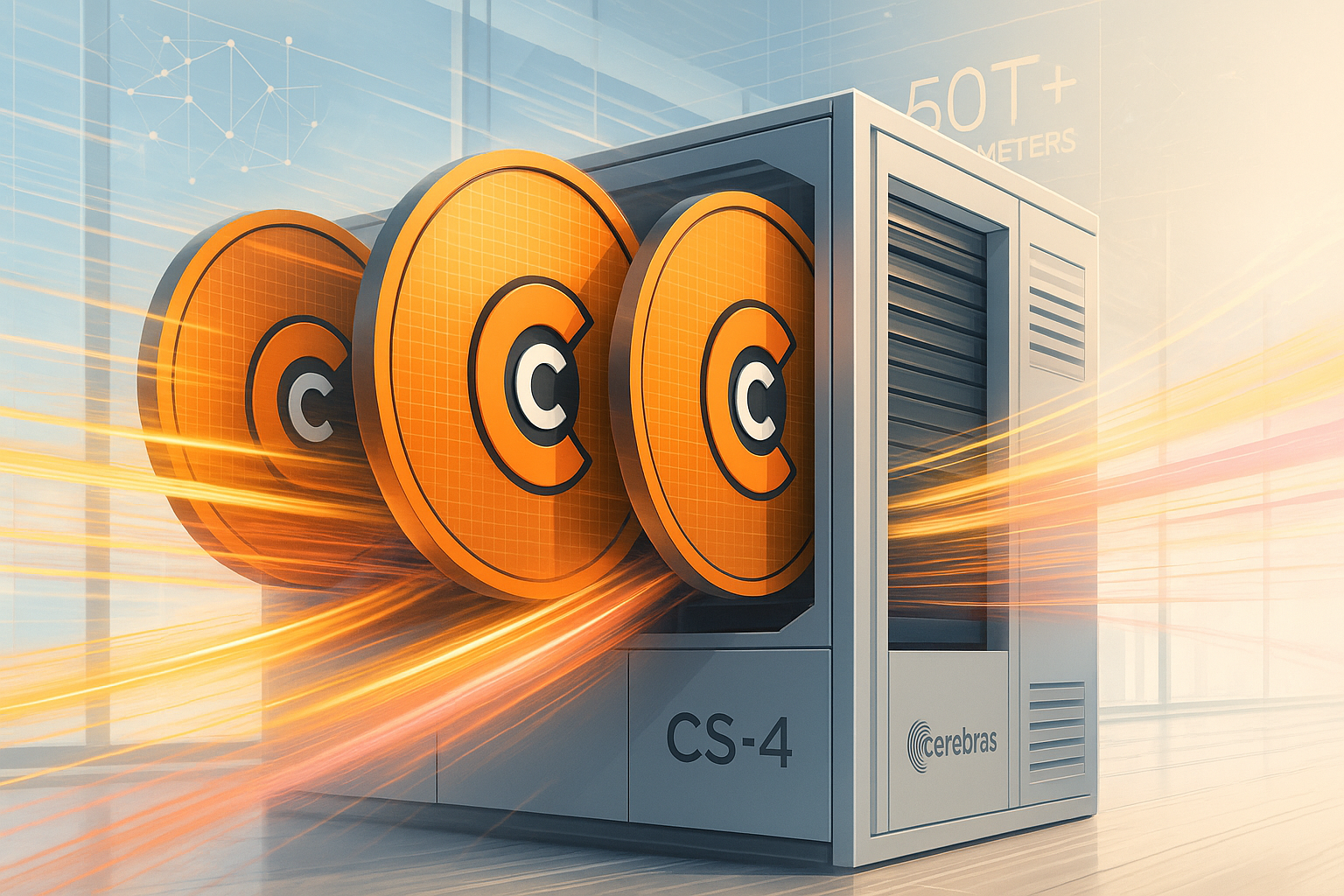
- A single CS-4 rack unites three wafer-scale engines via the Nexus platform, packs modular ‘backpack’ power/cooling, and hits 6x more bandwidth per rack than before.
- With 43.2 petabytes per second of on-chip memory bandwidth and model weights stored directly on the wafer, CS-4 can generate tokens for large language models up to 30x faster than Nvidia’s best GPUs.
Power Delivery Revolution
By moving power conversion circuitry within half a millimeter of the wafer and tightly integrating advanced cooling, Cerebras doubled compute and memory bandwidth on the same 5nm chip—unlocking performance gains without a new process node.
Cerebras achieved a remarkable doubling of the CS-4’s performance over its predecessor by innovating around power delivery and cooling rather than advancing the silicon process node. By relocating power conversion circuitry to within approximately 0.5 millimeters of the wafer—100 times closer than typical GPU boards—the CS-4 drastically reduces power delivery losses, allowing twice the wattage to reach the processor. This architectural shift enables the WSE-3 Turbo chip to double its clock speed on the same 5nm wafer, directly doubling peak theoretical FLOPs and memory bandwidth, which are critical for accelerating AI inference throughput.
The enhanced power delivery is complemented by a sophisticated cooling infrastructure integrated into the CS-4’s 'Wafer-Scale Backpack,' which connects the wafer-scale engine to a larger liquid cooling network featuring leak detection, energy metering, and quick-disconnect valves. This tightly coupled cooling system supports sustained high-frequency operation by efficiently dissipating the increased heat generated from the doubled power intake, enabling the CS-4 to maintain higher clock speeds without thermal throttling. Together, these innovations sustain a doubling of compute throughput and memory bandwidth while preserving the wafer’s 44 GB memory capacity.
Beyond on-chip improvements, Cerebras also doubled the off-wafer I/O bandwidth from 1.2 Tb/s in the CS-3 to 2.4 Tb/s in the CS-4, while reducing I/O latency from 5 microseconds to as low as 2 microseconds. This balanced scaling of data movement capabilities ensures that the increased compute and memory bandwidth do not become bottlenecked by slower data transfer, enabling the system to realize near doubling of tokens processed per second per user. Such holistic enhancements across power, cooling, and I/O are foundational to the CS-4’s leap in AI inference speed and efficiency.

Multi-Wafer Rack Advantage
Cerebras’ Nexus platform unites three wafer-scale engines per rack, slashes latency, and modularizes power and cooling to deliver a sixfold jump in throughput and future-proof scalability.
Cerebras' CS-4 system marks a significant architectural leap by integrating three WSE-3 Turbo wafer-scale engines into a single rack, a design shift that boosts compute density and throughput while targeting frontier AI inference workloads. This multi-wafer rack-scale approach, enabled by the Nexus platform, emphasizes throughput per rack rather than per chip, achieving a 6x improvement in bandwidth and throughput metrics compared to previous generations. By consolidating power delivery, cooling, and I/O connectivity into modular, removable 'backpacks' at the chassis rear, Cerebras not only enhances operational reliability and serviceability but also addresses traditional power bottlenecks, moving power conversion hardware a hundred times closer to the processors to support higher performance scaling.
The Nexus platform serves as the foundational hardware backbone for Cerebras' rack-scale systems, designed with future-proofing in mind to support seamless upgrades across chip generations without major mechanical redesign. This forward-compatible architecture facilitates multi-wafer rack-scale expansion, enabling Cerebras to pursue an aggressive roadmap targeting roughly 2x performance gains annually and a 20x throughput improvement by 2027. Key to this scalability is the platform's ability to halve component counts and reduce wafer-to-wafer latency from five to two microseconds, while integrating high-speed interconnects such as RDMA over Ethernet, which collectively remove communication bottlenecks that typically hinder multi-GPU setups.
Operational robustness in the CS-4’s multi-wafer rack-scale design is bolstered through Cerebras' investments in error recovery, tray-level redundancy, and yield harvesting techniques that mitigate challenges inherent in wafer tray swapping and chip-level faults. These innovations ensure that the complex orchestration of multiple wafer-scale engines within a single rack remains reliable and maintainable in production environments, thereby enhancing deployment efficiency and uptime for demanding AI inference workloads. This focus on reliability complements the modular 'backpack' design, which streamlines assembly and maintenance, underscoring Cerebras' holistic approach to scalable, high-performance AI infrastructure.
Unmatched Token Generation Speed
CS-4’s wafer-scale memory and low-latency interconnects propel language model inference up to 30 times faster than leading GPUs, transforming real-time AI responsiveness.
Cerebras' CS-4 AI system dramatically outpaces traditional GPU-based inference, delivering up to 30 times faster token generation on large language models like GPT-OSS-120B. This leap is grounded in wafer-scale integration that consolidates entire models on a single wafer, enabling the system to produce over 4,400 tokens per second compared to roughly 350 tokens per second on leading GPU inference services. Independent analysts estimate the real-world advantage ranges from 20 to 40 times, underscoring the CS-4’s transformative impact on AI inference speed and responsiveness.
At the heart of the CS-4’s speed advantage lies its extraordinary memory architecture, with each WSE-3 Turbo wafer delivering 43.2 petabytes per second of memory bandwidth—roughly 2,000 times greater than Nvidia’s next-generation GPUs. This massive on-chip SRAM and ultra-high bandwidth minimize data movement latency, a critical bottleneck in AI workloads, allowing the CS-4 to handle dense, large-scale models efficiently and sustain rapid token generation without the communication overhead typical in multi-GPU clusters.
Beyond raw compute, the CS-4’s multi-wafer rack-scale design significantly reduces wafer-to-wafer latency from five microseconds to two, enabling faster data movement and switching essential for AI inference. This architectural emphasis on low latency and memory throughput, rather than peak math alone, allows the system to prioritize individual user token delivery over batch processing, resulting in more responsive AI interactions and enabling complex reasoning and verification tasks within the same wall-clock time, as highlighted by CTO Sean Lie.
Wafer-Scale Memory Redefines AI
By embedding entire models directly on-chip and orchestrating multi-wafer clusters, Cerebras eliminates external memory bottlenecks and sets a new paradigm for high-speed, large-scale inference.
Cerebras' wafer-scale architecture fundamentally redefines AI inference by integrating an unprecedented 40 GB of on-chip SRAM memory, enabling entire AI models to reside directly on the chip rather than relying on external memory like traditional GPUs. This inversion of the memory model required a complete overhaul of the software stack, shifting from external weight storage to embedding weights on the wafer itself, a strategic move that distinguishes Cerebras' CS-4 system from conventional multi-GPU inference approaches.
To tackle the challenge of scaling beyond the memory limits of a single wafer, Cerebras innovated a multi-wafer cluster design that orchestrates multiple wafers with coordinated external memory loading through a method called 'weight streaming.' Led by CTO Sean Lie, this architecture enables processing of trillion-parameter models by effectively turning single wafer systems into a cohesive wafer-scale cluster, thus extending the system’s capability far beyond what traditional GPU arrays can handle.
Unlike traditional multi-GPU systems that link numerous discrete chips, Cerebras bets on a 'one wafer to rule them all' approach, packing massive compute power and on-chip memory bandwidth into a single giant processor. This integration reduces latency and power consumption by embedding all components on a single system-on-chip (SoC), streamlining communication and wiring that would otherwise be complex and inefficient in multi-chip setups.
Overcoming the manufacturing hurdles typically associated with large wafer sizes, Cerebras has achieved impressive yields reportedly above 30% through advanced yield engineering. Their unique approach retains the wafer as a single processor rather than cutting it into smaller dies, employing innovative defect routing tools to navigate around manufacturing errors and dead spots, a feat that industry insiders describe as 'pretty stunning' and a key enabler of their wafer-scale architecture.