China’s 15th five-year plan roars ahead: tech boom, AI ambitions, and geopolitical chess move markets
The gist
China’s 15th Five-Year Plan is off to a roaring start, fusing blistering 5% GDP growth with an audacious tech push and power moves that are reshaping global markets.
What to know
- High-tech manufacturing profits soared 47.4% in Q1 2026 as China pivots from old-school growth to AI, biotech, and quantum breakthroughs.
- The new Plan aims to embed AI in 90% of the economy by 2030, even as Beijing pushes indigenous innovation to sidestep US sanctions.
- International investors are back in, thanks to a US-China trade truce and China’s tech boom—but portfolio risks and Xi’s tightening grip keep things interesting.
From Factories to Frontiers
China’s growth engine is shifting from property and infrastructure to high-tech sectors, but stubbornly weak consumption and a shaky property market threaten long-term economic rebalancing.
China’s 15th Five-Year Plan has kicked off with robust economic growth, registering a 5.0% GDP increase in Q1 2026, surpassing market expectations and aligning with Beijing’s upper growth target. This strong start is driven by a strategic pivot from traditional growth engines like land and heavy investment toward technology, innovation, and high-quality development, as evidenced by a remarkable 47.4% surge in high-tech manufacturing profits, including a staggering 336.8% increase in optical fiber production. The plan prioritizes investment in frontier technologies such as biotechnology, robotics, quantum computing, and AI, while maintaining a large goods trade surplus and exporting integrated technology packages to expand China’s geopolitical influence.
Despite the headline growth, domestic consumption remains a notable challenge, with retail sales growth slowing to 1.7% year-on-year in March and real household income growth tapering to 4.0% in Q1 from pre-COVID highs of 6.5%. The ongoing property market slump, marked by a nearly 25% drop in second-hand home prices since 2021 and uneven stabilization across regions, continues to erode household wealth and dampen consumer confidence. High household savings rates, reaching 37.8% in Q1, reflect cautious consumer behavior amid these pressures, underscoring the need for structural reforms to bolster social safety nets and income distribution to stimulate domestic demand.
Fiscal and monetary policies under the 15th Five-Year Plan emphasize precision and sustainability over aggressive stimulus, with policymakers favoring structural reforms and optimization to balance short-term growth with long-term transformation. Ren Zeping highlights that fiscal spending is set to increase, supported by ample room to raise government debt, which remains comparatively low, while monetary policy focuses on maintaining ample liquidity without cutting interest rates or reserve requirements. Infrastructure investment is strategically directed toward security and resilience projects—such as upgrading water networks, power grids, and next-generation communications—rather than traditional stimulus, reflecting a commitment to high-quality, sustainable development.
China is deepening institutional openness and improving its business environment by expanding market access and aligning with international standards, moving beyond mere trade volume or foreign investment quantity. With 23 pilot free trade zones accounting for about 20% of foreign investment and trade, and the negative list for foreign investment reduced to 29 items—removing all restrictions in manufacturing—China is fostering a more competitive and innovation-driven economy. Concurrently, the government is advancing a special action plan to expand domestic demand from 2026 to 2030, signaling a strategic shift toward building a more balanced and sustainable economic foundation through strengthened consumption and domestic circulation.





AI as National Muscle
Beijing is fusing AI, chips, and cloud into a unified innovation platform, unleashing massive industrial policy reforms and betting on tech self-sufficiency to outpace Western rivals.
China’s 15th Five-Year Plan marks a decisive leap toward technological self-reliance by embedding AI and future frontier technologies such as quantum computing, nuclear fusion, and brain-computer interfaces into its national strength framework. Ambitiously targeting AI integration in 90% of its economy by 2030, the plan envisions advanced applications ranging from autonomous agents and flying cars to brain implants and humanoid robots, signaling a shift from viewing AI as mere tools to embracing autonomous AI agents as core productive forces under Xi Jinping’s concept of 'forces productives nouvelles.'
China’s strategic innovation ecosystem is rapidly expanding, exemplified by Shenzhen’s 25,000 high-tech firms—quadruple Silicon Valley’s density—and BYD surpassing Tesla in global sales in 2025, underscoring the effectiveness of robust industrial policies that support startups and champions alike. Despite US sanctions and export controls, companies like DeepSeek are successfully operating on indigenous Huawei chips, reflecting Beijing’s intensified focus on indigenous development and national security to accelerate technological self-reliance in critical sectors like semiconductors and AI.
The plan introduces the innovative 'model-chip-cloud-application' (模芯云用) concept, a holistic AI architecture integrating AI models, semiconductors, cloud infrastructure, and applications, which contrasts sharply with the US’s semiconductor-centric approach. This comprehensive framework is reinforced by institutional reforms such as removing all foreign investment restrictions in manufacturing and centralizing project approvals to curb local protectionism, thereby fostering a unified market environment conducive to high-tech innovation and sustainable industrial growth.
China’s 'AI+' industrial strategy strategically embeds embodied intelligence to upgrade manufacturing, replace hazardous labor, and influence global supply chains and standards, with state-backed support mechanisms—ranging from tax incentives to credit and certification programs—nurturing the humanoid robotics sector despite early-stage technological and cost challenges. This state-led cultivation model tolerates initial failures to create industry champions, mirroring successes in sectors like electric vehicles, and aligns with the broader 15th Five-Year Plan goal to accelerate a modernized industrial system driven by AI and high-tech innovation.


Security Shapes Strategy
China’s five-year blueprint tightly entwines economic ambition with national security, leveraging tech exports, global logistics, and patient diplomacy to expand influence amid shifting geopolitical fault lines.
China’s 15th Five-Year Plan tightly weaves national security with economic development, emphasizing state-led growth, technological self-sufficiency, and control over frontier technologies to bolster geopolitical influence. By exporting integrated technology packages and Chinese standards, Beijing aims to expand its economic reach while exploiting political divisions within Taiwan—where the post-2024 fragmented government and weakened Constitutional Court create openings for China to complicate Taiwan-US defense coordination and undermine unity. This patient geopolitical strategy reflects a broader effort to integrate security considerations deeply into economic and technological planning.
Amid regional crises such as the US-Israel-Iran conflict, China’s strategic resilience—anchored by state control of energy, food supplies, and vast strategic stockpiles—has enhanced its diplomatic leverage across Asia. Investments in renewables and electric vehicles, alongside robust refining capacity, provide buffers that many neighbors lack, expanding Beijing’s political room in Southeast Asia. Concurrently, China’s extensive global port investments—363 projects worth $24 billion across 168 ports in 90 countries—create a maritime logistics and data network that strengthens geopolitical posture without direct sovereign control, facilitating naval visits and deepening influence.
China’s diplomatic posture under the Plan is marked by a patient exploitation of US policy missteps, particularly during the Trump administration, to fill strategic voids and weaken American influence. This approach includes fostering alliances through political channels, exemplified by the Kuomintang’s renewed engagement with Beijing, where chair Cheng Li-wun frames the US as a source of risk, reopening high-level party dialogue. Beijing’s calm diplomatic stance amid global conflicts, such as the Iran war, complements efforts to build the largest and most robust alliance integrating supply chains, trade, AI, and energy sectors, positioning China as a central node in a multipolar global order.
Internally, Xi Jinping’s consolidation of power through political purges, including the investigation of senior officials like Ma Xingrui, signals a tightening of party control that may weaken collective governance but solidify personal authority, impacting political stability. This centralization extends to economic governance, curbing local protectionism and aligning regional development with national strategic goals via tighter procurement rules and expanded standards regulation. Additionally, China promotes the yuan as a strategic currency to reduce dependence on the US dollar and mitigate sanctions risks, while domestic crackdowns on independent religious groups reflect a broader security strategy to maintain internal stability amid external geopolitical challenges.

Markets Rethink China Risk
Global investors are rushing back into China as tech prowess and a trade truce spark optimism, but hidden portfolio risks and a new multipolar order demand sharper scrutiny than ever.
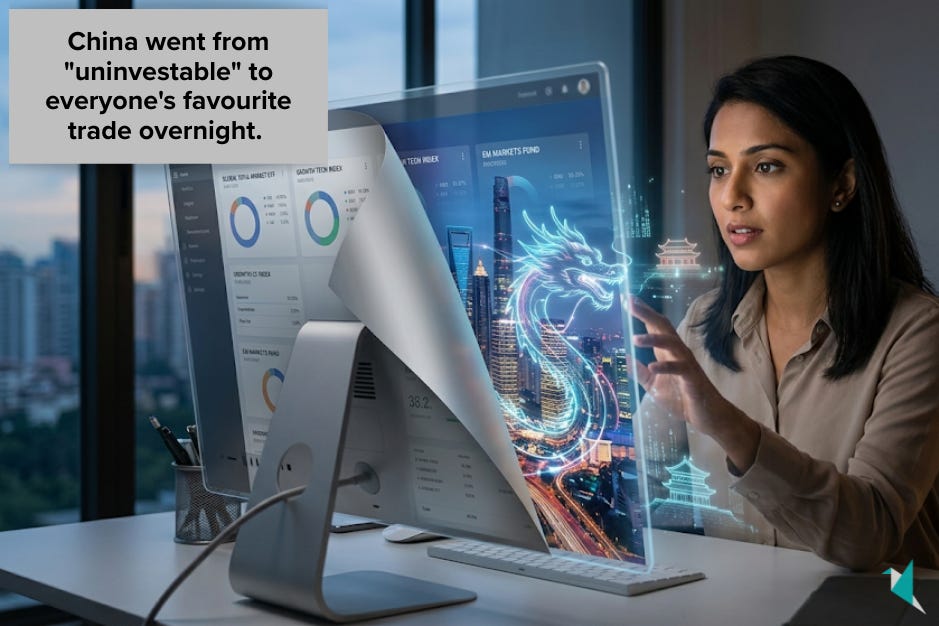
By early 2026, international investors have recalibrated their risk assessments of China amid a US-China trade truce extending through November 2026, which has seen bilateral tariffs meaningfully reduced from last year’s peaks. This easing of tensions, coupled with China's rapid technological advancements—exemplified by Alibaba’s AI model Qwen amassing 700 million downloads and competing with US counterparts at a fraction of the cost—has repositioned China from 'uninvestable' to a favored trade, prompting a strategic reassessment of portfolio exposures.
Despite the positive re-rating of Chinese equities, there is growing caution among global investors about unintended concentration risks, especially since broad emerging markets funds like VT and EEM already carry significant China exposure. The critical question has shifted from whether to invest in China to understanding the depth of existing exposure, underscoring the need for nuanced portfolio management in a landscape where China’s market influence is pervasive yet complex.
International experts emphasize the emergence of a multipolar global order where China and the U.S. serve as principal poles alongside regional and plurilateral organizations such as RCEP and CPTPP. As Da Wei articulates, this evolving governance framework calls for renewed China-U.S. bilateral coordination to stabilize economic and security relations, with President Trump’s imminent visit to China seen as a pivotal opportunity to reset grievances and establish a new equilibrium that could underpin global governance stability amid shrinking liberalism tempered by pragmatic realism.
US industry leaders are urged to deepen their understanding of China’s strategic trajectory by closely studying its Five-Year Plans, which reveal predictable areas of competition and risk. As Jack Welch advised GE executives, scrutinizing these plans is essential to identify whether their products are targeted, enabling companies to anticipate challenges and implement protective measures proactively—a call to action highlighting the current knowledge gap that hampers effective risk management in the private sector.