China’s battery tax sparks EV cost squeeze, tech shift
The gist
China is ending its decade-long tax break on lithium-ion EV batteries, jolting automakers with new costs and a race to innovate or integrate—or risk falling behind.
What to know
- Starting September 1, 2026, China will hit lithium-ion EV batteries with a 2% consumption tax, rising to 4% in 2027—adding up to 1,000 yuan ($147) per vehicle.
- Automakers like BYD, Svolt, and Geely are doubling down on in-house battery production to dodge the extra tax and stay ahead of rivals.
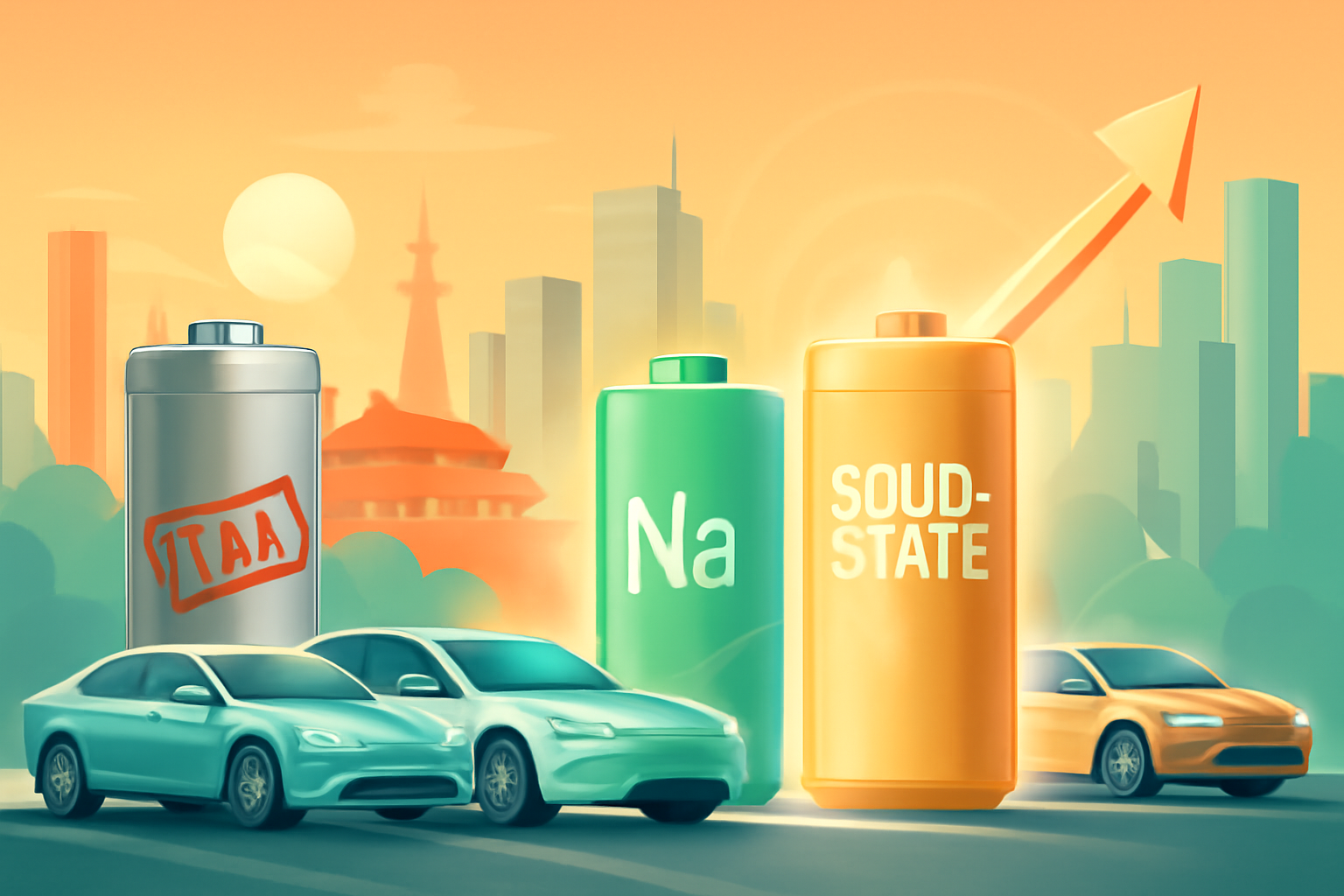
- Solid-state and sodium-ion batteries are tax-exempt through 2028, giving a big boost to next-gen tech as lithium prices stay wild.
Tax Ends Lithium Free Ride
China’s new battery tax marks a turning point for EV makers, squeezing profits and forcing a rethink of pricing and supply chain strategies after a decade of industry support.
China is reintroducing a consumption tax on lithium-ion batteries used in electric vehicles, starting at 2% from September 1, 2026, and rising to 4% by 2027, effectively ending a decade-long exemption that had supported the industry's early growth. This policy shift reflects Beijing's confidence in the maturation of the lithium-ion battery sector, with veteran analyst Jia Xinguang noting, 'Subsidies were needed at the start. They are not needed now.' The tax increase is expected to raise production costs by approximately 468 to 1,000 yuan (around $147) per vehicle, squeezing manufacturers' already thin profit margins and potentially nudging retail prices upward.
The consumption tax creates a new financial divide within the EV industry, incentivizing automakers to develop in-house battery production capabilities to mitigate the added costs associated with purchasing externally sourced lithium-ion batteries. Cui Dongshu, secretary general of the China Passenger Car Association, described this as 'a strong push' for carmakers to internalize battery manufacturing, which could reshape competitive dynamics and supply chain strategies across the sector.
To foster innovation and reduce environmental and supply chain pressures linked to lithium extraction, China has exempted emerging battery technologies—such as solid-state batteries developed by BYD and CATL, sodium-ion batteries, and fuel cells—from the consumption tax until the end of 2028. This selective exemption not only encourages the commercialization of next-generation, environmentally friendlier battery technologies but also signals a strategic pivot away from capacity expansion in mature lithium-ion chemistries toward sustainable innovation.
In-House Batteries Become King
Automakers racing to build batteries themselves will dodge millions in new taxes, making vertical integration the new battleground for EV industry dominance.
China's new consumption tax on lithium-ion EV batteries is a powerful catalyst driving automakers toward vertical integration by producing batteries in-house. As Cui Dongshu of the CPCA explains, automakers that manufacture and install their own batteries can avoid or deduct this tax, while those relying on external suppliers face substantial added costs—potentially hundreds of millions of yuan for a producer of one million vehicles. This tax-induced cost divide is reshaping industry dynamics, making in-house battery production not just a cost-saving strategy but a critical competitive advantage.
Beyond immediate cost considerations, mastering core power battery technology is emerging as a strategic imperative for automakers aspiring to global leadership. Cui emphasizes that 'automakers that do not make power batteries can never become world-class carmakers,' underscoring how in-house battery capabilities are now synonymous with long-term competitiveness. This perspective aligns with moves by industry leaders like BYD, Svolt Energy, and Geely, who have already invested heavily in large-scale battery production—BYD dominating LFP batteries, Svolt leading in ternary battery installations, and Geely advancing its own power battery development—positioning them well to thrive under the new tax regime.

Solid-State Surge Gets Green Light
China’s tax breaks for next-gen batteries give a major edge to solid-state and sodium-ion tech, fast-tracking their commercialization as lithium-ion faces new costs.
China’s strategic exemption of solid-state battery technologies from the new 4% consumption tax, notably benefiting industry leaders BYD and CATL, underscores a targeted governmental push to accelerate innovation in next-generation energy storage. This tax relief, effective from September 2026 through 2028, signals a decisive shift from supporting mature lithium-ion capacity expansion toward fostering advanced, environmentally friendly battery chemistries that promise enhanced safety and performance.
The nation’s vigorous promotion of sodium-ion batteries is exemplified by a landmark 60 GWh supply agreement between battery integrator HyperStrong and CATL, marking the largest commercial commitment to this emerging technology. HyperStrong’s CEO Jianhui Zhang highlights the company’s dedication to scaling sodium-ion production, aligning with China’s broader strategy to diversify battery chemistries and reduce reliance on lithium amid supply chain and environmental concerns.
By imposing a 2% consumption tax on lithium-ion batteries, China is effectively channeling financial support toward the commercialization and scaling of sodium-ion and solid-state batteries, as well as fuel cells and select solar technologies. This policy not only incentivizes manufacturers to accelerate factory scaling and supply chain testing for sodium-ion cells—ideal for shorter-range vehicles and grid storage—but also aims to mitigate risks associated with lithium supply shortages, price volatility, and environmental strain from concentrated lithium extraction.
Lithium Volatility Spurs Innovation
Wild swings in lithium prices and slow-moving extraction tech are pushing the battery industry to pivot toward alternative chemistries that promise greater market stability.
The lithium market's inherent volatility, exemplified by price surges nearing $25 per kilo followed by corrections, poses significant challenges for battery manufacturers and the broader EV and energy storage sectors, which rely on stable input costs to plan production and investment. While increased lithium exploration across Canada, the US, Africa, Australia, and China since 2018-2019 promises shorter supply-demand cycles, the protracted lead times for new mine development continue to constrain supply responsiveness, underscoring the delicate balance between market stability and growth.
Direct lithium extraction (DLE) technology, despite its promise to revolutionize lithium sourcing, remains hampered by high capital and operational costs that place it in the second and third quartiles of expense, limiting its scalability and universal applicability. Projects like EREMET’s operation in Argentina are beginning to meet performance targets, yet the technology's slow commercialization trajectory and site-specific viability mean it cannot yet offset the market’s supply pressures or fully mitigate lithium price volatility.
In response to lithium’s cost and supply uncertainties, the battery industry is accelerating innovation in alternative chemistries such as sodium-ion and solid-state batteries, which promise to diversify material dependencies and potentially stabilize market dynamics. These emerging technologies, while still in development, reflect a strategic pivot that could moderate lithium demand and dampen price swings, signaling a more resilient and adaptive battery ecosystem in the face of fluctuating raw material economics.