China’s DUV breakthrough rattles ASML, chip stocks slide
The gist
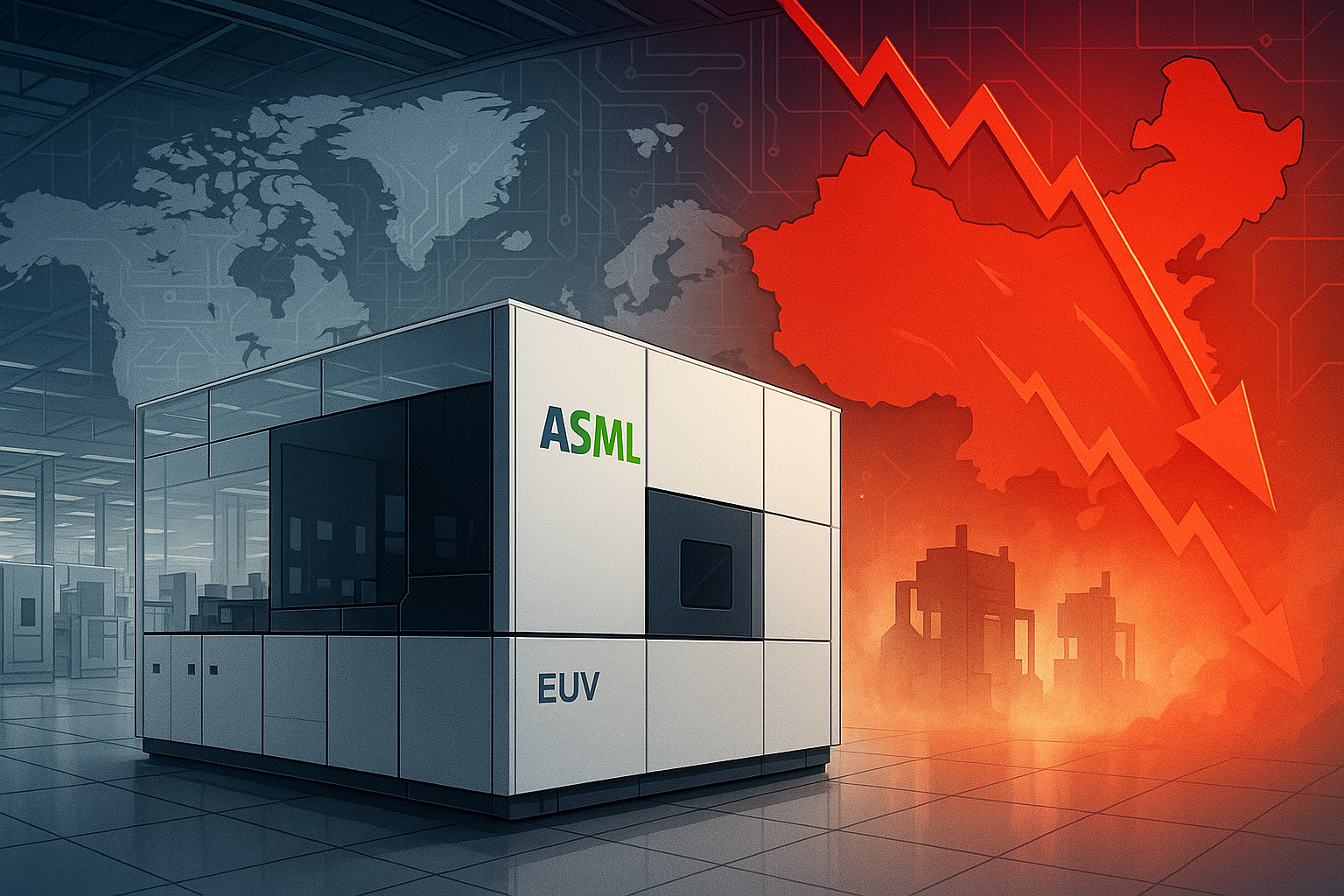
China’s surprise leap into mass-producing domestic DUV lithography machines has rattled ASML and sent global chip stocks tumbling as investors brace for a seismic shift in semiconductor power.
What to know
- State-backed Shanghai Aishengna will make 5 homegrown immersion DUV machines in 2026 and 20 in 2027, targeting mature 28nm nodes and challenging ASML’s longstanding dominance.
- ASML shares plunged over 7% on the news, with its China revenue expected to drop from 33% in 2025 to just 20% in 2026 as export controls bite and market share erodes.
- China’s DUV tools still trail ASML’s in speed (150 vs. 275 wafers/hour) and yield (as low as 10-20%), but state funding and export curbs are fueling a fast-evolving, geopolitically charged chip race.
China’s Lithography Leap
State-backed Shanghai Aishengna’s push into mass-producing immersion DUV machines signals the start of a credible Chinese challenge to ASML’s dominance and a pivotal shift in global chipmaking supply chains.
China has made a significant leap in semiconductor lithography by commencing mass production of domestically developed immersion deep ultraviolet (DUV) lithography machines through state-backed Shanghai Aishengna Electronic Technology Group. Targeting mature-node chip production primarily at major fabs such as SMIC, Hua Hong Semiconductor, and ChangXin Memory Technologies, the company plans to produce about five units in 2026 and expand to roughly 20 in 2027. This nascent but growing capability marks China's credible emergence as a competitor in the DUV lithography market, challenging ASML's longstanding dominance in this segment.
While Chinese DUV lithography machines currently lag behind ASML’s equipment in performance, reliability, and manufacturing yield, their deployment represents a strategic alternative amid tightened Western export controls, particularly those imposed by the Dutch government in 2025. These machines, engineered with mostly domestic components and employing the same 193-nanometre argon-fluoride laser immersion technology as ASML’s tools, are initially aimed at 28-nanometre nodes but designed with potential to push toward more advanced nodes using complex multipatterning. Although still undergoing customer testing and refinement, these tools provide Chinese fabs a fallback supply chain and capacity supplement where ASML equipment is scarce or unavailable.
China’s domestic DUV lithography production has already rattled markets and ASML’s valuation, with the Dutch company’s shares dropping over 7-10% in response to news of Shanghai Aishengna’s progress. This market reaction underscores investor concerns about China’s accelerating chip self-sufficiency, which has been inadvertently incentivized by US and Dutch export restrictions aimed at curbing China’s access to advanced semiconductor manufacturing technology. As researcher Sanne van der Lugt observes, these restrictions have created a commercial imperative for China to develop indigenous lithography capabilities, reflecting a broader geopolitical shift in the semiconductor supply chain landscape.

Market Jitters and ASML Fallout
ASML’s $70 billion market value drop and a global chip stock selloff reveal how China’s domestic DUV breakthrough is shaking investor confidence and undermining the perceived effectiveness of Western export controls.
ASML's stock suffered a sharp decline, falling more than 7% on July 27, 2026, marking one of its steepest single-day drops since June 8, as news broke that a state-backed Chinese company had begun mass-producing domestic immersion DUV lithography machines. This development rattled investors by signaling a credible challenge to ASML's longstanding market dominance in DUV tools, triggering a broader semiconductor market correction that dragged down major players like Nvidia, Sandisk, and CXMT, and weighed on key indexes globally. The selloff reflected not that China had surpassed ASML technologically, but that Beijing had finally put a domestic lithography substitute into production, undermining the effectiveness of Western export controls designed to restrict China's semiconductor ambitions and prompting a reassessment of ASML's market valuation and revenue exposure in China, which is expected to drop from 33% of ASML's 2025 revenue to about 20% in 2026.
Despite the immediate market turmoil, analysts caution that the scale and performance of China's domestic DUV lithography machines remain limited compared to ASML's production capacity and technological edge. With China producing roughly five immersion DUV units in 2026—only about 3.8% of ASML's targeted 130 systems—and projecting 20 units in 2027, representing approximately 11.8% of ASML's estimated capacity, the commercial impact on ASML's revenue is expected to be modest, potentially affecting only around 2.4% of group revenue according to Bank of America. Nevertheless, this nascent capability challenges the export control regimes and introduces supply chain fragmentation risks, fueling investor anxiety over the long-term erosion of ASML's market share amid ongoing geopolitical tensions.
The market reaction to China's lithography advancements underscores a broader shift in investor sentiment driven by geopolitical uncertainties and tightening export restrictions, such as the proposed MATCH Act, which aims to further limit sales and servicing of immersion DUV tools to Chinese chipmakers. ASML's CEO Christophe Fouquet has warned that these restrictions will only accelerate China's push to develop rival tools, intensifying competitive pressures. This evolving landscape has not only diminished ASML's revenue exposure to China but also sparked significant stock declines in major semiconductor firms like Samsung and SK Hynix, which lost approximately $270 billion in market value in a single session, highlighting the far-reaching implications of China's domestic DUV production on global semiconductor market dynamics.

Tech Gaps and Scaling Hurdles
China’s DUV machines trail far behind ASML in speed and yield, with fragmented production and persistent foreign dependencies threatening both reliability and the country’s ambitions for advanced chipmaking.
China's domestically produced DUV lithography machines currently lag significantly behind ASML's industry-leading tools in performance, reliability, and throughput, with wafer processing speeds around 150 wafers per hour compared to ASML's 275. Experts like Nick Patience emphasize that achieving not just functional tools but yield parity is essential for adoption, yet initial yields for Chinese systems reportedly remain as low as 10-20%, far below the 70% threshold needed for mass production. This performance gap limits China's DUV machines primarily to legacy 28nm nodes, with sharp yield declines when attempting advanced multipatterning for sub-14nm chips, underscoring the technological hurdles in scaling beyond mature nodes.
Scaling domestic DUV lithography production presents a formidable operational challenge for China, as plans to manufacture roughly five machines in 2026 and about 20 in 2027 pale in comparison to ASML’s shipment of 131 immersion DUV systems last year. Transitioning from initial prototypes to reliable, high-volume production lines demands extensive testing and refinement, often taking many months, a process compounded by the lack of a mature ecosystem and the need for coordinated efforts among multiple specialized Chinese companies rather than a single ASML-like entity. This fragmented approach, combined with economic disadvantages against ASML’s fully depreciated and field-proven machines, further complicates China’s ability to rapidly scale its lithography fleet.
China’s lithography ambitions remain constrained by critical technological and supply chain dependencies, notably its inability to replicate ASML’s advanced EUV technology, which is essential for leading-edge chip manufacturing below 7nm. The country continues to rely heavily on foreign components, including Japanese parts, and lacks the integrated feedback loops and global supplier relationships that underpin ASML’s product refinement and reliability. Moreover, ongoing and proposed U.S. export controls, such as the MATCH Act restricting maintenance and parts supply, threaten to disrupt the operational sustainability of China’s installed DUV machines, posing significant risks to long-term scaling and competitiveness.
Despite breakthroughs in developing immersion DUV lithography systems, China faces a multi-year journey to tune processes and achieve commercially viable yields comparable to established leaders like SK hynix, who themselves required two to three years post-adoption of ASML’s equipment. The high costs and inefficiencies of using older DUV technology for advanced chip nodes necessitate substantial state funding and policy support to sustain domestic production, especially as China’s largest DRAM maker CXMT struggles with yield, TSV stacking, and heat dissipation challenges without access to EUV. This reliance on government backing highlights the operational and economic fragility underlying China’s nascent lithography capabilities amid fierce global competition.


Export Controls Fuel Rivalry
Tougher U.S. export restrictions are backfiring by accelerating China’s lithography self-reliance, nudging global chipmakers to quietly assess Chinese tools as Beijing deepens supply chain localization amid ongoing geopolitical tensions.
U.S. export controls, epitomized by the bipartisan MATCH Act, have sought to curtail China's access to advanced semiconductor technologies by tightening choke point semiconductor exports and harmonizing allied export restrictions. However, these measures have paradoxically accelerated China's domestic development of immersion DUV lithography machines, with state-backed firms like those in Shanghai achieving breakthroughs in mass production that circumvent U.S. restrictions. This dynamic reflects a strategic pivot by China to reduce reliance on Western suppliers amid persistent geopolitical tensions and export barriers.
Major regional semiconductor players such as Samsung and SK Hynix have responded to the geopolitical uncertainty and tightening U.S. export controls by actively evaluating Chinese-made equipment from manufacturers like AMEC. Initiated roughly two years ago, these evaluations serve as contingency plans against potential disruptions in access to Western wafer fabrication tools, especially after the revocation and partial restoration of their Validated End User status in China. While adoption outside China remains constrained by security and intellectual property concerns, this trend signals a cautious but growing recognition of Chinese equipment’s cost advantages—typically 20-30% lower—and incremental technological progress.
China’s semiconductor supply chain is undergoing nuanced localization, balancing rapid expansion of domestic equipment production with selective imports of foreign tools that remain difficult to substitute. Despite a sharp decline in U.S. equipment imports to China—from 17.6% to 5.3% of total imports since 2020—imports from the Netherlands and Japan have increased, with Dutch lithography exports projected to reach over twice 2020 levels. Meanwhile, Korean equipment imports have remained relatively robust, rising slightly in share, underscoring a complex geopolitical landscape where China strategically navigates export controls while sustaining critical foreign technology access.
The tightening U.S. export regime has inadvertently created openings for Chinese semiconductor equipment makers to displace Western suppliers within foreign-owned fabs operating in China, particularly in the memory chip segment where extreme-ultraviolet lithography remains off-limits. Chinese firms like SMIC, Hua Hong, and CXMT are among the first customers for domestically produced immersion DUV machines, supported by massive state capital injections exemplified by ChangXin Memory Technologies’ $8.6 billion raise. This shift challenges the supply discipline that underpins South Korea’s memory industry dominance and highlights the complex interplay of geopolitical pressures, technological gaps, and supply chain realignments reshaping the semiconductor landscape.