China's EV juggernaut: BYD surpasses Tesla as global market disrupted by cost, tech, and robotaxis
The gist
China’s EV giants, led by BYD, have overtaken Tesla and unleashed a global price-and-tech shockwave that’s upending the car industry from Detroit to Düsseldorf.
What to know
- BYD toppled Tesla in 2024, selling 2.26 million battery EVs to Tesla’s 1.64 million, thanks to ruthless supply chain control and cars built for half the Western cost.
- Chinese automakers exported a record 5.5 million vehicles last year, flooding Europe and emerging markets with low-cost, tech-packed EVs despite rising tariffs and trade barriers.
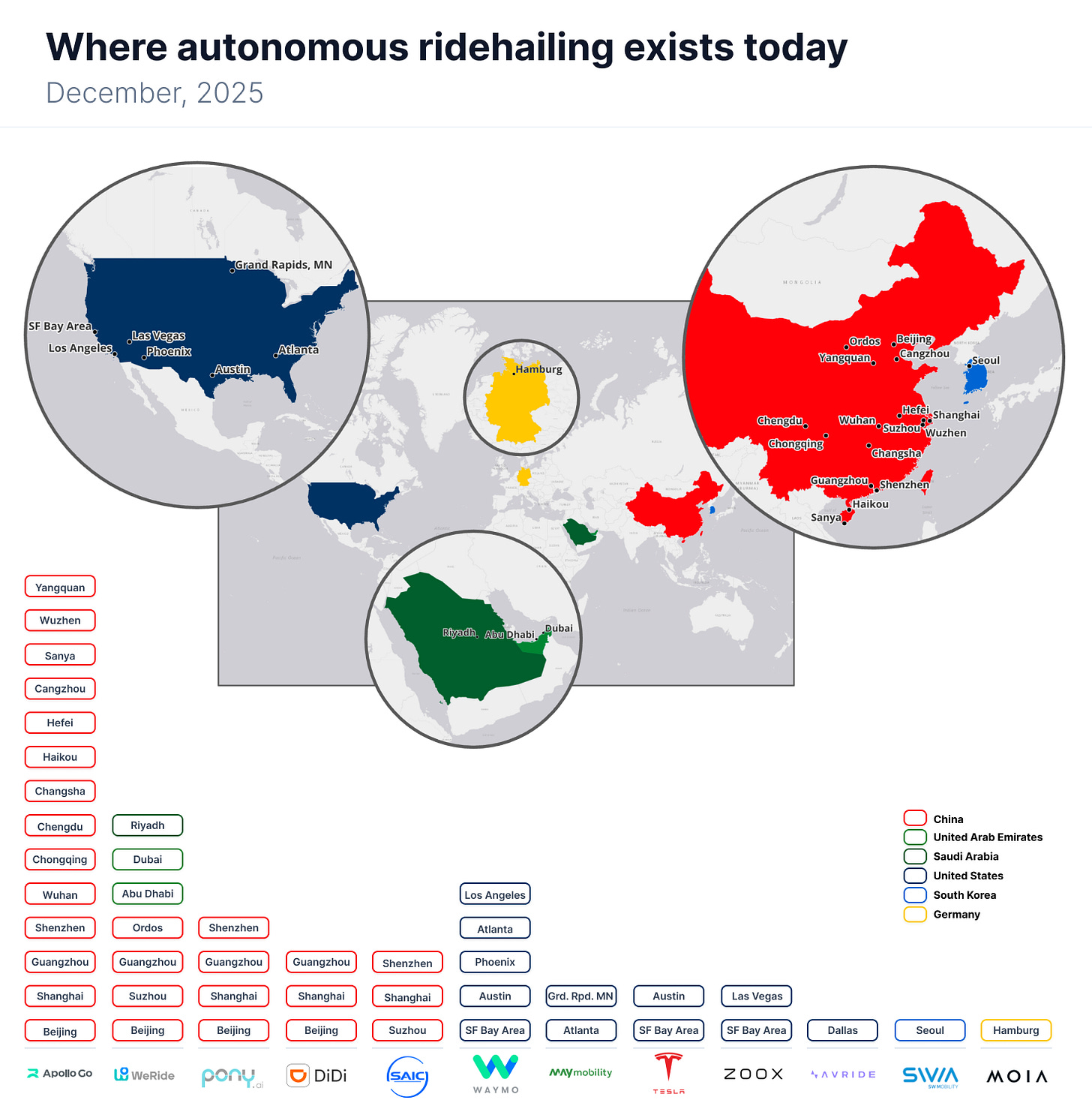
- China’s robotaxi leaders like Baidu’s Apollo Go are outpacing Western rivals by rapidly scaling autonomous fleets and redefining digital car experiences worldwide.
BYD’s Strategic Supremacy
BYD’s vertical integration and digital innovation have redefined global EV competition, leveraging China’s supply chain dominance and rapid feature deployment to outmaneuver Western rivals on both cost and technology.
China’s ascent to global EV leadership is epitomized by BYD’s meteoric rise, overtaking Tesla as the world’s top electric vehicle maker by pure battery EV sales in 2024—2.26 million units to Tesla’s 1.64 million. This shift is not merely a numbers game; BYD’s dominance is amplified by its ability to penetrate key markets like Europe, where it enjoys tariff-free access, while Tesla and other Western automakers struggle with higher costs and trade barriers. As a result, Chinese automakers are not just outpacing Western rivals in sales, but also fundamentally altering the competitive landscape through strategic market positioning and regulatory advantages.
Central to China’s automotive disruption is its mastery of supply chain integration and manufacturing scale, with companies like BYD producing EVs at less than half the unit cost of Tesla—around $10,000 versus $23,000—thanks to vertical integration from batteries to dealerships. This systemic advantage is reinforced by China’s control of 70–85% of global critical EV components, and the emergence of new Tier 1 suppliers like LeeKr Technology, which are pioneering intelligent chassis systems and software-defined vehicles. The result is a supply chain juggernaut that not only underpins China’s domestic dominance but also powers its global export surge, contributing nearly 70% of worldwide new energy vehicle sales growth in 2025.
Chinese automakers are redefining digital innovation in the automotive sector by adopting consumer electronics strategies—rapidly launching new models, integrating advanced digital features, and leveraging deep customer insights from their connected device ecosystems. Companies like Xiaomi and Nio exemplify this approach, with Xiaomi’s Hyperfactory showcasing full production-chain automation and rapid product development cycles, while their vehicles boast features ranging from megawatt charging to in-car entertainment and smart voice integration. This software-native, fast-follower mindset, combined with a regulatory environment that enables swift feature deployment, positions Chinese brands at the forefront of the global digital automotive experience.
China’s push into intelligent driving technologies is reshaping the future of mobility, as firms like WeRide and Pony.ai deploy robotaxi services worldwide and steadily advance autonomous driving capabilities in mass-market EVs. The rise of new-generation suppliers and the influx of capital from tech investors and national institutions have created a robust ecosystem for software-defined vehicles, further cementing China’s leadership in both hardware and digital intelligence. As a result, Western automakers are increasingly compelled to partner with Chinese firms for access to cutting-edge EV platforms and battery technology, underscoring China’s growing influence over the global automotive supply chain and innovation agenda.





Tariffs, Trade, and Turbulence
Despite mounting tariffs and regulatory hurdles, Chinese automakers are flooding global markets, forcing Western and emerging market competitors to overhaul strategies as policy, not just product, determines market access.
China’s meteoric rise as a global automotive powerhouse is reshaping competitive dynamics worldwide, with Chinese automakers exporting a staggering 5.5 million vehicles last year—nearly 40% of which were EVs. This rapid expansion has prompted Beijing to introduce export permits for electric vehicles starting in 2026, a move designed to regulate the sector’s explosive growth and address mounting international trade tensions. As Chinese brands flood foreign markets, their aggressive push is forcing both Western and emerging market automakers to confront unprecedented competitive pressures and rethink their own strategies.
Trade barriers, including U.S. and EU tariffs on Chinese EVs, have become central battlegrounds in the global automotive contest, yet their effectiveness is increasingly in question. Despite steep tariffs and accusations of unfair subsidies, Chinese brands like BYD are making significant inroads in Europe—BYD’s German sales, for example, soared over 700% in 2025, even as the EU considers shifting from tariffs to minimum pricing to better manage the influx. Meanwhile, the U.S. maintains a bipartisan front to keep Chinese EVs at bay, limiting their presence to brands like Volvo and Polestar under Geely, underscoring how policy, rather than just product, now shapes market access and leadership.
Chinese automakers’ dominance is underpinned by their mastery of scale and vertical integration, exemplified by BYD’s ascent past Tesla to become the world’s largest EV maker, selling 4.6 million vehicles in 2025. This full-stack manufacturing advantage—especially in batteries—enables Chinese firms to outcompete Western rivals on cost and innovation, challenging the traditional premium brand playbook. As a result, Western automakers are scrambling to update their competitive intelligence and consider deeper vertical integration, knowing that future leadership may hinge as much on navigating shifting subsidies and trade policies as on technological breakthroughs.
The global spread of Chinese automotive influence is not confined to Europe and North America; emerging markets are also feeling the impact as Chinese companies offer competitively priced new vehicles that threaten the used car market for established brands. In developing countries, the appeal of a $10,000 brand-new Chinese car is rapidly eclipsing the draw of a $15,000 used Corolla, accelerating China’s export footprint. This expansion is further fueled by China’s leadership in electrifying medium and heavy-duty vehicles, where robust domestic infrastructure contrasts sharply with slower adoption in the U.S. and Europe.




Cost Wars Reshape the West
Western automakers are scrambling to match China’s low-cost, tech-forward EVs as U.S. incentives fade, triggering a wave of strategic pivots, alliances, and in-house innovation to avoid losing ground.
Western automakers are grappling with the end of EV tax credits and the formidable cost advantage of Chinese rivals, prompting a delicate balancing act between absorbing costs and adjusting prices across market segments. While incentives at the lower end compress margins, higher-end models may see price increases as subsidies vanish. This challenge is exacerbated by China's aggressive subsidization, which keeps the average price of a new electric vehicle around $25,000—well below what most U.S. manufacturers can match—raising concerns about the long-term competitiveness of American brands in a global market increasingly shaped by Chinese pricing power.
Despite subsidy headwinds, the U.S. EV market has matured, with electrified vehicles now making up one in four new car sales and companies like GM approaching 200,000 units of annual EV production. Improved cost structures and a broader product range have enabled American automakers to compete more effectively on the world stage, even as they face mounting pressure from Chinese manufacturers whose lower prices and government support threaten to erode U.S. market share abroad. This competitive dynamic is forcing Western firms to accelerate innovation and efficiency to remain viable contenders.
The rise of Chinese EV giants like BYD—now the world’s largest seller of electric vehicles, surpassing Tesla with 2.26 million pure battery EVs sold in 2023—has become a wake-up call for Western automakers. Industry leaders such as Ford’s Jim Farley and Rivian’s RJ Scaringe openly acknowledge BYD’s dominance, citing its low-cost structure, advanced software, and vertical integration as benchmarks Western firms must strive to meet. This realization has triggered a strategic pivot toward in-house software development, innovative manufacturing methods, and, crucially, high-profile partnerships like Rivian’s $5.8 billion software joint venture with Volkswagen, all aimed at closing the technology and cost gap.
Tariffs, trade barriers, and geopolitical shifts remain persistent hurdles for Western automakers, complicating efforts to offer affordable EVs and compete with Chinese imports. Companies are responding by rethinking sourcing and manufacturing strategies—such as Ford’s push for smaller batteries and unibody casting to cut costs, and Rivian’s global supply chain adjustments for its R2 vehicle. Meanwhile, the geographic imperative of building cars close to consumers is likely to drive new waves of local production and even Chinese automaker investment in U.S. factories, setting the stage for both intensified competition and the potential for cross-border partnerships.
While the immediate aftermath of subsidy expiration has led to a pullback in EV offerings and sales, Western automakers are betting that consumer appreciation for lower operating costs and maintenance will sustain long-term demand. Historical precedent suggests that Chinese competition, rather than prompting retreat, can catalyze a renaissance in innovation and productivity—as seen in the 'First China Shock.' European automakers like Volkswagen have already demonstrated successful adaptation, signaling that with the right mix of innovation, cost discipline, and strategic alliances, U.S. manufacturers can not only survive but thrive in the new automotive landscape.



Robotaxi Rivalry Accelerates
China’s multi-provider, fast-scaling robotaxi rollout is outpacing Western pilots, with Baidu’s Apollo Go and rivals expanding fleets and features at a speed regulatory caution in the West can’t match.
The global race for autonomous vehicles has crystallized into a fierce contest between China’s rapid, multi-provider expansion and the West’s more measured, regulated rollout. By late 2025, Baidu’s Apollo Go matched Waymo’s milestone of 250,000 weekly paid robotaxi rides, underscoring how Chinese firms are scaling up at a pace that rivals, and in some cases surpasses, their Western counterparts. This surge is not just about numbers; it reflects China’s unique model of fostering direct competition among multiple providers in major cities, which is accelerating service improvements and pushing the boundaries of what’s possible in autonomous mobility.
While the West boasts a diverse field of autonomous vehicle innovators—Waymo, Zoox, Tesla, and Wayve among them—no single company dominates outright, and regulatory caution has kept most services in pilot or limited phases. Waymo stands out as the only Western firm offering a fully commercial, driverless robotaxi service, having captured over 10% of San Francisco’s ride-sharing market, yet it faces operational bottlenecks and geopolitical headwinds that threaten to slow its expansion. In contrast, Chinese leaders like Pony.ai, WeRide, and Apollo Go are not only scaling fleets domestically but also deploying robotaxis across the Middle East and Europe, leveraging aggressive cost reductions and multi-region strategies to outpace Western rivals.
At the heart of this competition lies a battle over software, data, and ecosystem integration—areas where both sides are investing heavily, but with distinct philosophies. Chinese EV makers are rapidly integrating advanced features, from megawatt charging to in-car entertainment, reflecting a consumer electronics-inspired innovation cycle that enhances the overall user experience and drives adoption. Meanwhile, Western firms like Tesla and Waymo are locked in a high-stakes contest for self-driving supremacy, with trillions at stake, but must navigate regulatory hurdles and supply chain constraints that complicate their path to mass deployment.
The consumer experience is emerging as a decisive factor in the adoption of autonomous vehicles, with robotaxi services serving as a critical proving ground. As analyst Stephanie Valdez observes, buyers are increasingly drawn by the seamless, software-defined in-car experience rather than the promise of full autonomy alone—a trend that is shaping both marketing strategies and product development on both sides of the Pacific. In China, direct app-based competition among robotaxi providers is fostering rapid service evolution, while in the West, platform-based models like Uber may boost ridership but risk diluting the competitive edge that comes from direct consumer choice.



EV Ecosystems: The Next Battleground
The future of mobility hinges on ecosystem integration and data-driven services, as Chinese and Western automakers race to build platforms that lock in users far beyond just selling cars.
The future of mobility hinges on ecosystem integration and data-driven services, as Chinese and Western automakers race to build platforms that lock in users far beyond just selling cars.