Chinese open-weight models fuel AI price war
The gist
A fierce price war has erupted as Chinese open-weight AI models seize half the global market with near-U.S. performance at a fraction of the cost, fracturing the American tech sector and igniting a regulatory arms race.
What to know
- By mid-2026, models like MiniMax M2.5 and GLM 5.2 deliver near-parity to U.S. rivals at one-fifth the cost, fueling rapid adoption among cost-sensitive firms.
- U.S. companies such as Coinbase have slashed AI expenses by 50% as Chinese models capture almost half of all global token processing, triggering massive financial strain and investor skepticism.
- The U.S. tech industry is split, with giants lobbying for tighter controls while hundreds of startups embrace cheap Chinese AI, fueling heated debates over security, open-source innovation, and the future of AI regulation.
China’s AI Cost Advantage
Chinese open-weight models are reshaping global AI economics by offering near-U.S. performance at a fraction of the price, locking in market share through supply-chain control and making migration increasingly costly for competitors.
By early 2026, Chinese open-weight AI models had carved out a dominant position in the cost-sensitive AI inference market, capturing significant market share among startups and enterprises due to their striking price-to-performance advantage. Models like MiniMax M2.5 and GLM 5.2 demonstrated near-parity with leading U.S. counterparts such as Claude Opus 4.6 and Anthropic’s Opus 4.8, but at a fraction of the cost—often one-fifth or less—enabling companies like Airbnb to deploy Alibaba’s Qwen model for 40% of their customer support issues. This affordability stems from China's lower electricity costs, which are about 40% cheaper than in the U.S., and innovations like DeepSeek V3’s MoE architecture that reduce inference costs by up to 36 times compared to GPT-4o, creating a compelling economic case for adoption.
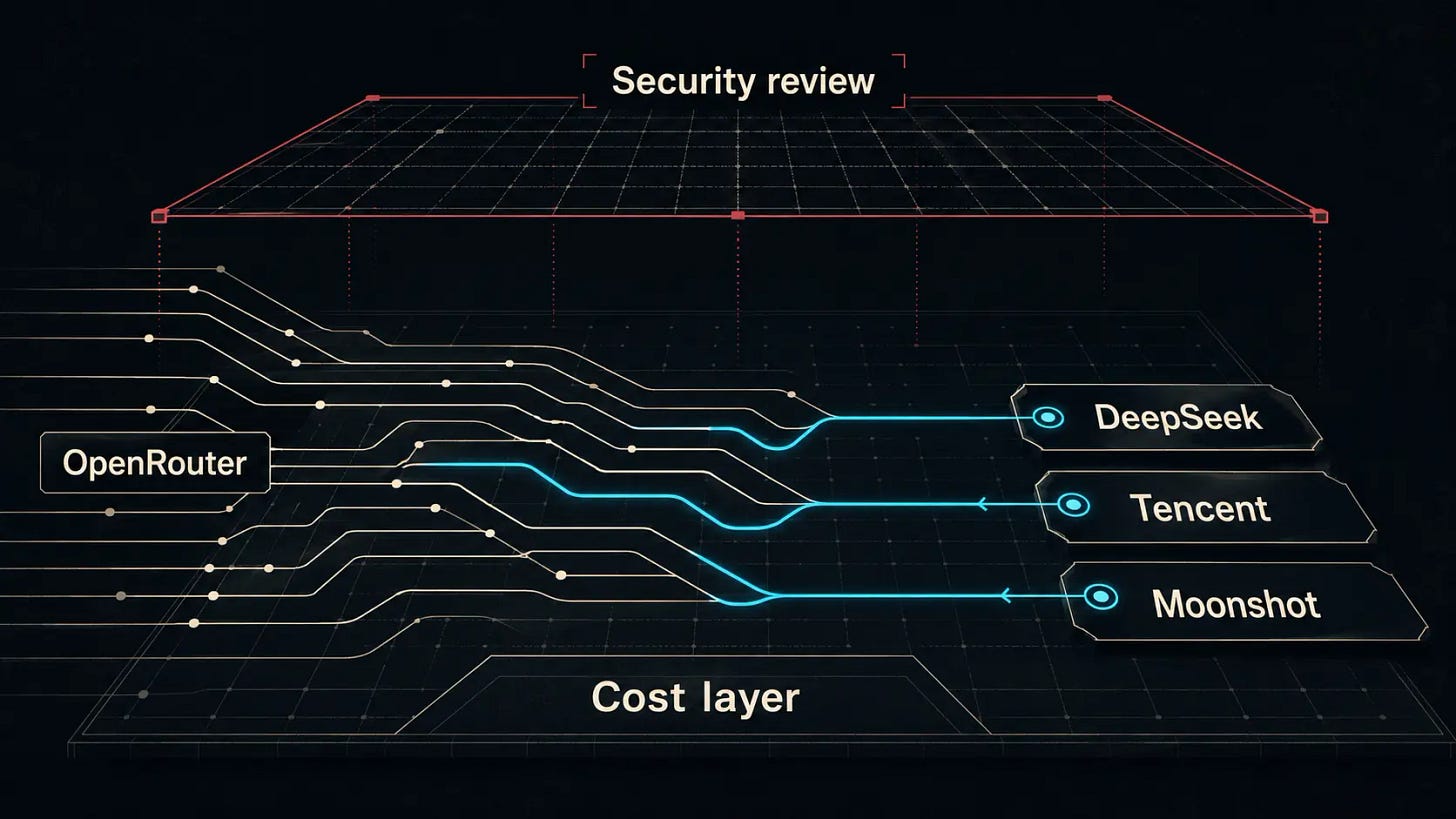
The surge in adoption of Chinese AI models by U.S. firms, including Lindy and Vercel, reflects a broader market shift driven by escalating costs of frontier models from OpenAI and Anthropic. As these costs began to erode profit margins, companies increasingly embraced a 'thrift-maxxing' approach, blending cheaper Chinese foundational models with premium U.S. offerings depending on task requirements. This hybrid strategy is supported by emerging software solutions like model routers and harnesses from startups such as Codestrap and Martian AI, which optimize AI usage across providers without fully abandoning closed-source models, highlighting a nuanced response to the evolving cost landscape.
The economic dynamics of Chinese open-weight models extend beyond mere cost savings to strategic implications for global AI infrastructure. Their open-source nature grants customers supply-chain control, auditability, and immunity from vendor-imposed restrictions or remote disabling, making them especially attractive amid U.S. export controls and regulatory scrutiny. This has led to a structural entrenchment where migration costs to alternative providers rise exponentially, granting China outsized influence over global token consumption patterns and digital economy infrastructure, a development that has unsettled U.S. policymakers concerned about national security and economic competitiveness.
The rapid decline in AI inference costs fueled by Chinese open-weight models is accelerating demand and reshaping market volumes, with platforms like OpenRouter routing over 25 trillion tokens weekly and Chinese models handling a majority share of this traffic. This cost-driven expansion contrasts with the premium frontier model segment, which, while growing, accounts for a smaller fraction of token volume but higher spending. As the economics shift, investors and companies alike face pressure on profit margins and valuations, with market selloffs reflecting concerns over the sustainability of high-cost AI buildouts in the face of commoditization risks posed by these affordable Chinese alternatives.






Open-Source Models Reshape Playbook
Enterprises are shifting to hybrid AI stacks, using fast-improving, open-weight Chinese models for most workloads while reserving expensive frontier models for high-risk tasks, fundamentally changing how and where AI is built and deployed.
By early 2026, open-weight Chinese AI models such as DeepSeek V3.2, MiniMax M2.7, and Z.ai’s GLM family had surged in enterprise adoption by delivering 'good enough' performance at dramatically lower costs, reshaping the AI market landscape. This bifurcation created a dual ecosystem where premium, state-of-the-art models like OpenAI’s GPT-5.4 coexisted with affordable open-source alternatives, enabling enterprises to tailor AI usage based on specific cost-quality tradeoffs. As a result, many companies found tuning and training open models internally not only more cost-effective but also faster and better suited for niche applications, exemplified by Intercom’s Fin Apex 1.0 model, which outperformed expensive API-based closed models in customer service tasks.
Despite significant convergence in benchmark performance between open-weight Chinese models and closed-lab US models—evidenced by Chatbot Arena scores narrowing from an eight-point gap in 2024 to under two points by early 2025—frontier models maintained an edge in complex, long-horizon reliability and adaptability, as shown by GPT-5’s lead on Meta’s Gaia2 benchmark. However, the economic calculus increasingly favors open models like DeepSeek V4 Pro, which offer near-frontier capabilities at inference costs up to 100 times cheaper than GPT-5.5, driving their dominance in median production workloads. High-stakes sectors such as legal and medical continue to rely on closed frontier models for their security and reliability, but the broader AI economy is now anchored on open-source substrates that foster innovation and scalable adoption.
The rising prominence of open-source AI is further accelerated by geopolitical and regulatory dynamics, notably US export controls that restrict access to closed models like Anthropic’s Mythos 5, inadvertently boosting the global adoption of open-weight Chinese models such as Z.ai’s GLM-5.2. These open models, distributed under permissive licenses and immune to remote disabling, offer enterprises and governments enhanced sovereignty, auditability, and continuity, making them especially attractive amid concerns over vendor lock-in and sudden API shutdowns. As Oren Michels observes, the era of exclusive reliance on a single closed provider has ended, with hybrid strategies blending open and closed models becoming the norm to balance flexibility, cost, and security.
This commoditization trend, fueled by companies like Cohere, Nvidia, and Reflection AI offering efficient open-weight models, is driving a price war in LLM API tokens and prompting US enterprises to adopt 'thrift-maxxing' strategies that combine cheaper Chinese open models with premium US offerings depending on task requirements. While this diversification enhances cost efficiency and innovation, it also threatens to erode the premium margins and high valuations of foundational closed models, as token expenditures have dropped 20% from their May 2026 peak despite a 70% surge in total token volume. The ecosystem is evolving into a more open, agnostic marketplace where model makers are components of a broader AI supply chain rather than gatekeepers, signaling a profound shift in enterprise AI adoption and competitive dynamics.





Regulatory Crossfire Intensifies
A single Chinese AI release erased $1 trillion in U.S. market value, prompting both nations to tighten export controls and sparking fierce policy battles over whether to protect domestic AI or preserve open-source innovation.
By mid-2026, the escalating AI arms race between the US and China had triggered significant market and regulatory turbulence, exemplified by a single Chinese AI model wiping out $1 trillion in US market value in one day and prompting financial institutions to apply crisis-era debt management tactics. This volatility underscored the fragility of the US AI sector amid China's aggressive push for cheaper, competitive AI models, often developed through opaque or questionable means, which not only threatened US market dominance but also fueled public opposition and concerns over regulatory capture.
In response to national security and competitive pressures, both China and the US have converged on implementing stringent export controls targeting advanced AI models. China proposed a tiered export control system restricting overseas access to its frontier AI technologies, engaging major firms like Alibaba and ByteDance in quiet talks about limiting exports and foreign investment, while the US Commerce Department suspended foreign access to Anthropic’s Claude Fable 5 and Mythos 5 models in June 2026. These parallel moves reflect a shared strategic goal of safeguarding proprietary AI capabilities amid fears of espionage, trade secret theft, and cybersecurity threats, with China even considering criminalizing unauthorized AI technology disclosures under its national security law.
The US-China AI rivalry has intensified with China's rapid advancement in open-weight AI models like Moonshot AI’s Kimi K3, which offers competitive performance at roughly 70% lower cost and is freely downloadable, challenging the proprietary dominance of US frontier labs such as OpenAI and Anthropic. This has sparked heated policy debates in the US, where some industry leaders advocate for regulatory measures or selective bans on Chinese models to protect domestic investments and national security, while others, including Nvidia, Microsoft, and a coalition of nearly 200 startups known as the 'Little Tech Alliance,' oppose such restrictions, warning they would stifle innovation, raise costs, and entrench market duopolies. The debate also reveals internal government divisions, with some officials favoring targeted export controls on AI hardware over broad model bans to maintain US leadership without undermining open-source ecosystems.
Amid these tensions, allegations of intellectual property theft have further strained US-China relations, exemplified by the US government's threats of sanctions against Chinese firms like Moonshot AI for purportedly stealing Anthropic’s technology and circumventing export controls using banned Nvidia chips. China has vehemently denied these accusations, warning of retaliatory measures, highlighting the complex legal and geopolitical challenges surrounding AI supply chain security and cross-border technology transfer. This fraught environment has led to a cautious US approach favoring regulatory uncertainty and soft law to deter adoption of Chinese AI models rather than outright bans, while emphasizing the need for a global regulatory framework to manage AI risks and protect frontier AI intellectual property.





Tech Sector Fractures on AI Policy
Major U.S. players are split between lobbying for bans on Chinese AI and rallying for open access, as startups and industry giants clash over security, innovation, and the future of AI competition.
By mid-2026, US tech companies and startups found themselves sharply divided over the adoption and regulation of Chinese open-weight AI models. While firms like Palantir partnered with Nvidia to offer secure 'Sovereign AI' solutions avoiding Chinese sources, many startups and companies such as Lindy and Vercel increasingly routed AI workloads to cost-effective Chinese models like DeepSeek and GLM 5.2, which matched domestic benchmarks at a fraction of the price. This surge—peaking at 46% of weekly AI workload routing via Chinese models on platforms like OpenRouter—intensified competitive pressures and sparked strategic shifts in procurement and compliance amid ongoing regulatory scrutiny. (Insights)
Major US AI firms such as OpenAI and Anthropic have taken a defensive stance, advocating for tighter export controls and regulatory restrictions to protect their substantial investments and market dominance. Accusations against Chinese startups like Moonshot AI for IP theft and unauthorized use of banned Nvidia chips have fueled calls from leaders including Treasury Secretary Scott Bessent for sanctions and heightened export controls. OpenAI’s Dean Ball openly suggested leveraging regulatory fear to deter adoption of Chinese open-weight models, while Anthropic’s CEO Dario Amodei pushed for government authority to block risky AI deployments. This regulatory lobbying reflects a strategic effort to curb cheaper Chinese competition and maintain premium pricing, even as some US labs like Thinking Machine Lab embrace open-weight models themselves. (Insights)
Contrasting with the closed-lab duopoly of OpenAI and Anthropic, other major US tech players including Nvidia, Microsoft, Meta, Palantir, and nearly 200 startups have publicly opposed broad bans on Chinese open-weight AI models, arguing that open access fosters innovation, lowers costs, and prevents monopolistic market dominance. This coalition, exemplified by an open letter signed by Nvidia CEO Jensen Huang and Microsoft CEO Satya Nadella, warns that restrictive policies risk stifling startups and consolidating power among a few large firms. The 'Little Tech Alliance' formed by startups and investors like Y Combinator actively lobbies against protectionist measures, emphasizing that banning Chinese models would cripple hundreds of US companies reliant on affordable, high-volume AI tasks. This division underscores a broader tension between safeguarding IP and fostering a vibrant, competitive AI ecosystem. (Insights)
The US government’s approach has evolved toward nuanced, selective restrictions rather than blanket bans, balancing national security concerns with industry innovation imperatives. While some officials contemplate banning advanced Chinese models like Kimi K3, others, including White House science advisors and industry leaders, advocate for targeted export controls on high-end hardware such as Nvidia processors to maintain US AI leadership without stifling open-source development. This calibrated stance reflects internal policy divisions and acknowledges the complex realities where Chinese open-weight models fill functional gaps left by US models due to strict safety filters. As Ben Horowitz and Sriram Krishnan highlight, open-source models offer transparency and security benefits, complicating the debate over regulation amid escalating geopolitical tensions. (Insights)
AI Price War Shakes Wall Street
Cheap Chinese AI is forcing U.S. firms to slash costs and rethink business models, fueling investor anxiety as debt-laden tech giants face eroding margins and the threat of a sector-wide financial reckoning.
By mid-2026, the US AI sector is grappling with intense financial pressures as cheaper Chinese open-source AI models, costing roughly five times less yet delivering comparable performance, disrupt the market and siphon revenue from American firms. Companies like Coinbase have halved their AI expenses by adopting these models, while major tech stocks such as SpaceX and Oracle have experienced sharp declines amid investor skepticism about the sustainability of AI buildout financing. This cost competition exacerbates the sector's vulnerability, threatening capital destruction and broader economic repercussions given the massive debt underpinning US AI infrastructure.
The US AI industry's financial fragility is further underscored by its reliance on extensive debt financing to support costly AI infrastructure, with banks employing risk-spreading strategies reminiscent of the 2008 financial crisis—potentially endangering pension funds. Hyperscalers like Alphabet are projected to spend hundreds of billions annually, with 2027 capex estimates reaching $870 billion. Yet, the sector faces mounting investor wariness as token prices collapse and profitability remains uncertain, raising questions about the sustainability of trillions invested in frontier models amid rising competition from China's aggressively priced alternatives like Moonshot's Kimi K3, which offers near-top-tier performance at 70% less cost.
The growing dominance of Chinese AI models—processing nearly half of global tokens by mid-2026 compared to the US's 20%—has forced American firms to rethink their AI spending strategies, often shifting toward these more affordable options to manage ballooning costs. However, potential US restrictions on Chinese AI exports threaten to eliminate this cost advantage, potentially imposing an additional $3 to $12 billion annual burden on American businesses, according to Georgia Tech's Daniel Yue. This looming policy shift raises critical questions about whether US labs like Meta will bolster their domestic open-source ecosystems or if demand will revert solely to expensive frontier models, further straining the sector's financial resilience.
Underlying these financial dynamics is a strategic and ideological divide: China treats AI as a public good fostering global cooperation, enabling widespread adoption of cost-effective models, while the US views AI as a private, profit-driven asset intertwined with national security concerns. This divergence complicates cross-border technology flows, as both governments increasingly restrict access to their most advanced models, intensifying operational and financial challenges for US AI firms reliant on Chinese technologies. The sector's 'more is more' investment approach, exemplified by OpenAI's $21 billion loss in 2025 and delayed IPO, highlights the risk of capital destruction amid an evolving and fiercely competitive global AI landscape.


Security Fears Meet Open Innovation
The proliferation of Chinese open-weight AI models has ignited a fierce debate over national security versus the benefits of open-source, as policymakers grapple with the risks of foreign influence and the realities of global AI interdependence.
The proliferation of Chinese open-weight AI models has ignited a fierce debate over national security versus the benefits of open-source, as policymakers grapple with the risks of foreign influence and the realities of global AI interdependence.