Claude design shakes creative software giants as AI race heats up, figma falters
The gist
Anthropic’s Claude Design is upending the creative software market, sending Figma and Adobe scrambling as AI-native rivals and investor anxieties intensify.
What to know
- Claude Design, powered by Opus 4.7, can automate up to 90% of design workflows and triggered a 4% Figma stock drop after its viral 2026 launch.
- Figma is reeling from margin pressures and clunky AI integration, while Canva is surging ahead by partnering with Anthropic and building proprietary AI models.
- The 2026 design software race hinges on compute supply, ethical AI, and infrastructure as Anthropic, Adobe, and Canva battle for dominance in a rapidly evolving market.
Claude Design Ignites Market Turmoil
Anthropic’s Claude Design has redefined creative workflows and rattled investor confidence, triggering sharp stock drops for Figma and Adobe as fears of AI-driven disruption escalate.
By early 2026, Anthropic’s Claude Design, powered by its Opus 4.7 AI model, has emerged as a formidable disruptor in the design software market, directly challenging entrenched incumbents like Adobe and Figma. This breakthrough AI, noted for its deep world understanding and evolution beyond static image generation into interactive multi-image storytelling, is reshaping product development and creative workflows, intensifying competitive pressures on traditional platforms.
Investor anxiety over Anthropic’s rapid AI advancements has translated into tangible market repercussions, with Adobe and Figma stocks experiencing significant declines—Figma’s shares notably plunged over 4% immediately following the viral launch of Claude Design. Despite critiques labeling Claude Design’s capabilities as more hype than substance, the market reaction underscores deep-seated fears that AI-driven tools are poised to upend the creative software landscape.



AI Transforms Design Workflows
Claude Design’s unified platform automates the bulk of design and coding tasks, collapsing traditional workflows and raising the bar for creative professionals in an AI-first era.
Anthropic's Claude Design, powered by the Opus 4.7 model, represents a significant leap in AI-driven design innovation by integrating advanced capabilities such as stronger coding, sharper vision processing, and built-in cybersecurity controls. This comprehensive platform not only accelerates design workflows—enabling users to generate complex outputs like videos, landing pages, and mobile apps with AI handling up to 90% of the work—but also combines design, coding (via Claude Code), and collaboration tools (Co-Work) into a unified knowledge work ecosystem, positioning Anthropic as a formidable competitor to incumbents like Adobe and Figma.
Claude Design's AI-native approach fundamentally reshapes traditional design paradigms by collapsing the blank-canvas phase and automating routine assembly tasks, allowing designers to focus on higher-level creative problem-solving. While still in early stages and occasionally buggy, the platform supports rapid prototyping and end-to-end workflows—including integrated play testing and multi-format exports—that compress design cycles from hours to minutes, as demonstrated by building diverse assets in just 16 minutes. This shift elevates the demand for highly skilled designers, as 'good enough' design is no longer sufficient in an AI-augmented landscape.
Anthropic's Opus 4.7 model excels at translating vague natural language prompts into structured, brand-consistent visual assets, seamlessly integrating enterprise design systems by reading existing codebases and maintaining consistency across projects. Claude Design's chat-plus-canvas interface enables non-designers to produce polished prototypes, slide decks, and branded materials that export directly into ecosystems like Canva or hand off to Claude Code for front-end implementation, which supports flexible coding outputs ranging from vanilla HTML/CSS/JavaScript to React frameworks. This tight integration between AI-powered design and code generation challenges traditional tool boundaries and accelerates the entire product development pipeline.



Figma Falters, Canva Surges
Figma’s dependence on external AI and lagging innovation has left it vulnerable, while Canva’s vertical AI integration and Anthropic partnership propel it to the forefront of the design software arms race.
In 2026, incumbents like Figma are grappling with AI disruption by adopting disciplined cost management and AI-driven pricing models to sustain growth amid mounting market pressures. However, Figma’s reliance on external AI APIs has exposed it to significant margin pressures and production reliability issues, with users describing it as 'grandpa software' lacking advanced AI integration compared to competitors. This has left Figma scrambling to keep pace as its traditional workflows falter under the demands of AI-native design environments.
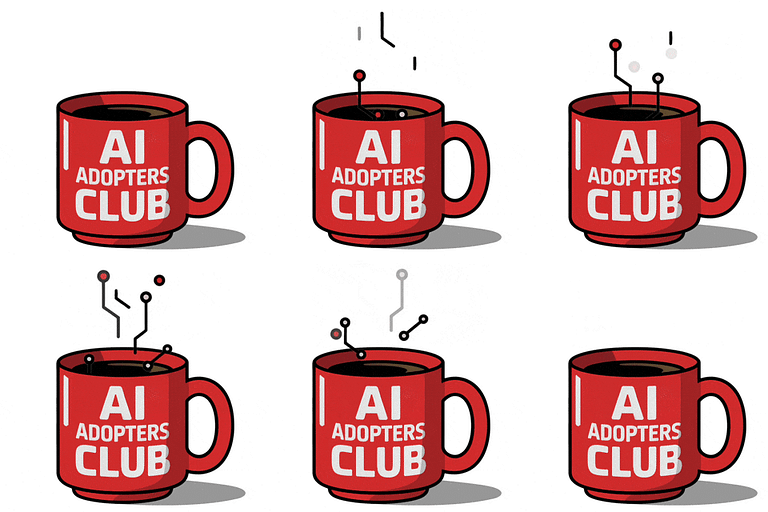
Canva is aggressively reshaping the competitive landscape by pivoting from a traditional design platform to an AI powerhouse, exemplified by its bold vertical integration of proprietary AI models and a strategic two-year partnership with Anthropic to embed Claude Design’s capabilities. This AI-native approach not only transforms design workflows through enhanced collaboration and data integration but also redefines AI monetization and business models, positioning Canva as a formidable challenger to both Figma and Adobe amid the broader AI-driven market disruption.
Adobe and Canva are spearheading an AI-powered interface revolution that is fundamentally reshaping design workflows and subscription models in response to rising AI disruption concerns. Adobe Illustrator’s superior AI agent capabilities enable more efficient, flexible design edits and automation in production workflows, setting a new industry standard that highlights Figma’s lagging position. This strategic innovation underscores how incumbents are leveraging AI integration not just to compete but to redefine user experience and operational efficiency in the evolving design software market.
The evolving competitive dynamics in 2026 underscore a strategic shift from rivalry to collaboration, as leading design software companies recognize the necessity of partnering with AI model vendors like Anthropic to harness generative AI’s full potential. As David Floyer observes, the winning formula is making 'one plus one equal more than two,' with Canva’s broad user base and AI-native engine exemplifying how distribution and deep AI integration are becoming decisive factors in outpacing incumbents like Figma and Adobe.





Compute, Ethics, and Power Plays
The 2026 design software race is shaped by fierce competition for compute resources, strategic infrastructure investments, and mounting debates over AI ethics and creative agency.
Access to compute supply remains the backbone of AI competition in the design software market, as it enables the development of superior models that attract users and create lock-in value, exemplified by Anthropic's Claude integration in Cowork. However, as industry experts emphasize, ultimate market dominance hinges not just on raw compute but on innovative product design and powerful distribution channels that can maintain user engagement and fend off competitors by replicating best-in-class solutions.
The AI ecosystem in 2026 is marked by intense rivalry among major players like OpenAI, Anthropic, and Meta, each investing heavily in compute infrastructure to support advanced models such as Anthropic's Opus 4.7 and OpenAI's Mythos. This arms race is driving rapid expansion of datacenters and fueling supply chain challenges, which in turn reshape innovation dynamics and distribution power within the design software market, underscoring the critical role of infrastructure in sustaining AI-driven disruption.
Ethical considerations and safety remain central to AI development strategies, with Anthropic exemplifying caution through its phased release of Opus models, prioritizing cyber safeguards and responsible deployment. Concurrently, debates intensify around AI's impact on creativity and labor in design workflows, as seen in initiatives like Springboards' Flint, which aims to enhance rather than homogenize creative outputs, reflecting broader concerns about AI's role in preserving diversity and human agency within creative industries.
Sustainability challenges loom large as the AI industry grapples with the environmental and financial costs of powering generative models that drive productivity and design tools. Investor jitters are compounded not only by market disruption but also by compute supply constraints and the escalating race to build sustainable AI infrastructure, forcing urgent decisions around model reliability, operational expenses, and user adaptation amid fears of company bankruptcies and long-term viability.