Claude science faces trust test: anthropic’s dual role fuels pharma skepticism
The gist
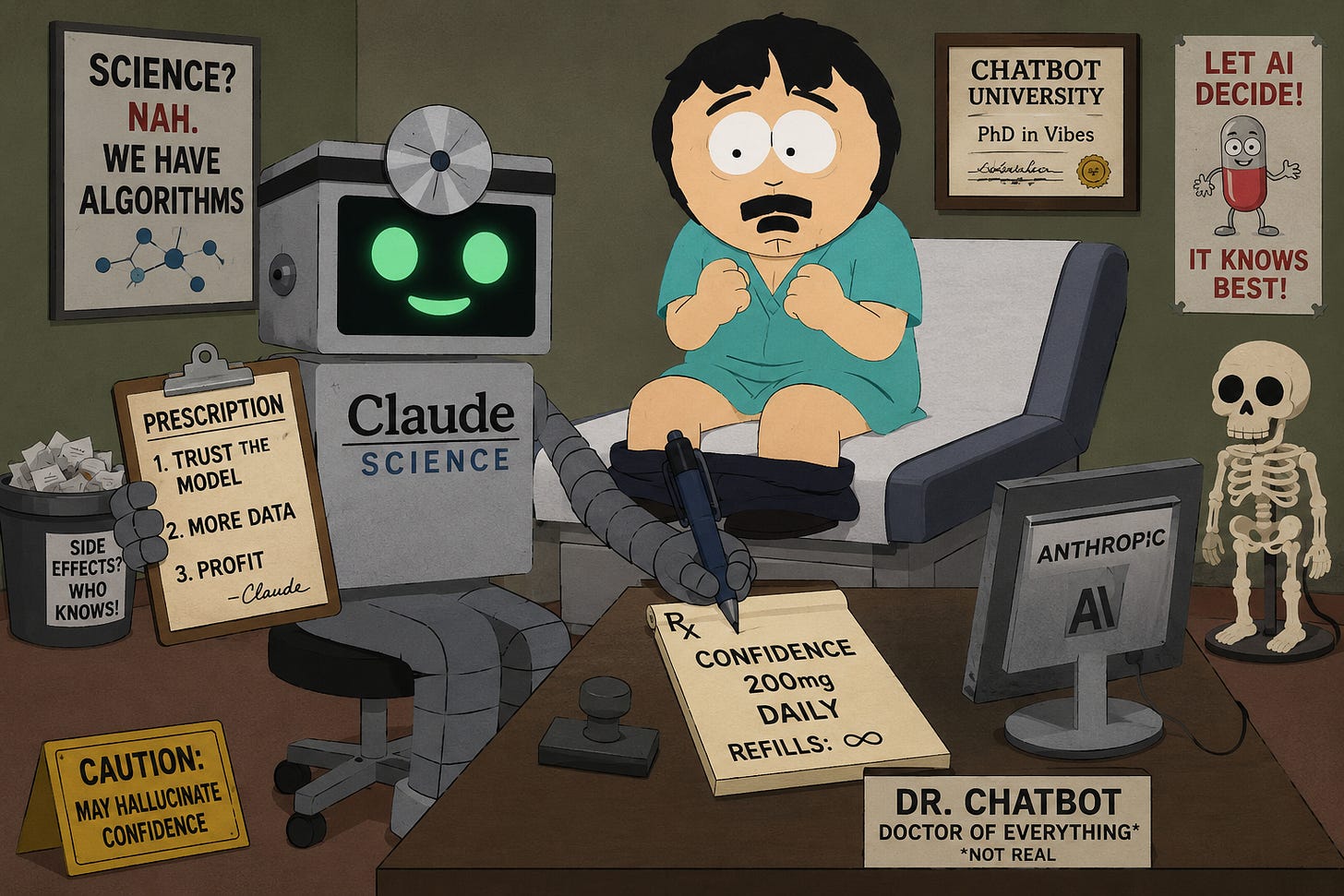
Anthropic’s Claude Science is betting big on transforming drug discovery with AI, but faces a credibility crunch as pharma skeptics demand real-world proof, not just promises.
What to know
- Claude Science unifies 60+ scientific databases and tools, accelerating life sciences workflows for early adopters like UCSF and Manifold Bio.
- Anthropic is both selling Claude Science and using it to hunt for treatments for neglected diseases, but lacks proprietary wet-lab data to fully validate its AI predictions.
- Pharma partners remain wary—adoption beyond pilot projects, transparent drug milestones, and trust from bench scientists will make or break Claude Science’s pharma ambitions.
AI Workbench Revolutionizes Labs
Claude Science’s unified platform slashes research time and error rates by fusing 60+ scientific tools with rigorous auditability, turning fragmented workflows into auditable, reproducible pipelines trusted by top biomedical teams.
Claude Science emerges as a comprehensive AI-driven scientific workbench that consolidates over 60 pre-configured connectors and databases spanning genomics, proteomics, cheminformatics, and structural biology into a unified platform. This integration significantly reduces the fragmentation and context switching that traditionally hampers life sciences research workflows, enabling researchers to manage complex computational pipelines locally or on HPC clusters with scalable multi-agent orchestration. Early adopters such as Manifold Bio and UCSF’s Brain Tumor Center report dramatic accelerations in experimental design and data analysis, with UCSF completing germline variant analyses in roughly one-tenth the previous time while maintaining independent validation.
A defining feature of Claude Science is its rigorous emphasis on reproducibility and auditability, producing 'auditable artifacts' that bundle every generated figure or manuscript with the exact underlying code, plain-language explanations, and complete message histories. This is complemented by a continuous reviewer agent that autonomously verifies citations and calculations, ensuring error correction before results propagate downstream—an innovation that addresses critical provenance and regulatory compliance needs in pharma and life sciences research. By enabling deployment on private lab infrastructure, Anthropic also tackles data governance challenges inherent to sensitive scientific data handling.
Rather than introducing a new AI model, Anthropic strategically positions Claude Science as a workflow orchestration layer built atop existing Claude models like Claude Opus 4.8, focusing on integrating diverse scientific tools and orchestrating specialist sub-agents to augment researchers’ capabilities. This approach reflects Anthropic’s conviction that the bottleneck in scientific discovery lies not in raw biological model intelligence but in overcoming fragmented workflows and administrative burdens. By automating code generation and execution on compute clusters and natively rendering complex scientific artifacts such as 3D protein structures and genome browser tracks, Claude Science empowers scientists to accelerate iterative research cycles and pursue more ambitious projects.
Anthropic’s development of Claude Science is deeply intertwined with its internal drug discovery efforts, embodying a feedback loop where real-world preclinical programs inform and refine the platform’s capabilities. This dual role as both a scientific tool provider and an active drug developer distinguishes Claude Science from other AI-native biotech platforms, aiming not merely to embed within existing workflows but to own a larger portion of the drug discovery pipeline. While this integrated strategy promises to compress R&D timelines by an order of magnitude, market skepticism remains regarding the long-term impact of such vertical-specific AI tools, with some observers cautioning that initial enthusiasm often fades absent clear transformative outcomes.

Anthropic’s Double-Edged Strategy
Anthropic blurs the line between toolmaker and drug developer by using its own AI platform for internal drug discovery, simultaneously courting pharma clients and risking conflicts of interest over data privacy and competition.
Anthropic’s dual role as both a supplier of AI scientific tools and an internal drug developer represents a strategic integration designed to sharpen its AI capabilities through active engagement in preclinical research. By focusing on neglected and rare diseases—conditions characterized by clear biological causes but weak commercial incentives—Anthropic fills a niche often overlooked by traditional pharma, leveraging its status as a public benefit corporation to prioritize patient impact over profit. As Jonah Cool articulates, targeting monogenic diseases where 'one gene, one mechanism, one target' simplifies biology aligns with the current generation of AI models’ strengths, enabling Anthropic to pursue socially valuable outcomes while minimizing direct competition with paying customers.
This mission-driven rationale is underscored by Anthropic’s leadership, with Eric Kauderer-Abrams emphasizing that building credible, industry-accelerating AI tools requires 'living it alongside the researchers' through internal drug discovery programs. This 'dogfooding elevated to strategy' approach blurs the line between toolmaker and drug developer, shifting Anthropic’s identity from a pure AI vendor to an AI-native drug developer. By associating Claude Science not just with AI capabilities but with tangible preclinical programs, Anthropic aims to enhance its credibility and impact in pharma R&D, signaling a deliberate narrative shift toward socially meaningful innovation.
However, Anthropic’s simultaneous pursuit of tool sales and internal drug discovery introduces inherent tensions and skepticism within the pharma ecosystem. The company’s model—selling Claude Science broadly while quietly running its own preclinical programs—creates a potential conflict of interest likened to 'selling shovels while opening a mine next to your customers’ mines.' To address concerns about data privacy and competitive advantage, Anthropic employs private-infrastructure designs ensuring customer data remains isolated from its internal pipelines, attempting to balance commercial trust with its dual ambitions.
The integration of wet-lab capabilities marks a significant departure for Anthropic, traditionally known for fast, scalable AI inference, as it ventures into the slow, complex, and unscalable realm of biological research. This expansion reflects a major strategic commitment to life sciences, which the company now positions as its largest vertical opportunity alongside coding and knowledge-work agents. By embedding preclinical programs focused on neglected diseases within its AI platform, Anthropic underscores life sciences not as a side project but as a core pillar of its mission and market strategy.
Limits of AI-Driven Discovery
Claude Science’s lack of proprietary wet-lab data and late-stage drug development capabilities exposes its vulnerability to commoditization and skepticism from pharma, as true breakthroughs still hinge on experimental validation.
Anthropic’s Claude Science platform excels in early-stage molecule design, potentially commoditizing general AI reasoning capabilities in computational biology and challenging AI-native biotechs to pivot from touting proprietary AI models to emphasizing exclusive data and rigorous validation. However, its lack of capabilities in later, more complex drug development stages—such as clinical trials, manufacturing, and regulatory navigation—raises questions about its ability to deliver end-to-end solutions, a gap that has long plagued AI-driven drug discovery efforts. As noted in analyses from mid-2026, while designing promising molecules has become cheaper, the real hurdles remain toxicity, efficacy, and patient enrollment, areas where Anthropic currently lacks infrastructure and track record, underscoring the limits of AI’s role beyond early discovery [1, 3, 4, 5].
Anthropic’s competitive moat is further challenged by its reliance on external data sources and absence of proprietary in-house wet-lab feedback loops, a critical advantage held by AI-native biotechs like Recursion and Insilico that integrate experimental biology tightly with AI modeling. This vertical integration enables those companies to generate unique phenomic and chemistry-plus-clinical datasets, reinforcing their differentiation, whereas Anthropic currently rents data and sequencing services, making it vulnerable to commoditization and limiting its ability to validate and refine predictions experimentally. Industry experts emphasize that despite advances in AI, the wet lab remains the ultimate arbiter, as general-purpose AI systems often hallucinate or miss regulatory nuances, highlighting the indispensable role of experimental confirmation [2, 6, 12].
Anthropic’s hybrid strategy of coupling horizontal AI agent products with internal drug discovery programs serves as a double-edged sword: it acts as 'remarkably cheap advertising' and a live R&D testbed but risks being perceived by sophisticated pharma buyers either as a costly distraction or a competitive threat, especially since its focus on rare diseases might unsettle potential partners wary of future competition. This delicate positioning is compounded by market skepticism over Anthropic’s commercial viability given its high token costs, competition from open-weight models, and the expensive compute environment reportedly exceeding a billion dollars monthly. Pharma remains the most attractive vertical for Anthropic’s AI platform due to its deep pockets and mission alignment, but the company must carefully navigate these challenges ahead of its 2026 IPO [7, 8, 9, 10].

Trust Hinges on Transparency
Anthropic’s commercial future depends on winning pharma trust through clear drug milestones, broad adoption beyond pilots, and establishing Claude Science as a credible, reproducible scientific platform—not just a flashy demo.
Transparency in Anthropic’s disclosure of specific drug targets and development timelines emerges as a litmus test for its authentic commitment to drug discovery rather than mere strategic positioning. As highlighted in the 2026 analysis, vague or indefinite program details risk signaling superficial efforts, whereas concrete milestones would demonstrate real investment and seriousness. This emphasis on clarity is especially critical as the industry eyes the impending wave of AI-discovered drugs reaching Phase 3 clinical trials by the end of 2026; success in these trials could validate Anthropic’s timing and reshape market perceptions, while failure would cast doubt on the broader AI drug discovery narrative.
The degree to which pharmaceutical companies adopt Claude Science beyond cautious pilot projects constrained by data governance concerns will decisively determine whether Anthropic’s platform transitions from a proof-of-concept to a viable commercial enterprise. Analysts note that if pharma partners run Claude Science at scale on private infrastructure, it signals genuine business traction; conversely, limiting use to small pilots suggests the technology remains a demonstration tool. This adoption challenge is compounded by market skepticism fueled by Anthropic’s limited domain expertise and the absence of a robust scientific software feedback loop, contrasting with their success in core areas like Quad code, which benefits from active user engagement and iterative improvement.
Beyond drug development outcomes, Claude Science’s credibility hinges on its ability to win over bench scientists through reproducibility and auditability, establishing itself as a transparent, trustworthy scientific tool. This subtle yet essential factor could carve a niche for Claude Science as a recognized scientific infrastructure platform, a prospect that may ultimately matter more to Anthropic’s commercial success than the actual delivery of medicines. As one analysis puts it, the medicines represent the mission, but the workbench—the platform itself—constitutes the business, underscoring a dual model that could sustain Anthropic regardless of drug pipeline breakthroughs.
Market skepticism remains a significant headwind for Anthropic’s Claude Science, reflecting a broader pattern where initial hype around AI-driven tools in pharma often fails to translate into sustained disruption or widespread adoption. Industry observers caution against overestimating the transformative impact of such launches, noting that early excitement frequently dissipates without substantive follow-through. This skepticism underscores the importance of Anthropic demonstrating tangible, measurable outcomes and sustained engagement to overcome doubts and establish lasting credibility in the competitive AI drug discovery landscape.