CleanSpark’s $6.6b AI lease draws rally, skepticism
The gist
CleanSpark’s $6.6 billion AI data center lease marks a blockbuster pivot from bitcoin mining to digital landlord—fueling a stock rally but keeping execution risks firmly in play.
What to know
- CleanSpark inked a 20-year, $6.6 billion triple-net lease on its Georgia campus, projecting $330 million in annual net operating income as it transforms into an AI and HPC landlord.
- The company is financing a $1.75–$2.1 billion data center buildout using debt collateralized by 13,941 BTC, but faces major hurdles around construction, climate, and crypto price swings.
- Despite a 25% stock surge in 90 days, CleanSpark trades below its $21.12 fair value as shorts hover at 44%—signaling investor skepticism about execution and lingering bitcoin exposure.
AI Pivot Redefines CleanSpark
CleanSpark’s transformation from bitcoin miner to AI landlord hinges on a high-stakes, $6.6 billion lease and ambitious data center buildout, where flawless execution—not just bold contracts—will determine if promised cash flows materialize.
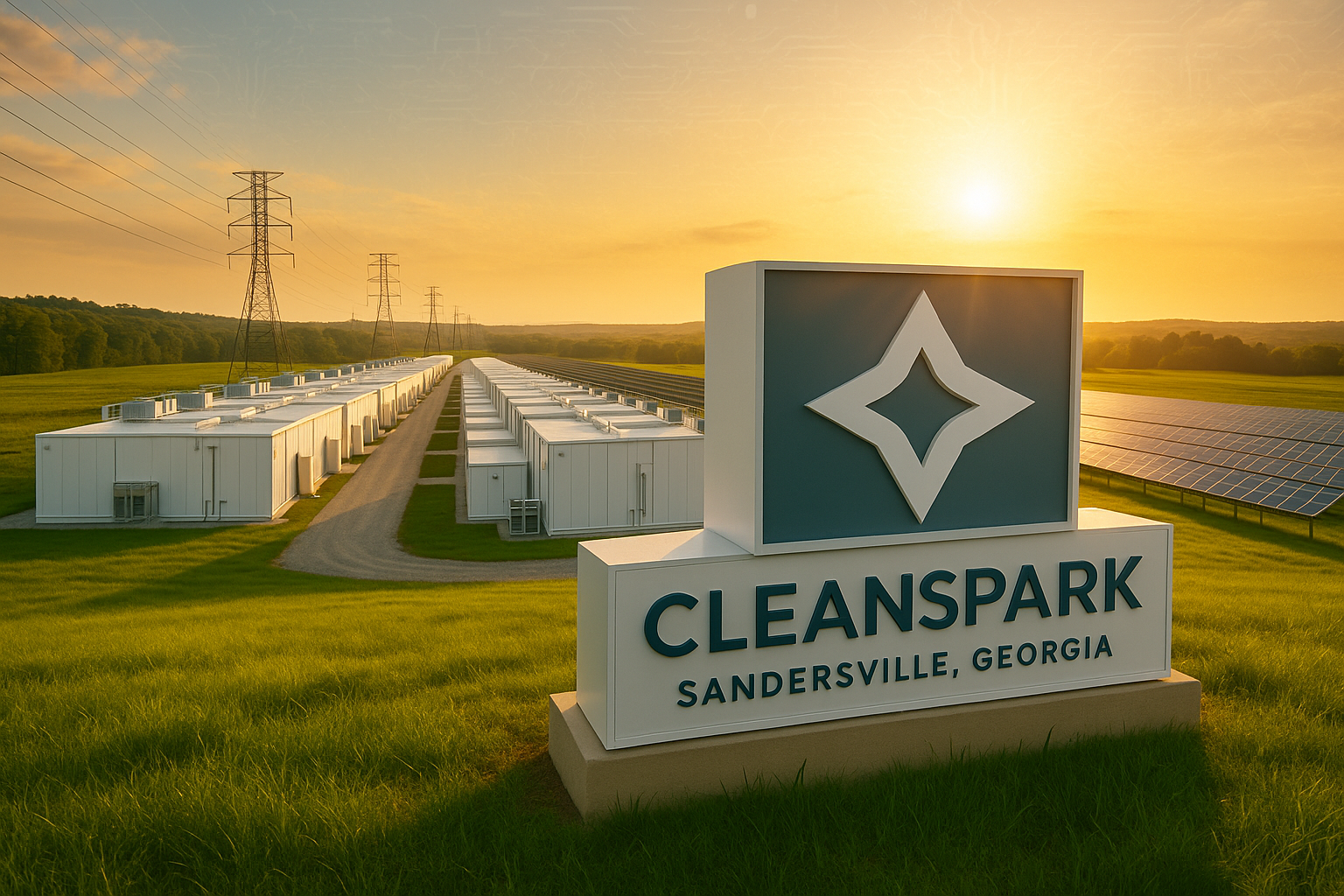
CleanSpark's landmark $6.6 billion, 20-year triple-net lease at its Sandersville, Georgia campus signifies a pivotal strategic shift from volatile bitcoin mining to becoming a landlord for AI and high-performance computing (HPC) infrastructure. This triple-net structure, where the tenant assumes property expenses such as taxes, insurance, and maintenance, enables CleanSpark to achieve nearly 100% net operating income margins, translating to approximately $330 million in average annual NOI. By leveraging its extensive land and power assets, originally acquired for crypto mining, CleanSpark positions itself as a critical infrastructure provider in the booming AI sector, securing long-term, stable cash flows that decouple its valuation from cryptocurrency volatility.
The lease deal includes exclusivity over CleanSpark’s expansive Texas portfolio, encompassing 718 acres and up to 885 megawatts of secured and planned power capacity, which could scale CleanSpark’s annual net operating income beyond $1 billion. This exclusivity arrangement broadens CleanSpark’s role from a bitcoin miner to a major digital infrastructure landlord with a diversified footprint, underscoring the strategic importance of land control and grid engineering in powering AI and HPC workloads. However, the ambitious build-out—estimated between $1.75 billion and $2.10 billion for 175 megawatts of critical IT load—introduces significant execution risks tied to complex data center construction and financing.
CleanSpark plans to finance much of the costly data center build-out through project debt, potentially using its bitcoin treasury of approximately 13,941 BTC as collateral, a move that enhances financing access but also exposes the company to crypto price volatility during construction. The lease contract contains standard but critical provisions allowing rent reductions or termination if construction milestones are missed, emphasizing that timely delivery of powered, cooled, and commissioned space is essential to realize the projected $330 million annual NOI. As CleanSpark’s CEO highlighted, 'You cannot announce your way into $330 million of annual NOI. You have to deliver powered, cooled, commissioned space,' spotlighting execution risk as the immediate swing factor despite the deal’s transformative potential.

Debt-Backed Bet on AI Buildout
CleanSpark is leveraging nearly $900 million in bitcoin as collateral for unusually favorable debt terms, but faces a race against time and technical hurdles to deliver high-density AI facilities before revenue can flow.
CleanSpark’s financing strategy for its ambitious $1.75 to $2.1 billion Sandersville AI infrastructure buildout hinges on leveraging its substantial Bitcoin treasury—approximately 13,941 BTC valued near $878 million—as collateral to secure debt financing, thereby minimizing equity dilution amid concerns of undervaluation. The CFO highlighted that current debt terms are exceptionally favorable, with loan-to-cost ratios soaring to 90-95%, well above historical norms, and interest rates around 6.5-7%, which starkly contrast with equity costs that could reach 20%, making debt the preferred capital source to optimize returns.
While the $6.6 billion, 20-year triple-net lease deal dramatically enhances CleanSpark’s near-term cash flow visibility by shifting operational expenses to the tenant and projecting approximately $330 million in annual cash flow, it simultaneously concentrates execution risk on meeting stringent construction and financing milestones. The exclusivity arrangement tying CleanSpark’s 718-acre Texas power portfolio directly to the AI hosting tenant underscores that timely buildout, funding, and energization are pivotal catalysts, with revenue recognition not expected until late 2027, necessitating meticulous project management to bridge the multi-year development phase without jeopardizing shareholder value.
Execution risks extend beyond financing to the technical complexity of the build, particularly the challenge of cooling high-density AI chip deployments in the hot South Georgia climate, where 75 megawatts of the 250-megawatt site power is dedicated solely to cooling infrastructure. The CFO emphasized that successful capital deployment depends on operational execution to generate targeted revenue and EBITDA, which in turn unlocks more favorable financing options and preserves strategic flexibility, reflecting a collaborative finance-operations approach that positions the CFO as a strategic partner rather than a mere gatekeeper.

Investor Tug-of-War Intensifies
Despite recent stock gains, market skepticism runs deep as CleanSpark’s surging short interest and steep valuation discount spotlight doubts about its ability to manage heavy losses and deliver on its AI ambitions.
CleanSpark's stock has exhibited a volatile yet overall positive trajectory, with a notable 145.99% total shareholder return over three years and a 25.31% gain in the past 90 days, despite a recent 17.56% pullback that hinted at fading momentum before the AI lease announcement. This mixed momentum reflects investor uncertainty as the market grapples with balancing optimism about CleanSpark's strategic pivot against lingering concerns about execution risks and Bitcoin exposure.
Despite the bullish narrative underpinning CleanSpark's pivot to AI and high-performance computing, the stock trades at a significant discount to its narrative fair value—closing around $14.13 to $15.33 versus a fair value estimate near $21.12—signaling a market that is cautiously optimistic but wary. This valuation gap underscores skepticism about the company's ability to achieve projected revenue growth and margin improvements, especially given its elevated price-to-sales ratio of 4.9x compared to the US Software industry average of 3.5x, which raises concerns about potential downside if investor sentiment cools.
Market skepticism is further evidenced by CleanSpark's substantial 44.39% short interest, positioning it as the fourth most shorted stock, a reflection of bearish sentiment fueled by the capital-intensive nature of its AI infrastructure buildout and the volatility of its legacy Bitcoin mining operations. Recent financial results, including a $378.7 million net loss and an EPS miss, have intensified doubts about the company's ability to manage heavy capex and debt levels—$820 million—while successfully executing its strategic pivot amid fluctuating Bitcoin prices.
Investor sentiment remains conflicted despite a strong 11.4% stock price jump following the $6.6 billion, 20-year triple-net lease announcement, which many view as validation of CleanSpark's AI infrastructure strategy. However, concerns persist that any delays in financing or construction milestones could jeopardize the lease and undermine the stock’s valuation, keeping the market cautious. This tension is mirrored in options markets, where a low put/call ratio skewed toward calls suggests budding bullishness, even as prominent AI-focused analysts exclude CleanSpark from top sector picks, highlighting the nuanced and divided market perception.

Miners Chase AI Gold Rush
Major bitcoin miners are rapidly repurposing power assets for AI, chasing multi-billion dollar contracts and stable revenue—but face a steep learning curve in data center operations and technology.
CleanSpark's strategic pivot to AI and high-performance computing infrastructure is emblematic of a broader industry transformation where major bitcoin miners such as Hut 8 and IREN are securing multi-billion dollar, long-term AI contracts—Hut 8's $9.8 billion 15-year lease and IREN's $2.8 billion AI cloud deals collectively represent over $12 billion in commitments outside traditional crypto mining. This shift reflects a sector-wide reallocation of power and data center resources from ASIC-based Bitcoin mining to GPU-powered AI workloads, repositioning public miners as multi-purpose digital infrastructure platforms rather than pure crypto plays.
The move into AI infrastructure offers bitcoin miners more stable, recurring revenue streams that are decoupled from Bitcoin's notorious price volatility and halving cycles, thereby attracting institutional capital and reshaping investor narratives across the crypto mining sector. Morgan Stanley highlights that bitcoin miners control nearly 20 GW of grid-interconnected sites, a sizable portion of the 68 GW U.S. data center power demand forecasted between 2026 and 2028, underscoring their strategic value in powering AI workloads amid growing market recognition.
Despite the promising financial outlook, execution risks loom large as transitioning from bitcoin mining to AI data centers demands distinct operational expertise, supply chains, and cooling technologies. Companies like Hut 8 face significant near-term challenges in scaling AI campuses such as Beacon Point and River Bend, reflecting a common sector-wide complexity in adapting infrastructure and talent to meet AI's demanding requirements.
The rapid repricing of AI infrastructure assets is further illustrated by Switch’s impending $80 billion IPO, which has drawn heavyweight investors like Andreessen Horowitz, Brookfield, and KKR, signaling robust cross-sector enthusiasm beyond traditional software and chip companies. This surge in valuation underscores a critical industry insight: AI growth is no longer just about chips and software but equally about physical infrastructure—power, land, cooling, and connectivity—vital for hosting next-generation AI workloads, a paradigm mirrored by Nvidia’s $50.2 billion, 30-year lease at Hut 8’s Beacon Point campus and CleanSpark’s similar strategic pivot.