Context is king: why orchestration, not just AI, is winning the enterprise race
The gist
Enterprises aren’t winning the AI race by chasing smarter models—they’re pulling ahead by mastering orchestration layers and context engineering to turn fragmented AI pilots into scalable, business-ready workflows.
What to know
- Despite 94% of companies using generative AI, only 21% have mature governance, leaving skill gaps and shadow AI risks rampant.
- Industry leaders like Elastic and Workday report up to 5x improvements in AI accuracy by building robust context layers and orchestration systems.
- ROI soars when AI is embedded deep into workflows—Virgin Media O2 scaled to over a million AI interactions, while agile firms outpace larger rivals stuck in pilot purgatory.
Skill Gaps Stall AI Ambitions
Even tech-savvy managers struggle with AI adoption as fragmented deployments, cultural resistance, and unreliable outputs expose the urgent need for governance and cross-team collaboration.
A persistent workforce skill gap remains a critical barrier to enterprise AI adoption, even among typically tech-savvy groups like Gen Xers and older millennials, as Carrie Tolorico observed with middle managers requiring extensive support during AI training. This gap is compounded by cultural resistance and organizational confusion, where AI-generated solutions may be defended by leadership despite being incorrect, underscoring the urgent need for clear governance frameworks and AI literacy to manage conflicts and build trust.
Enterprises struggle with fragmented and siloed AI deployments that complicate governance and strategy, as 94% of mid-market companies use generative AI but only 2% have operationalized it at scale. This decentralized adoption overwhelms executives and fuels shadow AI risks, where employees create rogue automations to bypass IT, highlighting the challenges of cybersecurity, legacy system integration, and the high costs associated with multi-tool AI workflows.
The gap between AI capability and enterprise reliability remains a formidable hurdle, with products like Humane Tech PIN and Rabbit R1 exhibiting error rates around 10%, far from the 'five nines' reliability enterprises demand. This reliability challenge, coupled with the need for continuous measurement of AI accuracy and latency, demands rigorous evaluation stages and cross-functional collaboration beyond research breakthroughs, involving software engineering, product design, and operations to ensure AI solutions perform robustly in complex, real-world workflows.
Cultural and structural barriers, including pilot fatigue, superficial AI usage without process redesign, and cautious governance, slow the transition from assisted AI to trusted autonomous workflows. Despite widespread plans to deploy agentic AI, only 21% of companies have mature governance models, and many remain stuck in pilot mode, risking a widening productivity gap. McKinsey’s design principles emphasize the need for AI to maintain context, support multistep tasks, and enable seamless human-AI collaboration to bridge this divide and realize AI’s transformative potential beyond mere efficiency gains.





Context Engineering Takes Center Stage
Building precise context pipelines—balancing deterministic data with agentic orchestration—has become the linchpin for accurate, compliant, and scalable enterprise AI.
Context engineering has evolved into a foundational discipline that extends traditional data pipelines into precise orchestration systems managing data, prompts, and evaluation to enable AI agents to deliver accurate and compliant outputs. As Nick Schraff from the 2025 interview emphasized, 'context pipelines are going to be the new data pipelines,' highlighting orchestration as the backbone uniting data and AI platforms into a single surface. This orchestration must balance deterministic data management with the probabilistic, agentic orchestration performed by AI agents, underscoring the complexity and novelty of context engineering beyond classical data engineering.
By late 2025 and early 2026, industry leaders like Elastic and Workday underscored context engineering as the critical differentiator between successful AI deployments and failures. Elastic’s vision to lead with open standards such as MCP aims to enable agentic applications that are reliable and compliant, while Workday’s chief data officer reported a fivefold accuracy improvement by adopting a context layer approach that transforms raw data into business-ready intelligence. This shift reflects a broader realization that context readiness precedes AI readiness, requiring close collaboration between data and business domain experts to build reusable, scalable context foundations that drive measurable ROI.
The technical core of context engineering lies in assembling a precise 'Context Package' that smartly balances short-term conversational memory with long-term semantically indexed knowledge, leveraging retrieval-augmented generation (RAG) techniques to ground AI outputs in up-to-date, relevant data. As detailed in the 2026 analyses, this involves dynamic prioritization of system instructions, current state, policies, and user profiles within token limits to transform LLMs from probabilistic guessers into reliable reasoning engines constrained by real-world compliance rules. This architectural shift from prompt engineering to context engineering addresses fundamental failures in AI production, where insufficient or outdated context leads to confident but erroneous outputs.
Beyond technical orchestration, context engineering demands organizational coordination and governance to ensure AI agents operate with trusted, verified, and auditable information aligned with enterprise processes and culture. As Ken Exner of Elastic and Patrick Thompson of Celonis highlight, sustainable context engineering is dynamic and multi-player, requiring cross-team agreements on agent knowledge and access standards, centralized governance models, and the creation of digital twins or process models that provide temporal views of operations. This holistic approach mitigates the staggering 85–90% AI failure rates reported by MIT and Gartner, positioning context engineering as the ultimate competitive advantage in enterprise AI adoption by embedding business-specific knowledge and reducing operational costs through structured content and semantic coherence.




Orchestration Powers Multi-Agent Workflows
AI-first architectures now daisy-chain specialized agents, enabling rapid automation of complex tasks and shifting enterprise workflows from static scripts to dynamic, autonomous problem-solving.
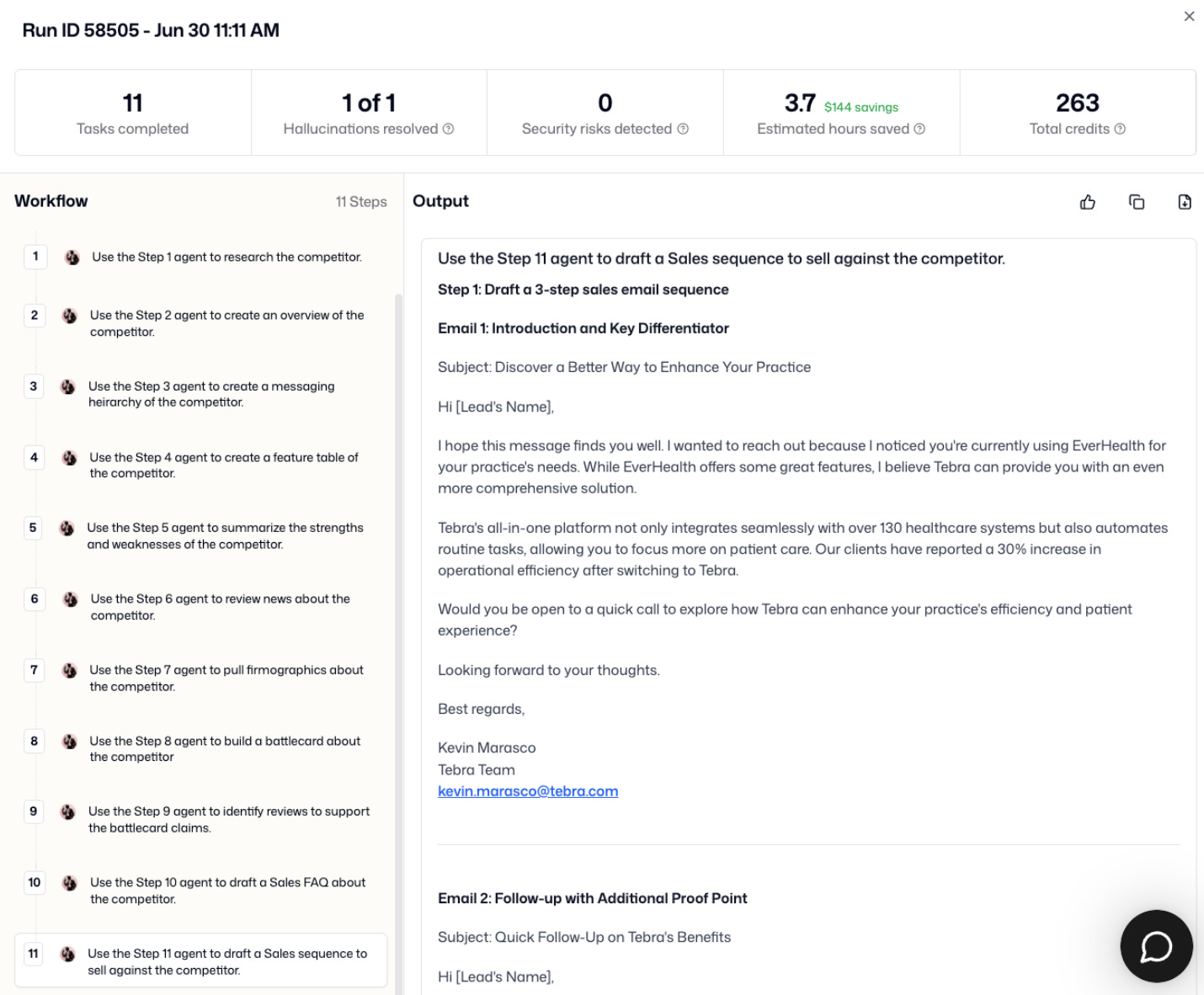
By late 2025, enterprises like Tebra demonstrated the power of AI orchestration architectures that daisy-chain multiple specialized agents to automate complex workflows, such as generating competitive battle cards in under 10 minutes—a task that previously took days. Leveraging AI-first platforms like DoubleO, founded by veterans from Meta and PlayStation, these orchestrations incorporate built-in hallucination and security checks, making multi-agent workflows both accessible to non-developers and reliable in execution.
As AI adoption matured into 2026, thought leaders like Nick Schraff emphasized that orchestration is the beating heart of enterprise AI, evolving beyond traditional data pipelines into dynamic, agentic orchestration that manages probabilistic prompts and reasoning across multiple AI agents. Companies such as Poolside use platforms like Dagster to seamlessly integrate data ingestion, foundation model training, and workflow orchestration, illustrating how orchestration layers unify AI with enterprise data systems to enable scalable, end-to-end automation.
Zapier’s 2026 insights reveal a paradigm shift from static workflows to agentic AI workflows characterized by autonomous reasoning and iterative problem-solving, where orchestration manages a collective workforce of specialized agents connected to enterprise data and tools. This orchestration addresses agents’ stateless nature by embedding robust context engineering and leverages standards like Machine-Readable Capabilities Protocols (MCPs) to efficiently define tool access, enabling agents to act independently yet cohesively within complex enterprise environments.
By mid-2026, orchestration layers emerged as the new operating system for enterprise AI, serving as connective mortar that integrates existing systems without costly replacements, as Appian’s architecture exemplifies. This convergence, echoed by industry leaders like Satya Nadella and evidenced by Anthropic’s leaked scaffolding, highlights that competitive advantage now hinges on orchestration’s ability to manage context, compliance, and multi-step workflows rather than on AI model sophistication alone. Successful enterprises prioritize contextual continuity, governance, and modular multi-agent workflows, with 96% adopting AI agents and over half employing human-on-the-loop models to scale trusted, compliant AI-driven business processes.
Despite productivity gains from AI agents embedded in siloed SaaS applications, experts like Anand Eswaran and Alex from Palantir stress the critical need for higher-level orchestration layers that provide trustworthy data integration and enable end-to-end business process management. This missing orchestration layer, focused on data and AI trust, is essential for transforming isolated AI copilot enhancements into scalable, customizable enterprise automation capable of delivering measurable business impact.




Governance Fuels Scalable AI
Cross-functional collaboration and business-led governance frameworks are redefining how organizations embed AI, moving beyond pilots to accountable, risk-aware enterprise deployments.
By late 2025, companies like Zuora and Snowflake demonstrated that embedding AI deeply into enterprise workflows necessitates robust governance frameworks coupled with cross-functional collaboration. Zuora’s three-stage AI governance process balances innovation with security by enabling controlled experimentation while ensuring compliance and business value, preventing shadow IT and fostering trust among employees and customers alike. Similarly, Snowflake centralized its data teams under a chief data officer and embedded data scientists and analysts closely with business units, ensuring AI solutions address real-world problems and maintain stakeholder engagement, which was critical for scaling AI-driven sales operations effectively.
By early 2026, research from Deloitte and CrewAI underscored that successful enterprise AI adoption hinges on cultural and structural shifts towards business-led strategies that prioritize measurable outcomes and workforce skills alongside governance. Despite 81% of enterprises actively scaling agentic AI, only 21% had mature governance models, highlighting a widespread need for frameworks that manage risk, ensure security, and integrate AI reliably into existing systems. As Jim Rowan of Deloitte noted, organizations excelling with AI invest not only in automation but also in talent, enabling teams to reimagine business models rather than merely chasing productivity gains.
Throughout 2026, thought leaders and enterprises emphasized that scaling AI beyond pilots requires a shift from technology fascination to business-centric orchestration, where AI agents connect legacy systems and workflows under clear accountability and governance. Maryam Ashoori highlighted the need for product leaders to blend technical, engineering, and user experience skills to embed AI deeply, while Appian’s CEO Matt Calkins stressed that AI must align with robust business processes to deliver reliable ROI, especially in regulated industries. This organizational evolution includes adopting reliability frameworks that remediate AI errors preemptively, as seen in Appian’s approach to high-stakes environments, and treating governance mechanisms like permissions and audit logs as foundational rather than optional.
Recent analyses reveal that embedding AI at scale demands a unified context infrastructure governed centrally to avoid fragmented solutions and build trust through observability and measurable outcomes. Enterprises like Celonis advocate for process intelligence as a 'digital twin' of operations to provide the contextual foundation AI needs to function effectively, while also monitoring process adherence post-transformation to bridge strategy and execution gaps. This cultural and governance shift includes fostering cross-functional collaboration across business units and investing in knowledge-first approaches that capture enterprise-specific context, enabling AI to move from isolated experiments to durable, mission-critical systems that deliver sustained business value.



ROI Favors Context-Driven Firms
Enterprises investing in context layers and workflow reinvention are leapfrogging pilot purgatory, achieving measurable ROI and operational scale while larger rivals lag behind.
By late 2025, the narrative around enterprise AI ROI began to shift significantly as a Wharton study revealed that 74% of businesses measuring generative AI ROI were already seeing positive returns, a stark contrast to earlier MIT findings focused narrowly on pilot profitability. This broader definition of ROI, encompassing productivity, employee retention, and operational efficiency, illuminated why tech and telecom sectors, along with smaller, more agile companies, reported higher ROI, while larger enterprises and middle managers remained cautious or entrenched in pilot phases. Box CEO Aaron Levie encapsulated this dynamic, emphasizing that AI output correlates directly with how much workflows are reset—a flexibility more accessible to smaller firms.
Entering 2026, enterprises that invested in building robust context layers witnessed a transformative leap from AI pilots to operational systems delivering measurable ROI. Workday’s chief data officer highlighted a fivefold increase in AI accuracy after adopting context layers, while Virgin Media O2 scaled AI usage to over a million interactions across 6,000 employees. This approach, championed by MasterCard and others, reframed organizations as data-centric, with context engineering serving as the critical bridge that makes technical data business-ready and reusable, thereby enabling sustainable AI value beyond isolated use cases.
By early 2026, surveys and case studies converged on a clear inflection point: enterprises were decisively moving AI initiatives from pilots to scaled production, with over half expecting to operationalize 40% or more of their AI pilots within six months. This shift was accompanied by growing recognition that true competitive advantage stems not from incremental productivity gains but from reimagining workflows and business models, as Jim Rowan of Deloitte noted, emphasizing simultaneous investment in AI tools and workforce capabilities. Governance and risk-aware deployment strategies, especially for emerging Agentic AI, were identified as essential enablers of this transition, balancing rapid adoption with operational stability.
Throughout 2026, evidence mounted that embedding AI deeply into core business processes and workflows was the primary catalyst for measurable ROI and competitive differentiation. From insurance firms slashing claim processing times by over 80% using AI agents to LangChain and ClickUp achieving multi-fold pipeline growth through AI-augmented sales workflows, operational AI demonstrated tangible productivity and cost savings. Leaders like Appian’s Matt Calkins stressed that AI must be integrated with governance, auditability, and process alignment to move beyond hype into mission-critical applications, a view echoed by McKinsey’s finding that workflow reimagination—not just AI adoption—drives ROI. However, despite widespread AI use, only a minority of organizations report enterprise-level EBIT impact, underscoring the ongoing challenge of scaling individual productivity gains into organizational value.


Context Is the Competitive Edge
Mastering context engineering and orchestration—not model complexity—now determines which enterprises unlock durable AI value and shape the next wave of industry leaders.
By late 2025, Elastic positioned 2026 as the pivotal year for mastering context engineering, emphasizing that success in AI projects hinges on building robust context infrastructure and open standards like MCP to support real-world agentic applications. Ken Exner of Elastic highlighted that integrating observability and context into AI workflows, alongside developing secure orchestration layers, is essential to overcoming adoption challenges and unlocking durable enterprise AI value.
Entering 2026, industry consensus crystallized around the idea that competitive advantage in enterprise AI will derive less from model sophistication and more from the strength of orchestration layers that manage contextual continuity, error handling, and output verification. Analysts stressed that organizations winning over the next five years will treat contextual continuity as a strategic asset, linking processes, content, and communications into unified orchestration frameworks while demystifying LLMs rather than treating them as black boxes.
Recent analyses underscore that AI performance is multiplicative between intelligence and context, meaning even the most capable models fail without accurate, organization-specific context. The new frontier in AI is mastering situated intelligence—capturing tacit knowledge, resolving semantic conflicts, and continuously customizing context solutions for evolving domains—shifting the competitive landscape from raw reasoning engines to tailored context engineering and orchestration as the ultimate differentiators.