Core scientific rockets ahead on AI pivot, outsizes peers
The gist
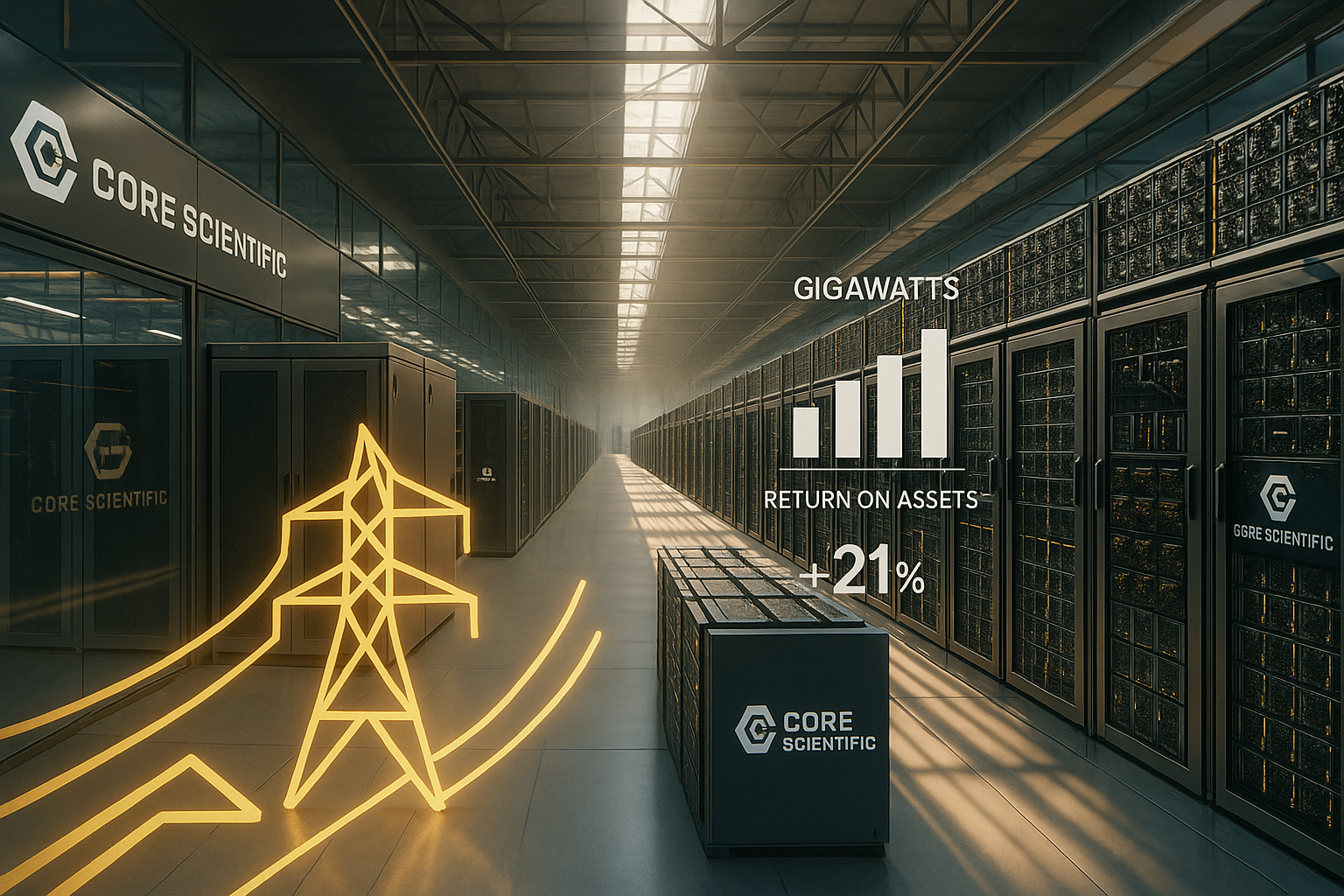
Core Scientific’s game-changing CoreWeave deal rockets its AI hosting returns to 75% ROA—leaving bitcoin mining (and its rivals) in the dust.
What to know
- A unique $6.7B AI hosting contract with CoreWeave required just $105M in capex, fueling massive 75% returns on assets—ten times what peers earn.
- Core Scientific’s AI colocation segment hit $80M gross profit at a 59% margin in Q2, prompting a strategic pivot away from struggling bitcoin mining.
- Analysts now see Core Scientific reaching $1.2B EBITDA by 2028, with price targets up to $42, but warn that CoreWeave’s debt-fueled growth carries real legal and financial risks.
Capex Hack Fuels Profit Surge
Core Scientific’s unprecedented 75% returns are powered by a one-of-a-kind, nearly risk-free financing structure that slashes capital outlay to a fraction of industry norms, leaving rivals unable to compete on profitability.
Core Scientific’s AI hosting deal with CoreWeave stands out as a sector outlier, delivering an extraordinary 75% return on assets (ROA) that dwarfs competitors like TeraWulf and Cipher Mining, whose ROAs linger in the single digits at 5% and 4%, respectively. This exceptional profitability is anchored in a rare, long-duration $6.7 billion hosting contract described by Bernstein analyst Gautam Chhugani as 'capex-advantaged' and 'hard to replicate,' effectively setting a profitability ceiling that latecomers are unlikely to match.
The secret sauce behind Core Scientific’s stellar returns is not superior contract economics but a uniquely capital-expenditure-light financing structure with CoreWeave, which financed $750 million of the $855 million buildout through revenue prepayments. This arrangement left Core Scientific to fund only $105 million—about $1.5 million per megawatt—an order of magnitude less than peers who typically invest $8-11 million per megawatt, enabling Core Scientific to achieve a 79% yield on cost and vastly superior profitability.
This strategic pivot to AI hosting has transformed Core Scientific’s financial profile, with its AI colocation segment generating $80 million in gross profit at a 59% margin—surpassing the company’s entire consolidated gross profit—while its traditional Bitcoin mining business posted a stark negative 56% gross margin in Q2. Reflecting this shift, Core Scientific is actively repurposing remaining mining facilities for high-density AI colocation 'as circumstances allow,' underscoring a deliberate transition to capitalize on the lucrative AI infrastructure market.

AI Pivot Ignites Wall Street
An 800% explosion in AI colocation revenue and a swelling power pipeline have analysts projecting billion-dollar EBITDA and stock price targets nearly doubling—despite lingering execution risks.
Core Scientific's AI colocation business has ignited robust market enthusiasm, propelled by an extraordinary 800% surge in AI colocation revenue and a power infrastructure pipeline expanding to 4.5 GW. This rapid growth underpins bullish analyst sentiment, with firms like those covering NASDAQ:CORZ upgrading the stock to Strong Buy and setting price targets reflecting up to 40% upside, driven largely by strategic partnerships and the company’s decisive pivot away from bitcoin mining.
Analysts are projecting Core Scientific to achieve approximately $1.2 billion in EBITDA by 2028, a forecast grounded in the ramp-up of CoreWeave, the AMD Phase 1 contract, and enhanced power monetization strategies. Valuation models applying the sector median forward EV/EBITDA multiple of 14.24x to this EBITDA estimate suggest substantial financial upside, reinforcing the stock’s appeal with potential price targets soaring to $42 by FY2027, implying nearly a 93% gain from current levels.
Despite the overwhelmingly bullish outlook, analysts maintain a cautious tone due to risks such as construction delays, financing costs, and customer concentration. These factors inject a note of prudence into the otherwise optimistic growth narrative, underscoring the importance of execution in sustaining Core Scientific’s market momentum and validating its strategic shift toward AI infrastructure colocation.
Outpacing Rivals in the AI Race
Core Scientific’s strategic partnership with CoreWeave and capital-light model have vaulted it ahead of TeraWulf and Cipher Mining, cementing its dominance in the booming AI infrastructure sector.
Core Scientific’s AI infrastructure pivot distinctly outpaces peers like TeraWulf and Cipher Mining by leveraging a unique low upfront financing deal with CoreWeave, enabling rapid scaling with strong revenue visibility. While TeraWulf has made strides transitioning from pure bitcoin mining to diversified contracted revenue streams—highlighted by its 20-year, 401 MW Justified Data Campus Lease with Anthropic PBC that nearly doubles its fair value estimate—Core Scientific’s 75% ROA and strategic partnerships position it more favorably amid the sector’s AI infrastructure boom.
CoreWeave’s specialization in AI-optimized GPU clusters and its expansive footprint of 49 state-of-the-art data centers with over 3.5 gigawatts of contracted power capacity underscore its leadership in the neocloud space, setting a high bar for peers. Piper Sandler analyst James Fish highlights this AI infrastructure surge as a ‘gold-rush’ demanding long-term compute commitments, a trend CoreWeave capitalizes on through strategic expansions like its collaboration with Leidos for secure federal AI cloud services and entry into the Asia-Pacific market, further differentiating it from competitors such as TeraWulf and Cipher Mining.
Despite TeraWulf’s strong longer-term momentum reflected in a 42.54% year-to-date share price return, its AI infrastructure strategy carries risks including potential capital spending outpacing cash generation and underperformance by key AI tenants, challenges less pronounced for Core Scientific given its robust revenue growth and customer confidence. CoreWeave’s 168% year-over-year revenue surge to $5.13 billion in 2025 and 127% growth in Q1 2026 exemplify superior market positioning within the neocloud sector, reinforcing Core Scientific’s competitive advantage through its partnership and infrastructure model.
CoreWeave’s Debt-Fueled Gamble
CoreWeave’s rapid-fire expansion and unconventional financing have enabled explosive growth but left the company exposed to mounting legal, liquidity, and solvency risks that could ripple through its partners.
CoreWeave's rapid infrastructure expansion is driven by an innovative strategy of retrofitting powered shells to circumvent traditional greenfield construction delays and grid interconnection queues, enabling it to surpass one gigawatt of active power and contract over three and a half gigawatts. This growth is tightly interwoven with its partnership with Core Scientific, particularly through mining-to-AI conversions on stranded power-secured land, which has been pivotal for Core Scientific's AI hosting success but has also triggered significant legal challenges, including a securities fraud class action alleging concealment of delays flagged since late 2025.
Despite CoreWeave's impressive 112% year-over-year revenue surge to $2.08 billion, its financial health is precarious due to a heavily leveraged capital structure marked by a debt-to-equity ratio exceeding five and current liabilities more than twice its liquid assets. This imbalance has led to a GAAP net loss widening to $740 million and a negative free cash flow of $4.7 billion against $7.7 billion in capital expenditures, underscoring the company's dependence on continuous debt market access and customer prepayments to sustain its aggressive buildout.
CoreWeave's financial rigidity is stark: it cannot slow its infrastructure expansion without risking the contracts that justify its massive debt load, nor can it return capital due to a lack of free cash flow, making its capital structure less a strategic lever and more a defining characteristic of its business model. While one ring-fenced facility within CoreWeave holds investment-grade status, this does not extend to the consolidated entity, allowing selective financing at competitive costs but leaving the company overall vulnerable to market fluctuations and financial stress.