CoreWeave’s AI boom meets debt and margin pressure
The gist
CoreWeave is blasting past $5B in revenue on an AI gold rush, but soaring debt, huge CapEx, and brutal GPU wars threaten to squeeze its margins and test investor nerves.
What to know
- Revenue is set to skyrocket from $15.8M in 2022 to $5.05B in 2025, but a $13B CapEx bill and $10.6B in debt are putting CoreWeave’s cash flow under major strain.
- Despite hitting operating profitability, heavy depreciation and interest mean net losses persist, with margins dipping to 6% in late 2025 before a hoped-for rebound by end of 2026.
- An exclusive Nvidia partnership gives CoreWeave cutting-edge tech but locks in premium costs just as rivals like AMD and WhiteFiber—backed by crypto-fueled loans—move aggressively into the AI infrastructure fray.
Growth Outpaces Cash Flow
CoreWeave’s explosive revenue surge is fueled by a massive AI-driven backlog, but aggressive spending and mounting debt are straining cash flow and delaying true profitability.
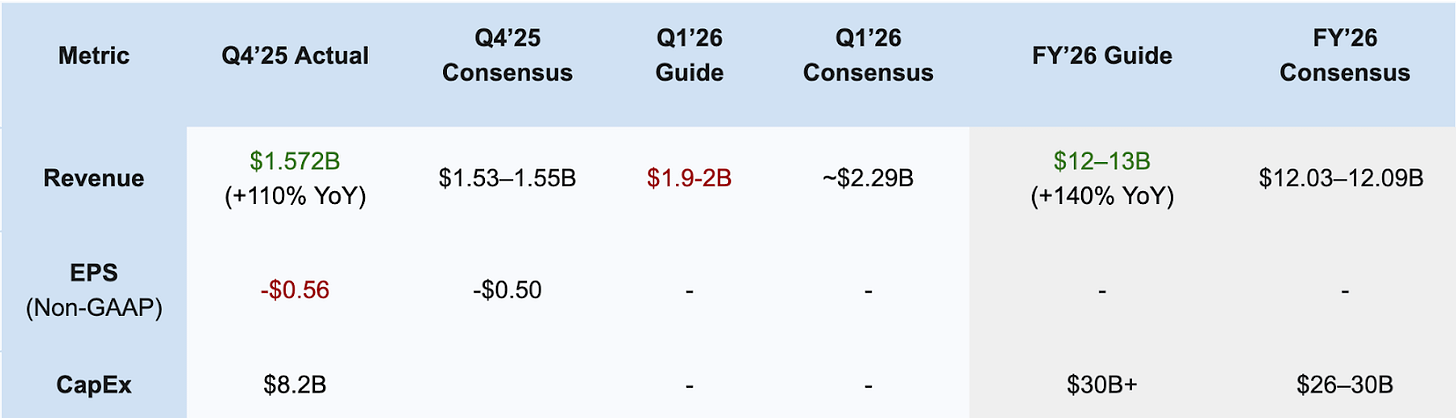
CoreWeave's meteoric revenue growth, soaring from $15.83 million in 2022 to a projected $5.05 billion in 2025, is underpinned by an enormous $55.6 billion revenue backlog and overwhelming demand from AI-native customers and new verticals integrating AI at scale. However, this rapid expansion comes with a hefty price tag: a $13 billion capital expenditure plan in 2025 alone, escalating to nearly $30 billion in 2026, alongside $1.25 billion in interest expenses and $10.6 billion in total debt, creating significant financial strain and cash flow challenges as the company invests heavily upfront in data center infrastructure before realizing corresponding revenues.
Despite CoreWeave's strides toward operating profitability—evidenced by improved adjusted EBITDA and a move to operating profit in 2024—the company remains deeply unprofitable at the net level due to heavy depreciation, interest, and financing costs. This dynamic is exacerbated by a timing mismatch where depreciation and lease expenses hit the profit and loss statement before revenue recognition, compressing near-term margins to as low as 6% in Q4 2025 and driving expectations for margins to trough in early 2026 before a gradual recovery to low double digits by year-end, with long-term targets of 25–30% once capacity ramps and the business normalizes.
CoreWeave’s strategic reliance on Nvidia products grants priority access to cutting-edge technology, a critical advantage amid fierce competition and surging AI infrastructure demand. Yet, this partnership also locks the company into a premium cost structure that is sustainable only while supply scarcity persists, adding another layer of financial pressure. Management acknowledges the ephemeral nature of technological moats in this sector, raising concerns about whether CoreWeave can maintain its pricing power and market share if AI demand slows or competitors erode its position.
Parallel to CoreWeave, WhiteFiber mirrors the growth-with-pain narrative, boasting rapid revenue increases and a substantial backlog highlighted by a 10-year, $865 million contract with Nscale. Yet, like CoreWeave, WhiteFiber remains loss-making, with profitability challenges contributing to stock volatility and vulnerability to profit-taking once the initial AI-fueled rally cools. Both companies’ aggressive infrastructure buildouts underscore the capital-intensive nature of scaling AI-optimized GPU infrastructure amid an uncertain profitability horizon.





Financial Guidance Under the Microscope
CoreWeave and WhiteFiber are redefining capital management—balancing unconventional revenue timing with crypto-backed credit lines and innovative loan structures to weather industry volatility.
CoreWeave adopts a risk-balanced financial guidance strategy that prioritizes transparency about operational variables affecting revenue outcomes, thereby maintaining credibility with investors despite the inherent lumpiness of its revenue backlog. The CFO emphasized managing expectations around the timing and size of outsized multi-quarter contracts, explaining that fluctuations in backlog figures do not necessarily indicate performance declines but reflect the industry's unconventional revenue recognition patterns.
By mid-2026, WhiteFiber demonstrated a sophisticated capital management approach by securing a $100 million Ethereum-denominated secured credit facility from Bit Digital, which allowed it to access flexible, non-dilutive growth capital while Bit Digital retained ETH exposure and earned risk-adjusted yields surpassing traditional staking. Complementing this innovative financing, WhiteFiber pursued traditional non-dilutive funding sources like an expanded credit facility with the Royal Bank of Canada, balancing cutting-edge and conventional capital strategies to support its AI data center expansion.
WhiteFiber's strategic financing was further bolstered by a $100 million delayed-draw loan facility priced competitively at 9.5%, with potential step-downs to 8.0%, which, combined with a multi-year AI compute contract exceeding $160 million, enhanced investor confidence and provided predictable revenue streams to underpin its capital management and project funding. This synergy between contract wins and financing arrangements underscores WhiteFiber’s proactive approach to aligning growth capital with operational cash flow needs.
CoreWeave’s aggressive capital raising through significant debt issuance—$1.25 billion in senior notes plus €2 billion due 2032—reflects a bold financing strategy to fuel AI infrastructure growth, even as it raises concerns about elevated debt levels and associated financial risks. Nevertheless, investor enthusiasm remains robust, evidenced by a 17.3% stock price increase ahead of CoreWeave’s Nasdaq-100 debut, highlighting the delicate balance between leveraging debt for expansion and managing market expectations in a rapidly evolving sector.

Market Volatility Intensifies
CoreWeave’s stock swings wildly as insider selling and debt concerns clash with bullish institutional moves and major AI contracts, exposing deep investor uncertainty.
CoreWeave's market sentiment has been a rollercoaster, with its stock surging 55% in April 2026 amid major AI compute contracts with Meta, Anthropic, and Jane Street, signaling strong optimism about growth prospects. However, this enthusiasm is tempered by cautious bond market behavior; despite multiple billion-dollar debt issuances being well received due to backing by financially robust customers like Meta, investors remain wary of execution risks tied to sustaining AI compute demand, aware that any faltering could trigger broader credit market disruptions.
By mid-May 2026, CoreWeave's stock plunged over 11% following an earnings miss and rising capital expenditures, a downturn exacerbated by intensified insider selling—1,782 sales without any purchases in six months—that stoked investor jitters about the company's financial sustainability. Institutional investor activity painted a divided picture, with heavyweights like NVIDIA and Vanguard increasing stakes while others trimmed positions, reflecting mixed confidence. Analyst sentiment remained cautiously optimistic, with upgrades and price targets up to $175 buoyed by hyperscaler contracts but tempered by concerns over the costly, GPU-heavy operating model. Concurrently, options market activity spiked around the $114 strike price, underscoring heightened uncertainty about near-term stock direction.
Despite ongoing financial and execution concerns highlighted by significant insider selling—over 27 million shares in three months—and missed earnings estimates, institutional confidence showed signs of revival by June 2026, exemplified by Northwestern Mutual Wealth Management's 358% stake increase and BNP Paribas Exane's Outperform rating with a $192 price target. CoreWeave's upcoming inclusion in the Russell 3000 and Nasdaq-100 indices, along with deploying NVIDIA's Vera Rubin NVL72 system, enhanced its market visibility and investor appeal, contributing to a 17.3% stock surge ahead of the Nasdaq-100 debut. Yet, the company's substantial debt load from recent $1.25 billion and €2 billion senior note issuances continues to cast a shadow over its financial risk profile.
Parallel to CoreWeave's journey, WhiteFiber's stock experienced a dramatic 20.1% jump in mid-June 2026 following a $160 million-plus AI contract win and a new $100 million delayed-draw loan facility priced initially at 9.5%, which positively shifted investor sentiment by balancing growth financing costs against anticipated AI infrastructure needs. Although the rally cooled with a 7.7% pullback attributed mainly to profit-taking rather than negative news, institutional interest remained robust with 58 hedge funds holding positions. Analysts maintained a cautiously optimistic stance, buoyed by substantial AI infrastructure contracts and a landmark $865 million 10-year agreement, while acknowledging ongoing net losses and execution risks that temper the growth narrative.

Operational Fragility Exposed
CoreWeave’s reliance on third-party contractors and rapid GPU turnover amplifies supply chain and refinancing risks, threatening margins as competitors close in.
CoreWeave’s operational risks are deeply intertwined with its reliance on third-party contractors and the complexities of rapid AI infrastructure expansion. Early delays from external data center developers caused revenue recognition setbacks and guidance cuts, highlighting supply chain vulnerabilities that, although resolved ahead of schedule by early 2026, underscore the fragility of CoreWeave’s delivery model. This dependency, coupled with the challenge of scaling power capacity—evidenced by a 260 MW increase in Q4 2025 and plans to more than double to 1.7 GW by the end of 2026—illustrates the enormous operational hurdles the company must overcome to fulfill its $55.6 billion revenue backlog and maintain service availability.
Financially, CoreWeave is navigating a precarious path marked by aggressive capital expenditures and mounting debt burdens. With $13 billion initially earmarked for CapEx and interest expenses consuming roughly 25% of revenue, the company’s leverage ballooned to $10.6 billion in total debt by early 2026, accompanied by billions in net debt. This high leverage is compounded by rapid GPU depreciation—estimated at 30-40% annually—threatening to erode adjusted operating margins from a robust 60% EBITDA down to as low as 7-8% by 2027. The heavy depreciation and interest costs keep CoreWeave deeply negative in net income and free cash flow, exposing it to significant refinancing risks as the collateral value of Nvidia GPUs declines with each new generation.
CoreWeave’s competitive moat remains tenuous amid a rapidly evolving AI infrastructure landscape prone to commoditization. While the company benefits from priority access to Nvidia GPUs, this exclusivity locks it into a premium cost structure sustainable only as long as supply scarcity persists. The rise of AMD and ASIC competitors threatens to undermine this advantage, especially since CoreWeave’s Nvidia-centric infrastructure may become a liability if these alternatives gain market share. Furthermore, the company’s focus on AI model training infrastructure leaves it less equipped for inference workloads, which demand globally distributed, low-latency compute—a domain dominated by hyperscalers like AWS and Azure with far broader regional footprints. This competitive pressure, combined with the uncertainty embedded in a $99.4 billion backlog that includes terminable contracts, places CoreWeave’s pricing power and long-term profitability under significant threat.
Operational sustainability hinges on maintaining high utilization rates and successful contract conversions into cash flow, a model that is inherently fragile given the scale and pace of CoreWeave’s expansion. The mismatch between upfront capital deployment—funding data center construction, power infrastructure, and equipment installation—and delayed revenue recognition compresses near-term margins and strains profitability. As management candidly acknowledges, the business model 'only works if utilization stays high and contracts keep converting into cash,' underscoring the tightrope CoreWeave must walk to avoid margin erosion and financial distress amid intensifying competitive and operational headwinds.

Backlog Drives Confidence
A diversified, multi-year backlog anchored by high-profile partners gives CoreWeave and WhiteFiber rare growth visibility, even as short-term volatility roils the sector.
CoreWeave's substantial $40 billion backlog, bolstered by diversified partnerships spanning AI labs, cloud providers, financial trading firms like Jane Street and Hudson River Trading, and robotics companies, provides a robust foundation for growth visibility despite short-term revenue fluctuations. CEO Michael emphasized that while the company is undergoing a massive infrastructure buildout, the multi-year backlog and expanding customer base, including major AI clients such as OpenAI and Cohere, create a clear pathway to profitability and margin expansion, with expectations of reaching low double-digit operating margins by Q4 2026.
WhiteFiber’s recent five-year AI compute infrastructure agreement exceeding $160 million with an investment-grade technology customer exemplifies its strategic approach to securing large-scale, diversified partnerships that enhance growth visibility and global market presence, particularly with its expansion into Europe. The deal’s structure, featuring customer prepayments and project-level financing, minimizes revenue volatility and financial risk by reducing reliance on WhiteFiber’s corporate balance sheet, thereby supporting the company’s ambitious HPC data center expansion plans and reinforcing investor confidence amid the inherently volatile AI infrastructure market.

WhiteFiber’s Capital Strategy Edge
WhiteFiber’s European expansion leverages project-level financing and crypto-backed loans to scale AI infrastructure without overburdening its balance sheet.
By mid-2026, WhiteFiber solidified its European expansion with a landmark five-year AI compute infrastructure agreement exceeding $160 million, deploying NVIDIA GPU systems in the Paris region. This deal underscores WhiteFiber’s growing global footprint and highlights its specialized colocation, hosting, and cloud services meticulously optimized for generative AI workloads, setting it apart in a competitive market.
WhiteFiber’s vertically integrated business model is central to its strategy for mitigating balance sheet risks, as evidenced by its innovative financing approaches. The Paris project leverages customer prepayments and project-level financing to minimize corporate balance sheet exposure, while a separate $100 million Ethereum-backed loan facility arranged by Bit Digital for its North Carolina AI data center expansion exemplifies how WhiteFiber taps specialized, non-dilutive capital sources. This loan, partially syndicated to B. Riley Securities and complemented by ongoing financing efforts with Royal Bank of Canada, illustrates WhiteFiber’s adeptness at structuring flexible credit partnerships that fuel growth without diluting equity.