Court limits tariff powers, Canada faces tougher US talks
The gist
A landmark Supreme Court ruling has clipped presidential tariff powers, throwing North American trade talks into chaos and forcing both Washington and Ottawa to rethink their playbooks.
What to know
- The Supreme Court's 6-3 decision in Trump v. CASA Inc. restricts broad emergency tariffs, demanding plaintiffs show specific harm and pushing the U.S. toward narrower, legally riskier tariff tools.
- Canada is countering U.S. tariff nationalism with sector-specific deals and a proposed trade 'war room,' but critics warn quick concessions could undermine Canadian sovereignty and expose $20 billion in exports.
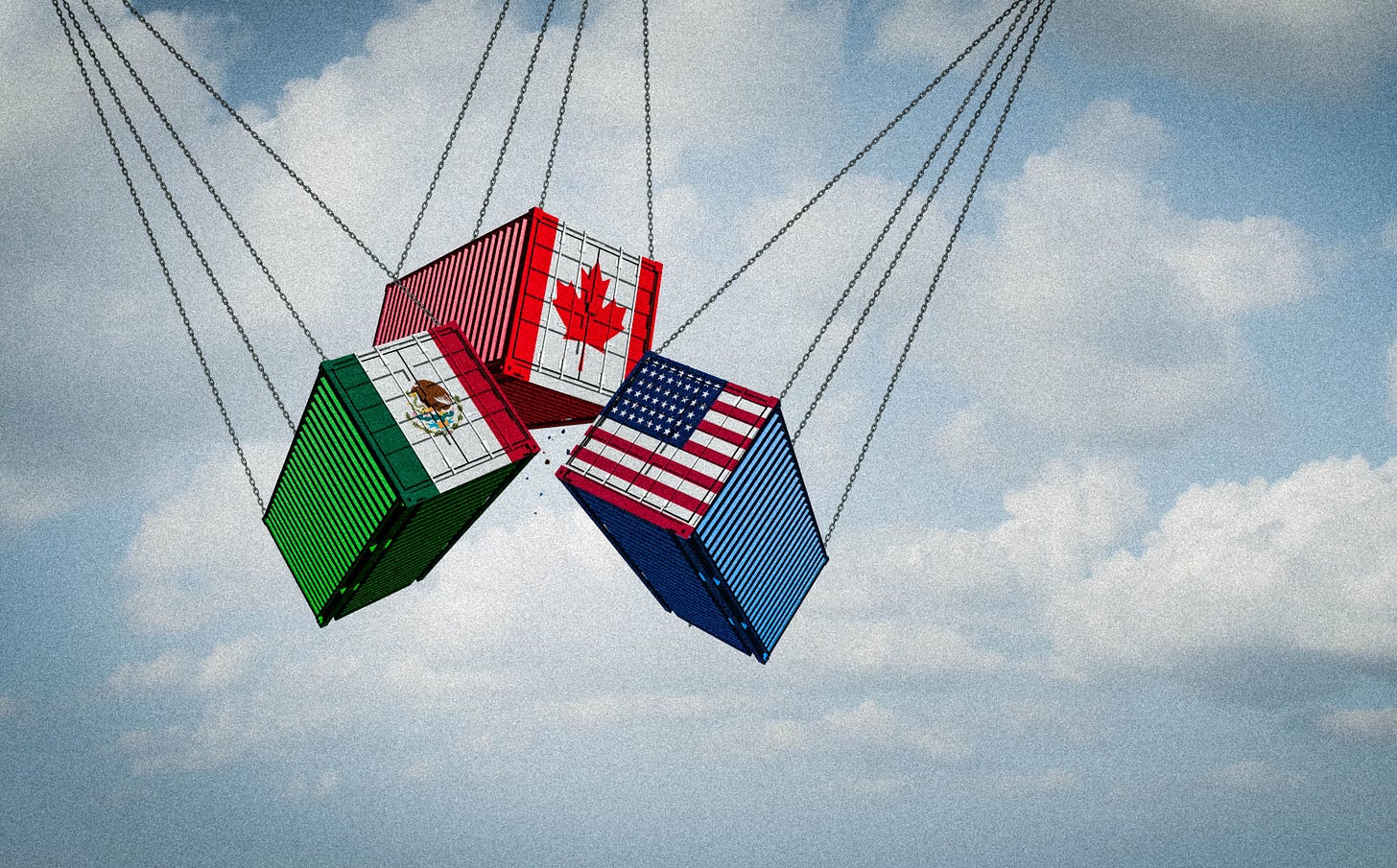
- With USMCA renewal stalled past 2026 and China routing goods through Mexico and Canada to dodge tariffs, North American supply chains face mounting uncertainty and calls for stricter rules.
Tariff Power Shrinks, Legal Risks Rise
The Supreme Court’s crackdown on emergency tariffs forces the U.S. to rely on narrower, legally vulnerable trade measures, triggering a wave of targeted lawsuits and ongoing uncertainty for importers.
The Supreme Court's landmark 6-3 decision in Trump v. CASA Inc. fundamentally curtailed presidential tariff authority by ruling that President Trump exceeded his powers under the Federal Emergency Power Law (IEEPA) to impose broad reciprocal tariffs, including those targeting Mexico and China. This ruling not only invalidated the emergency-powers tariffs but also limited federal courts from issuing universal injunctions, requiring plaintiffs to demonstrate specific, traceable harm to gain standing—a shift that has forced legal challenges to become more targeted and economically concrete, as evidenced by a coalition of 25 states alleging direct injury from forced labor tariffs.
In response to judicial setbacks, the Trump administration pivoted to alternative legal mechanisms, notably invoking less common provisions such as Section 338 of the 1930 Tariff Act and Section 122 of the Trade Act of 1974. The latter allowed imposition of a 15% global tariff for 150 days, exempting critical goods like semiconductors and USMCA-compliant imports from Canada and Mexico, reflecting a strategic narrowing of tariff scope. However, these new tariffs face ongoing legal challenges from US importers, threatening their sustainability and highlighting the contested nature of the administration’s tariff regime.
The administration’s tariff strategy has evolved toward more narrowly tailored investigations under Section 301 of the Trade Act of 1974, targeting major trading partners including China and the EU on issues such as industrial excess capacity, forced labor, pharmaceutical pricing, and digital taxes. This approach signals a shift from broad, sweeping tariffs to focused, evidence-based trade actions that require lengthy investigations but may better withstand judicial scrutiny and political pressures, especially amid midterm elections and concerns over the cost of living.
Uncertainties loom over the financial fallout from the Supreme Court’s invalidation of IEEPA-based tariffs, particularly regarding whether importers are entitled to refunds for duties collected, with potential reimbursement costs estimated up to $170 billion. The Court left this issue unresolved, delegating it to lower courts and individual lawsuits, thereby creating prolonged legal and financial ambiguity for affected companies and complicating the broader trade policy landscape. Concurrently, legislative efforts, such as the Senate’s passage of a bill broadening executive tariff authority to include Russia and China, underscore ongoing attempts to navigate and possibly expand tariff powers within the constrained judicial environment.


Canada’s High-Stakes Trade Gamble
Ottawa’s sector-specific concessions and new economic ‘war room’ strategy face fierce criticism for risking sovereignty and exposing billions in exports amid U.S. tariff pressure.
Canada’s trade negotiation strategy with the U.S. hinges on carefully calibrated sector-specific concessions aimed at securing durable, enforceable relief from tariffs while preserving privileged market access. Recognizing the strategic importance of economic intelligence and advocacy, Canadian officials have proposed establishing a permanent economic security war room within the Privy Council Office, leveraging regional consulates to build coalitions in American congressional districts most affected by tariffs. This approach reflects a sophisticated blend of targeted diplomacy and economic statecraft designed to counteract U.S. tariff nationalism by highlighting the domestic American job losses and supply chain disruptions caused by tariffs.
Internally, Canada confronts the dual challenge of managing its vast regional economic diversity and dismantling domestic trade barriers to strengthen its bargaining position. Prime Minister Mark Carney has emphasized national unity in the face of Washington’s understanding of Canada’s regional divisions, declaring a collective commitment to support the economy. Meanwhile, industry voices such as Ryan Mallough of the CFIB stress that reducing internal trade obstacles and facilitating labor mobility across provinces are critical to enabling Canadian exporters to pivot toward domestic markets amid tariff-induced uncertainty and revenue losses, particularly in manufacturing hubs like Ontario and Quebec.
Despite these strategic efforts, Canada’s current trajectory toward an interim trade deal with the U.S. has drawn sharp criticism for appearing to concede extensively to American demands while most tariffs remain in place. Critics like Jen Gerson argue that this approach represents a form of strategic surrender that undermines Canadian sovereignty and risks positioning the country as a vassal state to U.S. tariff nationalism. This perceived capitulation contradicts the resistance mandate given to Prime Minister Carney, who was elected on a platform of sacrifice and opposition to economic aggression, highlighting a tension between pragmatic negotiation and national resolve.
The complexity of Canada-U.S. tariff negotiations is underscored by the selective targeting of over 500 Canadian product categories—including dairy, alcohol, antiques, and electronics—with threatened 50% tariffs that could devastate sectors responsible for roughly $20 billion in exports. However, Canadian negotiators have leveraged strategic economic dependencies, such as the U.S. reliance on Canadian oil and potash, which were notably exempted from tariffs. This pragmatic calculus, as articulated by Carney, accepts negotiating potentially flawed deals to mitigate economic damage, even amid concerns about the reliability of the U.S. administration’s commitments and the broader structural challenges posed by tariffs piercing the protections of the Canada–United States–Mexico Agreement (CUSMA).

USMCA Uncertainty Disrupts Supply Chains
Annual reviews and Chinese tariff evasion through Mexico and Canada are destabilizing North American trade, threatening investment and fueling calls for tougher rules beyond the auto sector.
The US decision in July 2026 to decline the automatic 16-year renewal of the USMCA agreement with Canada and Mexico has introduced significant uncertainty into North American trade relations, triggering an annual review process that extends negotiations into 2027. This approach complicates long-term business planning, as companies face a 'hanging over' effect that discourages capital investments and supply chain commitments amid fears the agreement could be terminated at any review. Moreover, the administration's frequent use of tariffs as a foreign policy tool exacerbates unpredictability, raising concerns about the future effectiveness and strategic value of USMCA in a shifting global trade landscape.
A critical challenge undermining USMCA's integrity is China's strategic exploitation of tariff-free access by routing goods through Mexico and Canada, effectively bypassing US tariffs. Chinese producers have invested heavily—over $15 billion across 200 projects in Mexican states closely linked to the US market—to assemble inputs that qualify for tariff-free treatment under USMCA, a loophole described as a 'back door' that allows China to reap NAFTA-like benefits without formal participation. While autos face some content-based restrictions, other sectors remain vulnerable, prompting calls to tighten USMCA rules beyond automobiles to close these gaps and protect American industries from tariff evasion.
The automotive sector exemplifies the complex tensions within USMCA revisions, where Detroit automakers warn that proposed increases in US-made content requirements—from 50% for vehicles and raising North American content thresholds to 92%—could add at least $2 billion annually per company, eroding competitiveness. Ironically, these rules penalize deeply integrated North American supply chains, benefiting foreign automakers producing locally in the US South who face lower tariff exposures. Ford's recent decision to onshore production of the Lincoln Nautilus, citing tariff pressures, signals a strategic adaptation and possibly a negotiating tactic aimed at influencing Washington's trade stance amid ongoing USMCA renegotiations.



Export Controls Undercut U.S. Edge
Export licensing delays and broad restrictions are costing American firms billions, eroding global market share, and accelerating China’s competitive gains in critical industries.
The Trump administration’s export-control licensing regime has inflicted significant economic harm on American firms by causing months-long delays that cost the U.S. billions in exports and erode global market share. Despite these setbacks, the controls have failed to deliver strategic national security benefits, as many restricted items are already accessible in China from domestic or international suppliers, effectively sidelining U.S. companies without advancing security objectives.
Lengthy export license reviews have become a critical bottleneck, with two-thirds of applications pending beyond the statutory 90-day limit and nearly a third languishing for one to two years. This protracted processing, coupled with the Bureau of Industry and Security’s (BIS) decline in throughput—handling 20% fewer applications in 2025 than in 2023 and extending average review times by 24 days—has eroded business confidence, leaving only 30% of companies trusting that BIS adheres to established procedures and timelines.
These export controls have undermined U.S. competitiveness and innovation by enabling Chinese rivals to capture lost sales and market share, with 73% of surveyed firms reporting lost sales to Chinese competitors and 64% noting diminished market presence in China. This erosion of commercial footholds directly diminishes the resources American companies can allocate to research and development, thereby weakening the broader economic security and technological leadership of the United States.