Crypto war bets fuel insider-trading crackdown
The gist
Crypto prediction markets are igniting a firestorm of insider trading and national security risks, forcing regulators and Congress into a frantic scramble to contain the fallout.
What to know
- Army Sgt. Gannon Ken Van Dyke allegedly used classified intel to place a $400,000 bet on Polymarket predicting Nicolás Maduro's capture, exposing severe security vulnerabilities.
- Regulators like the CFTC and DOJ are cracking down on insider trading while Congress debates the bipartisan DEATH BETS Act to ban war and geopolitical event betting outright.
- High-profile scandals and political entanglements—including Donald Trump Jr.'s advisory role—are delaying legal clarity and fueling urgent calls for stricter oversight of $7.5B+ prediction markets.
Insiders Rig Crypto Markets
Crypto prediction platforms like Polymarket have become epicenters for weaponizing classified intelligence and exploiting regulatory loopholes, fueling a new era of high-stakes insider trading and market manipulation.
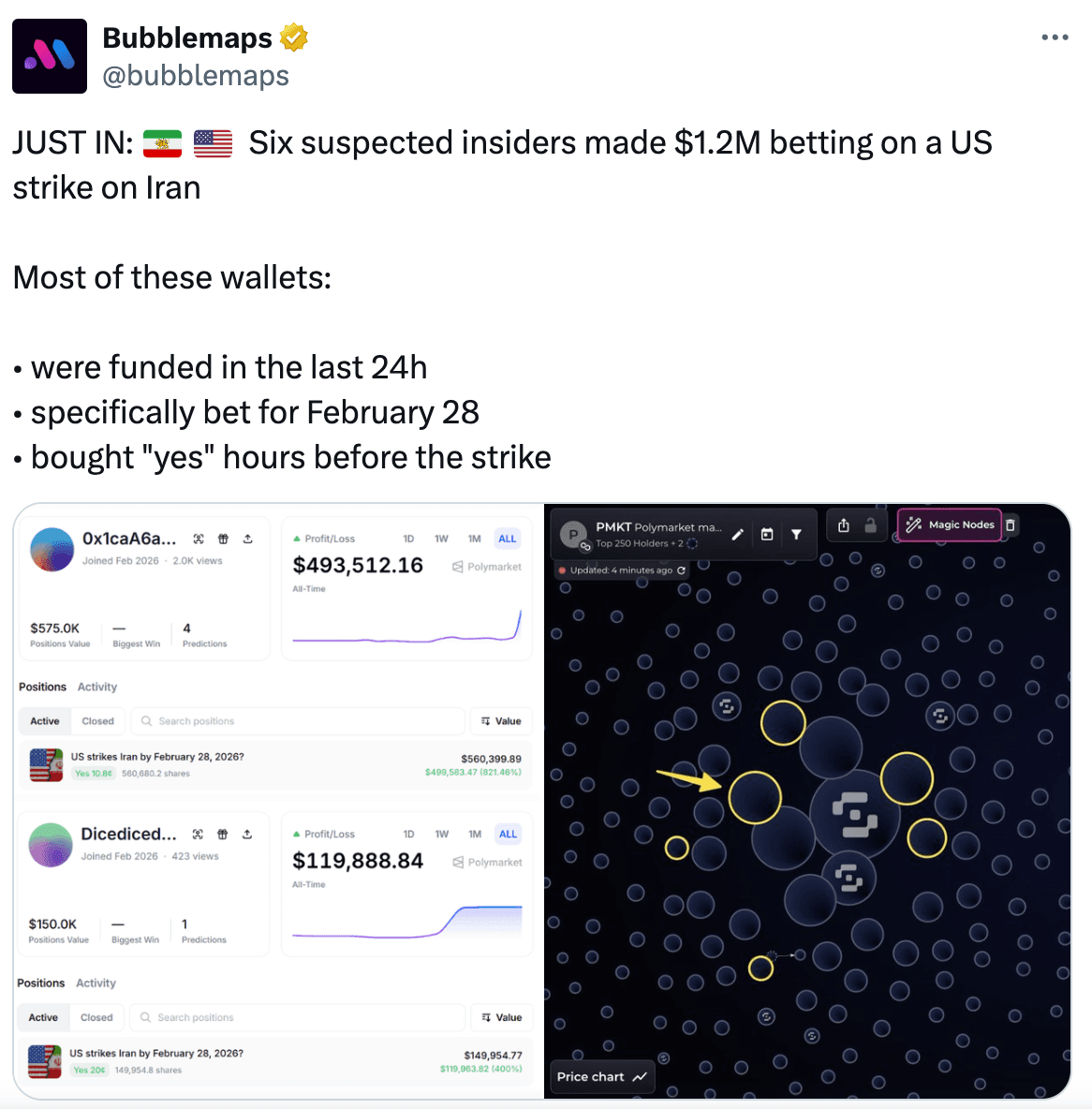
By early 2026, crypto prediction markets like Polymarket have become hotbeds for insider trading and market manipulation, particularly involving sensitive geopolitical events. A striking example is the arrest of Army Sgt. Gannon Ken Van Dyke, who allegedly exploited classified military intelligence to place a $400,000 bet on Polymarket predicting the capture of Nicolás Maduro, underscoring how privileged information is weaponized for financial gain. This scandal, alongside other suspiciously timed bets that appear to front-run U.S. military actions such as strikes on Iran, reveals a troubling pattern where insiders leverage confidential knowledge to profit amid weak regulatory oversight and enforcement.
The insider trading issues on platforms like Polymarket are exacerbated by their anonymous, high-stakes crypto bets on volatile geopolitical events, which not only shake public trust but also fuel calls for stricter regulation. Despite Polymarket’s transparent blockchain ledger exposing suspiciously timed trades and aiding prosecutions, Congress is moving toward banning war betting markets altogether, reflecting deep ethical concerns and the blurred line between savvy analysis and outright manipulation. Meanwhile, Kalshi faces its own legal battles amid a complex federal-state regulatory clash, highlighting the broader governance vulnerabilities in this rapidly institutionalizing sector.
The scope and scale of these markets have ballooned, with Polymarket reaching explosive volumes exceeding $7.5 billion, transforming them into highly efficient yet perilously vulnerable barometers of geopolitical risk. This rapid growth invites not only sophisticated insider trading but also low-tech manipulations—such as a user artificially spiking a temperature sensor to win a $34,000 weather bet—illustrating the multifaceted threats to market integrity. As these platforms straddle the volatile intersection of geopolitics, technology, and finance, the risk of insider leaks and exploitation threatens to erode public confidence and trigger intensified regulatory crackdowns.






Regulators Face Legal Crossfire
A fragmented enforcement landscape and mounting political conflicts are stalling decisive action as Congress and federal agencies battle over how—and whether—to rein in the explosive growth of war betting markets.
By early 2026, regulatory scrutiny of crypto prediction markets like Polymarket and Kalshi has intensified significantly, with agencies such as the Commodity Futures Trading Commission (CFTC) and the Department of Justice (DOJ) ramping up enforcement actions against insider trading. The CFTC has issued formal advisories following insider trading cases, including a $20,000 fine imposed by Kalshi, while Polymarket has introduced enhanced market integrity rules to combat abuses. This increased oversight follows high-profile scandals, such as the indictment of an Israeli Air Force reservist betting on classified war information, which have galvanized Congress and regulators to demand greater transparency and compliance from these platforms.
Legislative efforts are coalescing around banning war and geopolitical event betting on crypto prediction markets, driven by moral concerns and national security risks highlighted by insiders like Congressman Mike Levin. Levin’s DEATH BETS Act exemplifies bipartisan momentum to outlaw wagers on war, death, and assassination, citing threats to journalists and the potential endangerment of American service members. Despite this, political gridlock persists, partly due to conflicts of interest such as Donald Trump Jr.'s advisory role with Polymarket, which critics argue has contributed to regulatory inertia within the CFTC during the Trump administration.
The evolving regulatory landscape is further complicated by jurisdictional battles and legal challenges that pit state authorities against federal regulators and prediction market operators. Lawsuits filed by the New York Attorney General against Coinbase and Gemini for alleged violations of state gambling laws underscore the fragmented enforcement environment, while the Ninth Circuit Court’s recent skeptical hearing on the CFTC’s regulatory claims signals potential upheaval. These disputes delay regulatory clarity but also set important legal precedents that could ultimately define the scope of federal oversight and legitimize or restrict crypto prediction markets nationwide.
The regulatory debate over crypto prediction markets balances on a knife-edge between legitimization through clearer rules and the risk of driving trading volume offshore or into decentralized platforms. Draft legislation under consideration could impose CFTC registration requirements on continuous-trading contracts related to political and geopolitical events, potentially classifying them as derivatives. While such regulation might invite institutional participation and enhance market integrity, critics warn that overly stringent rules could fragment liquidity and stifle innovation, echoing broader tensions in crypto regulation where platforms like Kalshi strive for compliance, whereas Polymarket operates largely offshore to evade constraints.




War Bets Threaten Security Ethics
Insider scandals and political entanglements have exposed how crypto markets for war and assassination bets undermine national security, spark ethical crises, and provoke bipartisan outrage demanding a total ban.
The intersection of crypto prediction markets and national security has become alarmingly fraught as insider trading scandals reveal the exploitation of classified military intelligence for financial gain. Notably, the Department of Justice indicted a special operations soldier at Fort Bragg who allegedly used nonpublic information about a planned operation against Nicolás Maduro to earn over $400,000 on Polymarket, highlighting a direct threat to American service members and national security. Congressman Mike Levin has responded by championing the Death Bets Act, aiming to ban war-related betting markets to prevent such insider threats and uphold ethical standards in these volatile platforms.
High-profile geopolitical statements, such as former President Trump's vague claim that the Iran war would end “very soon,” have raised concerns about whether such remarks serve as market-moving signals exploited by crypto prediction markets like Polymarket. Critics question who profited from these announcements and whether regulators should classify these actions as manipulation or a novel form of insider trading, underscoring the blurred line between public information and market exploitation. This dynamic intensifies ethical dilemmas and amplifies national security risks by potentially incentivizing the premature disclosure or strategic use of sensitive information.
Lawmakers and regulators are increasingly vocal about the profound ethical and security implications of betting on war, death, and assassination through crypto prediction platforms. Congressman Mike Levin and former SEC Chair Gary Gensler have highlighted glaring regulatory gaps and moral concerns, with Levin condemning war betting as inherently immoral and advocating for bipartisan legislative action to ban it outright. The lack of effective enforcement, exemplified by the CFTC's perceived inaction and conflicts of interest—such as Donald Trump Jr.'s advisory role at Polymarket—further undermines market integrity and public trust, inviting more aggressive crackdowns amid rising bipartisan scrutiny.
Beyond the direct financial and security risks, insider trading on war-related prediction markets fosters dangerous incentives that threaten journalists and the broader information ecosystem. For instance, a reporter covering the Iran war was reportedly threatened by an individual who had placed a sizable bet and sought a different narrative to prevail, illustrating how these markets can distort incentives and endanger free press. Without stronger oversight and technical safeguards, such platforms risk eroding public trust and invite intensified regulatory intervention, as the line between savvy market analysis and exploitation of insider information becomes increasingly blurred.