Crypto’s $330b crash: bitcoin buckles as AI stocks steal the spotlight
The gist
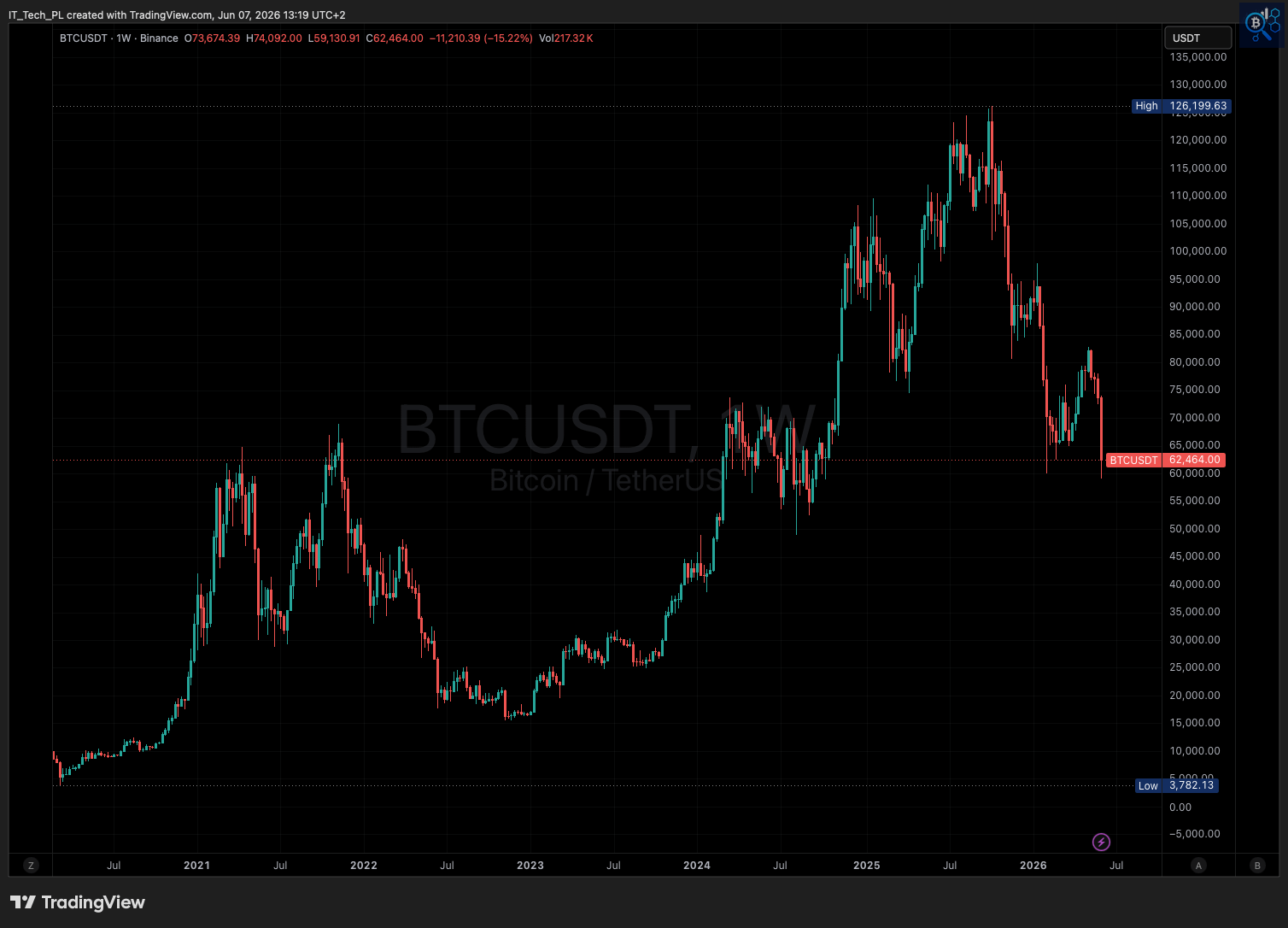
Crypto markets have been rocked by a $330 billion wipeout as Bitcoin plunges below $60,000 and investors stampede into soaring AI and semiconductor stocks.
What to know
- Rising US Treasury yields above 4.6% and escalating Middle East turmoil triggered over $10 billion in Bitcoin ETF outflows and $2 billion in forced liquidations since March.
- Bitcoin crashed through key support levels ($73K, $67K), sparking cascading liquidations up to $1.8 billion per event and dragging the entire crypto market down over 20%.
- With tech stocks surging 42% in two months, capital is fleeing crypto—leaving IPOs stalled, memecoins halved, and the Fear and Greed Index flashing extreme panic at 18.
Macro Storms Hit Crypto
Surging oil prices, Middle East turmoil, and relentless Treasury yield hikes have triggered massive outflows from Bitcoin ETFs and fueled a wave of forced liquidations, overwhelming even positive regulatory news.
By early 2026, cryptocurrencies faced mounting macroeconomic headwinds as elevated interest rates, cautious global growth outlooks, and renewed geopolitical tensions fostered a defensive stance among investors. This environment pressured risk assets broadly, with Bitcoin spot ETFs in the US experiencing significant outflows totaling approximately $1.8 billion, signaling waning marginal demand amid growing risk aversion.
The surge in oil prices, driven by escalating Middle East conflicts—particularly involving Iran and the Strait of Hormuz blockade—combined with rising US Treasury yields, intensified inflation concerns and tightened financial conditions. For instance, Brent crude futures jumped nearly 2% to $111.42 per barrel, while the 10-year Treasury yield climbed above 4.6%, contributing to Bitcoin’s sharp decline from $82,000 to below $77,000 within days and triggering over $580 million in leveraged liquidations.
Despite positive regulatory developments like the Senate Banking Committee’s approval of the CLARITY Act, macroeconomic and geopolitical pressures continued to dominate, undermining leveraged crypto positions and fueling bearish sentiment. Market participants anticipated limited Federal Reserve intervention amid worsening inflation and oil shocks, further dampening capital flows into cryptocurrencies and prompting a reversal of prior ETF inflows with $1 billion in net outflows over a single week.
Throughout mid-2026, the growing correlation between cryptocurrencies and traditional technology stocks became evident as a Nasdaq tech selloff sparked a $100 billion crypto market rout, with Bitcoin, Ethereum, and XRP falling 4-5%. This contagion was exacerbated by ongoing geopolitical tensions, notably stalled U.S.-Iran negotiations and renewed military threats, which strengthened the U.S. dollar and pushed investors toward safe havens, thereby intensifying market uncertainty and pressuring crypto assets as risk-on instruments rather than inflation hedges.
Deleveraging Wipes Out Billions
A cascade of forced liquidations erased over $330 billion from crypto markets as excessive leverage unraveled, exposing the fragility of speculative bets and leaving no sector unscathed.
Beginning in late March 2026, the crypto market experienced a massive deleveraging wave triggered by excessive leverage and critical liquidation price points, notably around $55,000 for Bitcoin and $1,400 for Ethereum. This forced unwind led to over $2 billion in liquidations within days, predominantly from long positions on derivative-heavy exchanges, as traders scrambled amid a broader global risk-off rotation that drained marginal demand, including significant Bitcoin ETF outflows totaling approximately $1.8 billion. Despite the severity, analysts viewed this as a necessary technical correction that cleansed speculative excess and lowered funding rates, potentially stabilizing the market for future moves.
Throughout May and early June 2026, the liquidation cascades intensified with multiple $700 million to $1.8 billion sell-offs across major cryptocurrencies including Bitcoin, Ethereum, XRP, and Solana, often triggered by Bitcoin breaching critical support levels such as $73,000 and later $67,000. These events were closely tied to macroeconomic pressures like adverse US inflation data and rising Treasury yields, which dampened risk appetite and forced deleveraging despite recent regulatory wins like the Senate Banking Committee's approval of the CLARITY Act. The sell-offs coincided with a sharp capital rotation away from crypto towards traditional tech stocks, further exacerbating liquidations and driving Bitcoin to nine-week lows with over $1.5 billion in BTC longs vaporized.
By early June, the crypto market faced a broad-based forced deleveraging event marked by uniform losses across infrastructure, DeFi, and AI sectors, with Bitcoin breaking below key support zones last seen before the 2024-2025 bull market peak. This triggered a sharp market structure reset, erasing over $330 billion from total market capitalization in a single week and intensifying fear sentiment. The liquidation cascades were compounded by record ETF outflows—nearly $10 billion in a single day—pressuring spot volumes and repricing the market, while dominance metrics confirmed a bearish environment with no emerging sector leadership, underscoring the depth and breadth of the deleveraging.
Late June saw continued volatility with over $1 billion in liquidations across Bitcoin, Ethereum, and XRP amid a $10 billion Bitcoin options expiry, intensifying forced deleveraging and market instability. Notably, Michael Saylor’s openness to Bitcoin sales amid this turbulence signaled potential further deleveraging by prominent holders, which could exacerbate liquidation cascades. The futures market alone saw liquidations exceeding $300 million, highlighting the persistent impact of high leverage and forced position unwinds. Traders were urged to exercise heightened caution as these liquidation earthquakes underscored elevated volatility and risk in the crypto ecosystem.



Altcoins Face 'Altpocalypse'
Memecoins and altcoins suffered brutal losses, with panic-driven sell-offs and uniform declines signaling that forced unwinds—not sector rotation—drove the crypto market’s historic plunge.
Throughout April to early June 2026, the crypto market endured a pronounced downturn marked by steep price declines across major cryptocurrencies. Bitcoin fell from highs above $82,000 in mid-May to below $67,000 by early June, breaking critical support levels such as the 50-day exponential moving average and the $73,000 and $68,000 thresholds, while Ethereum and altcoins like Solana retraced recent rallies, with ETH dropping nearly 10% in a single week. This sell-off was exacerbated by massive liquidations totaling over $1 billion within 24-hour periods, driven by macroeconomic shocks including rising US Treasury yields and geopolitical tensions, such as President Trump's warning on Iran, which triggered $580 million in overnight liquidations. The market capitalization plummeted by hundreds of billions, reflecting a broad-based deleveraging rather than sector rotation, as evidenced by uniform losses across top coins and declining Bitcoin dominance.
By mid to late June, the crypto market faced intensified selling pressure, with Bitcoin plunging below $60,000 for the first time since October 2024, marking a 20-month low and erasing gains made post-2024 election. This period saw a rare back-to-back quarterly decline for Bitcoin, with Q2 losses compounding Q1’s 22% drop, challenging traditional four-year cycle expectations. Ethereum and other altcoins underperformed Bitcoin, with ETH down 25% for the quarter and memecoins like Dogecoin and XRP posting double-digit weekly losses. Market sentiment reached extreme fear levels, reflected in a Fear and Greed Index reading of 18, while ETF outflows hit record highs, including a single-day $10 billion withdrawal led by IBIT. The sell-off was further intensified by forced deleveraging events, including MicroStrategy’s token sale and Mt. Gox wallet movements, driving over $1 billion in liquidations within a week.
Memecoins and altcoins bore the brunt of the market’s volatility, with sectors showing little resilience amid the broad sell-off. Memecoins like FARTCOIN plunged over 16% in a day and dropped 58% over 30 days, while Dogecoin and Shiba Inu lost key support levels, approaching oversold conditions. Altcoins’ total market capitalization fell below $900 billion twice within 24 hours, signaling panic and raising fears of an 'Altpocalypse.' Despite this, isolated pockets of strength emerged in select AI and real-world asset projects, though these gains were limited to low-cap outliers without meaningful sector rotation. The overall market heatmap was overwhelmingly red, indicating uniform losses across infrastructure, DeFi, and AI sectors, underscoring that the recent price action was driven by forced deleveraging rather than an orderly correction.
The crypto market’s price declines and technical breakdowns have increasingly mirrored broader macroeconomic and geopolitical dynamics, with growing integration into traditional equity market sentiment. Bitcoin and Ethereum’s slide in late June coincided with a Nasdaq tech selloff, underscoring heightened correlation between crypto and tech equities amid risk-off sentiment driven by hawkish Federal Reserve policies and geopolitical uncertainties such as U.S.-Iran tensions. This divergence from prior cycles, where Bitcoin often moved independently or in tandem with equities, has traders closely monitoring Nasdaq and tech indices for crypto market direction. Analysts highlight critical support levels near $60,000 for Bitcoin as pivotal for future price action, with the market’s sensitivity to external shocks reflected in rapid liquidations and ETF outflows amid a shifting investor focus toward sectors like semiconductors and AI.

AI Stocks Eclipse Crypto
Investor money is fleeing the crypto sector for AI and semiconductor stocks, as stalled IPOs and a preference for tangible growth leave digital assets struggling for relevance.
By mid-2026, investor enthusiasm for cryptocurrencies has noticeably cooled, with capital increasingly rotating toward traditional technology sectors such as artificial intelligence and semiconductors. This shift is largely driven by the clearer growth trajectories and stronger fundamentals offered by these industries, as evidenced by the stalling of the crypto IPO market in July 2026 amid rising macroeconomic uncertainty. Investors appear to be favoring sectors where innovation is paired with tangible earnings and more predictable regulatory environments, signaling a strategic pivot away from the volatility and speculative nature of crypto assets.
Crypto Now Moves With Wall Street
Bitcoin’s price swings are increasingly dictated by macroeconomic shocks and equity market rotations, cementing its status as a high-beta risk asset rather than an inflation hedge.
By mid-2026, Bitcoin and other crypto assets have become increasingly sensitive to traditional macroeconomic factors, such as rising US Treasury yields and geopolitical tensions, which have exerted downward pressure on prices. For instance, Bitcoin fell from $82,000 to below $77,000 as the 10-year Treasury yield surged to 4.6%, while geopolitical events like U.S.-Iran strikes and oil price spikes further tightened inflationary pressures, limiting Federal Reserve rate cut flexibility and dampening capital flows into risk assets including crypto and tech stocks. This evolving dynamic underscores how cryptocurrencies now behave more like risk assets correlated with equities rather than inflation hedges, as seen in Bitcoin's simultaneous decline with tech giants like Apple and Microsoft amid these macro risks.
ETF flows have played a pivotal role in reflecting and amplifying the cross-asset liquidity dynamics between crypto and traditional markets. After a six-week inflow streak, Bitcoin spot ETFs experienced a record-breaking 10 consecutive days of net outflows totaling nearly $3 billion by early June, signaling a significant withdrawal of institutional liquidity from crypto. This liquidity drain coincided with capital rotating into the stock market, particularly into semiconductor and AI-driven tech stocks, which surged 42% over two months, marking the biggest gain in 24 years. Such ETF-driven shifts highlight how investor appetite is increasingly bifurcated, with crypto becoming a 'contrarian bet' as AI stocks 'suck all the oxygen out of the room,' according to Bitwise CIO Matt Hougan.
The correlation between crypto assets and traditional equities has fluctuated, with periods of divergence followed by renewed synchronization driven by macro risk repricing and sector rotations. Notably, by early June, Bitcoin decoupled from the Nasdaq, plunging below $66,000 while tech stocks and AI-related trades hit record highs, reflecting a sector rotation away from crypto toward semiconductors and AI. However, by late June, a selloff in Nasdaq tech stocks triggered a $100 billion crypto market rout, dragging Bitcoin, Ethereum, and XRP down in tandem with equities. This pattern reveals that while crypto can temporarily diverge due to investor sentiment shifts, broad risk-off sentiment and equity volatility remain key drivers of crypto prices, with traders increasingly monitoring Nasdaq movements to gauge crypto market direction.
Investor sentiment across both crypto and traditional markets remains cautious amid ongoing macroeconomic uncertainties, liquidity challenges, and geopolitical tensions. The fear and greed index signals extreme fear as markets grapple with hawkish Federal Reserve policies, a strong dollar, and escalating Middle East conflicts, all of which simultaneously pressure crypto and tech equities. Futures traders are actively reducing risk exposure due to Fed policy concerns, raising questions about the sustainability of recent rallies in Bitcoin and AI stocks alike. This synchronized repricing of macro risk and liquidity conditions underscores the growing interconnectedness of crypto and traditional asset classes, where volatility in one market increasingly reverberates across the other.





Fear and Caution Dominate
With sentiment at extreme lows, regulatory limbo, and no clear catalyst in sight, the crypto market remains stuck in a defensive crouch—yet history hints that the next uptrend may be quietly brewing.
By early 2026, investor sentiment in the crypto market remained deeply cautious and predominantly bearish, with Bitcoin trading around $67,500—46% below its all-time high—and volatility having normalized without sparking a rebound. This cautious risk appetite is compounded by persistent regulatory uncertainty, notably the Clarity Act lingering in legislative limbo, and geopolitical tensions that continue to weigh heavily on confidence, as highlighted by ongoing macro risk-off rotations and over $2 billion in liquidations since late March. Despite these headwinds, there remains a cautiously optimistic long-term view that Bitcoin will not collapse to zero, underscoring a belief in the asset's fundamental resilience amid turbulence.
The crypto market's challenges to recovery are further intensified by sustained outflows from Bitcoin ETFs—totaling approximately $1.8 billion in recent weeks—and a defensive macroeconomic backdrop marked by prolonged high interest rates, global growth concerns, and renewed geopolitical risks such as potential military actions against Iran. These factors have driven significant deleveraging and liquidations, including a $563 million forced liquidation event in mid-May and $730 million wiped out within 24 hours by early June, which, while painful, may paradoxically help stabilize the market by cleansing speculative excess and improving technical conditions. Nevertheless, the absence of clear catalysts—whether regulatory clarity, new technological narratives, or market exhaustion—continues to suppress risk appetite and delay a meaningful rebound.
As mid-2026 progressed, investor sentiment remained fragile, reflected in a Fear and Greed Index plunging to 18—signaling Extreme Fear—and Bitcoin approaching critical support levels near $62,000. This precarious state is exacerbated by hawkish Federal Reserve policies under Kevin Warsh, a strong U.S. dollar, and looming regulatory pressures such as the European MiCa deadline, which collectively suppress appetite for risk assets. Concurrently, capital is rotating into traditional tech sectors, particularly semiconductor and AI stocks benefiting from an AI boom, further diverting investment away from crypto. Yet, historical patterns offer a glimmer of hope: previous instances of back-to-back red six-month Bitcoin candles in 2018 and 2022 preceded multi-year uptrends, suggesting that a catalyst could still emerge to stabilize or reverse the current downtrend.