CSL’s $5b write-down, CEO exit fuel historic 57% share crash—analysts split on recovery odds
The gist
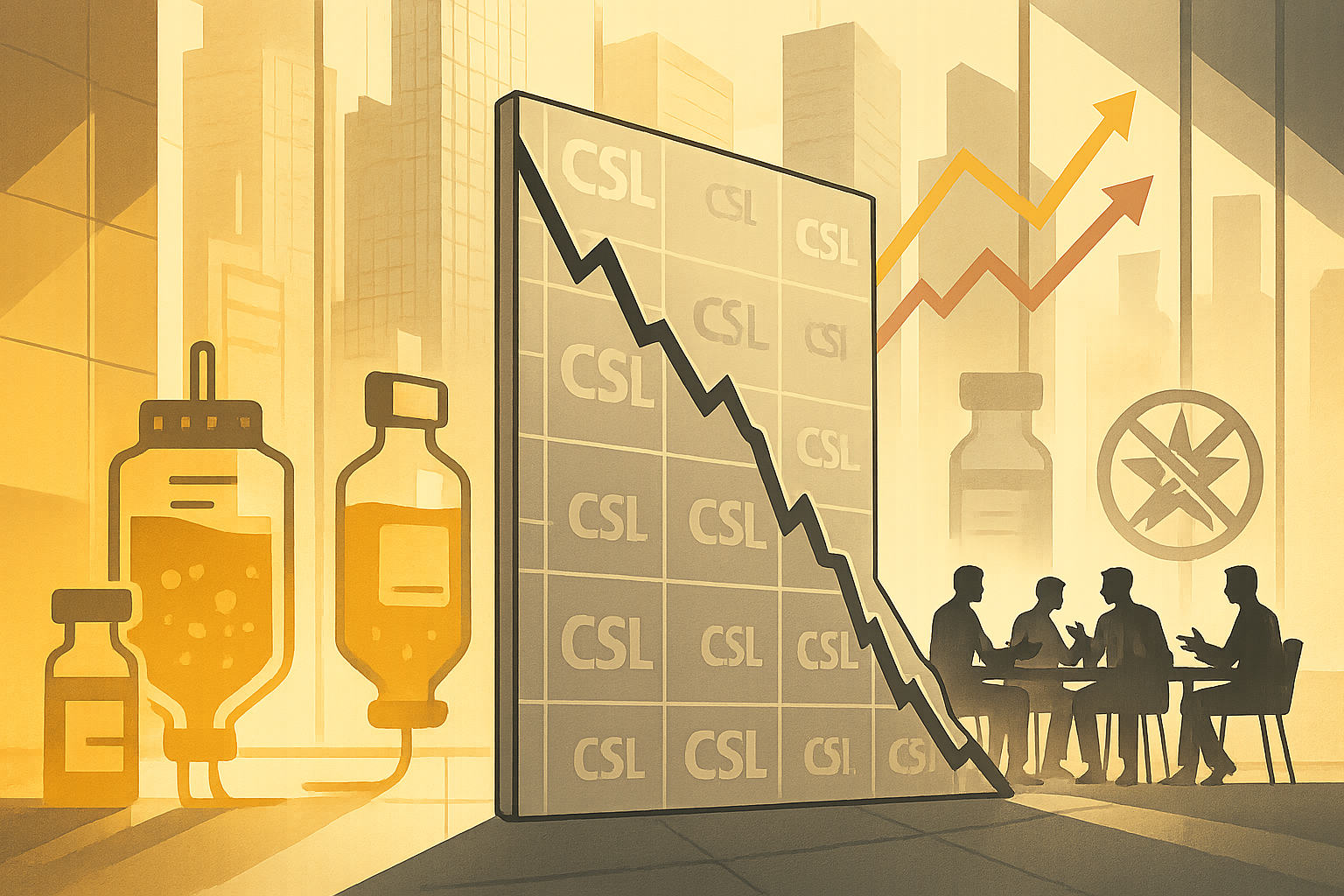
CSL’s $5 billion write-down, CEO exit, and a 57% share price crash have shattered investor confidence and sparked fierce debate over whether the biotech giant can recover from its historic slump.
What to know
- A shock downgrade to FY26 guidance and sudden CEO exit triggered a 16% share price collapse, capping a brutal 57% plunge over the past year.
- Analysts have slashed CSL’s valuation targets—some as low as $40—citing US immunoglobulin inventory woes, China headwinds, and a massive US$5B Vifor impairment.
- Despite insider selling and management turmoil, some brokers maintain a buy rating, arguing CSL’s plasma franchise and vaccine business could drive a long-term rebound.
Complex Headwinds Crush Valuation
CSL faces a tangled web of operational setbacks, multi-billion dollar impairments, and margin threats, driving its valuation to decade lows and fueling doubts about management’s ability to deliver a turnaround.
Analysts broadly agree that CSL's FY26 guidance downgrade reflects a confluence of operational challenges rather than isolated issues, complicating the recovery trajectory. The company flagged significant revenue impacts including a US$300 million hit from US immunoglobulin inventory normalization, US$200 million from albumin in China, and an additional US$150 million related to Middle East conflicts and competitive pressures, underscoring a multifaceted headwind environment. This complexity has eroded CSL's once-premium valuation, with shares now trading around 12 times estimated FY27 earnings—down sharply from over 30 times—prompting expectations for a more cautious rerating to 18-20 times earnings contingent on execution and delivery.
The substantial impairments tied to the CSL Vifor acquisition, expected to total approximately US$5 billion across FY26 and FY27, have intensified analyst concerns about CSL's capital allocation and strategic execution. This looming impairment burden, coupled with unclear timing of recognition, fuels market skepticism and clouds near-term earnings visibility, as highlighted by Bell Potter's caution regarding the NPATA to statutory NPAT reconciliation. Such financial strain compounds doubts about management stability and the company’s ability to navigate operational setbacks effectively.
Market skepticism is further reinforced by CSL's interim CEO Gordon Naylor's admission that growth initiatives will take longer than anticipated to translate into financial benefits, tempering hopes for a swift turnaround. Bell Potter’s downgrade, which cut FY26 revenue guidance by approximately $750 million (4.7%) and NPATA by $300 million (8.7%), reflects this cautious stance, as does their concern over persistent gross margin weakness at CSL Behring. The combination of market softness, increased competition—exemplified by EU approval of Grifols’ Egyptian plasma supply chain—and ongoing price pressures in the US immunoglobulin market signals a challenging environment for margin recovery.
Reflecting these operational and financial headwinds, analysts have significantly lowered price targets for CSL, with BTIG’s Mark Massaro setting a $40 target and Baird’s Catherine Ramsey at $43, marking a stark contrast to prior valuations. Bell Potter’s sharp reduction of their price target from $155 to $100, while maintaining a Hold rating, encapsulates the tempered investor sentiment driven by earnings declines, management turnover, and credibility issues following repeated disappointments. This consensus of cautious outlooks underscores a market grappling with CSL’s near-term challenges amid hopes for eventual stabilization.


Buy Ratings Defy the Gloom
Despite slashed forecasts and market pessimism, some analysts and investors remain bullish on CSL’s core plasma and vaccine businesses, betting on a long-term recovery amid execution missteps.
Despite CSL's significant FY26 guidance downgrade and CEO departure, Morgans remains steadfast in its buy rating, framing the challenges as primarily executional rather than structural. They highlight issues such as infrastructure overbuild, organisational complexity, and weak commercial execution but emphasize that underlying demand and industry fundamentals remain robust. Positive operational signals, including Seqirus outperforming expectations, mid-to-high single digit immunoglobulin demand, and early signs of plasma market stabilisation, underpin their confidence in CSL's long-term growth trajectory.
While Morgans has lowered its FY26-28 earnings forecasts and trimmed its blended valuation-based target price to A$147.59, it argues that the market is overly discounting CSL’s plasma franchise, which it views as structurally sound. The firm underscores CSL’s global leadership, exposure to structurally growing end markets, and ongoing operational initiatives as key pillars supporting a sustained recovery, justifying the retention of a buy rating despite near-term headwinds.
Beyond institutional analysis, buy-side sentiment reflects cautious optimism, with commentators acknowledging the share price collapse has enhanced CSL’s dividend yield, making it an attractive income play for patient investors. Some suggest a phased investment approach, recommending gradual capital deployment to balance the uncertainty of recovery timing with confidence in CSL’s valuable healthcare assets spanning plasma therapies, vaccines, and specialist medicines. This nuanced stance captures a belief that while executional challenges persist, the core long-term investment case remains intact.
Analyst Downgrades and Insider Sales
A wave of price target cuts and a surge in insider selling underscore deep market skepticism about CSL’s ability to regain its former growth premium anytime soon.
CSL's shares have endured a historic 57% plunge over the past year, culminating in a fresh 52-week low after the company slashed its FY26 guidance to approximately US$15.2 billion in revenue and US$3.1 billion NPATA, down from FY25's US$15.6 billion revenue and US$3.3 billion profit. This dramatic downgrade triggered a one-day 16% share price collapse, underscoring the market's harsh reassessment of CSL's near-term prospects amid operational headwinds.
Reflecting deepening market skepticism, analyst price targets for CSL have been sharply revised downward in recent weeks. UBS’s earlier $205 target is now obsolete following the guidance cut, while more recent forecasts like BTIG’s Mark Massaro setting a $40 target and Baird’s Catherine Ramsey at $43 reveal a significant valuation recalibration from January’s $52 target by Lake Street’s Thomas Flaten. This shift signals a broad consensus that CSL’s operational challenges warrant a more cautious valuation approach.
Adding to the bearish sentiment, insider trading activity over the past six months reveals 61 transactions with a notable skew toward open market sales, suggesting that those with intimate knowledge of CSL’s operations may harbor reservations about the stock’s near-term trajectory. This insider selling acts as a subtle but potent signal of internal caution, reinforcing external analyst downgrades and the broader market’s skeptical stance.
Dividend Appeal Amid Market Pain
CSL’s battered share price has transformed it into a high-yield income play for patient investors, mirroring a broader shift in ASX 200 sentiment as blue-chips reel from macroeconomic headwinds.
CSL shares have plummeted 57% over the past year, hitting a fresh 52-week low amid a significant FY26 guidance downgrade and CEO departure, reflecting deep investor skepticism. This decline is part of a broader market malaise affecting major ASX 200 stocks such as Harvey Norman and Wesfarmers, which have also approached 52-week lows due to macroeconomic pressures like rising interest rates and inflation, underscoring a challenging environment for large-cap Australian equities.
Despite the sharp selloff, some investors view CSL’s depressed share price as a potential buying opportunity, encouraged by brokers like Morgans who argue that the company’s issues are largely executional rather than structural. Morgans’ BUY rating, albeit with a reduced target price of A$147.59, reflects confidence in CSL’s global leadership and growth prospects, suggesting that the current valuation may overly discount the plasma franchise’s long-term viability and industry dynamics.
Investor sentiment toward dividend-paying stocks remains cautiously optimistic amid the market downturn, with companies like Harvey Norman still attracting long-term investors due to historically strong dividend yields despite near-term headwinds. CSL’s dividend investment thesis is similarly evolving; its share price collapse has boosted dividend yield attractiveness, offering income potential while investors await a recovery, though confidence remains fragile and some advocate a gradual investment approach to manage ongoing volatility.
Comparatively, Wesfarmers shares have experienced a more moderate decline and are perceived by analysts as close to fair value, with a consensus one-year target price about 5% above current levels. This relative stability contrasts with CSL’s steep drop and highlights varying degrees of investor confidence across sectors within the ASX 200, reflecting differentiated assessments of structural risks and growth outlooks.