Nvidia tightens AI grip as rivals, supply risks loom

The gist
Nvidia’s AI chip supremacy is under siege as supply chain snarls and powerful tech giants’ custom silicon ambitions threaten to rewrite the rules of the AI hardware game.
What to know
- Nvidia controls over 80% of the AI data-center GPU market, pulling in $75.2 billion in a single quarter despite critical shortages in advanced packaging and memory.
- Skyrocketing demand and supply constraints have pushed H100 GPU rental prices up 20%, but US export bans and ongoing bottlenecks cap Nvidia’s ability to cash in.
- Hyperscalers like OpenAI, Amazon, and Google are building their own chips, while Nvidia fights back by locking in crucial supply deals and shifting to full-stack AI infrastructure to keep customers close.
Nvidia’s Ironclad AI Moat
Nvidia’s dominance is fueled not just by hardware, but by deep software lock-in and relentless supply constraints that let it hike prices even as it hits physical limits.
Nvidia has entrenched itself as the undisputed leader in the AI GPU market, commanding an overwhelming 80-81% share of the data-center segment according to IDC, with its CUDA software ecosystem creating strong lock-in effects that make its GPUs indispensable for AI training and inference across major labs and cloud providers. This dominance is reflected in Nvidia’s staggering $75.2 billion Data Center revenue in Q1 FY2027 alone, which accounts for 60% of the entire AI-compute market size forecasted for 2027, underscoring the company’s central role amid surging AI infrastructure demand.
Despite this commanding market position, Nvidia faces severe supply constraints that sharply limit its ability to scale. Critical bottlenecks persist in advanced packaging capacity—particularly TSMC’s CoWoS technology—and in the availability of High Bandwidth Memory (HBM), a specialized, non-substitutable component integrated directly on or near the AI accelerator chip. CEO Jensen Huang has emphasized that these shortages are a binding constraint on AI industry growth, capping revenue expansion to roughly doubling annually and creating a multi-front supply challenge involving construction delays, labor, permits, and power infrastructure.
These supply limitations have paradoxically bolstered Nvidia’s pricing power, as demand for AI GPUs outpaces supply by a staggering 12 to 1 ratio, according to analyst Dan Ives. This imbalance has driven cloud GPU rental prices up—H100 rentals rose approximately 21% over six months, with even older A100 models increasing by 5%—and contributed to Nvidia’s robust financial performance, including an 85% year-over-year revenue surge and a tripling of net income in Q1 FY2027. However, there remains uncertainty whether hyperscalers like Alphabet, Amazon, and Microsoft will sustain their elevated capital expenditures if supply constraints persist, despite their recent guidance increases partly driven by rising memory costs.
Geopolitical factors further complicate Nvidia’s supply dynamics, as US export restrictions continue to limit shipments to China, with only minimal volumes of the H200 AI chips reaching the market by mid-2026. Meanwhile, the repurposing of Bitcoin miners’ vast GPU infrastructure toward AI workloads adds additional strain on Nvidia’s already tight supply chain, highlighting the multifaceted pressures constraining growth and underscoring the company’s complex position as both the most credible voice on supply bottlenecks and the most insulated player within them.



Hyperscalers Plot Their Escape
Tech giants are racing to build their own chips and adopt open-source tools, threatening Nvidia’s margins as the AI hardware landscape fragments and customer loyalty wanes.
Nvidia's strategic position is increasingly challenged by its heavy reliance on a concentrated customer base of hyperscalers and AI labs such as OpenAI, Amazon, Google, Meta, Microsoft, and ByteDance, many of whom are aggressively pursuing custom silicon projects like OpenAI's Jalapeño, Google's TPU Ironwood, and Amazon's Trainium series to reduce costs and gain pricing leverage. This 'chip independence movement' not only threatens Nvidia's pricing power but also serves as a potent bargaining chip, with customers signaling, 'If you don't cut prices, we'll use our own,' thereby intensifying competitive pressures within the AI chip market.
The erosion of Nvidia's once-impenetrable CUDA ecosystem is accelerating as hardware-agnostic frameworks like PyTorch and open-source toolchains such as DeepSeek lower the barriers for customers to migrate to alternative AI hardware. Innovations like DeepSeek's UE8M0 FP8 format, which triples computation speed and slashes memory usage by up to 75%, combined with the validation of in-house chips through trillions of inference operations at Google and Amazon, have emboldened customers to diversify away from Nvidia GPUs despite the trade-offs in peak performance and stability. This shift transforms Nvidia's moat from an 'impossible to enter' fortress to a 'preferable to stay' ecosystem, forcing Nvidia to respond by deepening integration across chips, interconnects, and system software to maintain customer stickiness.
Competitive dynamics are intensifying as AMD emerges as a formidable challenger, securing substantial multiyear commitments from hyperscalers like OpenAI and Meta, while Broadcom's custom ASICs and customers' own silicon efforts collectively threaten to erode Nvidia's historically high gross margins. This mounting pressure coincides with a diversification of AI hardware procurement, where customers increasingly spread workloads across Nvidia, AMD, AWS Trainium, and bespoke chips, facilitated by AI models like Claude that optimize cross-platform performance and reduce software switching costs. Such fragmentation poses a material risk to Nvidia's profit pool and valuation multiples, especially amid decelerating growth projections.
Beyond competitive and customer concentration risks, Nvidia faces operational vulnerabilities tied to its concentrated supply chain and geopolitical headwinds, including export controls that have effectively barred access to the Chinese AI market and the manufacturing concentration in Taiwan, which represents a single point of failure. Nevertheless, Nvidia leverages its scale to secure critical components—optical parts, TSMC wafers, and HBM memory—through prepayments and strategic stockpiling, reinforcing its supply chain moat. Furthermore, Nvidia's extensive ownership stakes across leading AI companies deepen ecosystem lock-in, partially mitigating customer concentration risks by aligning incentives and reinforcing its dominant market position.

Full-Stack Power Play
By locking in long-term memory deals and delivering end-to-end infrastructure, Nvidia is embedding itself at every layer of the AI stack to outmaneuver rivals and reduce hyperscaler risk.
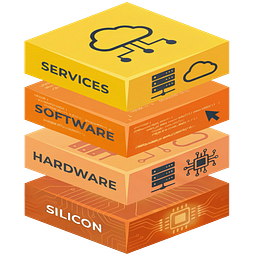
Nvidia is aggressively transforming its business model from a GPU vendor to a full-stack AI infrastructure provider by investing heavily in its supply chain and integrated system offerings. The landmark $500 billion partnership with SK Group exemplifies this strategy, securing long-term supplies of critical high-bandwidth memory from SK Hynix and enabling SK Telecom to become a major AI cloud provider powered by Nvidia’s AI supercomputers. This collaboration not only addresses severe supply bottlenecks in memory and physical infrastructure—land, power, and construction labor—but also creates a strategic loop that tightly integrates computing, memory, and cloud services, reinforcing Nvidia’s dominance and customer lock-in in AI data center ecosystems.
Beyond securing component supply, Nvidia is deepening customer lock-in by shifting from selling discrete GPUs to delivering fully integrated AI rack-scale systems. This pivot is evident in their DSX AI factory model, where Nvidia controls the entire stack—from chips and networking to cooling software—transforming the unit of sale into deployable infrastructure clusters rather than individual silicon units. By embedding its architecture and operational know-how into customers’ AI factories, Nvidia raises switching costs substantially, extending lock-in beyond software like CUDA to the entire operational fabric of AI workloads, a dynamic that especially entangles customers with limited engineering resources.
Nvidia’s evolving ecosystem strategy encompasses broadening its product portfolio and customer base to mitigate dependency risks and sustain growth. The company now offers a comprehensive AI platform that integrates GPUs, CPUs (like the high-performance Vera CPU), DPUs, networking technologies, and software frameworks such as CUDA, supporting over 7,000 accelerated applications. This integrated roadmap through 2028 targets diverse markets including AI labs, enterprises, and AI natives—clients like Anthropic, OpenAI, Eli Lilly, Samsung, Tesla, and TSMC—thereby reducing hyperscaler concentration and embedding Nvidia’s technology deeply across the AI value chain.
To further secure its supply chain and scale AI infrastructure capacity, Nvidia is proactively investing in key suppliers and partners beyond traditional semiconductor manufacturing. Stakes in optical component companies like Lumentum and Coherent, along with collaborations with Foxconn, Quanta, and Wistron to assemble Nvidia-designed server trays, illustrate a hands-on approach to vendor financing and supply chain control. These moves not only alleviate bottlenecks amid surging GPU cloud demand but also reinforce Nvidia’s integrated system approach, enabling tighter control over product design and delivery while countering competitive pressures from custom silicon providers in the inference market.