DeepSeek’s $7b chip bet on inference
The gist
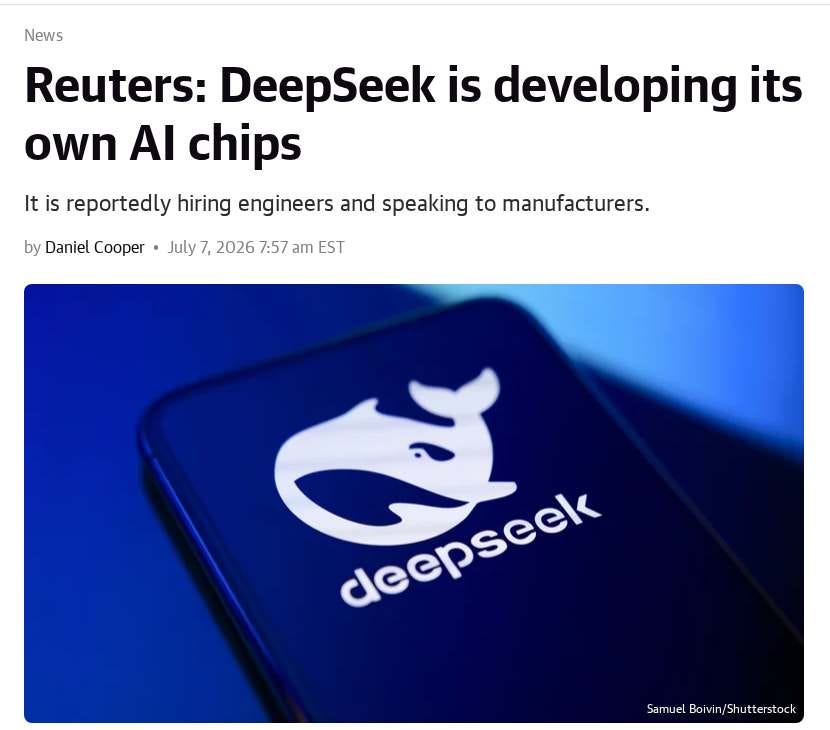
DeepSeek’s blockbuster $7B chip initiative has supercharged China’s AI arms race, igniting a homegrown bid to dethrone Nvidia and secure the nation’s compute future.
What to know
- DeepSeek raised $7 billion to develop proprietary AI inference chips and a custom compiler, aiming to slash reliance on Nvidia and Huawei amid US export controls.
- Half of China’s AI accelerator budgets are now flowing to domestic chipmakers like DeepSeek, Huawei, and Cambricon, powered by a $295 billion government push to hit 80% local tech self-sufficiency within five years.
- Huawei’s Ascend 950 chip now claims to match or beat Nvidia’s flagship GPUs, as DeepSeek and allies race to close the remaining performance gap and rewrite the global semiconductor pecking order.
DeepSeek’s Inference Gambit
DeepSeek is betting big on proprietary inference chips and custom software to break free from Nvidia and Huawei, aiming for full-stack control and lower AI deployment costs in China’s high-stakes chip race.
DeepSeek is making a bold strategic leap by raising $7 billion to develop its own AI inference chip, aiming to break free from reliance on Nvidia and Huawei. This move, which has jolted the competitive landscape of China’s AI hardware market, underscores DeepSeek’s commitment to building a domestic AI chip ecosystem that challenges entrenched players and aligns with broader national ambitions to reduce dependence on foreign technology amid US export restrictions.
Focusing specifically on inference workloads rather than the resource-intensive training phase, DeepSeek recognizes that inference represents the recurring operational cost and deployment bottleneck for AI services. By developing proprietary inference chips and a complementary software stack—including a high-level compiler called TileLang—the company is pursuing deeper vertical integration to optimize performance, reduce infrastructure costs, and enhance the scalability of its AI models across millions of users.
Behind the scenes, DeepSeek has quietly expanded its chip design capabilities through internal team growth and strategic partnerships with chip design houses, foundries, and memory suppliers. Despite recent collaborations with Huawei—leveraging Huawei’s Ascend 950 super-node chip claimed to rival Nvidia’s GB200 and GB300—DeepSeek’s push for in-house chip development reflects a long-term strategy to mitigate risks associated with external suppliers and to foster a self-reliant domestic AI hardware ecosystem.
While manufacturing capacity currently constrains DeepSeek’s AI chip ambitions, the company remains optimistic that this bottleneck will ease within five years, enabling it to close the existing fourfold performance gap with leading global chipmakers. This capital-intensive and technically challenging initiative signals a transformative shift in China’s AI hardware race, as DeepSeek’s integrated approach to software and hardware design aims to reshape the competitive landscape and accelerate domestic innovation in AI semiconductor technology.


China’s Homegrown Chip Surge
Major Chinese tech giants are doubling down on local chipmakers, fueled by government mandates and billion-dollar investments that are rapidly building a self-sustaining AI hardware ecosystem.
Chinese AI firms, including DeepSeek, Tencent, Alibaba, and Huawei, are dramatically increasing investments in domestic AI chip suppliers to reduce reliance on foreign technology amid escalating US export restrictions. Executives plan to allocate nearly half of their AI accelerator budgets to local products within the next year, up from 30% currently, signaling a strategic shift toward self-reliance supported by government policies and surging market demand. This surge is part of a broader national effort, with China committing roughly 2 trillion yuan ($295 billion) over five years to build data centers and ensure that at least 80% of core AI technologies, including chips, come from domestic sources.
The competitive landscape of China’s AI hardware market is rapidly evolving as local suppliers such as Hygon, Cambricon, and Huawei gain significant traction, while Nvidia’s presence diminishes due to export controls and Beijing’s explicit discouragement of its chips. Notably, Cambricon has achieved a market capitalization of approximately $138 billion despite holding only a 2.9% market share, reflecting extraordinary investor confidence in domestic chipmakers. Meanwhile, major internet platforms like Alibaba and Baidu are spinning out semiconductor businesses and securing multi-billion-dollar chip purchase commitments, further fueling the growth of a self-sustaining AI chip ecosystem.
China’s aggressive push to build a domestic AI chip ecosystem is exemplified by the completion of massive 1-gigawatt data centers, such as Zhipu AI’s facility running entirely on Chinese-made chips without a single Nvidia accelerator. These projects underscore the government’s strategic plan to create interconnected AI data centers with mandated domestic chip usage in state-funded initiatives, effectively creating a captive market that enables local manufacturers to scale production and innovate independently. Collaborative efforts like the 'Galaxy Initiative,' involving firms such as SenseTime, Huawei, Cambricon, and Moore Threads, further accelerate ecosystem development and support hundreds of AI startups, integrating hardware and software to optimize chip utilization.
DeepSeek’s strategic development of proprietary AI inference chips and a high-level compiler called TileLang illustrates the broader industry trend of moving closer to hardware control to reduce dependence on Nvidia’s ecosystem. While DeepSeek and Huawei acknowledge a current fourfold performance gap in chip hardware compared to Nvidia, they remain optimistic about closing this gap within five years, with Huawei’s Ascend 950 super-node already matching or exceeding Nvidia’s GB200 and GB300 in performance and price. This confidence reflects a maturing domestic AI chip ecosystem poised for real-world deployment within a year, signaling a fundamental shift in China’s AI hardware capabilities.



Export Controls Fuel Innovation
US chip restrictions have triggered a dual-track strategy in China: importing just enough Nvidia hardware to stay competitive while fast-tracking domestic chip R&D to close the technology gap within five years.
US export restrictions on high-end AI chips like Nvidia's H200 have created a significant shortage of compute resources for Chinese AI firms, compelling Beijing to adopt a pragmatic stance by allowing limited imports of these chips under strict conditions. This partial easing reflects a delicate balancing act where China addresses immediate AI compute demands to maintain competitiveness while signaling that domestic AI chip development remains the strategic priority, as evidenced by controlled import quotas and explicit government directives prioritizing homegrown technology.
The export controls have accelerated China's push to build a self-reliant AI chip ecosystem, with companies like DeepSeek and Huawei leading efforts to close the AI hardware gap within a few years. DeepSeek is strategically reducing dependence on Nvidia’s ecosystem by developing its own compiler, TileLang, while Huawei’s Ascend 950 chip aims to rival Nvidia’s GPUs in both performance and price, potentially reshaping the hardware landscape amid ongoing export restrictions. Despite these advances, industry leaders acknowledge a remaining performance and manufacturing capacity gap that could take two to five years to fully bridge.

Vertical Integration Redefines Power
DeepSeek’s push for custom silicon and software marks a global shift as AI leaders race to control their compute destiny, threatening Nvidia’s dominance and reshaping the semiconductor power structure.
DeepSeek's ambitious push to develop proprietary AI inference chips epitomizes a broader industry trend where leading AI firms like OpenAI, Meta, and DeepSeek are breaking away from Nvidia's long-standing hardware dominance. By securing approximately 51 billion yuan ($7.5 billion) in financing and collaborating with chip design firms and foundries, DeepSeek aims to embed its algorithmic expertise directly into custom silicon, achieving software-hardware co-optimization that reduces inference costs and accelerates response times. This vertical integration strategy reflects a growing desire among AI giants to gain compute sovereignty, as Forrester analyst Mike Gualtieri emphasizes, 'If you rely on someone else's chips, you can never become a true AI giant.'
Within China’s AI hardware market, DeepSeek’s chip initiative, coupled with Huawei’s Ascend 950 super-node, signals a strategic transformation aimed at closing the domestic AI chip gap and challenging Nvidia’s supremacy. Huawei’s 950 reportedly matches or exceeds Nvidia’s GB200 and GB300 in both performance and price, with claims that four Huawei chips equal one Nvidia chip, positioning Huawei as a formidable competitor. Although a performance gap remains—estimated at a fourfold difference with a two-year technology lag—DeepSeek’s collaboration with Huawei and state-backed investments underscore a coordinated effort to build a self-reliant AI chip ecosystem that could reshape the semiconductor industry’s balance of power in the coming years.
This shift toward integrated AI ecosystems—where companies control both hardware and software stacks—is redefining the competitive landscape by fostering efficiency gains and cost reductions critical for scaling AI workloads. DeepSeek’s development of a high-level compiler, TileLang, and its move away from Nvidia’s ecosystem exemplify this trend, as firms seek to optimize performance through tight coupling of proprietary chips with tailored software. As more AI companies invest in custom silicon, the semiconductor industry faces a potential power redistribution away from traditional suppliers like Nvidia and Huawei toward vertically integrated AI giants, intensifying competition and innovation within China’s burgeoning AI hardware market.