DeepSeek’s open-source blitz reshapes china’s AI race
The gist
DeepSeek’s open-source blitz and chip innovation are supercharging China’s AI ambitions, shaking up global power dynamics and putting the US on notice.
What to know
- Backed by Tencent, DeepSeek has raised $7.4B and is targeting a $71B valuation ahead of a transformative 2027 IPO.
- Founder Liang Wenfeng champions open-source AI, team stability without formal KPIs, and hardware pricing designed to recoup costs in ten months.
- DeepSeek is tackling China’s chip shortage by partnering with Huawei and rolling out models like V4 Flash at a fraction of OpenAI’s costs, challenging US dominance.
DeepSeek’s Billion-Dollar Power Play
DeepSeek’s meteoric fundraising, strategic investor mix, and founder’s tight control have redefined what it means to be an AI heavyweight in China—blending private ambition with selective state alignment to set new industry benchmarks.
DeepSeek has executed an extraordinary capital raising trajectory, securing approximately $7.4 billion in a Tencent-backed round and swiftly targeting an additional $1.5 billion at a soaring $71 billion valuation. This rapid escalation—from a $52 billion post-money valuation in May 2026 to negotiating a $71 billion pre-money valuation within weeks—signals robust investor confidence and underscores DeepSeek's emergence as a dominant force in China's AI landscape. The aggressive fundraising is strategically aligned with ambitious infrastructure projects, including building proprietary data centers and inference chips, positioning DeepSeek for a transformative IPO expected in 2027 that could reset valuation benchmarks across the domestic AI sector.
DeepSeek's investor composition reveals a deliberate blend of industrial heavyweights and state-backed capital, featuring Tencent, CATL, JD.com, NetEase, and the National Artificial Intelligence Industry Investment Fund. Rather than serving as a cash-out event, this infusion reflects a long-term strategic partnership aimed at stabilizing the company's growth trajectory and governance. Founder Liang Wenfeng has reinforced this stability by personally investing around 20 billion RMB and rejecting offers from major players like Alibaba to avoid excessive dilution, thereby preserving tight founder control through a limited partnership structure. This nuanced approach balances private innovation with selective state engagement, challenging assumptions about DeepSeek’s role as a purely state-driven national champion.

A Culture Built for AGI
Liang Wenfeng’s radical focus on open-source collaboration and team cohesion over profit or hierarchy is forging a uniquely stable and mission-driven environment that prioritizes long-term AI breakthroughs over short-term wins.
Liang Wenfeng’s vision-driven AI strategy at DeepSeek centers on sustainable growth and open-source collaboration, deliberately eschewing short-term profit maximization or monopolistic ambitions. He advocates for a restrained commercial approach where pricing aims only to recoup hardware costs within about ten months, fostering a cooperative ecosystem that balances fair profit with broad accessibility. This philosophy reflects his belief that AGI is the ultimate goal, with business successes viewed merely as natural byproducts rather than primary objectives.
At the heart of DeepSeek’s pursuit of AGI lies an unwavering commitment to team stability, which Liang identifies as the company’s single most critical internal priority. Rather than chasing top-tier talent alone, DeepSeek focuses on maintaining a cohesive, consensus-driven culture without formal organizational structures or KPIs, fostering a relaxed research environment free from overtime pressures. This approach is reinforced by recent fundraising rounds that provided substantial option grants to reduce retention risks, underscoring the belief that sustained innovation depends more on team continuity than on external resources.
DeepSeek’s open-source commitment is both a strategic and philosophical cornerstone, rooted in Liang’s conviction that AI’s vast scope defies monopolization and thrives through shared innovation. By open-sourcing even their strongest models, DeepSeek seeks to eliminate conflicts between commercial interests and collaborative progress, trusting that high operational barriers and deployment challenges will safeguard their competitive edge. This stance also aligns with their decision to focus narrowly on core AGI technologies—such as language models, chains of thought, and continual learning—while deliberately leaving other AI domains like video generation to the broader ecosystem, promoting cooperative rather than combative growth.


China’s Compute Bottleneck Battle
DeepSeek is racing to close China’s AI hardware gap by developing proprietary chips, partnering with Huawei, and building massive data centers, betting that resource independence—not just talent—will decide the next AI superpower.
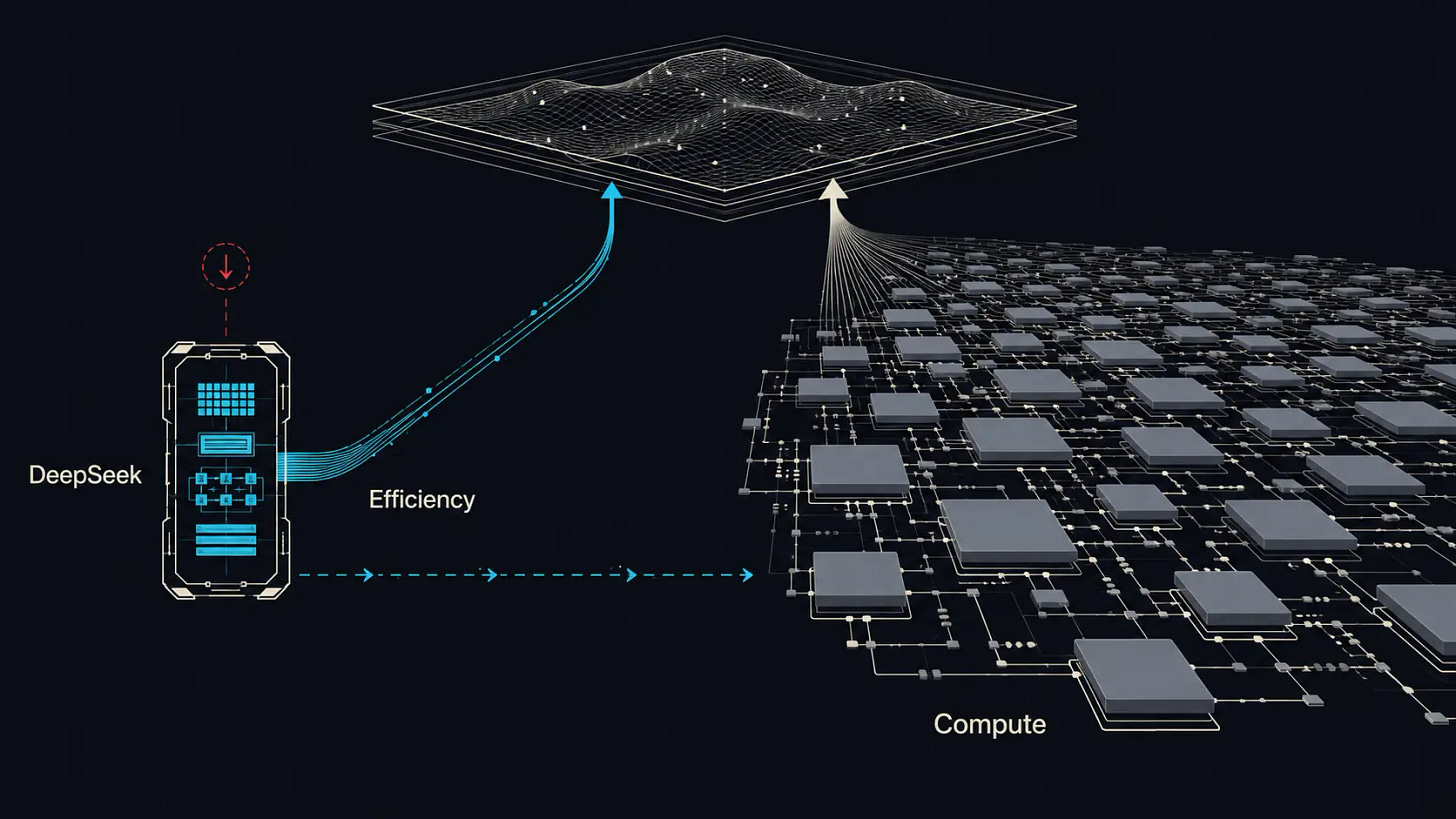
DeepSeek founder Liang Wenfeng identifies the core AI performance gap between China and the U.S. as fundamentally rooted in compute resource scarcity rather than talent deficits. He emphasizes that limited chip availability and high costs restrict experimental opportunities, which in turn stifle talent development and model scaling—"Talent is not the bottleneck. Resources are the biggest bottleneck," Liang asserts, highlighting that domestic models remain an order of magnitude smaller, with tens of billions of activated parameters compared to the U.S.'s 800 billion. This compute gap constrains ambitions, forcing DeepSeek to train models at scales dictated by resource limits rather than sufficiency.
In response to these constraints, DeepSeek is aggressively pursuing domestic AI chip independence through secret proprietary chip development and strategic collaboration with Huawei. Liang reveals that DeepSeek’s latest models run on Huawei’s Ascend 950 super-node chips, which he claims can match Nvidia’s GB200 and GB300 in both performance and price, with a notable 4:1 chip substitution ratio. Complementing this hardware push, DeepSeek has developed TileLang, a high-level compiler that minimizes reliance on Nvidia’s CUDA ecosystem, which Liang believes is rapidly being dismantled due to AI-assisted code generation and specialized chip architectures. This domestic substitution effort is part of a broader industry trend among leading Chinese AI labs, driven by U.S. semiconductor export controls.
Despite significant progress, Liang acknowledges that China’s AI chip ecosystem still lags behind the U.S. by roughly fourfold in raw hardware performance and about two years in technological maturity, primarily due to limited manufacturing capacity. However, he remains optimistic that this gap will close within five years as production scales up, supported by state-backed semiconductor investment funds. DeepSeek’s ambitious 1GW data center project in Ulanqab, Inner Mongolia, exemplifies this strategic push to build sovereign compute capacity aligned with China’s 'East Data, West Compute' initiative, signaling a shift where physical infrastructure scale will become a defining factor in the AI race.
The economics of AI inference computing have become a critical bottleneck, with inference chip investment accounting for up to 90% of a large model’s lifecycle computing costs. DeepSeek’s secret development of proprietary AI inference chips over the past year aims to address these soaring costs and reduce dependence on foreign suppliers. This strategic focus on inference hardware underscores the urgency of domestic chip substitution within a narrow one-year window, as Chinese AI companies like DeepSeek and Alibaba allocate the majority of their computing budgets toward inference chips to sustain scalable AI deployment amid geopolitical pressures and export restrictions.


Open-Source Shakes Global AI Order
DeepSeek’s open-source push is upending US pricing dominance, fueling cross-border innovation, and recasting China’s AI ecosystem as both a geopolitical flashpoint and a model for accessible, secure AI development.
DeepSeek’s open-source AI strategy is emblematic of a transformative shift in China’s AI ecosystem, where open models rapidly close the performance gap with closed systems while fostering a more accessible and competitive landscape. By openly publishing models and techniques, DeepSeek and peers like Tencent and Xiaomi enable a two-way innovation exchange with US firms, challenging the narrative of one-sided copying and reshaping global valuation benchmarks. This democratization reduces reliance on costly API fees, preserves digital sovereignty for startups and governments, and promotes sustainable growth by preventing monopolistic dominance, as emphasized by founder Liang Wenfeng’s philosophy of “restraint.”
The rise of Chinese open-source AI, led by DeepSeek’s cost-effective models like V4 Flash priced at roughly one-hundredth of OpenAI’s GPT-5.5 output-token cost, is disrupting US closed-model labs’ pricing power and prompting American companies such as Nvidia’s Nemotron and Thinking Machine to develop their own open alternatives. This intensifies the US-China technological rivalry by challenging US dominance in GPUs, capital, and AI platform standards, while fostering a multipolar ecosystem where global developers may increasingly turn to Chinese or European open models if US restrictions on openness tighten.
DeepSeek’s open-source approach also intersects with complex geopolitical tensions, as critics allege illicit practices like smuggling compute resources or IP theft underpin China’s AI advances, framing the strategy as part of an AI cold war. However, nuanced legal distinctions separate legitimate knowledge distillation from illegal extraction, underscoring challenges in regulating AI innovation amid rivalry. Moreover, open-source models enhance cybersecurity by enabling broader community involvement in vulnerability detection and patching, which strengthens China’s AI ecosystem’s robustness despite concerns about potential backdoors—concerns Liang Wenfeng dismisses as misunderstandings.