Defense tech booms, but Pentagon Wall remains
The gist
Defense tech startups are raking in record-breaking billions and pioneering AI, autonomy, and quantum breakthroughs—yet they’re still locked out of the Pentagon’s big-money contracts.
What to know
- By mid-2026, defense tech startups raised $16.8 billion but still snag less than 1% of Pentagon contracts.
- Israel’s defense-tech sector tripled startup funding to $3 billion and hit $19.2 billion in exports, fueled by AI and autonomy.
- Primes like Lockheed Martin and BAE Systems are doubling down on startup partnerships, as global defense spending soars to $2.88 trillion.
Defense Tech’s New Frontiers
Venture capital is fueling a wave of startups in AI, autonomy, and quantum, but Pentagon procurement remains locked in legacy mode, leaving breakthrough innovators largely on the sidelines.
By mid-2026, the defense technology landscape has dramatically diversified beyond traditional platforms to encompass cutting-edge fields such as autonomous boats, hypersonic missiles, quantum computing, nuclear batteries, augmented reality, and lunar rovers. This broadening scope is fueled by a voracious appetite for private capital, with investors like In-Q-Tel backing 33 companies and Andreessen Horowitz supporting 15 startups, underscoring a robust influx of innovation and funding that continues unabated. Despite this surge, these emerging firms still capture a mere 0.5% of Department of Defense contract obligations, highlighting a persistent gap between rapid innovation and traditional procurement channels.
Israel’s defense-tech ecosystem exemplifies this global diversification trend, shifting from conventional manufacturing to a comprehensive model integrating autonomy, AI, sensors, and data analytics. Dominated by unmanned and autonomous systems—which account for nearly 70% of the top 60 firms in the Duns 100 index—this sector has seen startups like Aero Sentinel and Kela AI rise to prominence, supported by a tripling of investment to nearly $3 billion in the first half of 2026. This innovation surge has propelled Israel to record $19.2 billion in defense exports for 2025, a 30% increase over the previous year, reflecting the global demand for advanced, integrated defense technologies.
The emergence of an 'AI military complex' marks a paradigm shift in defense innovation, where software-driven capabilities and integrated data platforms increasingly complement traditional hardware. This evolution has given rise to new categories of firms—'neoprimes'—that specialize in military AI applications, alongside established defense primes and big tech players. High-profile contracts, such as the UK’s £2 billion AI training deal led by Raytheon UK and NATO’s adoption of AI platforms from Anduril and Palantir, underscore AI’s central role in modern military readiness and operations worldwide.
Legacy defense contractors are actively integrating AI into their existing platforms, blending traditional hardware with advanced software to enhance operational capabilities. Lockheed Martin’s flight-testing of an AI tool for F-35 jets to accelerate hostile aircraft identification and L3Harris’s AI-enabled targeting cameras, which work in tandem with Shield AI’s autonomous drone detection, exemplify this fusion. This acceleration of AI adoption aligns with rising global military expenditures—reaching $2.88 trillion in 2025—and reflects the Pentagon’s evolution from its 2014 Third Offset Strategy to an 'AI-first' military approach, supported by multiple contracts with leading tech firms.

Investment Surge, Strategic Shifts
Major funding rounds and corporate venture expansions are transforming defense tech, with primes moving from passive investors to active partners in a rapidly diversifying global ecosystem.
By mid-2026, the defense-tech sector witnessed an unprecedented surge in global investment, with venture capital and corporate funding reaching new heights. Defense startups collectively raised $16.8 billion in the first half of 2026, nearly doubling the $9.95 billion raised in all of 2025, underscoring a voracious private capital appetite described by Mike Keating as 'not going down.' This influx was driven by major funding rounds such as Anduril’s $5 billion Series H at a $61 billion valuation and Shield AI’s $1.5 billion Series G, alongside substantial corporate venture commitments, including Lockheed Martin Ventures doubling its fund size to $1 billion and BAE Systems investing €50 million in European defense tech funds.
The investment landscape is diversifying rapidly beyond traditional defense technologies, embracing cutting-edge fields like AI, quantum computing, autonomous systems, and space capabilities. Companies such as Quantum Systems raised a record $1.2 billion for drone technologies, while startups like SE3 Labs secured €5.5 million for spatial AI platforms used by allied forces. Philippe Klitzing of Peak VC emphasized that investments like the €57 million for eleQtron represent not just tech funding but 'geopolitical infrastructure policy,' highlighting the strategic and geopolitical dimensions shaping European and global defense tech investments.
Defense primes are transitioning from passive observers to active ecosystem participants, strategically deploying capital and forging partnerships to integrate innovative technologies swiftly. Lockheed Martin Ventures' expansion into Europe with a $1 billion fund and a London office, alongside its $100 million commitment to UK and European startups, exemplifies this shift. Similarly, collaborations between agile startups and established defense giants like Rafael, Elbit, and IAI in Israel reflect a move towards modular, integrable components rather than full systems, enabling faster adoption of disruptive technologies highlighted by the war in Ukraine and evolving warfare needs.
This surge in strategic capital deployment coincides with a broader structural transformation in defense innovation financing, where venture capital accelerates development cycles and reshapes the global defense tech ecosystem. The record $4.1 billion invested by global defense contractors in 2026, focused on AI, drones, and combat robotics, complements a 25% rise in internal R&D spending since 2021, fueling rapid scaling of startups like Quantum Systems and Kraken Technology. Analysts view this as a fundamental shift driven by lessons from recent conflicts, with defense giants increasingly integrating AI capabilities into existing platforms and expanding M&A activity, such as Thales’ €3.9 billion acquisition of Exail Technologies.


National Innovation Overhauls
The UK, Israel, and Germany are rewriting their defense playbooks—channeling billions, breaking old funding taboos, and forging public-private alliances to supercharge startups amid intensifying security threats.
The UK government’s 2026 Defence Investment Plan (DIP) marked a decisive pivot toward prioritizing drone infrastructure and cybersecurity, underscoring startups' critical role in national security. This strategic emphasis is complemented by private initiatives like Osney Capital’s £60 million cybersecurity fund targeting early-stage UK startups, reflecting a synergistic public-private approach to bolstering offensive cyber capabilities amid escalating cyber conflicts, such as the £2.5 billion Jaguar Land Rover hack attributed to Russia.
Israel’s defense innovation ecosystem is undergoing a transformative realignment into a 'Defense-Tech Nation,' characterized by a surge in startup funding that nearly tripled to $3 billion in the first half of 2026 and a broadening focus beyond traditional manufacturing to software, AI, autonomy, and sensors. The government’s strategic shift towards fostering independent, integrable components rather than full systems has catalyzed collaboration between agile startups and major defense primes like Rafael, Elbit, and IAI, with approximately 800 startups actively fulfilling Defense Ministry procurement orders, fueling record defense exports that surged nearly 30% to $19.2 billion in 2025.
Germany’s defense innovation landscape is experiencing a profound strategic realignment driven by a €25 billion risk capital push under the WIN-Initiative, dismantling previous ethical investment barriers to allow direct equity stakes in defense startups via state-backed funds like KfW. This ambitious industrial policy aims to spawn at least 1,000 university spin-offs and 200 scaling deep-tech firms by 2030, while regulatory reforms seek to channel private retirement savings into venture capital to close the funding gap with the US. Despite bureaucratic setbacks, such as the dilution of the 24-hour company founding promise, Germany’s comprehensive 152-point DefenseTech strategy and federal investment vehicles like Zukunftsfonds and Deutschlandfonds are catalyzing a surge in venture capital, with DefenseTech startups raising €579 million in H1 2026 amid heightened security threats from Russian espionage and domestic extremism.
Across Europe, wartime imperatives have galvanized governments to realign defense innovation priorities, markedly increasing spending and redirecting joint programs toward digital and space-based capabilities. This continental momentum is underscored by major defense contractors like Lockheed Martin and BAE Systems investing over $150 million collectively into European defense tech startups and funds, signaling a strategic commitment to nurturing robust domestic defense ecosystems capable of responding to evolving security challenges.

Procurement Bottlenecks Persist
Despite record investment and new partnership models, defense startups still face bureaucratic barriers and slow-moving acquisition systems that stifle rapid integration into military supply chains.
By mid-2026, defense tech startups had attracted a staggering $12.3 billion in investment, signaling strong private sector confidence. Yet, despite this influx and a tripling of Pentagon contract spending since 2022, these startups still receive less than 1% of total defense contracts, underscoring persistent procurement friction. The Pentagon acknowledges that its traditional acquisition machinery is too slow and is exerting pressure on primes to partner with new entrants, aiming to accelerate capability delivery and bridge this integration gap.
Collaboration models are rapidly evolving as defense primes like Lockheed Martin Ventures dramatically scale their engagement with startups, more than doubling their fund from $400 million to $1 billion and committing at least $100 million to UK and European innovators. This strategic realignment, including opening a London office, reflects a recognition that integrating cutting-edge technologies requires deep partnerships across the ecosystem rather than isolated procurement.
In the UK, startups face a labyrinthine procurement environment where initial interest from the Ministry of Defence often fails to translate into contracts due to complex processes and unclear decision-making authority. As one insider cautions, 'being liked by the people in the room is only a small part of it'—success demands understanding the precise military problem, its systemic context, and who holds responsibility before finalizing designs. This challenge persists despite the MoD’s largest procurement reform in over 50 years, led by National Armaments Director Rupert Pearce, which consolidates procurement, digital, science, and infrastructure teams under the National Armaments Director Group to streamline acquisition.
New UK initiatives such as UK Defence Innovation (UKDI) and the Dynamic Market aim to dismantle barriers for smaller businesses by consolidating a £400 million innovation budget and enabling faster, smaller-scale competitions. However, practical impacts remain limited as startups still grapple with identifying the right decision-makers within the MoD, a bottleneck highlighted by experts like Hicks and Keen. Meanwhile, the Defence Industrial Policy and Defence Investment Plan emphasize agility, cost-effectiveness, and technology integration—including AI and digital tools—to foster a technology-agnostic, mission-focused collaboration model that unites startups, primes, and government in accelerating capability delivery.

Ranking Defense’s Power Players
Future Union’s outcome-based rankings reveal a shifting innovation balance—America dominates core tech, but allied nations and shadow suppliers are redrawing the global defense landscape.
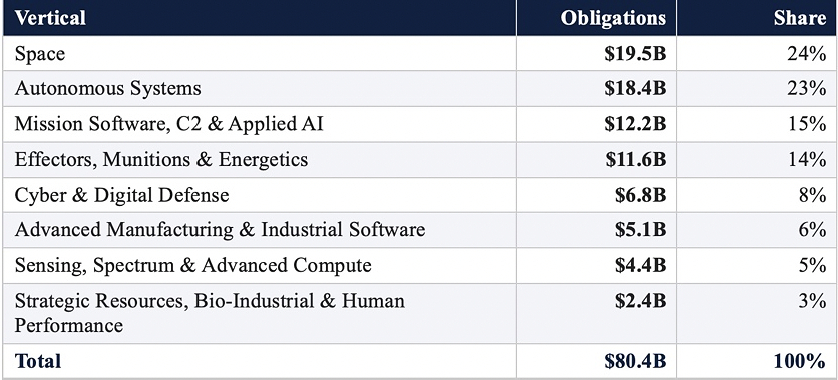
By mid-2026, Future Union pioneered a transformative approach to evaluating global defense tech companies through its All-World Defense 300 ranking, which eschews traditional financial metrics in favor of outcome-based measures like FAR contracts and SBIR awards weighted by government demand and capability comparables. This data-driven transparency not only offers a granular view of technological prowess across eight verticals but also underscores the indispensable role of often-overlooked 'Shadow Primes' and industrial firms that underpin critical defense supply chains, highlighting their essential contributions to technology-enabled production.
The rankings reveal a nuanced realignment in global defense innovation leadership: while the U.S. maintains an unassailable grip on foundational tiers—commanding 100% of the top 'Arsenal' tier in advanced compute and strategic resources and 79% across all sectors—there is a notable shift in strike capabilities where allied nations now outnumber American companies 22 to 17. As Andrew King of Future Union observes, ongoing global conflicts have catalyzed this redistribution, signaling a more multipolar innovation landscape.
Beyond national tallies, the data-driven ecosystem mapping illuminates vibrant regional centers of defense innovation, with the UK excelling in deep tech, Israel advancing cyber-kinetic systems, Ukraine pioneering combat-proven autonomy, and Turkey specializing in uncrewed systems and armor. Frank Edwards of Ankura emphasizes that this commercial innovation surge is reshaping modern defense paradigms and underscores the strategic imperative for cross-national and corporate collaboration to harness these emerging strengths effectively.