Democracy on autopilot: elites tighten grip as grassroots push back against authoritarian drift
The gist
As elite power tightens its grip on politics, finance, and culture, a restless grassroots movement is rising to push back against America’s accelerating authoritarian drift.
What to know
- By early 2026, unchecked government power and fiat money creation have deepened inequality and sparked calls for mandatory referendums and nondiscrimination policies.
- Militarized enforcement, elite regulatory capture, and tech-driven ideological conformity are undermining democratic norms and fueling public distrust across the board.
- Over 2,000 No Kings coalition protests and renewed activism signal that the battle for liberal democracy is intensifying—and the outcome is far from settled.
Elite Impunity Unmasked
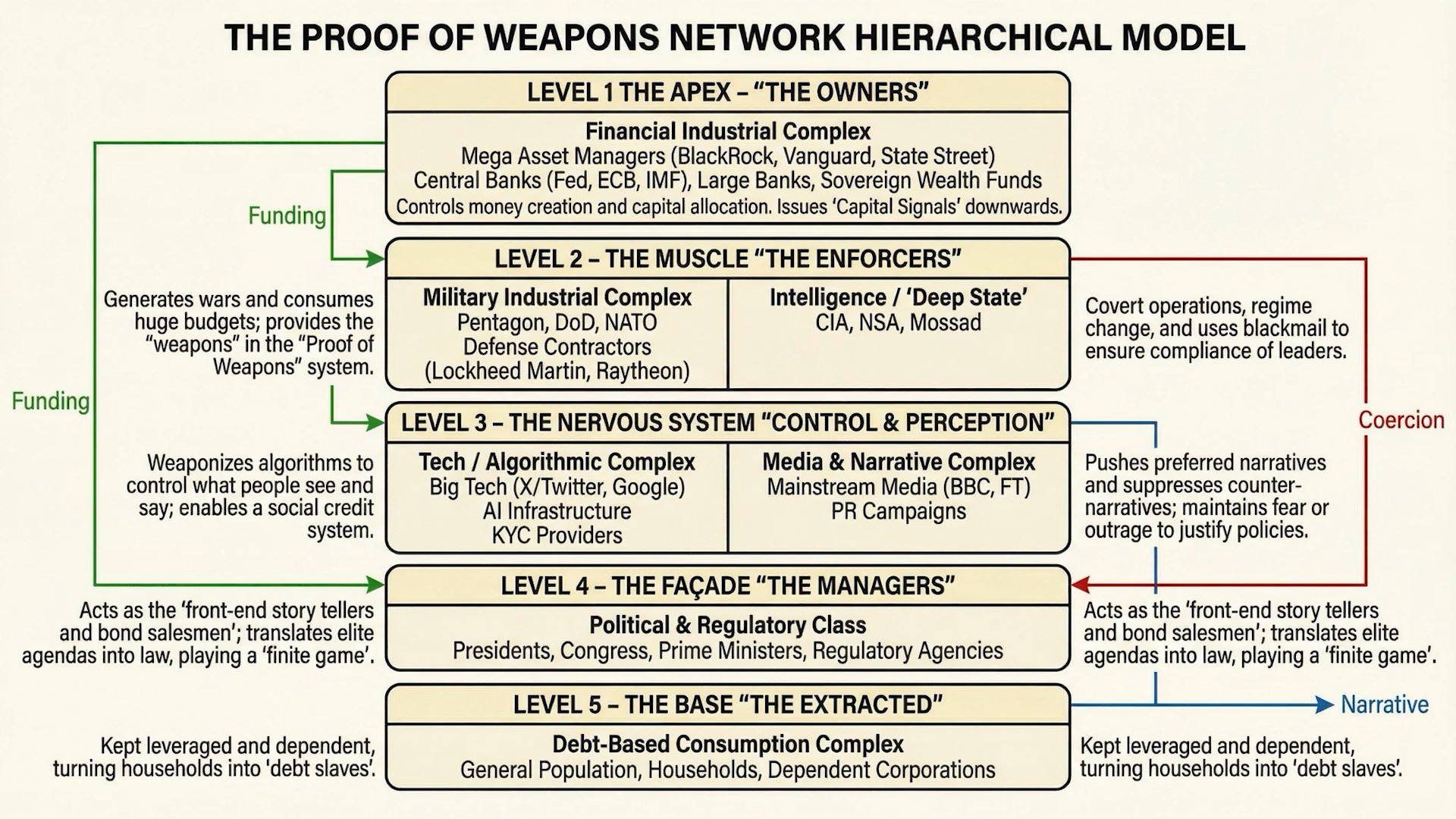
A hidden web of debt, regulatory capture, and elite cartels shields powerful actors from accountability, deepening inequality and eroding the rule of law.
By early 2026, unchecked government power—particularly the ability to create fiat money without public consent—has emerged as a critical driver of inequality and social division, as inflation disproportionately benefits asset holders while governments allocate resources preferentially, deepening societal fractures. Proposals to strengthen democratic accountability include mandating referendums before borrowing or money creation and enforcing absolute nondiscrimination policies to constrain political favoritism, aiming to restore equality and agency under the law. As one analyst emphasized, "A policy of absolute nondiscrimination by the state would go a long way to constrain power just to refuse to allow politicians to discriminate in favor of one group and against another."
The erosion of democratic accountability is further compounded by a complex web of structural power where governments often serve banking, bond markets, and lobbying interests rather than voters, as Simon Dixon highlighted in his 2026 interview. This subordination is enforced through debt, which compels countries and companies to prioritize creditors over sovereign agency, while centralized financial entities—including Bitcoin companies—are frequently co-opted by regulatory and banking frameworks, reinforcing systemic control and limiting true independence. Leaders operate within these financial and military constraints, creating a divergence between public narratives and the actual power dynamics shaping policy decisions.
Institutional elites have entrenched a transnational power structure characterized by mutual leverage, secrecy, and bipartisan obstruction that effectively immunizes them from accountability, as detailed in analyses from March and April 2026. This 'power structure made up of a web of cartels, terror proxies, secrets, and shadow financiers' mocks national legal boundaries and transforms courts into 'slaughterhouses' where no one dares to enter, eroding public trust and legitimacy. The normalization of elite impunity—visible in sectors like federal law enforcement, high finance, and the presidency—deepens inequality, as ordinary citizens face swift prosecution for minor offenses while systemic corruption remains unpunished, accelerating the decline of democratic agency and the rule of law.
Power consolidation by new oligarchs, dubbed the 'Great American Politburo,' exemplifies the ongoing erosion of democratic accountability and individual liberty. Figures such as Elizabeth Warren, Bernie Sanders, and Ro Khanna are accused of leveraging their influence to control economic resources, education, and media under the guise of promoting justice and equity, while simultaneously enriching themselves through opaque stock trades and taxpayer-funded privileges. This elite consolidation is exacerbated by regulatory capture and government interventions—like the US pause on Anthropic’s Fable 5 AI model—that centralize control and stifle entrepreneurial agency, fostering dependency and learned helplessness among citizens, which further undermines democratic legitimacy and public trust.




Conformity at the Top
Despite public talk of inequality, elite and media circles suppress dissent and reinforce ideological orthodoxy to maintain their dominance.
By early 2026, elite circles began openly acknowledging systemic social issues such as poverty and inequality—Wall Street analyst Mike Green notably highlighted that a comfortable minimum income for a family of four in the US is $140,000, far surpassing the official $35,000 poverty line. However, this recognition often serves as a containment strategy rather than a genuine embrace of pluralism, as neoliberal systems have adeptly sterilized and absorbed dissent, maintaining ideological conformity and limiting the emergence of robust critical narratives within power structures.
Despite the explosion of diverse viewpoints accessible through technology and AI, elite professional and intellectual circles exhibit striking ideological homogeneity, a phenomenon largely self-imposed through social and career incentives that discourage deviation from narrow orthodoxies. This conformity breeds a cycle where rising generations of professionals inherit and perpetuate uniform perspectives, as seen in political party discipline exemplified by figures like Alexandria Ocasio-Cortez, who faces pressure to align with establishment positions, underscoring how elite power structures actively moderate insurgent voices to preserve the status quo.
Media dynamics play a pivotal role in reinforcing elite ideological conformity, with ownership cultures—such as Nick Denton's Gawker, Rupert Murdoch's Fox News, and the Sulzberger family's New York Times—shaping editorial direction and political bias. Journalists often lack awareness of these embedded biases, leading to self-censorship driven by reputation control and economic incentives like article-click bonuses, which prioritize audience engagement over pluralistic discourse. Consequently, major outlets openly embrace political identities, challenging claims of neutrality and further narrowing public narratives.
The prevailing ethos among intellectual elites to 'speak truth to power' paradoxically fosters intellectual laziness and motivated reasoning, as pre-established truths replace rigorous inquiry, undermining pluralism and public trust in democratic institutions. This dynamic, coupled with ideological dogmatism on both left and right—ranging from critical theory's rigidity to right-wing conspiracism—illustrates how reputation control and self-censorship constrain critical discourse. Critics like Curtis Yarvin and Patrick Denine argue that liberalism functions as an oligarchic, morally thick ideology that narrows the marketplace of ideas, marginalizing dissenting conservative voices and reinforcing exclusionary norms within elite circles.






Coercion as Governance
Financial, military, and technological systems have normalized state coercion and cruelty, turning justice and security into tools for elite control.
By early 2026, governance has become increasingly enmeshed in a labyrinth of financial, military, and technological power structures that severely constrain political leaders and normalize coercion. Simon Dixon highlights how technology giants and AI-driven platforms act as geopolitical tools, amplifying polarization and ideological extremes to entrench existing power dynamics, while debt dependencies further erode national sovereignty and democratic accountability. This complex web ensures that public narratives often mask the underlying capital-driven incentives shaping decisions, revealing a governance model where coercion and control are institutionalized rather than exceptional.
Authoritarian regimes increasingly weaponize cruelty and impunity as deliberate strategies to suppress dissent and erode democratic norms, targeting vulnerable populations with systemic dehumanization. The indefinite detention of vetted refugee families by ICE and the Justice Department’s baseless criminal probe into Federal Reserve Chair Jerome Powell illustrate how legal institutions become instruments of intimidation rather than justice. As articulated in a March 2026 opinion piece, when war is reduced to entertainment, refugees to mere statistics, and justice to loyalty tests, the humanity of citizens is stripped away, facilitating authoritarian control through normalized cruelty.
The militarization of governance has escalated dramatically, both internationally and domestically, underpinned by fear-based rhetoric that frames multilateral cooperation as a sinister threat. The 2026 U.S. operation in Venezuela, which involved bombing a sovereign capital and capturing its president under the guise of securing 'additional wealth and resources,' exemplifies the normalization of imperialistic military aggression. Domestically, ICE’s unprecedented $170.1 billion budget has enabled hyper-militarized immigration enforcement using Black Hawk helicopters, armored vehicles, and drone surveillance, embedding armed federal presence into civilian life and signaling a profound shift toward coercive state power.
This era’s fear-based governance uniquely combines a retreat from international institutions with aggressive domestic coercion, reflecting a broader pattern of declining powers resorting to militarized authoritarianism in a desperate bid to maintain control. Unlike previous periods such as McCarthyism, the current administration openly rejects multilateralism while expanding executive overreach, embodying what analysts term 'premortem convulsions'—chaotic, violent actions symptomatic of systemic collapse. As J. William Fulbright warned, great powers often conflate their authority with moral virtue, justifying militarized governance as a divine mission, a mindset that accelerates democratic erosion and institutional decay.

Culture Wars by Decree
Executive overreach and complacency are enabling a new oligarchy to reshape public institutions, threatening pluralism and liberal values.
By mid-2026, it became clear that rapid cultural shifts were being engineered through concentrated executive power and funding leverage targeting key public institutions such as accreditation systems, public schools, DEI programs, and federal arts organizations. These efforts, framed under banners like patriotism and fighting indoctrination, reveal a dangerous dynamic where political movements, convinced of their moral imperative, are willing to deploy unprecedented powers to reshape cultural norms, thereby threatening the foundational liberal values of pluralism and open discourse.
A pervasive complacency has settled over liberal society, where the hard-won behavioral defaults sustaining liberal institutions are taken for granted, making them vulnerable to erosion not through overt rejection but through neglect. This complacency transcends partisan divides, as authoritarian impulses—whether from the nationalist right or other quarters—threaten liberalism’s survival, especially when liberal advocates lose credibility by violating their own principles, complicating efforts to renew commitment to these values.
The rise of a new oligarchic elite, dubbed the 'Great American Politburo,' exemplifies how cultural complacency enables concentrated control over the economy, education, and media under the guise of equity and justice. Figures like Elizabeth Warren, Bernie Sanders, and Ro Khanna symbolize this consolidation, which undermines liberal principles of individual liberty and private property, while simultaneously eroding civic virtues essential for sustaining liberal democracy.
Simultaneously, liberalism faces ideological challenges from both the left and right that exacerbate cultural fragmentation. The MAGA right critiques liberalism as a 'thick moral way of thinking' that destroys social fabric and fuels a yearning for authoritarian figures, while liberalism’s perceived ideological exclusivity marginalizes conservatives, stifling genuine pluralism. This environment fosters a sense of entrapment, where social and professional repercussions suppress dissenting views, and performative corporate mandates—like mandatory Pride Month participation—further constrain authentic expression, collectively undermining the civic virtues and open discourse vital to liberal democracy.
As economist Deirdre McCloskey warns, these cultural and ideological pressures threaten the bourgeois virtues underpinning economic growth and liberal democracy. The left’s growing embrace of socialism as a familial, caring model among youth contrasts sharply with the authoritarian impulses rising on the right, creating a generational and ideological battleground. McCloskey calls for a renewed commitment to liberalism as 'adultism'—the principle that individuals should treat themselves and others as responsible adults—to counter both extremes and preserve the cultural foundations essential for liberal renewal.


Grassroots vs. Power Brokers
Mass protests and renewed activism signal a cultural reckoning, but lasting democratic renewal hinges on local organizing and bridging deep internal divides.
By early 2026, revitalizing liberal democracy has increasingly hinged on grassroots organizing and sustained community activism as vital counterweights to authoritarian encroachments. Movements like the nationwide No Kings coalition, which orchestrated over 2,000 mass nonviolent protests, exemplify how visible collective resistance breaks the spell of fear and reclaims democratic ownership from entrenched elites. Yet, as commentators stress, such single-day actions are merely gateways to deeper, enduring local organizing that protects voting rights, combats censorship evidenced by 6,870 book bans in one school year, and resists authoritarian blueprints like Project 2025. This blend of public courage, truth-telling, and solidarity underscores a cultural narrative renewal that insists democracy belongs to the many, not the powerful few.
Emerging critiques within progressive circles reveal a profound internal tension between the Hamiltonian impulse favoring centralized expert authority and the Jeffersonian desire to decentralize power back to ordinary citizens. This dichotomy, highlighted by analysts like Dunkelman, explains much of the political gridlock and public distrust, as the absence of a singular accountable figure to decisively weigh tradeoffs hampers effective governance. Efforts to rebuild trust thus demand more than abstract messaging; they require tangible, relatable benefits—such as the MTA’s congestion pricing story personalized through a plumber’s increased workday capacity—to make government action visible and enduring. Without reconciling these impulses, progressives risk perpetuating a credibility gap that fuels voter disillusionment and openness to anti-establishment appeals.
Liberal intellectuals and cultural leaders play a pivotal role in revitalizing liberal democracy by reclaiming its foundational narratives and addressing its blind spots. Scholars like Emily Chamlee-Wright emphasize deploying liberal symbols and ideals with conviction to restore constitutional checks and promote pluralism, dignity, and civility—qualities often obscured amid cultural decay. Meanwhile, voices such as Minna Salami call for confronting liberalism’s reluctance to engage with feminist and decolonial critiques, highlighting systemic inequalities exposed during crises like the COVID-19 vaccine rollout and ongoing conflicts. This cultural renewal, coupled with institutional reform, is essential to reclaim liberalism’s emancipatory potential and adapt it to contemporary demands for true equality beyond the dominance of a professional managerial class.
The future of liberal democracy also depends on engaging with generational political instincts and reimagining public-spiritedness amid rising anti-establishment sentiments. Thought leaders including Yascha Mounk and Rachel Janfaza argue that Gen Z’s political attitudes—while not traditionally liberal—offer crucial insights for a renewed liberalism that reclaims its radical roots and incorporates lessons from the republican tradition. This cultural and institutional renewal aims to rebuild a shared sense of civic responsibility and counteract fragmentation, ensuring liberal democracy evolves beyond complacency to meet the challenges of a fragmented era.

Tech Titans Defy Democracy
Tech giants operate as quasi-sovereign powers, challenging traditional governance and fueling a regulatory vacuum that risks public backlash.
By early 2026, the relationship between tech elites and democratic institutions had become fraught, exemplified by Elon Musk’s public frustration over exclusion from a Biden administration event, highlighting the complex interplay of innovation leadership and political power. Kara Swisher critiques this dynamic, noting how tech companies function as diffuse centers of power with their own insular 'mini cults' and visions, which complicates governance and regulatory efforts in the digital age. This fragmentation of authority challenges traditional democratic accountability as tech giants increasingly act as quasi-sovereign entities with outsized social influence.
The tech sector’s profit-driven motives starkly contrast with societal needs, as Scott Galloway and Ian Bremmer emphasize that CEOs and AI leaders prioritize shareholder value over public interest, often neglecting the social harms their platforms propagate, from radicalization to the erosion of discourse. Bremmer further highlights a governance gap where tech companies avoid responsibility for negative externalities, expecting governments to absorb social costs, thereby exposing the unsustainability of the US model where private firms effectively capture regulation. This self-regulation amid rapid AI advancement threatens to provoke significant societal backlash by 2028.
The future of AI governance is caught between competing global models: the US’s private-sector-dominated approach, China’s government-controlled system, and Europe’s independent regulatory framework, each balancing innovation and societal safety differently. Meanwhile, the rise of a new oligarchic class consolidates power over economy, education, and media under the guise of virtue, risking an erosion of individual liberty and entrepreneurial freedom. As Friedberg warns, government promises of security risk fostering 'learned helplessness,' undermining agency and the struggle necessary for progress, whereas capitalism—especially in tech—remains a rare domain fostering inclusion through shared equity and value creation.
AI regulation is becoming a high-stakes battleground where government intervention risks favoring hyperscalers like Amazon, Microsoft, and Google through regulatory capture, potentially imposing identity verification and centralized controls that threaten innovation and public trust. Ezra Klein adds that technology and social media platforms have reshaped democratic engagement by privileging outrage and performative posting over thoughtful governance, with algorithmic amplification fueling polarization and purity spirals. He advocates moving beyond simplistic regulatory debates toward building public capacity, implementing child-focused guardrails, and treating AI as a public good, while cautioning against distractions by sci-fi fears in favor of addressing present systemic challenges.