Derive buyback frenzy fuels crypto’s revenue-driven rally
The gist
Derive’s turbocharged buyback vote turned DRV into crypto’s latest cash flow darling, tripling its price and setting off a frenzy for revenue-backed tokens.
What to know
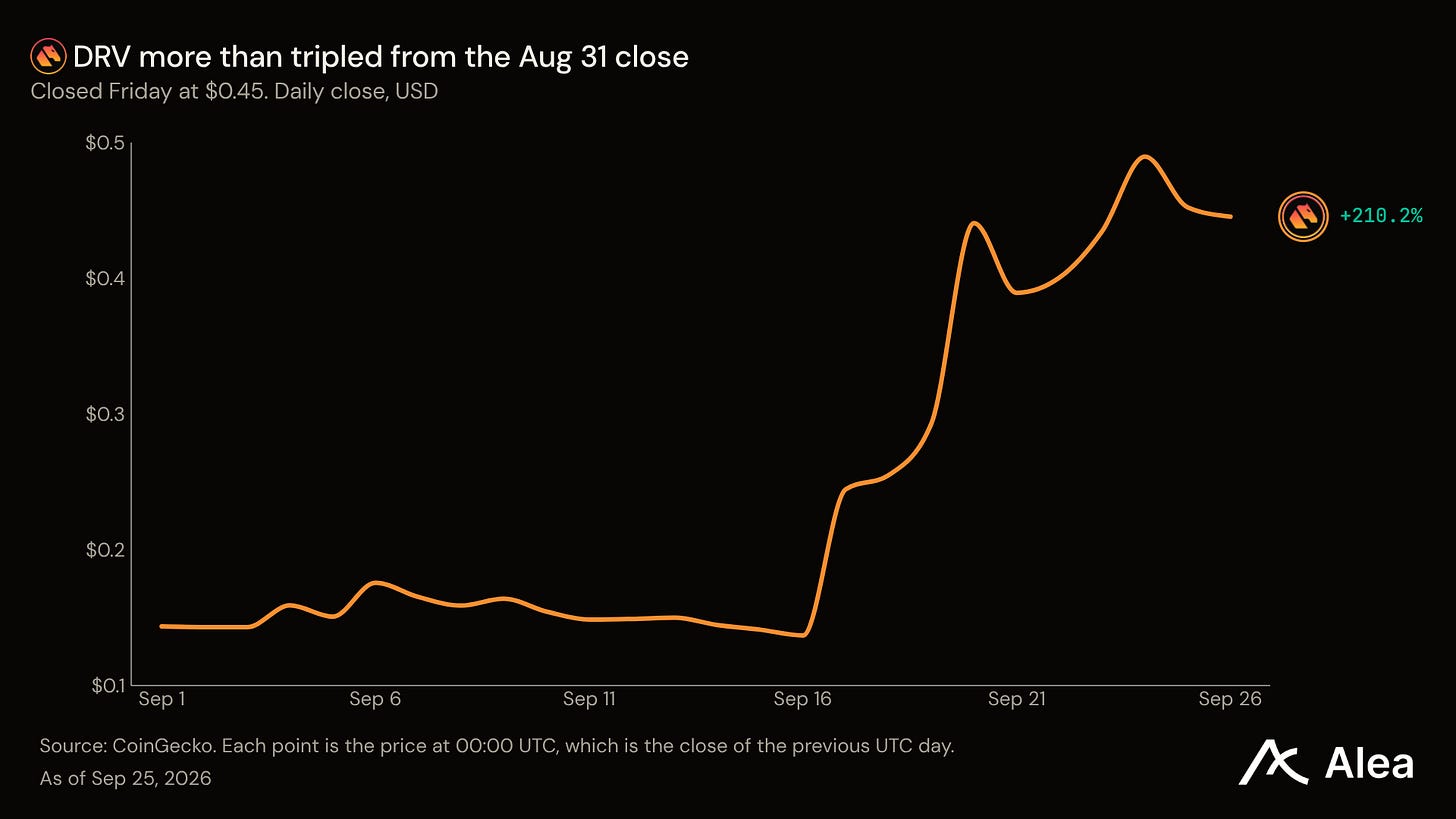
- Derive’s DAO hiked buybacks to 50% of fees via DIP 324 in late September 2026, catapulting DRV from $0.14 to $0.45 as its revenue multiple soared to 75x.
- Crypto investors are flocking to tokens with automatic revenue-sharing and buybacks—like Hyperliquid, Tron, and Chainlink—shifting the market from hype to hard cash flows.
- Protocols funneled a record $640M into buybacks in 2026, with Bankless and Alea Research spotlighting Derive’s 27.6M DRV removed from supply and surging capital into revenue-claim tokens.
Buybacks Redefine Token Value
Derive’s 50% buyback triggered a valuation leap as investors shifted focus to protocols with real revenue-sharing, echoing a broader move toward cash-flow-driven tokenomics.
Derive’s late-September repricing landed in a market already primed to reward tokens with explicit claims on protocol cash flow. As A mi los bloques! put it, “En 2026, el mercado dejará de guiarse por promesas o modas de redes sociales para enfocarse en lo que realmente importa: cuánto dinero genera un protocolo y cómo se reparte ese valor entre los dueños del token,” and it argued that 2026 tokenomics would increasingly rely on “Recompras y Dividendos” and burns to pass fee income to investors—exactly the logic that made DIP 324’s 50% buyback approval an immediate valuation event rather than a symbolic governance win.
That helps explain why Derive’s token could triple so quickly after the vote and why its multiples stretched to new highs: investors had recent precedents showing that governance-approved revenue capture can reprice tokens fast. TradingView highlighted Hyperliquid using “about 99%” of revenue to “buy and burn HYPE,” including “$169 million in second-quarter revenue” and “$141 million toward HYPE buybacks”; Hyperliquid also generated “over $800 million in revenue last year,” reinforcing how large those cash-flow-backed token programs had become. It also noted Uniswap approved protocol fees to “fund UNI burns” on Dec. 22, 2025, while Stani Kulechov said Aave was building “an automated, non-discretionary buyback mechanism” and that “100% of Aave Protocol and GHO revenue goes to the $AAVE token.”

Revenue Claims Trump Hype
Tokens now rise or fall on their direct link to protocol earnings, with cash flow distribution mechanisms separating genuine value from empty narratives.
The shift from hype to cash flow starts with a stricter test: tokens must be tied to revenue that is earned through use, not merely promised by narrative. Today in DeFi made that explicit in May, arguing that base-layer value accrues only when chains do real fee-generating work; its example was Tron, which “generates roughly $31 million in fees a month… off about $90 billion in stablecoin balances — almost entirely from USDT settlement,” and whose token “has a genuine link to that activity,” giving investors a concrete activity-to-value bridge.
By late summer, that bridge was being formalized into tokenholder entitlements that investors could compare across projects. Adrian’s DeFi Alpha ranked tokens by whether fees mechanically reached holders: Tier 1 sends “between 97% and 99% of trading fees” to automatic HYPE purchases, with “over $1.16 billion purchased since inception” and “no decision required from anyone”; Tier 2 routes revenue into NEAR buybacks, where “revenue captured by NEAR Intents buys NEAR on the open market and hands it back to holders,” “inflation was cut from 5% to 2.5% last October,” and “Roughly $9 million of” buybacks had already been completed. The same logic showed up in more aggressive burn models — “Venice… ‘We want to burn every last VVV token,’” “Lit… Perpex, wants to burn all of its tokens,” and “JTO… they burn 80% of the fees uh, that they receive with JTO” — while lower tiers fail precisely because “there is no buyback” or the token is mere “decoration,” and a record $640 million in 2026 buybacks showed protocols increasingly using fee cash to create recurring token demand.


Capital Chases Fee Distribution
Institutional and retail capital is pouring into tokens with proven, recurring revenue payouts, as leaderboard data and price action cluster around protocols rewarding holders.
By late September 2026, market commentary was no longer treating token revenue capture as a niche design choice but as a recognizable valuation bucket drawing capital. Bankless explicitly elevated “holders revenue” as a metric for “how much value [a] protocol is distributing back to its investors,” and argued that “capturing value for a token makes said token more attractive to hold,” while noting, “The number of defi protocols distributing money to holders via dividends or buybacks has been going up…” with Aave, Uniswap, Pendle, and Ethena cited as evidence of a widening cohort.
That framing was reinforced by both leaderboard data and where price action was clustering. Bankless noted that “Per DefiLlama 3 of the top 5 projects… Hyperliquid, Pump.fun, and Chainlink, have combined to return ~$30M to their respective holders via buybacks over the past week alone,” while Alea Research showed attention concentrating in DRV, where Derive “has collected $362.5M of option premium this year… 87.4% of everything paid for an onchain option,” kept $3.37M of $4.51M in fees, sent 35% to buybacks, and saw DRV rise from $0.2877 on Sep. 17 to $0.3857 by Saturday.
DAO Vote Supercharges DRV
A sustained buyback regime set the stage, but it was DIP 324’s approval that unleashed a repricing frenzy, sending DRV’s revenue multiple and market price soaring.
Derive’s repricing did not begin with DIP 324 out of nowhere; it was primed by an active buyback regime that had already become visible in the market. Hix0n’s Confidential Newsletter described a “buyback machine” still shrinking supply, noting that “Weekly buyback #84 took another 199,760 DRV off the market, 27.6 million bought back so far with 35% of protocol fees,” and in the same stretch “Wednesday it ripped 91% in a single day, and as I type, it sits at $0.254,” a move the newsletter tied to venue strength rather than a one-off headline: “No single announcement did this, the venue earned it,” with options positioning showing “89,100 ETH calls open at the $5K and $7K March 2027 strikes… 96% of it living on Derive.”
What turned that momentum into a full repricing was the DAO’s late-September escalation of the program. Alea Research said the DAO published DIP 324 on Sep 24, proposing to “raise the buyback from 35% to 50% of applicable fees,” after which DRV “more than tripled from $0.14 at the Aug 31 close to $0.45 on Friday”; crucially, “The price held its September gain through the week the DAO posted DIP 324,” while valuation stretched further, with “DRV holders went into the week paying 75 times Derive's annualized revenue, and the multiple rose 11% by Friday's close.”