DeSantis's $500k homestead gambit sparks fiscal feud as florida cities warn of 'survival mode'
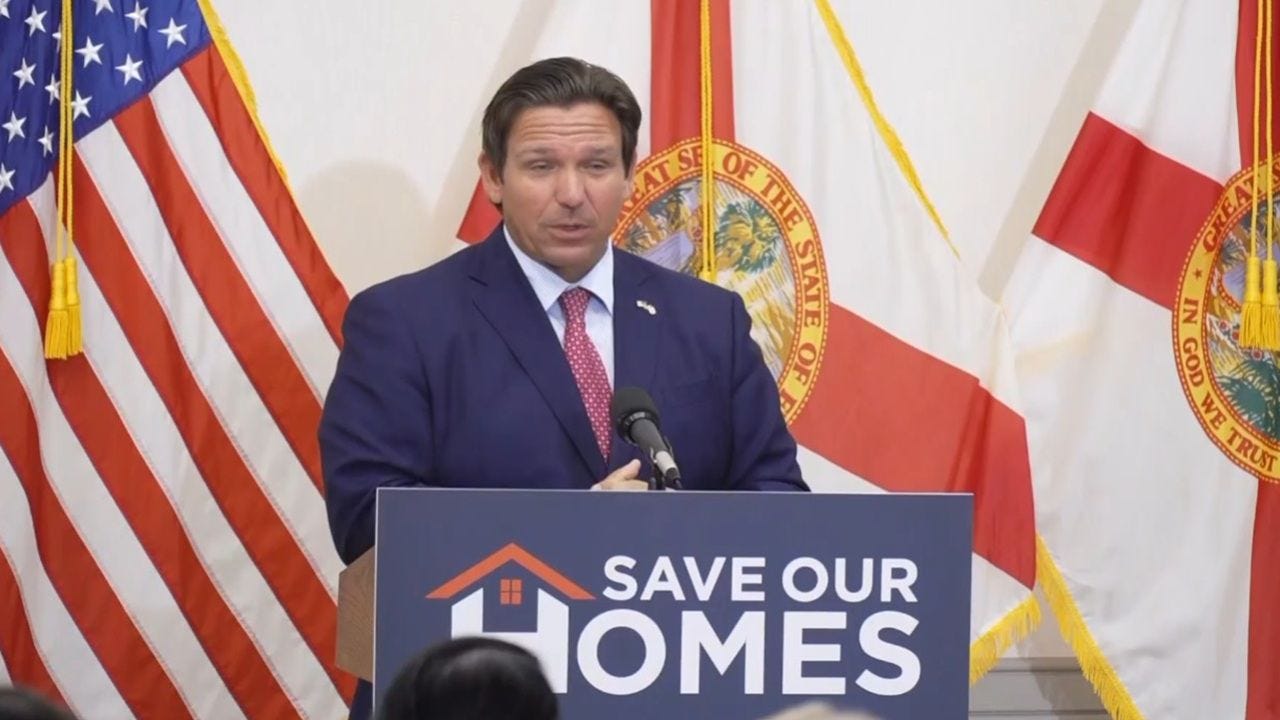
The gist
Governor DeSantis’s headline-grabbing plan to supercharge Florida’s homestead exemption has ignited a fiscal firefight, pitting homeowners’ relief against cities’ survival—and sparking a high-stakes debate over who really pays for paradise.
What to know
- DeSantis aims to boost the homestead exemption from $50,000 to $500,000 by 2028, promising to wipe out non-school property taxes for up to 92% of homeowners—though analysts say only 75-80% would actually benefit.
- Local governments warn of devastating budget holes, with Orange and Osceola counties alone facing potential combined annual losses over $500 million and essential services hanging in the balance.
- Florida’s housing boom, fueled by a 50% price surge and a rush of wealthy newcomers from high-tax states, is intensifying both affordability woes and interstate tax rivalry.
DeSantis’s Tax Revolution
DeSantis’s sweeping homestead exemption plan aims to redefine homeownership in Florida by phasing out property taxes for most residents and shifting the tax burden to a one-time sales tax, fundamentally altering the state’s fiscal landscape and housing market.
Governor Ron DeSantis has championed a bold property tax reform aimed at abolishing or significantly expanding Florida's homestead exemption to relieve 92 percent of homeowners from property tax burdens. His plan, initiated through a special legislative session, proposes raising the exemption from the current $50,000 to $250,000 by 2028 and eventually to $500,000, effectively eliminating non-school property tax bills for millions of primary residences. This phased approach includes a five-year residency requirement for new residents, underscoring DeSantis’s focus on protecting long-term Floridian homeowners amid surging property values driven by historic in-migration.
DeSantis frames the abolition of property taxes as a moral imperative to restore true ownership and liberty, arguing that property taxes reduce homeowners to 'renters' of their own homes subject to eviction for nonpayment, regardless of how long they have owned their property. He envisions replacing the opaque, recurring property tax with a transparent, one-time sales tax collected at the closing table, thereby removing the perpetual government claim on homeownership and aligning Florida with other states that prioritize individual liberty and economic prosperity through lower tax burdens. This philosophical stance dovetails with his broader economic narrative, highlighting nearly $10 billion in tax relief and a state economy that has grown from $1.1 trillion to $1.85 trillion during his tenure.
Beyond tax relief, DeSantis’s proposal aims to bolster housing affordability and market activity by reducing monthly escrow payments, which improves borrowers’ debt-to-income ratios and expands loan eligibility. Analysts from UBS estimate that homeowners in key counties like Broward and Miami-Dade could save between $1,500 and $1,800 annually, while Realtor.com projects that eliminating homestead property taxes could increase statewide home values by 7 to 9 percent, adding up to $250 billion in housing wealth. To mitigate fiscal impacts on local governments, particularly rural counties facing revenue shortfalls, DeSantis has proposed a trust funded by surplus state revenue, though critics question the adequacy and scalability of this measure.
The proposal also represents a significant shift in fiscal power from local governments to the state by stripping localities of a major controllable revenue source and restricting remaining property tax revenues to core services such as public safety and schools. This centralization reflects DeSantis’s broader strategy to override local housing policies to increase supply while acknowledging that supply-side solutions alone do not alleviate the tax burdens on long-tenured homeowners facing inflated assessments due to Florida’s unprecedented migration-driven housing demand.



Who Really Benefits?
Fiscal analysts warn that the proposed exemption will leave out millions of homeowners, deepen disparities between long-term residents and newcomers, and create gaping holes in local budgets with no clear replacement funding.
Financial analysts, including those at UBS, challenge Governor DeSantis's claim that expanding the homestead exemption to $500,000 would eliminate property taxes for 92% of Florida homeowners, citing state data that suggests only 75% to 80% coverage at that threshold. UBS highlighted a significant discrepancy between the governor’s promise and Florida’s Office of Economic and Demographic Research data, which shows only about 47% of homesteaded properties valued at $250,000 or less, contradicting the claimed 60%. This gap raises questions about the accuracy of the plan’s touted benefits and its actual reach among homeowners.
While the proposal could yield average annual property tax savings estimated at $1,500 to $1,800 in counties like Miami-Dade and Broward, critics argue these benefits disproportionately favor older, long-tenured homeowners and existing residents, as newcomers face a five-year wait for enhanced exemptions. This design risks entrenching disparities and limiting housing affordability for new arrivals, potentially exacerbating inequities amid Florida’s rapid population growth of 3 to 3.5 million since 2019, which simultaneously increases demand for public services and strains local budgets.
A core critique centers on the proposal’s failure to identify replacement revenue sources for local governments, threatening funding for essential services such as schools, police, and firefighters. House Minority Leader Fentrice Driskell emphasized, 'There is no plan to make our local governments whole on the back end,' while the proposed trust fund to offset rural counties’ losses remains vague and untested at the scale required by a $500,000 exemption. This fiscal uncertainty fuels concerns about the sustainability of local services and the broader quality of life for Floridians.
Analysts warn that eliminating or drastically reducing property taxes undermines a stable and efficient revenue source tied directly to land—an inelastic and immobile asset less susceptible to tax avoidance than income or sales taxes. Property taxes uniquely link taxpayers to local services, allowing voters to see tangible benefits reflected in property values and service quality. By shifting fiscal power from local governments to the state and restricting remaining property tax revenues to 'core services,' the plan risks eroding local fiscal autonomy and disconnecting residents from the accountability mechanisms that property taxes traditionally provide.
Cities Face Fiscal Cliff
Florida’s local governments warn of massive budget shortfalls and loss of control over public services as property taxes—their financial backbone—are threatened by sweeping state-level reforms.
Local governments across Florida are sounding alarms over the expanded homestead exemption's impact on their budgets, with Orange County facing a potential $253 million loss (nearly 14% of its levy), Seminole County $113 million (24%), and Osceola County $250 million (15%), according to the Florida Association of Counties. These shortfalls threaten essential services ranging from police and fire protection to parks and mosquito control, with cities like Winter Springs entering 'survival mode' where even drastic cuts to recreational programs won't bridge the funding gap, as Mayor Kevin McCann warns.
The amendment fundamentally shifts fiscal power by capping assessed value increases on homesteaded properties through the Save Our Homes provision, limiting local governments' ability to raise property tax revenues to offset losses. While municipalities can increase fees and assessments not tied to property values, this pivot to alternative revenue sources underscores a broader erosion of local fiscal autonomy, forcing officials to depend more heavily on state-level decisions and complicating budget planning amid uncertain funding streams.
Property taxes have long been the dominant and stable revenue source for Florida’s local governments and school districts, ensuring a direct link between taxpayers and beneficiaries that disciplines spending and sustains service quality. Eliminating or drastically reducing these taxes without a clear replacement funding strategy threatens to undermine this balance, shifting fiscal authority to Tallahassee and raising concerns about diminished local control and inevitable cuts to vital public services, as critics highlight the absence of any concrete plan to finance local government costs post-reform.
Tax Migration Arms Race
Florida’s bid to attract wealthy newcomers is fueling both a luxury real estate boom and fierce interstate tax competition, as states like New York retaliate with targeted taxes to reclaim lost revenue.
Florida's allure as a tax haven and safer alternative has sparked a significant influx of wealthy residents fleeing high-tax, high-cost states like California and New York. By early 2026, Los Angeles County alone lost over 54,000 residents, including tech moguls such as Mark Zuckerberg, Jeff Bezos, and Google founders Larry Page and Sergey Brin, who have relocated to Florida, boosting its luxury real estate market and economic profile. This migration wave is so pronounced that Miami real estate marketing actively targets affluent Californians, exemplified by billboards in Los Angeles promoting multimillion-dollar listings with the message 'your wealth is wanted in Miami,' underscoring the fierce interstate competition for wealthy taxpayers.
The surge of affluent newcomers from expensive Northeastern cities like New York has dramatically intensified Florida's housing demand, driving home prices up more than 50% between 2020 and 2022 and inflating property tax assessments despite stable tax rates. Governor DeSantis’s response includes a constitutional amendment proposal to expand homestead exemptions and legislation stripping local governments of zoning control to accelerate workforce housing development. However, while increasing supply addresses the housing crunch, it fails to relieve existing homeowners burdened by soaring assessments, illustrating the complex fiscal challenges migration-driven growth imposes on Florida’s tax base and affordability.
Interstate policy maneuvers are emerging as states grapple with the fiscal impacts of migration-driven tax base shifts. New York, for instance, has enacted a pied-à-terre tax targeting luxury second homes owned by part-time Floridian residents who do not qualify for Florida’s expanded homestead exemption, a move championed by NYC Mayor Zohran Mamdani and Governor Kathy Hochul. This strategy aims to recapture revenue from wealthy individuals who maintain residences in both states, potentially redistributing tax burdens and complicating Florida’s efforts to attract and retain affluent migrants.
While Florida’s migration boom initially promised greater affordability and economic vitality, tax experts like Gary Bingel warn that the influx of newcomers is replicating the very problems they sought to escape, such as skyrocketing property taxes and housing shortages. This paradox highlights the unintended consequences of rapid demographic shifts, where Florida’s growing popularity among wealthy migrants from high-tax states ironically fuels the same affordability challenges that prompted their relocation, intensifying the ongoing debate over property tax reform and housing policy.