Digital realty’s $7.8b AI data center bet
The gist
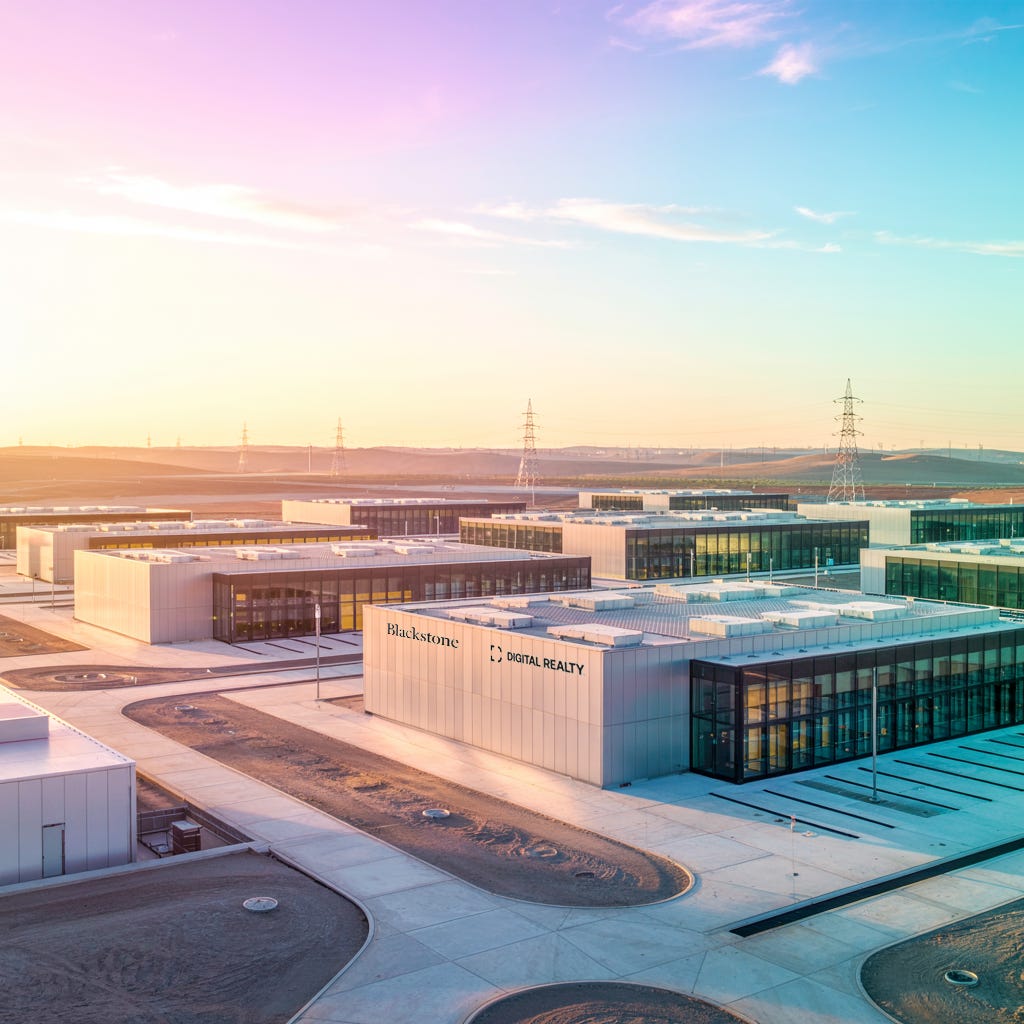
Digital Realty is betting $7.8 billion on Northern Virginia’s data center gold rush, snapping up Blackstone’s stake to fuel the AI infrastructure arms race.
What to know
- The deal adds 288 megawatts of fully leased hyperscale capacity under 15-year contracts—at a jaw-dropping $27 million per megawatt price tag.
- Digital Realty’s PlatformDIGITAL now spans 300+ global facilities, enabling dense, low-latency AI and GPU workloads with seamless cloud connections.
- A creative $3.5 billion financing mix preserved liquidity, but Blackstone’s rapid share sale spiked equity costs and triggered a 5% stock dip for Digital Realty.
Hyperscale Expansion Playbook
Digital Realty is reshaping global data center dominance with bold acquisitions, strategic land buys, and long-term hyperscale leases that lock in cash flow and accelerate international growth.
Digital Realty's strategic acquisitions and land purchases underscore its aggressive expansion into hyperscale data center infrastructure, with a notable $475 million site acquisition near Kansas City and an increased stake in Teraco to 77%, signaling a commitment to global growth. The $1.6 billion acquisition of Columbia Capital further bolsters its investment capabilities in digital infrastructure, positioning Digital Realty to capitalize on rising demand for hyperscale capacity across key markets.
The landmark $7.8 billion acquisition of Blackstone’s 64% stake in three fully leased hyperscale data centers in Northern Virginia, totaling 288 megawatts, marks a pivotal expansion of Digital Realty’s market presence in one of the world’s most constrained and coveted data center hubs. These facilities, leased to three distinct investment-grade hyperscale customers under 15-year leases with 3.6% annual rent escalators, provide a stabilized, long-term cash flow foundation that enhances portfolio quality and organic growth prospects.
Digital Realty’s innovative financing approach for the Blackstone deal—using $1.2 billion in cash combined with $2.3 billion in newly issued non-voting common stock—reflects a sophisticated capital strategy to acquire high-value hyperscale assets without overleveraging cash reserves. While this stock issuance allows Blackstone to maintain exposure to Digital Realty’s growth, the rapid resale of shares by Blackstone affiliates highlights the increasing costs and complexities REITs face when using equity as acquisition currency in large-scale transactions.
This acquisition exemplifies a broader industry shift in constrained markets like Northern Virginia, where scarcity of powered, permitted, and fully leased hyperscale capacity drives premium valuations far above traditional development costs—Digital Realty paid roughly $27 million per megawatt for stabilized assets. As greenfield development pipelines falter, operators pivot from speculative projects to owning fully operational, escalator-bearing data centers, securing predictable yields around 6.5% and underscoring the strategic value of converting joint ventures into wholly owned, stabilized portfolios.




AI-Ready Data Center Fabric
PlatformDIGITAL’s standardized, high-density campuses and metro clustering strategy enable seamless, low-latency AI operations and direct cloud interconnects for enterprise and hyperscale customers.
Digital Realty’s PlatformDIGITAL ecosystem stands as a cornerstone for AI-optimized data center services, spanning over 300 facilities across 25+ countries with major U.S. hubs in Northern Virginia, Dallas, and Silicon Valley. This standardized platform enables enterprises and cloud providers to deploy scalable, high-density AI and GPU workloads with consistent design and operations, while facilitating low-latency, direct interconnection through peering fabrics and carrier meet-me rooms—critical for hyperscale cloud and data-intensive applications.
Leveraging its proprietary Data Gravity Index, Digital Realty strategically positions PlatformDIGITAL campuses in dense metro hubs like Northern Virginia and San Francisco to minimize latency and networking complexity, thereby optimizing AI workload performance. This approach supports U.S. enterprises in hosting AI-ready private clouds and integration layers that seamlessly connect to major public clouds such as AWS, Azure, and Google Cloud, reinforcing PlatformDIGITAL’s role as a vital colocation and interconnection environment.
Digital Realty is aggressively scaling its AI infrastructure capacity, exemplified by a record-breaking 200-megawatt AI inference lease with a AA-rated hyperscaler in Charlotte, set to phase in through 2028. Complementing this expansion, the company integrates cutting-edge liquid cooling technologies to manage the intense thermal demands of AI accelerators and pioneers a 24/7 hourly renewable energy matching program with Vattenfall in Europe, ensuring sustainable and reliable power for AI workloads.
Looking ahead, Digital Realty is future-proofing its infrastructure by developing large, interconnected campuses designed to support hyperscale AI deployments alongside emerging energy innovations like hydrogen fuel cells. The $2 billion UK mega-campus exemplifies this vision, transitioning hydrogen fuel cells from a long-term concept to a planned, dispatchable clean power source integrated directly into AI-optimized data center operations.
Equity-Driven Mega Deal
A creative cash-and-stock structure let Digital Realty secure prized hyperscale assets while Blackstone’s rapid share sale exposed the hidden equity costs and market risks of REIT mega-acquisitions.
Digital Realty's innovative financial strategy for acquiring Blackstone’s 64% stake in three hyperscale Northern Virginia data centers deftly combined $1.2 billion in cash with $2.3 billion in newly issued non-voting common stock, enabling a $3.5 billion transaction without over-leveraging cash reserves. This approach not only preserved liquidity but also leveraged the public REIT’s stock as a strategic acquisition currency, exemplifying the symbiotic relationship between private equity and public markets where private capital fuels asset growth and public equity provides acquisition flexibility.
Blackstone’s immediate secondary offering of the $2.3 billion in Digital Realty shares, underwritten by Morgan Stanley, allowed it to swiftly convert equity into cash without directly impacting Digital Realty’s capital structure. However, this quick sale increased the effective cost of equity financing for Digital Realty and other REITs using stock as acquisition currency, as evidenced by a roughly 5% stock price dip post-deal due to near-term dilution and delayed accretion to funds from operations (FFO).
The acquisition is poised to be accretive to Digital Realty’s Core Funds From Operations per share in 2027 and 2028, enhancing portfolio quality with fully leased hyperscale assets at a fair 6.5% cap rate and long-term rent escalators. Yet, the deal’s layered financial structure—combining equity issuance, assumption of additional debt, and a $1.4 billion capital expenditure commitment for development—reflects a sophisticated capital deployment strategy balancing growth with prudent risk management.
Beyond traditional equity and debt, Digital Realty and other REITs are expanding capital market engagement by forging direct joint ventures with institutional investors and launching investment management platforms, broadening financing avenues in a competitive hyperscale data center market. This evolution is complemented by a broader shift in capital flows upstream into contracted power generation assets, such as National Grid Ventures’ $1.75 billion investment in Joulent’s West Texas facility, signaling a transformative move toward power-as-equity financing involving utilities, oil majors, and hyperscalers.


Power, Contracts, and Clean Energy
Digital Realty’s revenue growth and AI ambitions rest on securing scarce power, ironclad take-or-pay contracts, and pioneering 24/7 renewable energy tracking to future-proof its energy-hungry campuses.
Digital Realty’s growth engine is fundamentally power-constrained, with a $1.8 billion signed-but-not-commenced backlog reflecting a weighted-average 19-month lag between contract signing and project commencement. This model underscores how future revenue hinges on securing and efficiently utilizing limited power capacity, as evidenced by the company’s high portfolio occupancy of 90.1% and same-capital occupancy of 91.6%, which together drove a 7.9% year-over-year increase in same-capital cash NOI.
Securing reliable, long-term energy supply is paramount for scaling hyperscale and AI-optimized data centers, as demonstrated by National Grid Ventures’ $1.75 billion investment in a 2.67GW Chevron-built plant contracted to Microsoft. Digital Realty’s financial viability in this space depends on take-or-pay contracts with robust termination protections, exemplified by Anthropic’s $1.25 billion monthly commitment through 2029 for Colossus 1 and Google’s $920 million monthly commitment for Colossus 2, ensuring stable power procurement aligns with massive AI compute demands.
Transitioning beyond traditional annual renewable energy matching, Digital Realty has pioneered a 24/7 hourly renewable energy matching program with Vattenfall in Sweden and France, enabling real-time carbon-free energy tracking that aligns precisely with the continuous power demands of AI data centers. To address immediate grid constraints, the company employs on-site gas generation in Dublin as a bridge solution, while its $2 billion UK mega-campus is designed for future hydrogen fuel cell integration, signaling a strategic commitment to dispatchable, next-generation clean energy technologies.
Recognizing that cooling systems and servers consume nearly 80% of AI data centers’ power, Digital Realty is deploying advanced liquid cooling technologies to manage the substantial thermal loads generated by AI accelerators. This focus on innovative cooling solutions complements their broader energy strategy, ensuring operational efficiency and sustainability as AI workloads continue to intensify.