Earnix AIOS targets insurance AI trust failures
The gist
Earnix’s new AI Orchestration System (AIOS) is shaking up insurance by unifying scattered AI tools, slashing pilot failure rates, and putting governance at the heart of enterprise-wide adoption.
What to know
- AIOS tackles the industry’s 95% AI pilot failure rate by merging underwriting, claims, and pricing AI into a single, governed platform launched in June 2026.
- With built-in audit trails and robust governance, AIOS ensures regulatory compliance and transparency across the US and Europe, restoring much-needed trust for boards and regulators.
- Despite rising AI adoption, only 13.8% of customers trust AI-driven insurance recommendations—highlighting the sector’s urgent need for explainable, human-supervised AI workflows.
Breaking Down AI Silos
Earnix AIOS unifies fragmented insurance AI tools into a governed, enterprise-wide platform, enabling real-time, market-speed decisions and ending the era of isolated, failed pilots.
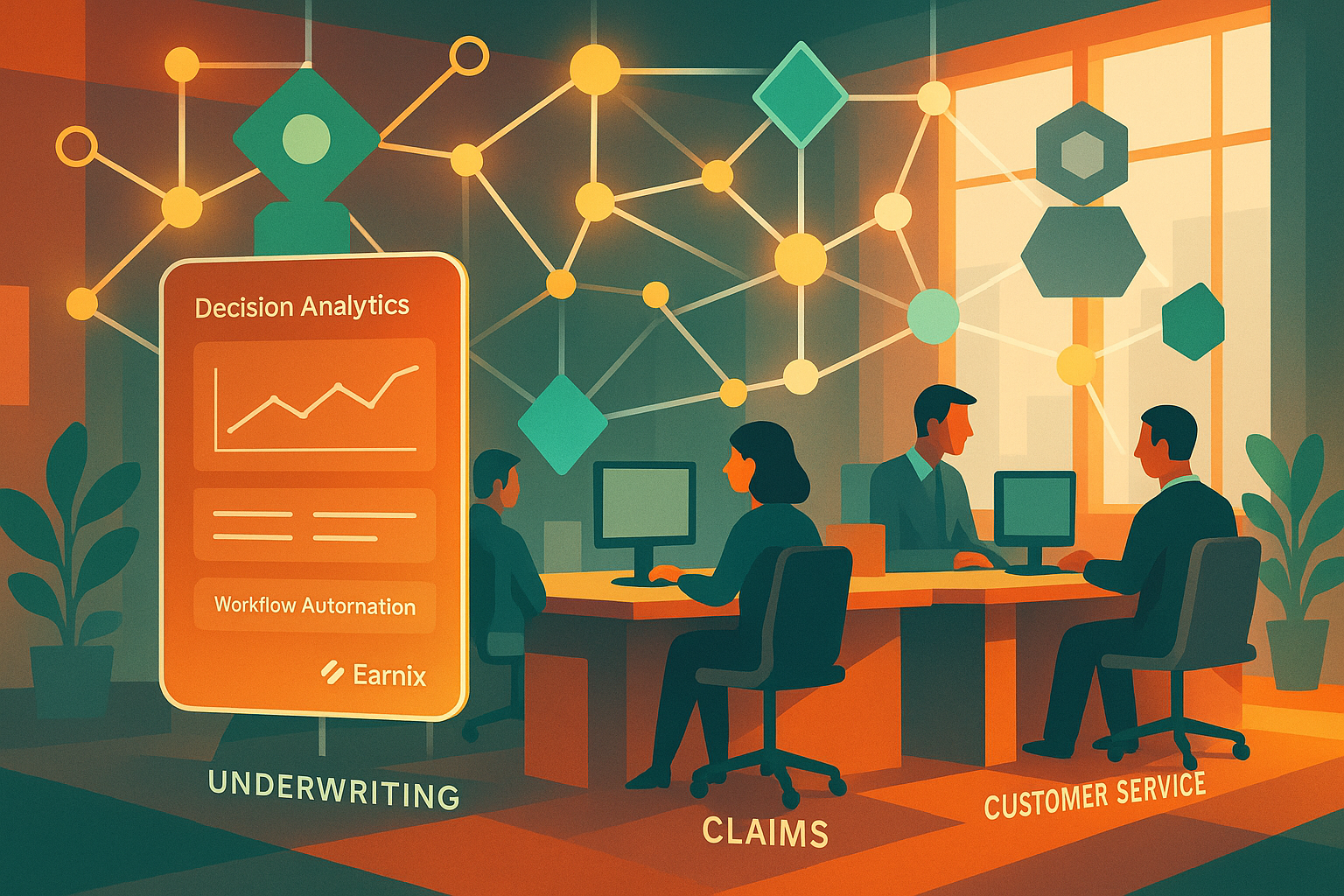
Earnix’s AI Orchestration System (AIOS) emerges as a strategic response to the pervasive fragmentation of AI tools within insurance operations, which Earnix identifies as a key factor behind the staggering 95% failure rate of AI pilots reaching production, as highlighted by MIT research. By unifying disparate AI models and workflows across underwriting, claims, and pricing into a single governed platform, AIOS breaks down silos that traditionally hinder data flow and decision consistency, enabling insurers to move beyond isolated pilot successes toward scalable, enterprise-wide AI adoption.
Central to AIOS’s design is its robust governance framework that ensures transparency, auditability, and regulatory compliance across the US and Europe. Earnix emphasizes that every AI-driven decision within AIOS carries a full audit trail detailing data usage and rationale, addressing insurers’ critical need for explainability and trustworthiness in AI outputs. This governance layer not only satisfies board and regulator demands but also supports faster, repeatable decision cycles that compress response times without sacrificing oversight.
AIOS integrates seamlessly with existing legacy systems through open interfaces, avoiding costly infrastructure overhauls while orchestrating predictive, generative, and agentic AI capabilities into a cohesive decisioning layer. This architecture enables real-time, connected decision-making across underwriting, claims, and pricing, empowering insurers to close the so-called 'insurance agility crisis'—the widening gap between rapidly evolving risks and insurers’ slow, fragmented responses. Leveraging Earnix’s 25 years of pricing and rating expertise, AIOS aims to transform siloed intelligence into governed, market-speed decisions that scale efficiently across geographies and volumes.

Governance: The New AI Imperative
AI governance now outranks speed and capability, with insurers prioritizing transparency, human oversight, and compliance to prevent silent risks and operational failures from unmonitored AI agents.
By early 2026, AI governance has emerged as the foundational pillar for successful AI agent deployment in insurance, surpassing even model capability or adoption speed in importance. Industry giants like Microsoft, Apple, Cisco, and Salesforce have collectively underscored governance as the critical gatekeeper, signaling a paradigm shift where identity, security controls, and continuous observability are prerequisites rather than afterthoughts. This emphasis addresses the insidious risk of ungoverned AI agents causing silent operational degradation—where minor inaccuracies compound unnoticed over hundreds of transactions, eroding margins and exposing firms to compliance violations without triggering traditional alerts.
Insurance organizations face a significant governance gap, particularly in the mid-market, where 80% of firms have encountered risky AI behaviors such as unauthorized access and improper data exposure, largely due to insufficient observability infrastructures. Effective operational readiness demands that AI agents operate on trusted systems of record with clear data ownership and permission controls, ensuring explainability and integration across complex workflows. As TechTarget highlights, partial automation under human supervision is currently the most pragmatic approach, balancing AI efficiency with the indispensable role of human judgment to maintain compliance and reliability in underwriting and claims processes.
The governance of AI in commercial insurance has evolved into a multidisciplinary mandate involving underwriting leadership, legal, compliance, cybersecurity, and boards of directors, reflecting the growing strategic and regulatory complexity. Explainability has become non-negotiable for maintaining trust and regulatory compliance, with underwriters and compliance teams requiring transparency on AI-driven decisions such as premium adjustments—understanding whether recommendations stem from claims history, location exposure, or financial signals. Human-in-the-loop models are now the norm, positioning AI as an assistant rather than a replacement, thereby balancing efficiency gains with accountability and ensuring that experienced professionals retain final decision authority.
Robust AI governance frameworks are not only risk mitigators but also competitive differentiators and financial levers within insurance. Platforms that quantify governance adherence using standards like NIST and ISO enable insurers to concretely calculate premium exposure and demonstrate responsible AI practices, potentially lowering premiums and reducing board liability. However, a critical knowledge gap persists among insurance boards, with 66% reporting limited AI understanding and only 5% fully integrating AI into corporate strategy, underscoring the urgent need for governance platforms that enhance oversight, map AI activities to evolving regulations, and provide continuous compliance updates in a dynamic regulatory landscape.
From Pilots to Predictive Power
Insurers are shifting from scattered AI pilots to integrated, cloud-based deployments that automate workflows and drive agility, while still struggling to bridge the trust gap between AI and human expertise.
By early 2026, the insurance industry is undergoing a pivotal shift from isolated AI pilot projects to strategic, enterprise-wide deployments that integrate AI across underwriting, claims, pricing, and customer service. Reports from Eminent Global Research Solutions and Majesco highlight that Leaders in the sector are leveraging AI as a core business imperative, redesigning operational models with cloud and AI-native technologies to achieve unprecedented agility and competitive advantage. This transition is driven by AI's ability to automate routine workflows, enhance decision quality, and create new revenue streams, moving insurers from reactive to predictive management.
Despite rising AI adoption, the industry grapples with a profound agility crisis rooted in fragmented decision-making and siloed functions such as pricing, underwriting, and claims. Earnix characterizes this as the widening gap between rapidly evolving risks and insurers' sluggish response capabilities, exacerbated by AI gains that remain local and fail to scale enterprise-wide. This fragmentation not only slows risk responsiveness but also creates blind spots and friction, underscoring the urgent need for unified AI workflows that compress decision cycles without sacrificing governance or explainability.
Balancing AI efficiency with human accountability remains a critical challenge as insurers like State Farm phase out thousands of independent agents in favor of AI-backed sales models featuring digital assistants and tailored recommendations. However, customer trust in AI-driven information is notably low—only 13.8% of users express confidence—highlighting the necessity to clearly delineate AI recommendations from human judgment. Industry analyses emphasize defining ownership, challenge mechanisms, and recovery processes to ensure that AI accelerates customer journeys without compromising emotional intelligence or accountability.
The strategic deployment of AI in insurance is evolving beyond mere cost savings to generating new value through faster decision-making, improved product quality, and enhanced operational efficiency. AI agents are increasingly utilized for complex analyses such as price elasticity and profitability, enabling insurers to 'try fast and fail fast' with less effort, fostering a culture of rapid experimentation. However, successful scaling depends heavily on robust data foundations—maturity, governance, and integration—as well as avoiding excessive bureaucracy, ensuring AI initiatives deliver tangible outcomes rather than becoming governance-heavy exercises.