Edge AI race heats up: rugged PCs push 180 TOPS power
The gist
Edge AI is surging into the heart of industry as new rugged PCs smash the 180 TOPS barrier, powering real-time, multi-camera robotics and factory automation—no cloud required.
What to know
- Advantech, AAEON, and Vecow have unleashed industrial PCs with up to 180 TOPS AI performance, leveraging Intel Core Ultra Series 3 for blazing-fast, on-premises inference.
- Platforms like Advantech’s ARK-2252 and DFI’s Mini-ITX boards are engineered for extreme conditions, combining fanless, compact designs with robust industrial I/O and modular expansion.
- ASUS and major tech partners are building end-to-end AI ecosystems, delivering rugged, scalable edge solutions that keep sensitive data local and operations resilient.
AI Power Meets Harsh Environments
Industrial PCs like AAEON’s UP Xtreme PTL Edge and Advantech’s ARK-2252 are fusing 180 TOPS AI performance with rugged, compact builds to enable real-time robotics and multi-camera analytics directly on the factory floor.
AAEON’s UP Xtreme PTL Edge exemplifies cutting-edge industrial automation by harnessing the Intel Core Ultra Series 3 processor to deliver an impressive 180 TOPS of AI performance, enabling complex real-time AI inference with minimal latency. Its compact, rugged design supports multi-camera analytics, object detection, and seamless integration with sensors and PLCs, all while running robust software stacks like Ubuntu 24.04 LTS and OpenVINO to accelerate AI workloads in harsh industrial environments.
Advantech’s ARK-2252 pushes the boundaries of intelligent robotics in industrial settings by combining a fanless, compact form factor with powerful AI inference capabilities powered by the Intel Core Ultra Series 3 processor. With 180 TOPS AI power and support for up to 128 GB DDR5 memory, it processes multi-camera vision data locally to drastically reduce perception-to-action latency, enabling real-time robotic manipulation without reliance on cloud infrastructure. Its extensive industrial connectivity and the WEDA software ecosystem further facilitate scalable deployment and streamlined management of AI-driven robotic solutions.
Scalable Edge AI, No Compromises
Vecow and ASRock Industrial are leading modular, stackable edge platforms—delivering 180 TOPS AI in ultra-compact, customizable systems that flexibly scale performance and connectivity for demanding, space-constrained deployments.
The Vecow TGS-2000 Series exemplifies modular scalability in Edge AI with its ultra-compact, stackable design that allows seamless expansion through AI accelerators, high-speed I/O, and wireless modules. Powered by a 16-core Intel Core Ultra Series 3 processor featuring a hybrid CPU+GPU+NPU architecture delivering up to 180 TOPS, it supports diverse applications from medical imaging to intelligent factories, enabling businesses to scale performance flexibly without replacing entire systems.
ASRock Industrial’s NUC Ultra 300 BOX Series complements the trend toward scalable, flexible Edge AI by offering a compact platform optimized for space-constrained environments across industries like retail and manufacturing. With up to 180 TOPS AI performance and extensive connectivity options including dual 2.5GbE LAN, USB4/Thunderbolt 4, and Wi-Fi 7, its slim form factors provide versatile deployment possibilities for smart commercial applications and immersive digital experiences.
Both Vecow and ASRock emphasize ruggedness and customization in their scalable Edge AI solutions, with Vecow’s TGS-2000 supporting a wide temperature range (-25°C to 55°C) and diverse I/O modules such as isolated DIO and 4G/LTE, enhancing adaptability to challenging edge environments. This focus on robust, customizable hardware ensures that flexible expansion does not come at the cost of reliability, meeting the varied demands of next-generation intelligent systems.
Built Tough for Robotics
AAEON, DFI, and Advantech are engineering robust, thermally stable AI hardware for mission-critical robotics, integrating powerful inference and diverse I/O to slash latency and cloud reliance in the most demanding environments.
The AAEON UP Xtreme PTL Edge and DFI ARH171/ARH173 Mini-ITX platforms exemplify rugged, compact hardware engineered for harsh industrial environments and mission-critical robotics. AAEON’s device boasts a stable thermal profile within an 8.6” x 5.1” x 2.0” form factor, while DFI’s boards support 24/7 operation with wide-range DC input and modular sensor integration, addressing the demanding reliability and space constraints of autonomous systems.
Both AAEON and DFI integrate high-performance AI capabilities directly on their platforms to enable real-time edge inference crucial for robotics applications. AAEON’s UP Xtreme PTL Edge leverages an Intel Core Ultra Series 3 processor delivering 180 TOPS through combined CPU, GPU, and NPU, while DFI’s Mini-ITX boards utilize Intel Arc GPUs and dedicated NPUs to achieve up to 99 TOPS, reducing the need for discrete graphics and minimizing thermal and spatial overhead.
Advantech’s ARK-2252 further advances rugged robotics applications with a fanless, compact design capable of operating between -20 to 60 °C and supporting a wide 12–24 VDC power input. Its extensive industrial I/O—including multiple 2.5 GbE LAN ports, serial interfaces, CANBus, and triple 4K display outputs—facilitates seamless integration with diverse sensors and peripherals, enabling complex multi-camera vision processing and AI inference directly at the edge to reduce latency and cloud dependency.
Modularity and remote management are key themes across these platforms, enhancing adaptability and operational resilience in specialized robotics deployments. Advantech’s support for M.2 expansion and iDoor modules allows customization for wireless, vision, PoE, and I/O needs, while DFI’s inclusion of Intel vPro technology and optional out-of-band power cycling ensures robust remote hardware management, minimizing downtime and maintenance costs in mission-critical environments.
ASUS’s Edge AI Ecosystem Strategy
ASUS is uniting industry giants to deliver end-to-end AI infrastructure, pairing data center muscle with rugged edge computers that safeguard sensitive data and ensure reliable AI in volatile industrial settings.
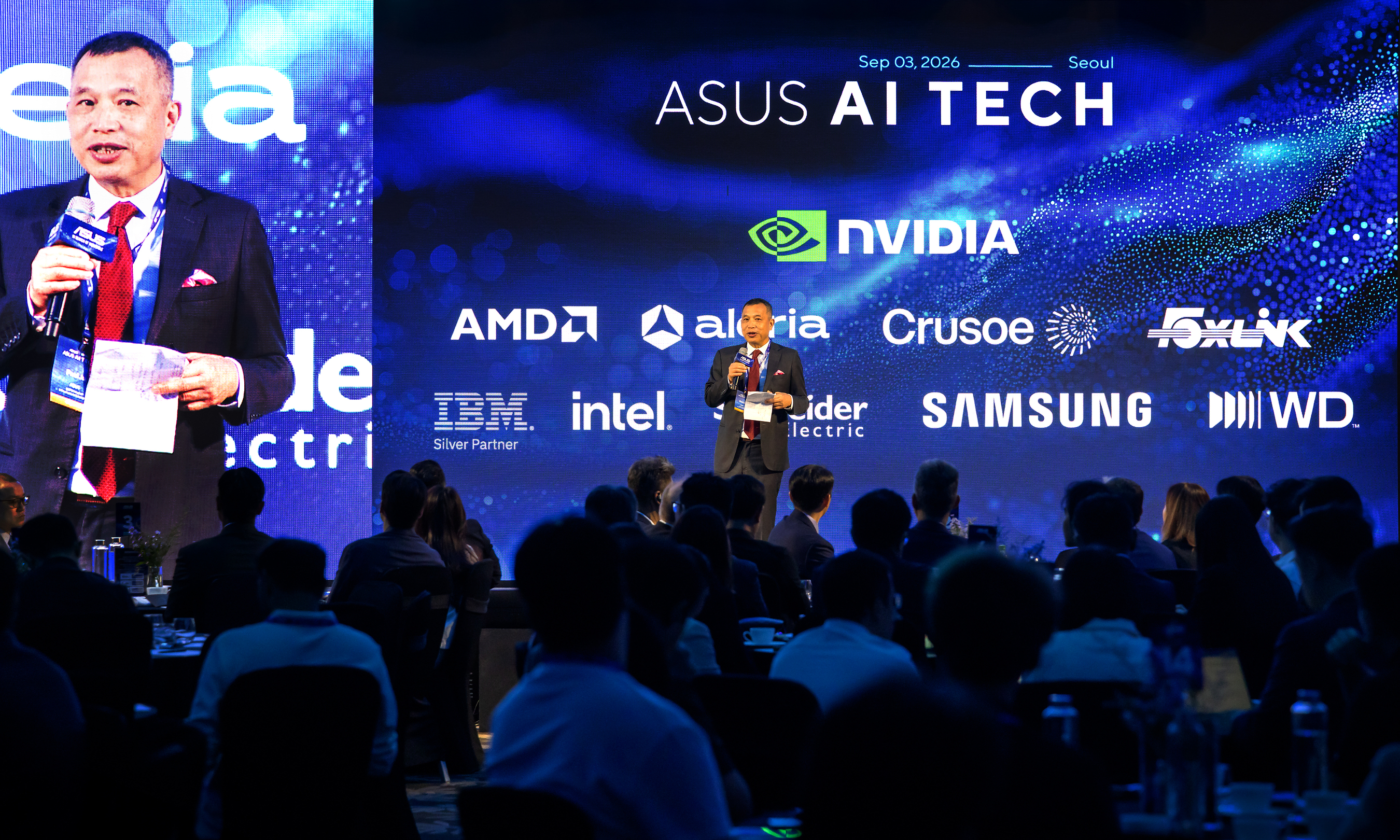
ASUS is strategically broadening its AI infrastructure ecosystem by partnering with industry giants such as Intel, AMD, IBM, Samsung, and Schneider Electric to deliver high-performance AI computing solutions that seamlessly span from cloud data centers to edge environments. This collaborative approach enables ASUS to offer a robust portfolio featuring scalable platforms powered by Intel Xeon and AMD EPYC processors, tailored to support diverse AI workloads across enterprise and industrial applications. Complementing these data center solutions, ASUS advances real-time AI intelligence at the industrial edge with rugged, fanless embedded computers like the RUC-2000 series, which harness Intel Core Ultra Series 3 processors delivering up to 180 AI TOPS for demanding use cases such as machine vision, video analytics, and in-vehicle AI.
Recognizing the critical importance of data confidentiality and operational resilience, ASUS emphasizes edge AI infrastructure designed to process sensitive information locally within challenging environments such as factories, hospitals, and power plants. By enabling onsite data handling, ASUS’s hardware mitigates risks associated with cloud transmission of confidential patient records, production metrics, and surveillance footage, while its ruggedized systems are engineered to withstand extreme temperatures, unstable power supplies, and electrical noise, ensuring reliable AI performance in harsh industrial conditions.