Electric mining trucks surge ahead with new battery breakthroughs
The gist
Electric mining trucks just hit the fast lane, with battery breakthroughs and autonomous fleets shaking up the global mining industry.
What to know
- Zijin Mining is rolling out nearly 300 electric LK220E trucks with swappable 776 kWh batteries, delivering 17% energy savings—even at 5,300 meters altitude.
- Hina Battery and Shaanxi Tonly debuted the world's first sodium-ion mining truck, packing a 676 kWh battery that fast-charges in 20–25 minutes and thrives in deep freeze conditions.
- Tonly scored an 800-truck autonomous deal in China while giants like SANY and LKAB are launching all-electric fleets from Swedish tunnels to South American sites.
Zijin's Battery Swap Revolution
Zijin Mining's proprietary LK220E trucks achieve rapid four-minute battery swaps and over 90% uptime in extreme high-altitude conditions, reshaping operational efficiency in mining.
By the end of 2025, Zijin Mining had developed and begun producing its proprietary battery-electric mining dump truck model LK220E to address operational needs unmet by existing market options. These trucks feature swappable 776 kWh batteries, and an automated battery-swapping system capable of completing rapid four-minute swaps even in extreme temperatures ranging from minus 40 to plus 40 degrees Celsius, showcasing a significant leap in operational efficiency and adaptability.
Operating in the challenging high-altitude environment of the Julong copper mine at 5,300 meters, the LK220E trucks demonstrated over 90% availability and reduced energy consumption by more than 17% compared to similar models. This performance underscores the robustness and energy efficiency of Zijin’s battery-electric fleet under demanding conditions.
By mid-2026, Zijin had scaled its battery-electric fleet to nearly 300 trucks deployed across multiple sites, including the Xinjiang Zijin zinc mine where these electric trucks now handle over 80% of the mine’s transport volume. This rapid expansion highlights Zijin’s commitment to electrification and the operational benefits realized through their proprietary technology amid a market lacking suitable alternatives.

Sodium-Ion Trucks Debut
Hina Battery and Shaanxi Tonly's sodium-ion trucks deliver fast charging, deep-freeze resilience, and are poised to match lithium-ion costs by 2028, unlocking new durability standards for mining fleets.
In July 2026, Hina Battery and Shaanxi Tonly Heavy Industries unveiled the world’s first sodium-ion battery-powered electric mining truck for Sanyou Group, featuring a 676-kWh Haixing series battery with an energy density above 165 Wh/kg. This breakthrough battery system can fast-charge from 0% to 100% in just 20 to 25 minutes and boasts a remarkable cycle life exceeding 8,000 cycles, positioning it as a durable and efficient solution tailored for the demanding mining sector. CEO Li Shujun highlighted that sodium-ion cell costs are projected to reach parity with lithium-ion by 2027–2028, a development expected to accelerate widespread adoption of this technology in mining fleets.
Sodium-ion batteries distinguish themselves with superior low-temperature performance and enhanced durability compared to lithium-ion counterparts, retaining over 90% capacity even at -40°F and enduring more than 8,000 fast-charging cycles. While their energy density is lower than lithium iron phosphate batteries, these attributes make sodium-ion cells especially suited for fixed-route mining trucks operating in harsh environments where temperature resilience and rapid turnaround times are critical. This strategic trade-off underscores the technology’s alignment with the operational demands of heavy-duty mining vehicles.
The deployment of the Tangshan sodium-ion mining truck serves as a vital real-world testbed, operating under sustained heavy-load conditions to generate data that will directly inform future iterations of sodium-ion battery technology. This milestone aligns with 2026 being a pivotal year for sodium-ion batteries transitioning from prototype to commercial product across multiple sectors, as evidenced by CATL’s scaling of sodium-ion production for diverse applications and FAW Jiefang’s completion of all-scenario testing of a heavy-duty truck using Hina Battery’s technology earlier that year.

Autonomous Fleets Scale Up
Tonly’s 800-truck autonomous deal and Zijin Longking’s 230-ton electric behemoth mark a leap in both scale and cost efficiency, outpacing even the biggest global robotaxi deployments.
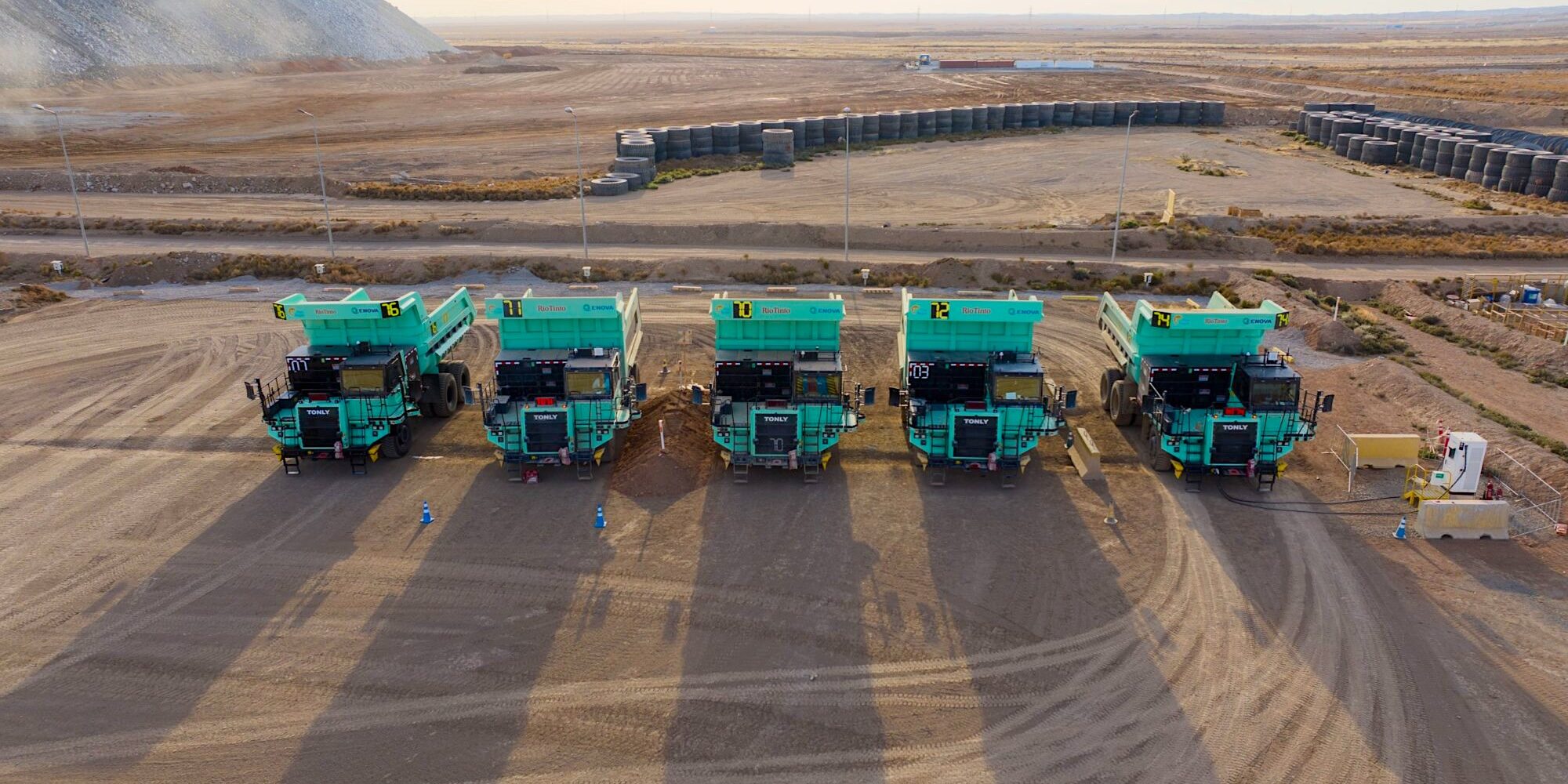
In a landmark move signaling a dramatic scale-up in mining fleet electrification, Tonly secured a record-breaking deal to deliver 800 autonomous electric mining trucks to Xinjiang Hanxiang, dwarfing other autonomous vehicle deployments like Tesla's 17-unit Robotaxi fleet. These trucks, including models such as the TLE135 and DTE145, leverage battery-electric power combined with rapid battery-swapping technology that enables pack replacement in about seven minutes, minimizing operational downtime and maximizing productivity.
Shortly after, Zijin Longking unveiled China's largest all-electric autonomous mining truck, the ZL230E, boasting a massive 230-ton payload and a 1,400 kWh battery capable of charging from 10% to 90% in just 25 minutes. Developed in partnership with Australia's EACON, this truck employs dual 800 kW electric motors and advanced autonomy to enable driverless operations in large open-pit mines, marking a significant leap in both capacity and operational sophistication.
Zijin Longking’s ambitious goal to replace conventional diesel mining trucks with electric models within three years underscores the operational and environmental advantages of this electrification wave, citing nearly 29% reductions in operational costs and over 17% energy savings compared to diesel counterparts. This shift not only promises substantial economic benefits but also aligns with broader sustainability objectives in the mining sector.
Global Electric Expansion
SANY and LKAB are pushing electric mining trucks into new frontiers, from South American open pits to Swedish underground mines over 4,000 feet deep, proving electric fleets can thrive anywhere.
In August 2026, SANY Group marked a significant milestone by shipping its first SKT110Ei autonomous electric mining trucks to South America, expanding its autonomous fleet operations beyond China. This deployment integrates an intelligent dispatching system and lifecycle maintenance services tailored to the unique local conditions, reflecting a comprehensive approach to electrification and autonomy in a new regional context.
Simultaneously, Swedish mining giant LKAB advanced the electrification frontier by deploying two 120-tonne battery-electric Scania trucks deep underground at its Malmberget iron ore mine, operating at depths up to 1,250 metres. These trucks, developed in collaboration with Scania since 2022, are the largest and heaviest battery-electric vehicles currently running underground, designed to match diesel trucks in productivity and availability while supporting LKAB’s ambitious goal to electrify 30% of its fleet by 2027.
Further emphasizing the adaptability of electric mining vehicles to challenging environments, LKAB’s underground trucks operate more than 4,000 feet below the surface where stable temperatures of 12 to 15 degrees Celsius and well-maintained roads optimize battery performance. Equipped with a 624 kWh battery and fast-charging infrastructure capable of 375 kW CCS charging, these trucks can run fully loaded for seven hours and recharge in about 80 minutes, enabling continuous, efficient underground operations.
The collaboration between LKAB and Scania has yielded highly customized electric trucks featuring a central electric machine with an automated gearbox and conventional driven axles, delivering the high torque necessary for heavy-duty underground haulage. As Peter Gustavsson, LKAB’s Project Manager for Electrification of Mobile Machines, notes, these tailored vehicles are pivotal in advancing safer, quieter, and more sustainable mining practices, demonstrating that electric heavy-duty transport is viable across diverse global mining environments today.

Autonomy Redefines Labor
Steer’s retrofittable autonomous haulage system shifts mining workforce needs from drivers to technicians, signaling a transformation in both fleet management and job roles across the sector.
By mid-2026, Steer revolutionized quarry fleet operations with its Next Generation Autonomous Haulage system, introducing retrofittable, low-cost driverless trucks managed remotely via centralized control centers. This innovation not only reduces reliance on traditional drivers but also shifts labor demand toward skilled technicians, reflecting a broader industry trend of evolving workforce roles in mining automation. Furthermore, Steer's platform breaks new ground by targeting cross-commodity applications, providing mining operations with a versatile alternative to conventional truck suppliers and expanding autonomous fleet management beyond single-ore specialization.
Fleet Electrification Gains Momentum
Mining’s rapid electrification is accelerating as proprietary batteries, fast-charging tech, and autonomous platforms converge to redefine productivity, sustainability, and global competitiveness.
Mining’s rapid electrification is accelerating as proprietary batteries, fast-charging tech, and autonomous platforms converge to redefine productivity, sustainability, and global competitiveness.