Enterprise AI grows up: from failed pilots to agentic unicorns and audit-ready automation
The gist
Enterprise AI has finally outgrown the hype—transforming from a failed pilot graveyard into an engine for real productivity, new unicorns, and audit-ready automation.
What to know
- Just 5% of companies have cracked the code on AI ROI, moving past hype-driven pilots to deep, workflow-integrated systems that actually deliver results.
- Agentic and vertical AI are modernizing legacy processes and spawning over 35 new unicorns in 2025, with some domains seeing productivity spikes up to 80%.
- Trust, governance, and explainability are now non-negotiables—giants like Salesforce and JPMorgan are pouring resources into security and compliance to scale AI safely.
From Hype to Hard Lessons
Enterprise AI’s early gold rush fizzled as 95% of pilots failed, forcing a painful reset toward ROI-driven, workflow-integrated solutions where only the most adaptable companies survived.
The initial gold rush of enterprise AI adoption was propelled by vendor-driven hype and a frenzy of experimentation, but this enthusiasm quickly collided with reality. Studies like MIT’s found that an overwhelming 95% of generative AI pilots failed to reach production, largely due to employee resistance, poor output quality, and misallocated resources—most notably, 70% of budgets funneled into low-ROI sales and marketing tools. As Jamal observed, this mirrors previous tech cycles such as social media and SaaS, where thousands of early ventures ultimately gave way to a handful of survivors, foreshadowing a necessary market correction and consolidation in the AI space.
By late 2025, the AI adoption narrative shifted decisively from hype to pragmatism, with organizations recalibrating their focus toward practical, ROI-driven applications. Companies began prioritizing back office optimization—where AI could automate edge cases and deliver high accuracy and cost savings—over flashy, low-impact pilots. This transition is reflected in the plateauing of AI adoption rates at 45%, as tracked by the RAMP AI index, and a growing consensus that meaningful progress means tying AI initiatives directly to key performance indicators like efficiency, scalability, and revenue growth, rather than chasing every new tool for its own sake.
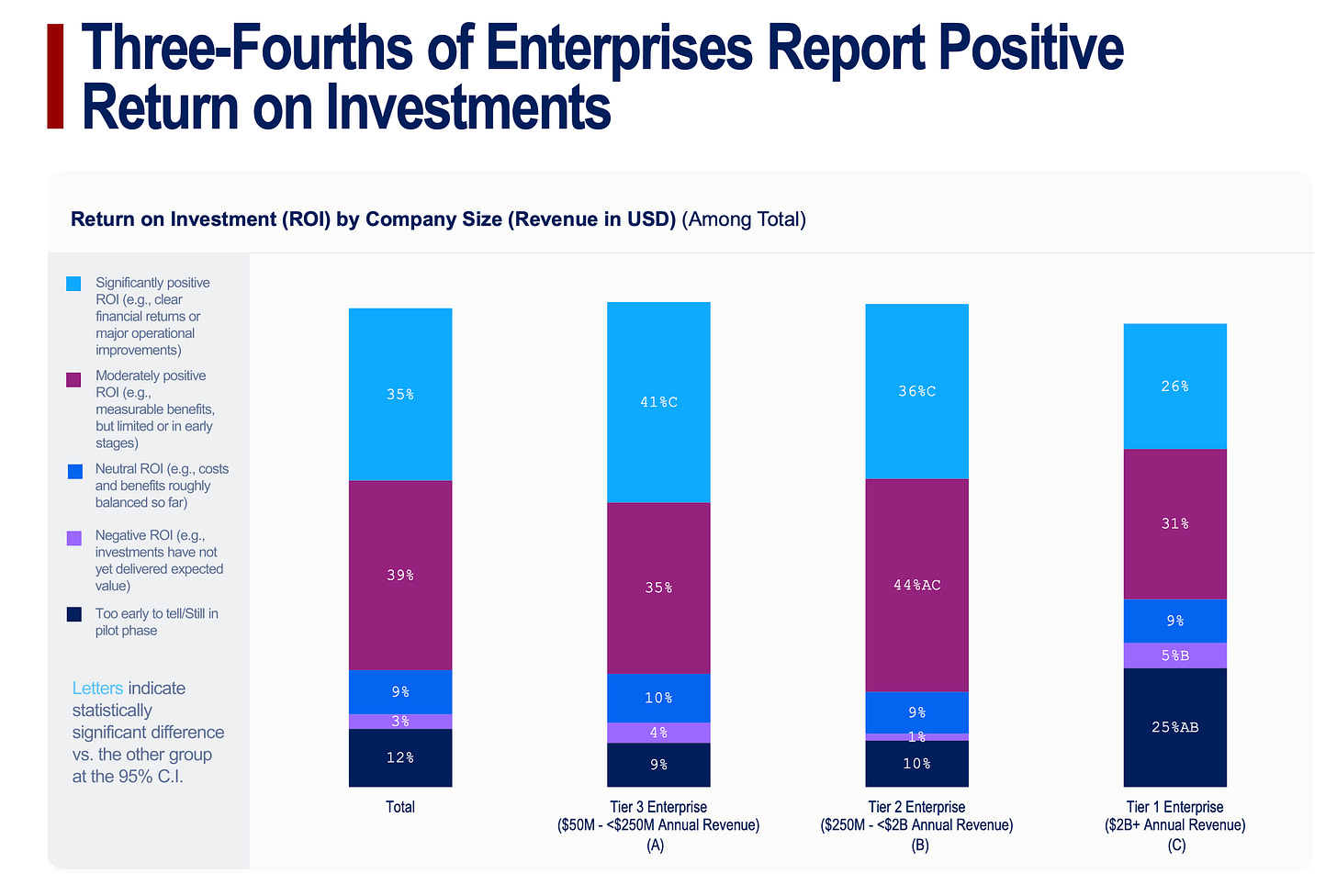
Despite the cooling of initial hype, recent studies reveal a more nuanced picture of AI’s business value, with the University of Pennsylvania’s Wharton School reporting that 74% of companies now see positive ROI from generative AI—contrasting sharply with earlier, more pessimistic findings. This optimism is partly due to a broader definition of ROI encompassing productivity, employee retention, and operational efficiency, and is most pronounced in agile sectors like tech, telecom, and finance. However, the rollout remains uneven, with smaller companies and senior leaders reporting faster and greater returns, underscoring the importance of workflow transformation and organizational agility in realizing AI’s benefits.
The transition from hype to pragmatism is also marked by a growing recognition of the barriers to effective AI integration, such as persistent skill gaps among employees—even in tech-savvy demographics—and the need for organizations to distinguish between commodity and custom software. As Denis Čahuk notes, real competitive advantage comes not from adopting AI first, but from knowing where to deploy it for maximum differentiation, while using AI to accelerate commoditized business layers. This pragmatic approach is further complicated by the opaque, personal nature of AI interactions, which challenge traditional software adoption cultures and require new strategies for building trust and reliability.
By the close of 2025 and into early 2026, AI had crossed a usability threshold, moving from isolated pilots and hype cycles to dependable, embedded infrastructure within real business systems. As highlighted by Andrej Karpathy and the State of AI Report 2025, advances in distillation and inference-side optimization lowered costs and enabled broader adoption, with AI tools becoming integral to daily professional routines—especially in software engineering. Yet, while executives increasingly view AI as a driver of innovation and growth, most organizations still lack clear roadmaps for practical integration, with only 7% of mid-market CEOs reporting a coordinated AI strategy, signaling that the journey from hype to pragmatic, company-wide adoption is still underway.





The GenAI Divide Widens
Despite widespread experimentation with generative AI, only a select 5% of enterprises have achieved real operational impact, exposing a stark gap between flashy pilots and true workflow transformation.
Despite a surge in AI pilots—over 80% of enterprises have experimented with tools like ChatGPT and Copilot—most organizations have struggled to move beyond surface-level deployments, resulting in productivity gains that are largely confined to individuals rather than transforming enterprise-wide operations. The so-called 'GenAI Divide,' as highlighted in the 2025 MIT AI Report, reveals that only about 5% of enterprises have managed to extract measurable ROI through deep workflow integration, and these successes are typically driven by external vendor partnerships and bottom-up adoption by line managers. In contrast, internal AI builds have failed at twice the rate, underscoring the critical importance of seamless workflow integration, context retention, and learning capabilities in operationalizing AI at scale.
A persistent barrier to true operational integration has been the lack of AI systems that can learn, retain context, and embed themselves seamlessly into existing workflows—challenges that have caused 60% of firms to stall after initial evaluation and left only a small fraction (5%) reaching production with enterprise-grade AI. The issue is less about model quality or regulatory hurdles and more about the inability of AI to function as a deeply integrated, context-aware partner in daily operations. This gap has left most organizations stuck in pilot mode, with fragmented point solutions threatening to create technical debt rather than deliver on the promise of transformative automation.
The enterprises that have successfully crossed the operational integration chasm are those that prioritize embedding AI into core, often underfunded, back-office functions such as finance, procurement, and operations—areas where workflow automation delivers the highest ROI. Despite this, the majority of AI budgets (50–70%) still flow to sales and marketing, even though back-office automation has demonstrated cost savings of $2–10 million annually and efficiency gains like a 30% reduction in agency spend. This misallocation highlights a disconnect between where AI can drive the most substantive operational transformation and where investments are actually being made.


Agentic AI Modernizes Legacy
Agent-based and vertical AI systems are dismantling decades-old technical debt, powering industry-specific unicorns and yielding productivity leaps up to 80% in targeted workflows.
Agent-based AI systems are dramatically reducing the cost and complexity of modernizing legacy enterprise software, especially in sectors still reliant on outdated codebases like Fortran and COBOL. By automating much of the 'plumbing work' that once required decade-long contracts with consulting giants like Accenture or Deloitte, these agents have collapsed one-time migration costs and enabled rapid upgrades. Notably, countries with newer IT infrastructure, such as Singapore, are leapfrogging legacy challenges altogether, adopting agentic systems more seamlessly than older economies burdened by decades of technical debt.
The rapid evolution from rule-based bots to cognitive, agentic AI is fundamentally reshaping enterprise workflows, but the path to adoption is uneven and trust remains paramount. While digital-native teams may soon see up to 90% of their pull requests authored by AI agents, legacy modernization will unfold more gradually, and regulated industries like financial services are proceeding with caution, prioritizing compliance and security. Building trust in agentic systems is a deliberate process—organizations with established RPA infrastructure have a head start, while greenfield adopters must carefully balance speed with risk management to ensure reliable, auditable outcomes.
The rise of vertical AI—industry-specific, modular agentic systems—has proven to be a watershed moment for enterprise transformation, delivering ROI far beyond generic horizontal tools. In 2025 alone, 35 new vertical AI unicorns emerged, each surpassing $90M ARR, as companies like GC AI and Harvey AI embedded themselves directly into core workflows such as legal contract review and clinical documentation. These vertical solutions leverage proprietary data and regulatory expertise to create defensible moats, with productivity gains of 50-80% in targeted workflows, and are now expanding into adjacent domains, signaling that 2026 will be the most significant year yet for vertical AI adoption.
Major enterprise vendors are racing to build robust agentic platforms, as seen with Salesforce's Agentforce, AWS's suite of agent development tools, and Automation Anywhere's collaboration with OpenAI. These platforms are not only driving rapid customer adoption—Salesforce added 6,000 enterprise customers in a single quarter—but also require substantial investment in governance, security, and orchestration, with teams of hundreds dedicated to production-grade agent AI. However, the complexity of designing effective agents, the need for high-quality structured data, and the persistent challenge of balancing autonomy with trust and safety mean that agentic AI is both a technical and organizational transformation, demanding new disciplines like Agent Engineering and iterative experimentation to realize its full potential.




Trust Becomes the True Differentiator
Enterprise AI adoption now hinges on auditable, explainable systems—driving massive investment in governance, security, and compliance as the foundation for scaling agentic automation.
The evolution of trust and governance in enterprise AI has shifted from a focus on model accuracy to building systemic confidence through robust frameworks, as seen in the practices of leaders like Salesforce, Zuora, and Box. Early experiments with AI agents revealed that high costs, cybersecurity risks from 'shadow agents,' and poor data quality were major barriers, underscoring the need for foundational capabilities such as semantic layers, effective search, and workflow redesign. As enterprises move from deterministic RPA bots to agentic AI, trust is constructed incrementally—first by embedding AI in low-risk, auditable tasks, then progressively layering in human-in-the-loop controls, audit trails, and explainability mechanisms that transform AI from 'magical demos' into dependable, scalable tools.
By late 2025 and into 2026, trust, security, and compliance have become existential concerns at the board level, driving the rise of dedicated trust layers and governance frameworks as prerequisites for scaling AI-driven decision and coordination systems. Companies like Salesforce have invested in specialized teams—sometimes numbering in the hundreds—to build enterprise-grade agentic platforms with sophisticated security, auditability, and orchestration, differentiating themselves from consumer AI tools. This surge in governance investment is mirrored by the growing regulatory focus in regions like Europe, the adoption of 'compliance by design' tied to CEO and board KPIs, and the prioritization of data sovereignty and cyber resilience, especially as autonomous agents begin to execute complex workflows and handle sensitive transactions across distributed environments.
The competition to control the new enterprise coordination layer is intensifying between incumbents like Salesforce, ServiceNow, Microsoft, and SAP—who leverage existing trust, integration, and systems of record—and newcomers building inference-first, agentic architectures. While incumbents benefit from established relationships and distribution, their legacy systems were designed for human-in-the-loop workflows, requiring significant reengineering to support autonomous agents. Meanwhile, vertical AI tools such as Harvey must evolve into horizontal, auditable coordination systems to win enterprise trust, as the ultimate differentiator shifts from model intelligence to the ability to earn and maintain trust in how work gets done, with auditability, explainability, and control as non-negotiable requirements for enterprise adoption.
Across regulated industries like finance and healthcare, trust in AI is tightly linked to oversight, compliance, and demonstrable real-world outcomes, as evidenced by Advisor360°'s survey showing that 93% of financial advisors insist on retaining control over AI-driven decisions. Adoption remains limited to administrative tasks until regulatory approval, proven use cases, and auditable logic are in place, with many advisors hesitant to even discuss AI with clients. This pattern highlights that, regardless of sector, user confidence—quantified as Confidence in AI Results (CAIR)—is often more decisive for adoption than accuracy alone, and can be engineered through design choices that reduce risk and correction effort, such as human-in-the-loop systems and preview screens.




AI Reshapes Enterprise Power
The competitive edge is shifting to those who can orchestrate agentic AI platforms, monetize outcome-based automation, and build trust at scale—leaving legacy software models behind.
AI is fundamentally redrawing the competitive landscape by shifting value creation from traditional software and SaaS models to integrated, AI-native infrastructure and agentic platforms. Companies like Salesforce, Stripe, and IBM are racing to become the orchestration hubs for AI agents, moving beyond per-seat pricing to outcome-based and agentic enterprise license agreements that align with customer needs for predictability and scale. This transition is exemplified by Salesforce's rapid evolution of its pricing models and Stripe's emergence as the de facto financial infrastructure for both human and AI-driven commerce, while new entrants like Sky are pioneering decentralized agent networks that blend blockchain transparency with AI-powered operational decision-making.
The rise of autonomous AI agents is enabling radical new business models and operational efficiencies, transforming core enterprise functions from sales to finance. By early 2026, agentic AI is expected to become the default operating system for financial workflows, with companies like JPMorgan, Stripe, and Salesforce embedding AI across business lines to drive efficiency, automate decision-making, and unlock new revenue streams. This shift is not merely about automation but about redefining how work gets done, as seen in Jason Lemkin's replacement of his entire sales team with AI agents and Automation Anywhere's integration of reasoning-to-action automation loops with OpenAI, signaling a new era where human oversight focuses on exception management and high-value decisions.
Competitive advantage in the AI era is increasingly determined by the ability to build trust, integrate robust governance and security, and leverage proprietary data at scale. While tech giants like Google and Stripe compete for dominance in programmable payments and agent-initiated financial flows, established enterprise incumbents such as Salesforce, ServiceNow, and Microsoft are leveraging their existing trust and integration to maintain their edge, provided they can adapt their architectures for autonomous AI systems. Meanwhile, banks like JPMorgan are setting industry benchmarks by allocating billions to AI, creating data flywheels, and achieving valuation premiums that reflect investor confidence in their structural AI moats, outpacing peers who lag in transparency and scale.
The proliferation of AI agents and agentic platforms is catalyzing a shift toward outcome-based pricing, hybrid business models, and leaner, more efficient operations. Enterprises are moving away from static software systems of record to dynamic, AI-native platforms that automate complex workflows and extract actionable intelligence from unstructured data, as seen in Box’s pivot and Salesforce’s Agentforce success. This evolution is driving a new wave of second-order AI winners who focus on workforce augmentation, integrated multiservice solutions, and honest market share assessment, with AI-native startups growing up to three times faster than traditional SaaS peers and achieving unprecedented ARR per employee.





Workforce Reinvented for the AI Era
AI-driven transformation is redefining jobs, skills, and leadership—augmenting human expertise, breaking down silos, and turning employees into high-value collaborators alongside intelligent agents.
The future of work in AI-driven enterprises is marked by a fundamental reimagining of workforce roles, required skills, and organizational design, as companies move from incremental automation to holistic transformation. Early on, leaders like Saish warned that the true impact of AI would be delayed by persistent skill gaps—even among tech-savvy generations—underscoring that realizing AI's full potential would require more than simply layering new tools onto old structures. Instead, as seen in long-term AI winners, the focus is shifting from eliminating low-skilled jobs to augmenting and supplementing the workforce, enabling employees to become more efficient and productive in higher-value roles. This evolution mirrors the historic reorientation of factories around electrification, demanding not just new technology but a reinvention of how businesses are organized and how people work within them.
As AI matures, enterprises like Zuora, Snowflake, and Block are pioneering new leadership structures and governance models that balance rapid experimentation with security, compliance, and trust. These organizations are breaking down traditional silos by centralizing data teams and fostering cross-functional partnerships, while also mandating AI literacy and continuous learning across all levels—from senior leaders to frontline staff. For example, Snowflake's requirement for mandatory AI certification among solution engineers, and Zuora's three-stage AI governance process, illustrate how leadership is evolving to ensure responsible, scalable AI adoption. This shift is not just about managing technology, but about orchestrating a symbiotic relationship between human expertise and AI, with humans increasingly focused on strategy, oversight, and complex problem-solving as AI takes on more routine and repetitive tasks.
The relationship between human expertise and AI is becoming increasingly collaborative, with AI agents handling routine, high-volume tasks and freeing up humans for more specialized, judgment-intensive work. In customer support and sales, for instance, companies like Affirm and HubSpot have demonstrated that while AI can resolve a growing share of basic inquiries and manage low-intent conversations, substantial human involvement remains necessary for complex cases and high-value interactions. This gradual shift is also reflected in finance and data engineering, where AI automates grunt work and documentation, but domain knowledge, ethical oversight, and strategic decision-making remain firmly in human hands. As AI tools become more accessible, non-engineers are empowered to contribute directly to product development and operational workflows, blurring traditional role boundaries and fostering more inclusive, agile teams.
By early 2026, the drive for radical efficiency is reshaping organizational design, with companies like Shopify and C.H. Robinson achieving record ARR per employee and expanding margins while reducing headcount. This transformation is most pronounced in coordination-heavy, back-office roles—such as supply chain, customer support, and HR ops—where AI exposes and eliminates inefficiencies, enabling leaner, more resilient organizations. However, this is not simply a story of job cuts; rather, it signals a broader shift toward continuous transformation, where adaptability, AI fluency, and domain expertise become the new currency for both individual and enterprise success. As Bain & Company and Cognizant highlight, the winners in this new era will be those that move from rigid hierarchies to empowered, tech-first teams, embrace ongoing reskilling, and focus on targeted 'micro-battles' to drive sustainable innovation.