Enterprises hit the AI trust Wall: human oversight, governance hurdles stall autonomous agent rollout
The gist
Enterprises are slamming into an AI trust wall, with most agentic AI still stuck in pilot mode as human oversight, governance gaps, and security fears stall true autonomy.
What to know
- By early 2026, only 13% of enterprises have fully deployed autonomous agentic AI, with a whopping 69% of AI-driven decisions still requiring human verification.
- Industry leaders like Snowflake, Domino Data Lab, and Hitachi are doubling down on robust governance, human-in-the-loop controls, and unified development platforms to restore trust and rein in AI risk.
- Despite 58% factory AI adoption, 79% of teams report no reduction in downtime—proving that execution maturity, workforce training, and operational culture remain vital to unlocking AI’s industrial promise.
Trust Bottlenecks Stall AI Agents
Deep-seated fears over opaque AI decision-making and fragmented architectures force enterprises to prioritize transparency, robust governance, and business-aligned design before scaling autonomous agents.
By early 2026, enterprise adoption of agentic AI remains largely in pilot or proof-of-concept phases, with only 13% of organizations deploying fully autonomous agents and 69% of AI-driven decisions still requiring human verification. This cautious approach underscores the critical role of observability tools, such as those integrated by Snowflake into agent creation workflows, which provide real-time visibility into agent behavior and performance, enabling enterprises to build trust through transparency and safe, controlled deployments.
Trust barriers, rather than skepticism about AI’s value, dominate the challenges to scaling agentic AI across enterprises, particularly in complex domains like supply chains. Concerns around governance gaps, accountability, security, privacy, and compliance affect over half of organizations, with 52% citing these issues and 51% highlighting technical complexity. As one supply chain analysis notes, leaders fear AI operating in opaque ways that could cause costly errors, emphasizing the need for robust governance frameworks featuring supervised delegation, permission boundaries, audit trails, and comprehensive observability dashboards to regain control and confidence.
A significant cultural and architectural mismatch hinders agentic AI scaling in enterprises, especially in supply chains where slow, quarterly planning cycles clash with AI’s rapid iteration pace. This gap is compounded by inconsistent vendor definitions and siloed tools, which confuse CIOs and obstruct unified adoption strategies. Experts argue that overcoming these barriers requires a shift from viewing agentic AI as a mere technology challenge to focusing on clear business outcomes, readiness, and architectural design—particularly around world models and decision intelligence infrastructure—to reduce reliance on human supervision and enable scalable, trusted deployments.
Bridging the divide between fast-evolving personal AI agents and slower enterprise systems offers a promising path to trust and scale. By embracing personal agents as prototypes within the enterprise, organizations can experiment with automations and multi-agent tasks under human oversight, gradually closing the structural gap that risks perpetuating legacy inefficiencies. This approach, combined with establishing guardrails, permissions, and accountability among advanced users, could transform rigid platforms like SAP into more malleable systems, enhancing productivity while maintaining necessary compliance and control.



Governance: The New AI Backbone
Enterprises are embedding multi-layered governance, human-in-the-loop oversight, and real-time operational metrics to transform agentic AI from risky pilots to trusted, production-ready systems.
By early 2026, enterprises confronting the challenge of scaling agentic AI in complex, regulated environments have recognized that robust governance frameworks are indispensable for building trust and ensuring safety. These frameworks integrate structured connectors, permission boundaries, and comprehensive audit trails to prevent uncontrolled AI decision-making, as highlighted in supply chain contexts where fears of autonomy run high. Snowflake’s approach exemplifies this layered trust model, embedding governance at every stack level to mitigate risks such as data leakage and security breaches, while providing customers with tools to tune agent responses and monitor performance in real time.
Human-in-the-loop controls have emerged as a cornerstone for safely transitioning agentic AI from pilots to production, reframing AI not as autonomous agents but as supervised delegates operating within bounded autonomy. This approach addresses enterprise skepticism about the non-deterministic nature of AI decision-making, especially for critical business functions, by maintaining supervisory oversight and enabling staged rollouts with rollback paths. Notably, over half of organizations now employ human-on-the-loop models, balancing reduced direct oversight with essential human judgment to uphold safety and trust.
Measurement-driven operational visibility is fundamental to the governance and scaling of agentic AI, transforming fragile experimental systems into reliable infrastructure. Enterprises are moving beyond traditional SDLC metrics focused on speed or output, instead adopting nuanced KPIs that capture agent behavior, decision-making processes, and alignment with business outcomes. This shift is critical to avoid fragmented efforts and governance challenges, as clear success criteria and continuous performance assessments enable leaders to justify scaling decisions and maintain control over increasingly complex AI workflows.
Security considerations are deeply intertwined with governance in scaling agentic AI, requiring proactive vulnerability detection and community-driven defense mechanisms. Greg Brockman underscores the importance of leveraging AI models themselves for end-to-end red teaming and emphasizes trusted access programs to enhance resilience. This holistic security posture, combined with observability and governance primitives, ensures that AI systems operate safely even as they autonomously execute complex tasks, addressing the critical human attention bottleneck by shifting focus from task execution to alignment with human values and intentions.

Unified Platforms Drive AI Scale
Industry leaders like Domino Data Lab and Snowflake are dismantling tool fragmentation by delivering end-to-end, compliance-ready platforms that integrate experimentation, deployment, and performance monitoring for agentic AI.
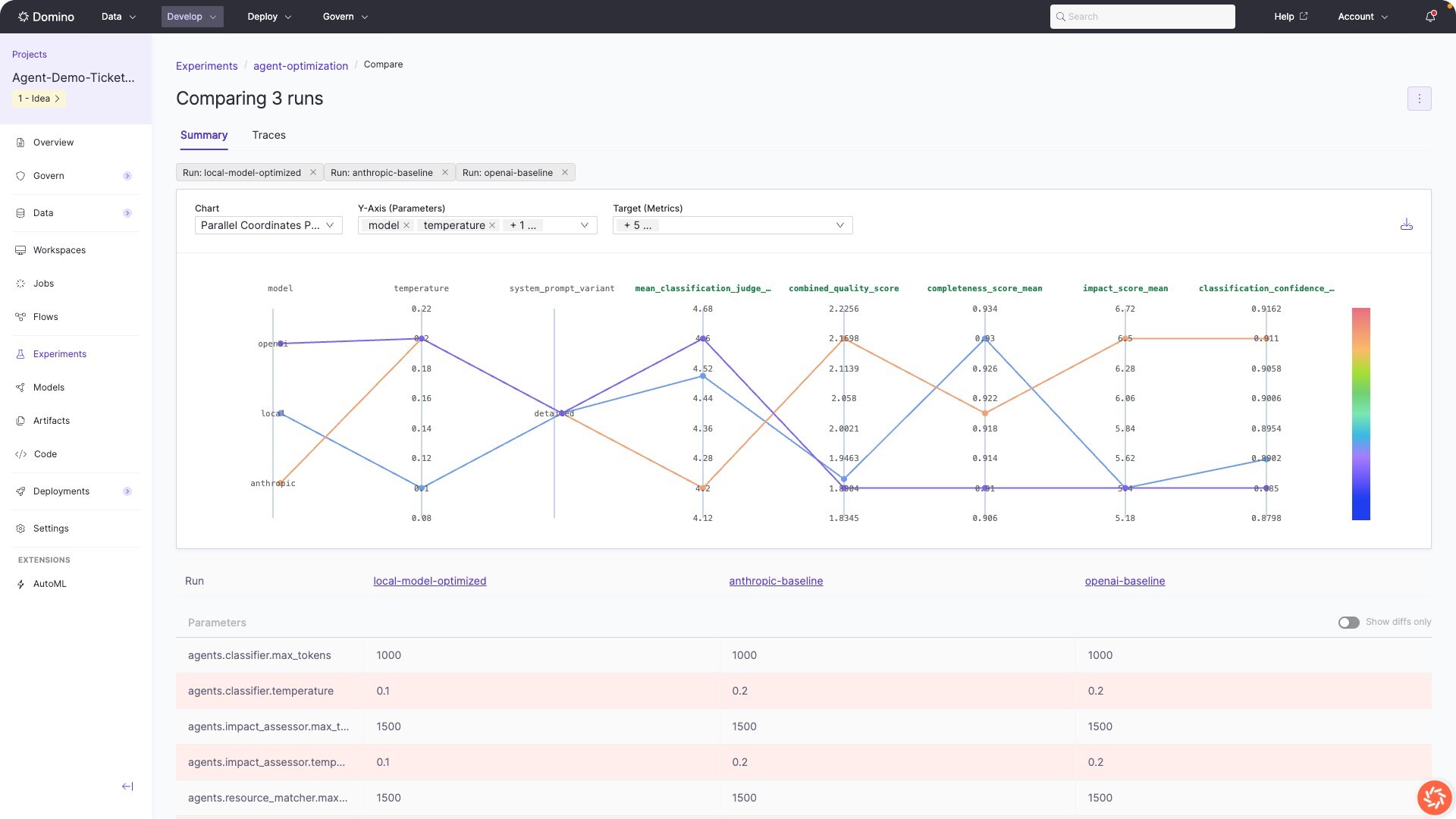
By early 2026, Domino Data Lab pioneered a fully governed, end-to-end platform that unifies the entire agentic AI development lifecycle—from experimentation through deployment to monitoring—addressing the chronic fragmentation and ad-hoc tooling that previously hampered enterprise scaling. Their Winter Release introduced universal tracing, structured evaluation, and secure in-house hosting of large language models (LLMs), enabling rapid, compliant scaling particularly for regulated sectors like financial services, government, and life sciences, where governance and transparency are non-negotiable.
Snowflake’s AI strategy exemplifies the next evolution of unified platforms by layering multiple top-tier and in-house models with retrieval, data, and application layers, offering customers unprecedented model choice and flexibility. Trust is embedded at every stage through governance, security guardrails, and integrated agent observability tools that allow enterprises to tune agent responses and monitor performance in real time, reinforcing reliability and compliance as foundational pillars.
Scaling agentic AI effectively demands more than technology—it requires a cultural shift driven by top-down mandates and a deep organizational understanding of AI’s transformative potential. Integrated platforms that unify development and deployment workflows accelerate adoption, but enterprises must also move beyond traditional SDLC metrics, embracing new evaluation frameworks that measure agent behavior, decision-making, and business impact to align AI initiatives with clear outcome-based metrics such as productivity gains and defect reduction.
A critical pitfall in scaling agentic AI is launching deployments without clearly defined success criteria, leading to fragmented efforts that are difficult to govern and misaligned with strategic goals. Unified platforms must therefore incorporate continuous evaluation, policy enforcement, and runtime controls to establish safe operating boundaries, calibrate autonomy levels, and maintain necessary human oversight—ensuring that business KPIs guide AI evolution and that agentic systems deliver measurable, responsible value.

Physical AI Hits Real-World Limits
Industrial collaborations are advancing robotics from simulation to factory floors, but the leap to reliable, autonomous deployment is slowed by persistent safety, determinism, and cybersecurity hurdles.
By early 2026, the integration of agentic AI into physical environments has accelerated through strategic collaborations exemplified by STMicroelectronics and NVIDIA, which combined advanced sensors, microcontrollers, and motor control solutions with NVIDIA’s robotics ecosystem to enhance humanoid robot design and deployment. This partnership also incorporated Leopard Imaging’s stereo depth cameras and high-fidelity sim-to-real IMU models into NVIDIA Isaac Sim, bridging simulation and real-world application to improve efficiency, reliability, and scalability in robotics and industrial automation.
The transition of AI robotics from controlled labs to real-world factory floors is marked by a focus on autonomous decision-making and practical deployment challenges such as programming ease, learning speed, and infrastructure readiness. Industry leaders like Universal Robots, PickNik Robotics, and Path Robotics are actively sharing best practices to overcome these hurdles, while programs like HII’s HYPR demonstrate hybrid AI architectures and real-time control systems that integrate robotic welding, autonomous material handling, and quality checks to address capacity backlogs in safety-critical shipbuilding environments.
The convergence of digital and physical AI realms is reshaping industrial systems into unified ecosystems where companies such as NVIDIA, Siemens, Rockwell Automation, Bosch, and Lenovo showcase innovations in real-time control, intelligent lifecycle management, and human-AI collaboration. Despite these advances, robotics still faces a significant gap between lab capabilities and reliable field deployment, with agentic AI now outperforming humans in complex industrial tasks but requiring rigorous safety, determinism, and cybersecurity measures—especially in safety-critical domains like driverless trucks and naval shipbuilding where errors are unacceptable.
Hitachi’s approach to industrial AI epitomizes the necessity for hybrid AI architectures that combine Large Language Models for processing unstructured data with formal logic and traditional machine learning at the edge to ensure deterministic, failsafe operation in mission-critical environments. Their partnership with Anthropic to enhance Lumada 3.0 and establishment of a Frontier AI Deployment Center underscore the importance of integrating advanced AI safely and securely, emphasizing resilience against adversarial attacks and leveraging over a century of industrial expertise to move beyond the 'fail fast' mentality prevalent in other AI domains.



Industrial AI Faces Execution Gap
Despite widespread factory adoption, unplanned downtime persists as skills shortages, poor operational discipline, and the need for auditable, deterministic AI systems outpace technology gains.
By early 2026, industrial AI had transitioned from experimental robotics to essential enterprise assets that enhance operational efficiency and safety risk identification beyond human capabilities. Leading companies like NVIDIA, Siemens, PTC, Rockwell Automation, and Bosch demonstrated AI-driven manufacturing improvements spanning product lifecycle management and factory system design, signaling a cultural integration of AI into industrial operations. This convergence of hardware and software created a seamless ecosystem, yet a notable gap remained between laboratory robotics capabilities and their reliable deployment in real-world settings, reflecting ongoing challenges in robustness and integration.
Despite 58% of factories adopting AI and 75% achieving ROI within six months, MaintainX’s 2026 report revealed that 79% of teams saw no reduction or even an increase in unplanned downtime, with 39% facing rising downtime costs. This discrepancy stems less from AI technology availability and more from execution maturity and workforce issues like labor shortages, poor knowledge transfer, and skills gaps. MaintainX executives Nick Haase and Chris Turlica emphasize that combining AI tools with strong operational fundamentals—such as disciplined scheduling, better training, and a proactive maintenance culture—is critical to unlocking AI’s full potential in industrial maintenance.
Hitachi’s industrial AI approach exemplifies the necessity for deterministic, fully auditable, and highly reliable AI systems in mission-critical environments, where errors or hallucinations can cause multi-million-dollar equipment damage and jeopardize worker safety. Their hybrid 'Reliable AI' framework integrates Large Language Models for extracting explicit and tacit knowledge from diverse sources—including PDF manuals and expert communications—while relying on formal logic and traditional machine learning for real-time, safe execution at the edge. This deep integration of AI with physical infrastructure expertise underscores the imperative to prioritize safety, resilience, and cybersecurity over experimental 'fail fast' methods in industrial AI deployment.
Case studies, such as a mom-and-pop car wash chain, illustrate how AI-powered predictive maintenance can dramatically reduce repair times by 74% and boost labor productivity through real-time guidance and systematized institutional knowledge. This AI integration fosters cultural change by enabling technicians across locations to share solutions, breaking down silos and shifting maintenance from reactive to proactive through detailed equipment usage tracking. Beyond repairs, AI-driven data also optimizes inventory control, delivery scheduling, and purchasing, effectively becoming the operational backbone, while AI copilots accelerate technician training and help bridge workforce skill gaps.

Ecosystem Alliances Fuel AI Scale
Hitachi’s deep partnerships and massive workforce transformation underscore that enterprise AI success now hinges on collaborative innovation, cross-sector alliances, and large-scale upskilling—not just technology.
By mid-2026, Hitachi's strategic partnership with Anthropic marks a pivotal collaboration between AI innovators and industrial leaders aimed at embedding frontier AI capabilities into critical sectors such as energy, transportation, and finance. This alliance leverages Anthropic's Claude models to enhance Lumada 3.0’s safety, efficiency, and cybersecurity, exemplifying how ecosystem partnerships are essential for advancing safe and scalable agentic AI in mission-critical environments. Complementing this, Hitachi’s establishment of the Frontier AI Deployment Center—with integrated teams of AI and system experts—demonstrates a hands-on approach to co-creating next-generation physical AI applications, further solidifying the role of collaborative innovation in driving industrial AI transformation.
Hitachi’s ambitious enterprise-wide AI transformation initiative, involving approximately 290,000 employees and the cultivation of 100,000 AI professionals, underscores the scale and complexity required to operationalize agentic AI at an industrial level. This 'Customer Zero' approach not only accelerates internal adoption but also serves as a blueprint for large-scale organizational change, highlighting how strategic ecosystem partnerships extend beyond technology integration to encompass workforce development and cultural shifts essential for sustainable AI deployment.