Enterprises slash AI bills with modular model mix—the era of smarter, cheaper AI has arrived
The gist
Enterprises are slashing AI costs by up to 60% by orchestrating modular, multi-model architectures that blend open-source and frontier models—heralding a new era of smarter, cheaper business AI.
What to know
- By mid-2026, companies like Salesforce and Airbnb are routing tasks to specialized models, cutting API costs from thousands to mere tens of dollars per project.
- OpenAI’s GPT 5.4 mini and nano let businesses delegate routine jobs to cheaper models, while frontier models like GPT-5.5 are reserved for complex reasoning.
- Hybrid AI stacks are now the norm: open-weight models from MiniMax and Mistral deliver near-frontier performance at a fraction of the cost, fueling a shift toward custom, in-house AI.
Generalist vs. Specialist AI
Enterprises are abandoning one-size-fits-all frontier models in favor of domain-specific AI stacks, sparking a new era of architectural complexity and competitive differentiation.
The foundational debate in AI adoption has revolved around whether a single generalized frontier model—exemplified by OpenAI's GPT, Anthropic's Claude, and Google's Gemini—can effectively serve all enterprise needs, or if specialized, domain-specific models are essential for deeper expertise and risk-sensitive applications. While frontier models offer broad, mainstream intelligence and excel in consumer engagement, enterprises such as JPMorgan Chase face significant engineering challenges in harmonizing proprietary data and building knowledge graphs, akin to the complexities of SAP implementations in the 1990s. This tension underscores the critical importance of architectural groundwork, as noted by Floyer, who argues that without the right stack and infrastructure, effective enterprise AI software cannot emerge.
By late 2025, divergence among frontier AI labs became pronounced, with each pursuing distinct optimization goals and training strategies that reflect their core values and target users. For instance, OpenAI prioritizes user engagement metrics, aiming for long sessions and daily active users, whereas Anthropic focuses on productivity and minimizing hallucinations, deliberately eschewing popular but misleading benchmarks like 'Alum Marina.' This divergence not only shapes the types of products and user bases they attract but also signals a broader realization that no single model will dominate all use cases; instead, enterprises must develop tailored AI theses aligned with their unique contexts and risk profiles.
The democratization of AI development has accelerated the rise of startups building specialized models tailored to niche domains, from healthcare to robotics and mineral exploration. These ventures leverage fine-tuning techniques, including reinforcement learning on open-source models, to outperform larger frontier models in specific benchmarks—such as a YC startup surpassing OpenAI’s healthcare benchmarks with an 8-billion-parameter model. However, this specialized edge is continually challenged as frontier models like GPT-4.5 and 5.1 advance rapidly, illustrating an ongoing, dynamic competition between broad generalist and finely tuned specialist approaches.
By mid-2026, industry leaders like Nikesh Arora articulated the fundamental trade-off between breadth and depth in AI models: frontier models excel in broad consumer applications where some inaccuracies are tolerable, but enterprise use cases demand zero tolerance for false positives and deep, context-rich training with proprietary data. This distinction is especially critical in high-stakes domains such as autonomous driving and legal services, where hallucinations and errors carry significant liability. Consequently, the AI ecosystem is witnessing a shift away from one-size-fits-all frontier intelligence toward specialized, collaboratively tailored AI solutions, a trend underscored by new ventures like Mira Murati’s Thinking Machines and the growing emphasis on organizational ownership of AI models rather than mere rental of generic intelligence.





Custom Models Redefine Control
Owning and fine-tuning proprietary AI models is now the enterprise gold standard for slashing costs, improving privacy, and building lasting moats beyond generic APIs.
By late 2025 and into 2026, a clear enterprise trend has emerged toward building and fine-tuning custom AI models tailored to proprietary data and specific business tasks, moving beyond reliance on large generic frontier models. Companies like Intercom, Cursor, Airbnb, and Pinterest have demonstrated that vertical AI models optimized for product-specific dimensions can significantly outperform generalist models, as seen with Intercom and Cursor shipping their own superior models. This shift is enabled by advancements in open-source models and platforms such as Modal, which facilitate intensive post-training and reinforcement learning loops, allowing enterprises to effectively own and customize their AI capabilities.
Enterprises are increasingly recognizing that owning specialized AI models is critical not only for competitive advantage but also for cost control, latency, and privacy. AWS’s development of the proprietary Nova model exemplifies this strategic move, offering better cost management, faster feature rollout, and improved latency compared to relying solely on frontier models. Similarly, Applied Compute’s CEO Yash Patil emphasizes that 'cost, not capability, is now the primary driver' pushing companies to develop custom models, reflecting a broader realization that fine-tuning and reinforcement learning with verifiable rewards are where sustainable competitive moats are built.
The enterprise AI landscape is moving toward a hybrid and nuanced approach where multiple models—frontier, open-source, and specialized—are deployed in concert to optimize for diverse use cases, performance, and cost. Resolve’s practice of running nightly evaluations and dynamically selecting between frontier and custom models underscores the importance of continuous adaptation and data-driven customization. This approach acknowledges that no single universal AI model suffices, as different objectives—such as OpenAI’s focus on user engagement versus Anthropic’s productivity orientation—demand tailored solutions aligned with industry-specific needs.
Leading enterprises and AI labs alike are converging on the principle that AI intelligence must be owned, specialized, and continuously refined to maintain sovereignty and maximize value. As articulated by thought leaders like Mira Murati and Yash Patil, the future belongs to organizations that build AI models deeply embedded with their proprietary data and domain expertise rather than renting generic intelligence. This mindset shift is reflected in the growing availability of fine-tuning tools from providers like Google and OpenAI, the narrowing performance gap between open-weight and frontier models, and venture investments targeting domain-expert teams with unique data flywheels, signaling a maturation of enterprise AI toward bespoke, high-value intelligence assets.




Model Routing Slashes Spend
Dynamic task routing across multiple AI models is saving companies millions annually, yet most enterprises still overspend by defaulting to premium models for routine work.
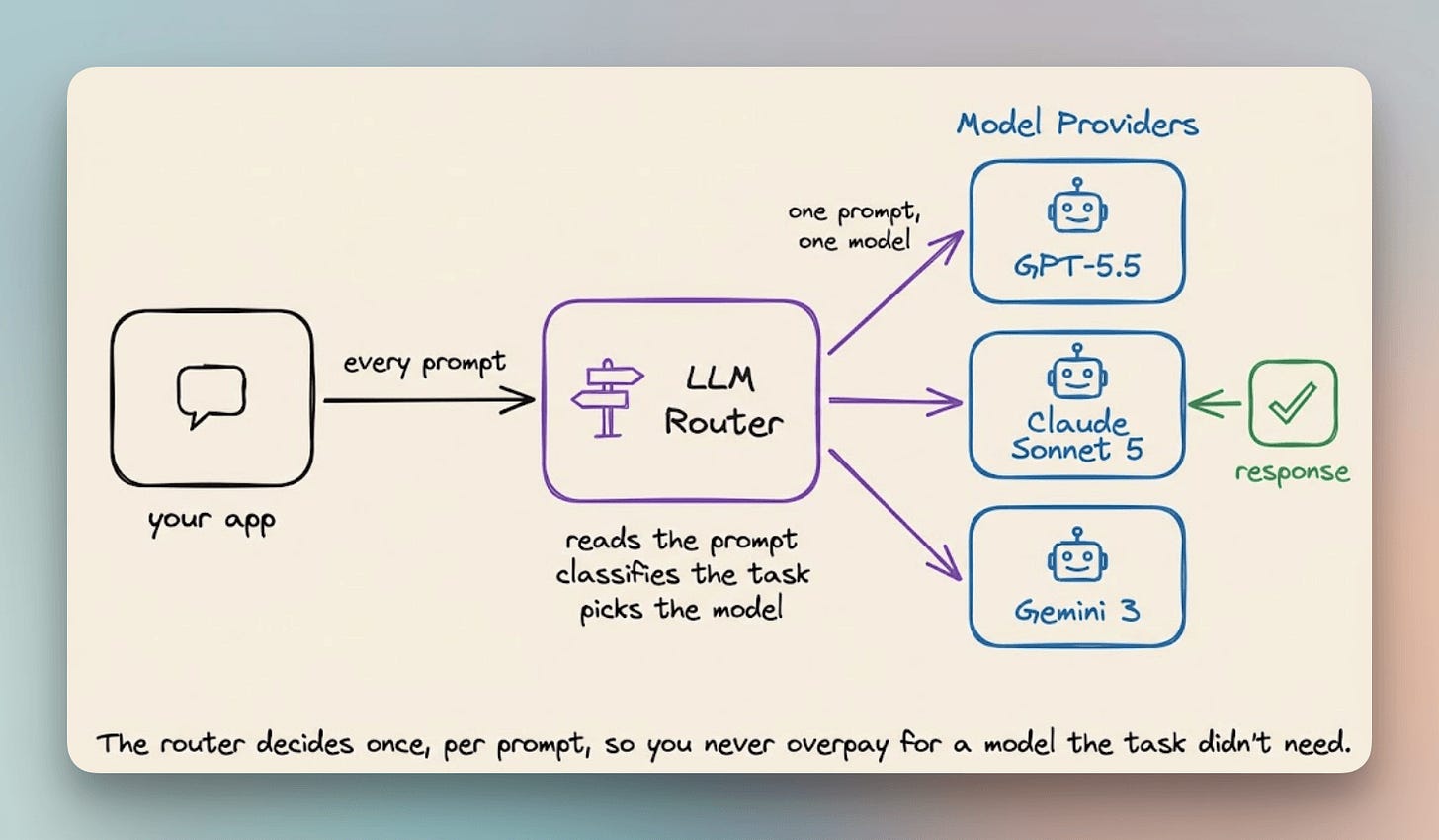
By early 2026, escalating AI token costs and looming price hikes compelled enterprises, especially those with tight margins, to rethink their AI spending strategies. OpenAI’s introduction of GPT 5.4 mini and nano models exemplified this shift, enabling companies to delegate simpler tasks like categorization and document summarization to smaller, cheaper models without compromising quality. This multi-model approach, as seen in platforms like Codex, allowed enterprises to optimize token usage by reserving expensive frontier models for complex queries while routing routine workloads to cost-effective alternatives.
The rise of model routing techniques has become a cornerstone for enterprises aiming to balance cost and performance, with companies like Cisco estimating AI expenses at $200 per employee weekly—translating to nearly $900 million annually for 90,000 employees. Industry leaders such as Scott Wu of Cognition highlight that routing boilerplate tasks to sufficiently capable, cheaper models can yield five to ten times better cost efficiency. Despite these benefits, about 95% of enterprise AI usage still defaults to expensive frontier models, underscoring the urgent need for smarter routing to avoid unnecessary overspending.
Innovative model routing solutions, including Kilo's Gateway and Coinbase’s AI gateway, demonstrate how dynamic task-based routing can slash AI costs by up to 60% or more without sacrificing output quality. These systems classify tasks by mode—such as planning, writing, or debugging—and assign them to models optimized for cost and capability, achieving cost reductions ranging from a third to over 90% in some cases. OpenRouter’s multi-model API further exemplifies this trend, processing 25 trillion tokens weekly by automatically selecting from over 300 models, enabling enterprises to scale AI usage while tightly managing token budgets.
The evolution toward multi-model, cost-aware AI architectures reflects a broader industry recognition that sustainable ROI hinges on outcome per dollar rather than raw model power. Enterprises like Salesforce and Agentforce are pioneering modular AI stacks that fine-tune specialized open-source models for distinct tasks, reducing reliance on costly frontier models and gaining greater control over latency, safety, and roadmap. As Michael Spencer dubbed mid-2026 'The Token Apocalypse,' the adoption of hierarchical routing—where frontier models handle complex reasoning and smaller models manage routine work—has become best practice, supported by emerging tools that embed routing logic directly into AI platforms to optimize token efficiency and cost-effectiveness.






Hybrid AI Disrupts the Market
Open-weight models now rival proprietary giants in most benchmarks, driving a split market where hybrid deployments maximize both cost savings and cutting-edge performance.
By early 2026, the AI market has crystallized into a strategic duality where premium frontier models like OpenAI’s GPT-5.4 and Anthropic’s Opus 4.6 coexist alongside a surging demand for affordable, open-weight models from providers such as MiniMax, DeepSeek, and Z.ai. Enterprises are increasingly adopting hybrid deployment strategies, leveraging open-source models internally to reduce costs and tailor performance for specific tasks, as exemplified by Intercom’s Fin Apex 1.0, which outperforms many API-based alternatives in speed and cost. This bifurcation challenges frontier labs to maintain a technological edge sufficient to justify their premium pricing amid a growing trend of in-house training and tuning of open models by advanced tech companies.
Benchmark convergence between proprietary frontier models and open-weight alternatives has narrowed dramatically—from an eight-point gap in early 2024 to under two points by early 2025—highlighting the rising viability of open models for most enterprise applications. Despite this, frontier models retain a meaningful advantage in long-horizon reliability and complex agentic tasks critical for high-stakes sectors like legal and medical domains. Consequently, while closed frontier models dominate mission-critical workloads, the broader AI economy increasingly runs on open-source substrate models that offer 10 to nearly 100 times cheaper inference costs, fueling growth in median agentic workloads where cost-efficiency outweighs marginal quality differences.
Enterprises are navigating a nuanced AI adoption journey, initially embracing frontier models for state-of-the-art capabilities but progressively integrating open-source models to optimize cost, privacy, and control. This strategic split manifests in hybrid deployments where frontier models handle high-performance needs while open-source models manage routine or high-volume tasks, as seen in companies like Fireworks using Kimi for coding due to privacy and cost benefits. The rise of intelligent model routing and software layers from startups like Codestrap and Martian AI further enables enterprises to balance performance and economics across multiple AI providers, reflecting a maturing market that values specialization and flexibility.
Geopolitical and economic factors are accelerating the shift toward open-weight models developed by American, European, and Canadian firms such as Reflection AI, Nvidia, Mistral, and Cohere, driven by demand for efficient, sovereign-controlled AI solutions that avoid reliance on Chinese models. This trend is underscored by a 20% price drop since May 2026 and a 70% month-over-month surge in LLM token volume, signaling commoditization pressures on frontier providers like Anthropic and OpenAI. Strategic partnerships, exemplified by Palantir and Nvidia's collaboration on 'Sovereign AI,' highlight the market’s pivot to secure, customizable AI deployments, while open-weight models’ ability to run on private infrastructure without vendor restrictions enhances supply-chain verification and resilience amid export controls.






Modular AI Harnesses Take Over
Multi-model AI architectures—mixing fine-tuned open-source and premium models—are transforming workflows, cutting API bills by 90% and enabling rapid, continuous optimization.
By mid-2026, enterprise AI architectures have decisively shifted towards modular, multi-model harnesses that orchestrate a mosaic of specialized models to optimize cost, performance, and control. Companies like Salesforce and Agentforce exemplify this trend by breaking down complex workflows into discrete tasks handled by fine-tuned open-source models such as GPT-OSS-20B derivatives, while reserving frontier models like GPT-5.5 for intricate multi-step reasoning. This approach dramatically reduces API costs—from thousands of dollars per project to mere tens—while enabling dynamic routing and continuous evaluation to adapt to the rapidly evolving AI landscape, as Resolve and Modal highlight through nightly configuration updates and scalable reinforcement learning sandboxes.
Fine-tuning moderately sized models (10-30 billion parameters) on proprietary datasets has emerged as a cornerstone for sustainable ROI, allowing enterprises to embed domain-specific vocabulary, reasoning, and style directly into model weights. This not only slashes latency—achieving sub-300 millisecond first-token outputs compared to much slower foundation models—but also ensures data privacy by enabling self-hosted inference within virtual private clouds. As Ben Cowen of Modal and Salesforce’s Jayesh Govindarajan emphasize, this targeted tuning aligns AI capabilities tightly with business logic, transforming high-volume, repeatable tasks into cost-effective, controllable workflows that outperform generic frontier APIs.
The rise of AI harnesses—applications tightly coupled with modular AI models—reflects a growing enterprise emphasis on human-aligned, controllable AI ecosystems that balance intelligence with spend. Harnesses like Claude Code and Claude Co-work create a 'flywheel' effect, integrating multi-model orchestration and intelligent routing layers that dynamically allocate tasks to the most cost-effective models based on complexity and latency requirements. This architectural innovation extends beyond token costs to encompass orchestration, retrieval, retries, and observability, as highlighted by the 'token apocalypse' analyses, ensuring reliability and cost control through system design rather than brute-force model scaling.
Enterprises are increasingly adopting architectural agency—embedding domain expertise, business logic, and customer workflows into modular AI systems—to achieve scalable, cost-effective solutions that can evolve rapidly with market demands. Agentforce’s experience demonstrates how finely tuned classifiers and evaluators, grounded in decades of domain knowledge and telemetry data, enable sub-30 millisecond routing across hundreds of thousands of use cases. This evolution is supported by reproducibility principles such as locked datasets, versioned model cards, and calibrated refusal mechanisms, ensuring trustworthy AI behavior while driving down cost-per-outcome urgently enough to unlock vast latent demand before market patience wanes.

AI Economics Enter the Boardroom
CFOs and CTOs are making AI spend a core strategic lever, with modular, cost-controlled deployments reshaping how enterprises budget for intelligence at scale.
CFOs and CTOs are making AI spend a core strategic lever, with modular, cost-controlled deployments reshaping how enterprises budget for intelligence at scale.