Equinox bets on human taste in AI ad era
The gist
AI-generated ads are flooding the market, leaving brands drowning in a bland 'sea of sameness' and forcing a return to human creativity as the true differentiator.
What to know
- By late 2025, High ROI AI reported that most commercials were at least partially AI-generated, making ad content nearly indistinguishable across brands.
- By October 2026, consumer 'AI fatigue' was so pronounced that people were 60% less likely to buy from brands using AI in their marketing, according to the Real Estate Insiders Unfiltered Podcast.
- With AI making content creation cheap and generic, brands like Equinox are standing out by embracing slower pacing, creative restraint, and human judgment as their competitive edge.
When Every Ad Looks Alike
AI-powered ad production has flooded the market with lookalike campaigns, erasing brand individuality and triggering a wave of consumer indifference.
By late 2025, the surge was already visible: High ROI AI noted that “more and more commercials are AI-generated, partially and completely,” turning AI into a dominant production method in advertising. That scale changed the texture of the market, because as AI use spread, differentiation got harder; High ROI AI warned that when everyone can generate ad content at speed, styles become more generic and more easily copied, creating the conditions for a crowded field where campaigns increasingly resemble one another rather than signaling a distinct brand point of view.
By October 2026, that dynamic had matured into a recognizable audience response. On Real Estate Insiders Unfiltered Podcast, the speaker said AI output may “look good from 20 ft away,” but up close “it really does blend homogenize everything and blend it into this sea of sameness,” adding bluntly: “it’s AI fatigue. People are tired of looking at it.” They also cited a “real stat” that consumers are “60% less likely to buy from a brand that is using AI in their copy and in their marketing materials because it feels inauthentic,” suggesting the glut had become commercially visible, not just aesthetically noticeable.


Creativity Is the Last Differentiator
As AI flattens creative output into polished sameness, brands now win by making distinctly human choices—embracing imperfection, pacing, and narrative risk that algorithms can't replicate.
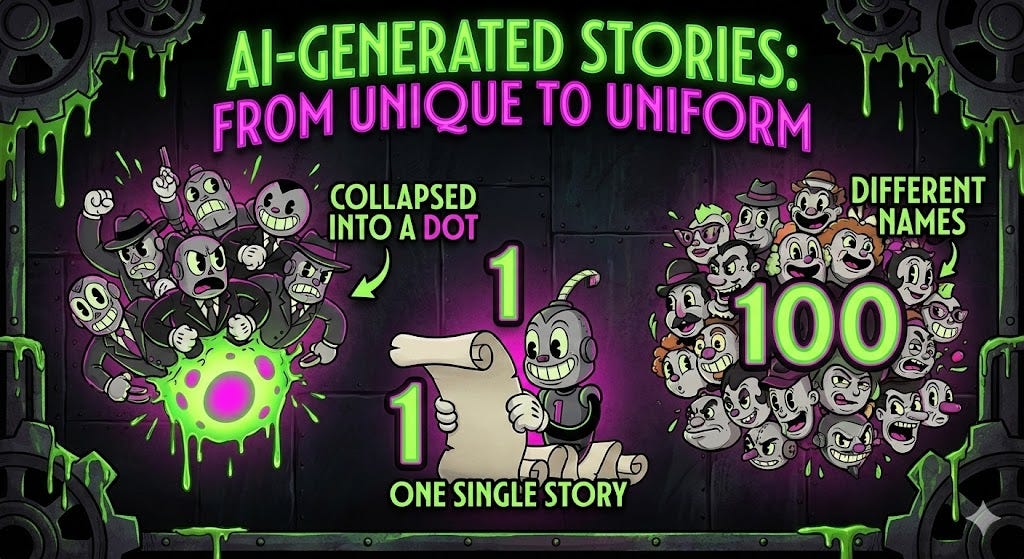
As AI drives the marginal cost of making copy, concepts, and visuals toward zero, creation itself stops being scarce and starts behaving like a commodity. ToxSec AI argues that once “the same probability distribution” is whispering into everyone’s process, distinctive variation collapses into a default output: teams may feel more productive because the tool did “the heavy lifting,” but that productivity mostly means reaching polished average faster, not producing work with the weird flourishes, judgment, or narrative edge that once made a brand recognizably its own.
That shift forces competition away from sheer output and toward human-led choices about taste, pacing, and story construction. Marketing Against the Grain points to an Equinox spot that withholds the brand line until 25 seconds into a 30 secondond ad and uses two second clips—“Change everything you see every 8 seconds”—as evidence that when generic AI content has made attention patterns cheap and obvious, differentiation comes from deliberate creative restraint, imperfect authenticity, and bespoke editorial decisions that machines can imitate stylistically but not originate strategically.