EU pay transparency directive sparks patchwork compliance—and global ripple effects—as employers scramble to adapt
The gist
The EU’s Pay Transparency Directive is triggering a compliance scramble, exposing multinationals to legal risks and global ripple effects as countries lag on implementation and employers rush to adapt.
What to know
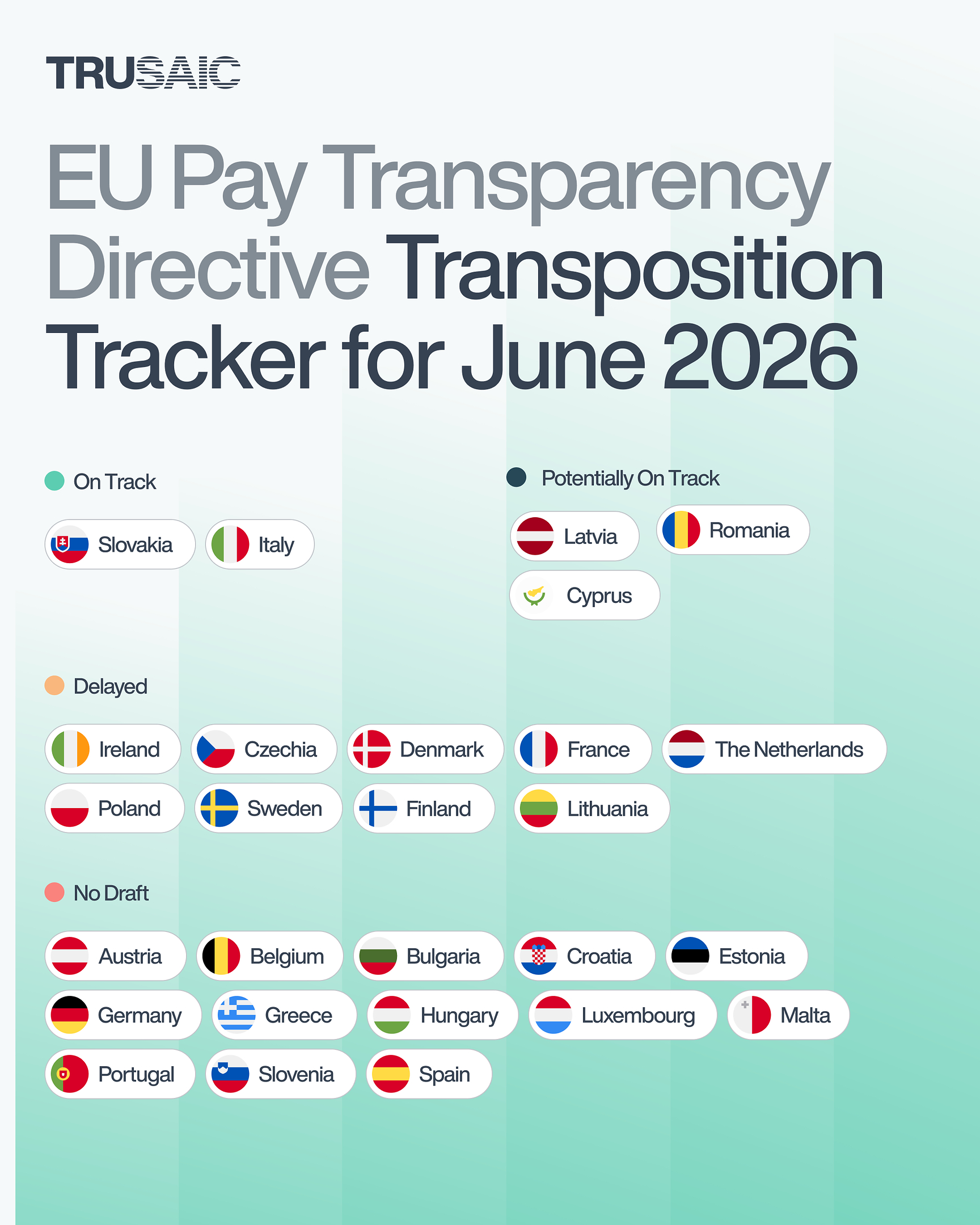
- Only 2 of 27 EU member states met the June 7 deadline to transpose the Directive, leaving a fragmented legal landscape and forcing companies to rely on real-time compliance tools like Trusaic’s Directive Monitor.
- Germany applies the Directive directly without national law, mandating salary range disclosures and banning pay history questions—while a 2025 court ruling exposes employers to up to three years of back-pay risk.
- Salary disclosure in EU job ads remains low (6.6%), with remote roles nearly twice as likely to reveal pay, as market competition—not regulation—currently drives most transparency.
Compliance Chaos Across Europe
A fragmented patchwork of national responses to the EU Directive is forcing employers to juggle real-time compliance tools, shifting legal definitions, and mounting back-pay risks in a climate of regulatory uncertainty.
By mid-2026, the transposition of the EU Pay Transparency Directive across member states reveals a patchwork of progress and approaches, with only two out of 27 countries on track to meet the June 7 deadline. This uneven landscape compels multinational employers to rely on dynamic tools like Trusaic’s enhanced Directive Monitor, which offers a real-time interactive map to navigate the complex and evolving national legislative requirements that go beyond mere compliance to encompass pay equity reviews, salary disclosures, and manager training.
Germany stands out as a unique case where the EU Directive applies directly without any national legislation, imposing immediate and stringent obligations on employers such as including salary ranges in job advertisements and prohibiting inquiries into candidates’ pay history. This direct application, coupled with a 2025 Federal Labor Court ruling enhancing employee rights to salary comparisons, exposes employers to risks including back-pay liabilities up to three years, while fragmented HR and payroll systems, especially in sectors like food processing with additional HACCP documentation demands, exacerbate compliance challenges.
The Netherlands exemplifies a proactive and structured approach by publishing a detailed draft decree in June 2026 that clarifies key definitions like gross wage and delineates the treatment of variable and complementary pay components, aiming to ease administrative burdens through the use of existing payroll data systems. This draft, open for public consultation until July 31, signals a methodical path toward compliance that contrasts sharply with countries like Austria, which, despite the deadline passing, have yet to publish any draft legislation, leaving employers in legal limbo amid significant new obligations such as reporting unadjusted gender pay gaps and facing a shifted burden of proof in discrimination cases.
Recognizing the operational complexities introduced by the Directive, particularly the nuanced concept of 'work of equal value,' the European Commission and the European Institute for Gender Equality (EIGE) have proactively released a comprehensive toolkit to assist employers. This resource guides organizations through gender-neutral job evaluation, classification, pay gap analysis, and joint pay assessments, providing much-needed clarity and practical support to navigate the Directive’s demanding transparency and reporting requirements across diverse national contexts.

Legal Hurdles and Hidden Risks
Germany’s direct adoption of the Directive, coupled with a shifting burden of proof and sector-specific requirements, exposes employers to costly litigation and operational headaches as fragmented compliance regimes multiply across the EU.
Germany’s direct application of the EU Pay Transparency Directive since June 8, 2026, without accompanying national legislation, has thrust employers into a strict compliance regime requiring salary range disclosures in job ads and banning inquiries into candidates’ pay histories. This regulatory vacuum amplifies operational challenges, especially given fragmented HR and payroll systems that complicate seamless documentation and digital signature requirements demanded by auditors, while sector-specific hurdles like HACCP documentation in food processing add further complexity.
The Directive’s enforcement framework intensifies legal risks for employers by shifting the burden of proof once an employee establishes a prima facie case of pay discrimination, compelling employers to justify pay disparities or face administrative fines and potential exclusion from public procurement. This heightened liability is underscored by Germany’s Federal Labor Court ruling in 2025, which facilitates salary comparisons for pay inequality claims, exposing employers to back-pay obligations up to three years and enhanced employee rights.
Fragmented and delayed transposition of the Directive across EU member states—including Germany, France, the Netherlands, Spain, and Austria—creates a patchwork of legal uncertainty and operational hurdles for multinational employers. With only a few countries like Slovakia, Italy, Lithuania, and Malta having finalized legislation by mid-2026, employers face inconsistent enforcement landscapes that complicate compliance efforts and necessitate proactive investments in harmonized pay architectures, integrated data systems, and disciplined governance to mitigate litigation risks amid evolving labor laws.
Beyond legal compliance, the Directive imposes substantive operational demands by requiring employers to report unadjusted gender pay gaps and take concrete steps to address disparities, compelling a thorough review and overhaul of pay structures, policies, and data systems. Employees’ enhanced rights to request detailed pay information and the lowered evidentiary threshold for proving discrimination intensify the pressure on employers to maintain transparent, consistent, and well-documented pay practices to avoid enforcement actions and reputational damage.
Tech-Driven Compliance Race
Employers are racing to centralize pay data and deploy advanced analytics platforms, transforming pay transparency from a compliance burden into a strategic pillar for workforce modernization and risk mitigation.
By mid-2026, multinational employers have increasingly turned to specialized tools like Trusaic’s enhanced EU Pay Transparency Directive Transposition Monitor to navigate the fragmented and evolving legislative landscape across member states. Trusaic’s expansion of European operations and its real-time interactive map enable organizations to track jurisdiction-specific compliance demands effectively, while its comprehensive solutions—including automated reporting, pay equity analysis, and remediation tools integrated with HR systems—help employers manage complex operational and governance challenges beyond mere compliance.
Simultaneously, Workday’s Pay Transparency Analyzer, powered by Kainos and adopted by leading companies such as Fugro, David Lloyd Clubs, and Kongsberg, exemplifies how employers are centralizing HR and pay data to produce defensible pay gap analyses. This strategic adoption reflects a broader shift where pay transparency is embraced not just as a regulatory checkbox but as a core component of workforce modernization, enhancing talent retention, trust, and legal risk mitigation.
To meet the Directive’s stringent requirements, legal experts like Mayer Brown recommend that multinational employers implement a centralized compliance framework with tailored local adaptations, supported by a clear pay architecture featuring harmonized job-evaluation frameworks and structured pay bands. Building high-quality, harmonized data infrastructures that integrate HR and payroll systems is critical, though it demands a significant lead time of six to twelve months, underscoring the need for early and strategic investment in data readiness.
Beyond data and reporting, employers must also overhaul recruitment and employee engagement processes to align with transparency mandates—providing initial pay ranges upfront, eliminating salary-history inquiries, and establishing standardized procedures for handling employee information requests with clear service levels. These operational adjustments, coupled with aligning payroll and pay equity data—especially variable pay components as highlighted by the Netherlands’ draft decree—serve to reduce administrative burdens while ensuring compliance and fairness across the workforce.
Transparency’s Unintended Fallout
Shifting compliance burdens onto companies is fueling internal pay disputes and drawing criticism that transparency mandates overlook deeper causes of inequality like caregiving gaps and outdated labor laws.
By mid-2026, HR and legal experts have raised concerns that the EU Pay Transparency Directive significantly increases employer workload by shifting compliance responsibilities from authorities directly onto companies. This shift demands that employers not only disclose salary ranges in job advertisements but also provide detailed pay information to employees, a move that, while intended to promote fairness, may inadvertently spark workplace conflicts as pay discrepancies become more visible. Critics further argue that the Directive’s focus on procedural compliance overlooks deeper systemic issues such as childcare burdens and outdated employment laws, which are fundamental drivers of pay inequality and require more comprehensive solutions beyond transparency alone.
Market Forces Outpace Law
Despite new regulations, salary transparency in EU job ads remains dismally low—with competitive pressures in remote hiring, national culture, and role seniority driving far greater change than legal mandates.
One month after the EU Pay Transparency Directive took effect, salary disclosure in EU job ads remains strikingly low at just 6.6%, a stark contrast to the nearly 40% seen in the US. However, this broad sluggishness masks notable nuances: remote job listings are nearly twice as likely to reveal pay (11.5%) compared to on-site roles (6.2%), driven largely by fierce competition in the international talent market. As one report aptly observes, "competition is currently doing more for European pay transparency than regulation," highlighting how market forces are nudging transparency ahead of formal enforcement.
Salary transparency varies dramatically across EU countries and sectors, underscoring uneven adoption of the Directive. For instance, Germany’s disclosure rate on Workday languishes at 2.8%, Sweden trails at a mere 0.4%, while the UK leads with 21%, followed by the Netherlands (12%), Ireland (10%), and France and Austria (9%). This patchwork reflects differing national cultures and platform practices, complicating a unified European transparency landscape.
Interestingly, seniority inversely correlates with pay transparency: junior roles in Ireland disclose salaries at around 32%, but this drops sharply to 11% for senior roles and 9% for lead positions. This trend risks disadvantaging candidates with less negotiating power, as opaque pay for higher roles may perpetuate information asymmetries and inequities in hiring.
The initial tepid uptake of salary disclosure is partly explained by the staggered rollout of national enforcement measures, with most member states’ laws not yet fully in force. Bulk implementations are anticipated through January 2027, with sanctions and rigorous enforcement to follow later. This phased approach suggests that while early data shows slow adoption, meaningful shifts in transparency practices are expected to accelerate in the coming months.
Global Ripple, Local Tensions
The EU Directive is triggering a worldwide shift in pay transparency laws, but divergent standards between regions like the UK, US, and Asia are creating internal friction and strategic headaches for multinationals.
The EU Pay Transparency Directive is catalyzing a wave of legislative alignment beyond its borders, notably influencing the UK’s approach where, starting in 2027, employers with 250 or more employees must publish gender pay gap action plans, echoing the EU’s mandate for companies with 100+ employees. This regulatory convergence places multinational organizations in a complex position, as they must navigate divergent transparency standards across jurisdictions while managing internal equity. The risk of visible disparities between EU and non-EU employees’ pay transparency practices can fuel tension and resentment within global workforces, challenging companies to harmonize policies without compromising compliance or cultural sensitivities.
In contrast to the EU and UK’s structured frameworks, the United States presents a fragmented landscape where pay transparency laws vary widely by state, such as California and New York’s early adoption of salary range disclosures, but lack a cohesive national mandate. This patchwork fosters a discretionary, negotiation-driven culture that diverges sharply from European norms, complicating multinational employers’ efforts to implement consistent transparency policies across their American operations. The cultural and legal divergence underscores the strategic challenge for global workforce management, requiring tailored approaches that respect local norms while striving for overarching equity.
Beyond Western contexts, countries like Canada and Australia are experiencing pay transparency reforms paralleling the UK’s trajectory, with Canadian provinces enacting legislation and Australia’s Fair Work Act 2022 banning pay secrecy clauses, thereby aligning more closely with EU standards. Conversely, nations such as South Korea, where opaque pay practices and a significant gender pay gap have been entrenched, face profound hurdles in adapting to the Directive’s requirements for their EU-based employees. These disparities highlight the Directive’s ripple effect on multinational corporations, compelling them to reconcile diverse regulatory environments and cultural pay norms while advancing global pay equity agendas.