Fed independence on the ropes: warsh nomination ignites political firestorm and market jitters
The gist
The Fed’s independence is under siege as Kevin Warsh’s nomination ignites a political brawl, DOJ probes swirl, and markets brace for a seismic shift in U.S. monetary policy.
What to know
- Political infighting and public endorsements from President Trump have fractured the Fed, with internal dissent and Senate drama threatening its long-standing autonomy.
- Kevin Warsh’s 2026 nomination as Fed Chair signals a sharp pivot toward monetary tightening, supply-side economics, and a controversial new Fed-Treasury accord.
- Warsh’s Senate hearings—marred by bipartisan grilling, ethics probes, and DOJ investigations—fuel market jitters and cast doubt on the future effectiveness of U.S. monetary policy.
Fed Fractures Deepen
Internal rifts and political appointees have split the Federal Reserve into warring camps, shattering the consensus that defined Powell’s era.
In late 2025, the Federal Reserve began to visibly grapple with political pressures that threatened its long-standing independence, notably marked by the appointment of Mr. Marin, a White House representative whose dissenting vote on the Fed committee diverged from the consensus and raised eyebrows about political influence on monetary policy. This development coincided with Chair Powell’s acknowledgment that the Fed was "leaning towards the employment side of our mandate," reflecting internal tensions as the institution struggled to balance rising inflation against weakening job creation amid economic uncertainty.
Despite these early signs of political encroachment, internal Fed dynamics revealed a complex defense of institutional autonomy, exemplified by Trump-appointed governors Bowman and Waller who resisted forming a dissenting bloc with the White House representative, signaling a subtle but firm 'You don't own me' stance. However, by November 2025, the Fed was clearly divided into two camps: one advocating caution on rate cuts due to inflation fears, and another prioritizing labor market support, underscoring deepening policy debates and the erosion of the consensus that had characterized Powell’s tenure.
Political pressure intensified as President Trump publicly announced his preferred successor for Fed chair, fueling market speculation that a new leader might aggressively pursue rate cuts, thereby unsettling the traditionally data-driven and collective decision-making process of the Federal Open Market Committee. This external interference, described as pushing 'this dissension that we're seeing so much,' coincided with internal calls from figures like Scott Bessant for the Fed to 'move back into the background,' highlighting tensions over the Fed’s visibility and independence amid a fraught economic and political landscape.
The convergence of mounting political influence and internal discord by late 2025 raised concerns that Trump’s strategy to control the Fed could act 'like a wrecking bull,' potentially triggering drastic overnight rate cuts and market instability. This precarious moment underscored the fragility of the Fed’s independence as it faced not only a nearly evenly split committee on interest rate direction but also the looming prospect of a leadership change in mid-2026 that could reshape U.S. monetary policy in unpredictable ways.




Succession Sparks Market Anxiety
The high-stakes Fed Chair nomination battle has fueled market volatility as political maneuvering threatens to erode the institution’s credibility and independence.
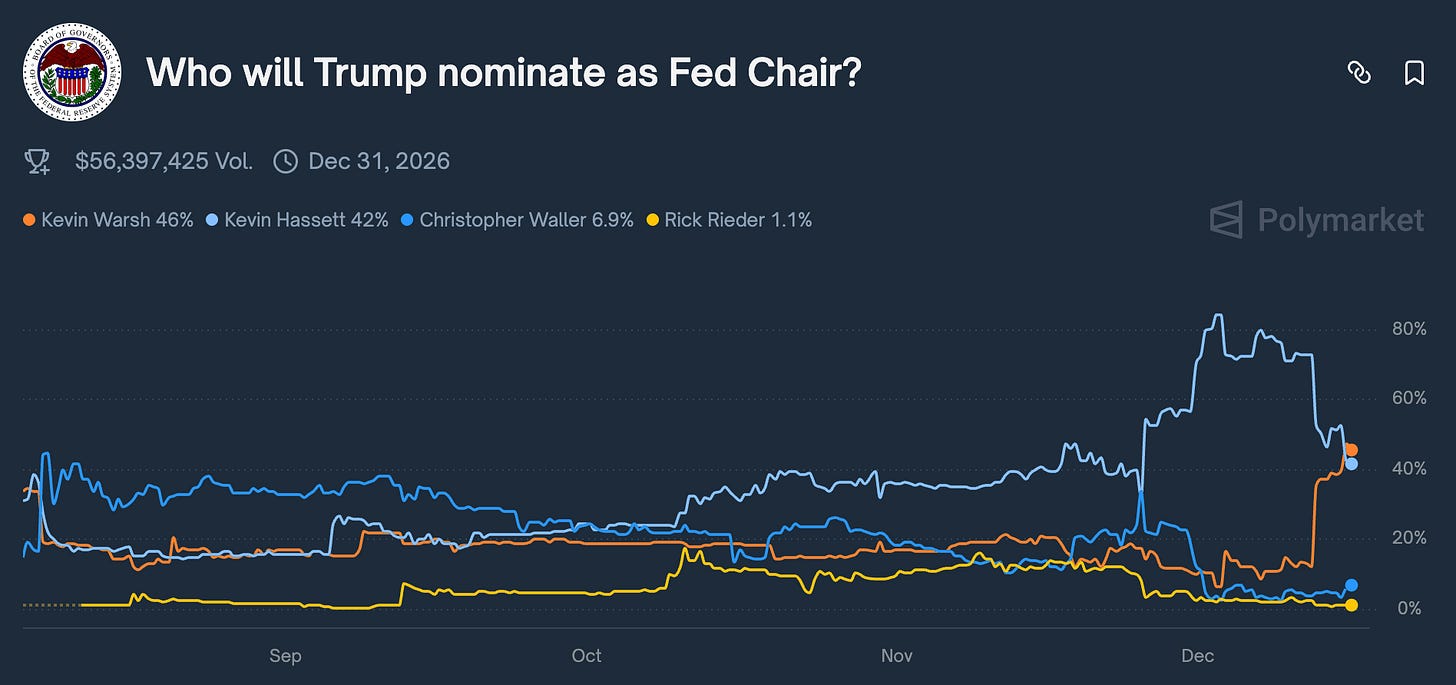
As Jerome Powell's term as Fed Chair approaches its May 2026 conclusion, uncertainty and speculation about his successor have intensified, with market participants and political actors closely watching the nomination process. Kevin Hassett initially emerged as the frontrunner, buoyed by hints from former President Trump that sent his odds soaring to around 85%, though skepticism about this surge was evident as bond markets expressed nervousness. The nomination process is fraught with political maneuvering, described as a strategic 'card that Trump wants to use early to put pressure on the Fed,' underscoring the high stakes and the intense scrutiny surrounding the confirmation amid ongoing political pressures and market volatility in late 2025 and early 2026.
The anticipated leadership transition signals a potential paradigm shift in Federal Reserve policy, moving away from the Volcker-Greenspan era under Powell toward a new direction influenced by supply-side economics. Both Kevin Hassett and Kevin Warsh, prominent supply-side economists and reform-minded figures, represent this shift, with Warsh in particular advocating for tighter monetary discipline and structural reforms to the Fed’s governance. While Warsh's hawkish stance and deep Wall Street ties suggest a move toward skepticism of balance sheet expansion and zero interest rate policies, market reactions have remained relatively muted, pricing in only modest policy changes despite the political drama.
Navigating the Fed Chair succession involves a delicate balancing act: the nominee must be loyal enough to secure Trump’s nomination yet independent enough to win Senate confirmation and maintain credibility within the Federal Reserve. This tension raises concerns about the potential for a revolving door of politically compromised Chairs who might push for aggressive rate cuts inconsistent with economic realities, risking internal Fed conflicts and undermining institutional independence. Analysts warn that the Senate must resist confirming nominees too closely aligned with the President to preserve the Fed’s effectiveness, especially as the new Chair will face intense political pressures amid a volatile policy environment.
Throughout the final months of Powell’s tenure, every communication and policy signal gains heightened significance, serving both as a guide to the Fed’s near-term policy trajectory and as a subtle indicator of the incoming Chair’s stance. Observers are advised to scrutinize Powell’s March 2026 press conference and Fed communications for nuanced shifts in language that may reveal underlying tensions or transitions. Concurrently, the confirmation process of Kevin Warsh is expected to create a parallel channel of market influence, adding complexity to the Fed’s messaging and shaping expectations during this pivotal leadership handoff.






Warsh’s Hawkish Yet Modern Vision
Kevin Warsh’s blend of Wall Street ties, supply-side orthodoxy, and crypto-friendly pragmatism signals a dramatic shift in Fed leadership and policy direction.
Kevin Warsh's nomination as Federal Reserve Chair in early 2026 marked a significant leadership transition, with Warsh bringing a blend of youthful experience and deep political connections. Having served as the youngest Fed governor at age 35 during the 2008 financial crisis and holding a background that includes investment banking at Morgan Stanley, Warsh's qualifications were initially questioned. However, his strong Republican ties, notably through family connections to major GOP donors like Ron Lauder of Estee Lauder fame, and his ability to tailor his messaging to appeal to President Trump and Republican audiences, positioned him as a favored candidate aligned with the administration's economic goals.
Warsh's policy stance signals a marked shift toward traditional monetary tools and fiscal responsibility, reflecting his longstanding criticism of the Fed's post-2008 expanded balance sheet and quantitative easing programs. He views the Fed's asset purchases as market-distorting and a bailout for Wall Street that exacerbated asset price inflation and wealth inequality, advocating instead for quantitative tightening and a reduction in the central bank's economic footprint. This perspective aligns with his calls for an organizational overhaul of the Fed to address 'mission creep' and modernize information processing, underscoring his intent to recalibrate the institution's role amid evolving economic challenges.
Despite his hawkish reputation, Warsh presents a nuanced economic outlook that embraces pro-growth policies, AI-driven productivity gains, and a cautious approach to interest rates. He supports lowering rates when justified by structural improvements and productivity enhancements from AI, viewing technology as a deflationary force reminiscent of Greenspan-era optimism. His openness to cryptocurrencies, describing Bitcoin as 'the new gold for people under the age of 40' and a 'good policeman for policy,' further distinguishes his forward-looking stance. Market commentators see him as a high-integrity, intellectual thinker likely to pursue measured quantitative tightening and prudent monetary policy, though concerns linger about his reluctance to deploy the Fed's crisis toolkit.
Warsh's path to confirmation is fraught with political hurdles amid a tense environment where some Republican senators, including GOP Senator Tillis, have vowed to block his nomination until the Department of Justice concludes its investigation into former Chair Powell. This standoff reflects broader partisan tensions that could prolong the confirmation process and complicate Warsh's ability to navigate relationships with political figures he has previously criticized. The nomination thus underscores the ongoing challenges to Federal Reserve independence and the politicization of its leadership amid evolving economic and political landscapes.



Confirmation Drama and DOJ Heat
Warsh’s Senate grilling, ethics controversies, and a DOJ probe have turned his confirmation into a political spectacle, rattling markets and exposing bipartisan distrust.
Kevin Warsh's April 21, 2026 Senate confirmation hearing unfolded amid intense bipartisan scrutiny, with Senators like Elizabeth Warren aggressively questioning his independence and transparency, particularly over his refusal to disclose details about his $100 million-plus assets. Warsh pledged a 'regime change' in the Fed’s inflation strategy while firmly asserting his commitment to maintaining Federal Reserve independence, denying any intention to act as President Trump's 'sock puppet.' However, the confirmation process was complicated by a Justice Department probe into a $2.5 billion Fed headquarters renovation, which fueled political opposition and market volatility, underscoring the fraught environment surrounding his nomination.
Senator Elizabeth Warren emerged as a leading critic, condemning Warsh for his past Fed record during the 2008 financial crisis and accusing him of being a 'rubber stamp' for Wall Street interests. She spearheaded a probe into his role in downplaying subprime mortgage risks and facilitating taxpayer-funded bailouts, while also challenging his monetary policy views and ethical compliance. Warren’s pointed criticisms, combined with Senator Thom Tillis’s procedural block pending resolution of the DOJ investigation into Chair Jerome Powell, stalled Warsh’s confirmation and highlighted deep bipartisan resistance amid concerns over the erosion of Fed independence under mounting political pressure.
Despite the political turbulence, Federal Reserve officials like John Williams emphasized operational continuity, assuring markets that the Federal Open Market Committee would maintain its focus and steady governance regardless of Warsh’s confirmation status. Williams acknowledged Warsh’s deep understanding of the Fed’s mission but suggested any proposed policy shifts would likely unfold gradually. This stance aimed to temper market anxieties amid the uncertainty, as investors closely watched the confirmation hearings for clues about the future trajectory of U.S. monetary policy and the Fed’s ability to resist politicization in a highly charged environment.
Warsh’s confirmation hearings became a focal point not only for assessing his policy vision but also as a barometer of the broader struggle over Federal Reserve independence in the Trump era. With President Trump openly pressuring the Fed for faster rate cuts and backing the DOJ’s criminal probe into Chair Powell, Warsh’s navigation of these political crosscurrents was critical. His potential willingness to initiate an internal Fed ethics investigation into the renovation scandal signaled a tactical move to appease political forces while attempting to preserve institutional integrity, illustrating the precarious balance between political loyalty and central bank autonomy at the heart of the 2026 confirmation saga.






A New Fed-Treasury Accord?
Warsh’s push for coordinated debt management and a strict inflation mandate could upend decades of Fed independence and reshape how monetary policy is made.
Kevin Warsh’s policy proposals mark a significant rethinking of the Federal Reserve’s balance sheet management and its relationship with the Treasury, advocating for a new accord to define the size and composition of the balance sheet. Unlike traditional QE, which is often viewed as money printing, Warsh highlights that since 2008 the Fed’s ability to pay interest on reserves effectively transforms fixed-rate government debt into floating-rate liabilities, consolidating Fed and Treasury balance sheets. This nuanced understanding underpins his call for coordinated debt maturity management between the Fed and Treasury, potentially challenging the Fed’s historic independence established by the 1951 accord and signaling a more integrated fiscal-monetary policy framework.
Warsh’s stance as an inflation hawk tempered by optimism about AI-driven productivity gains suggests a calibrated monetary policy approach that balances quantitative tightening with potential rate cuts. While he supports continuing to shrink the Fed’s balance sheet—albeit at a slower pace than recent efforts—he also believes that technological advances, particularly AI, could induce a deflationary shock enabling sustained GDP growth of 4-5% without aggressive rate hikes. This dual perspective has sparked market concerns about hawkishness, but insiders argue Warsh’s nuanced views may lead to a more balanced policy that supports innovation and risk assets like Bitcoin, which historically surged during easing cycles.
Warsh advocates for a fundamental 'regime change' at the Fed, emphasizing a strict inflation framework where the institution must take full responsibility for price stability, reflecting the influence of Milton Friedman’s doctrine. He calls for reforms that increase accountability and coordination with the Treasury while maintaining Fed independence, underscoring the need to restore institutional credibility after recent inflation surges. This includes rethinking transparency and communication strategies—he proposes eliminating the dot plot and reducing forward guidance to avoid market misinterpretations, favoring more deliberative, less telegraphed policy decisions that could introduce greater market uncertainty but potentially enhance policy flexibility.
While Warsh stresses the essential nature of Fed independence, he contends that operational autonomy largely depends on the Fed’s own discipline rather than political statements from elected officials. This view contrasts with the current political reality under President Trump’s aggressive pressure tactics, including legal actions against dissenting Fed officials, which threaten institutional autonomy. Additionally, Warsh’s potential maneuvering to shift investigations of Fed Chair Powell from the Department of Justice to internal Fed ethics inquiries illustrates his pragmatic approach to navigating political tensions, though such moves risk alienating Federal Reserve members and complicate the Fed’s institutional integrity amid expanding responsibilities beyond interest rate setting.


Fed’s Future at a Crossroads
Legal battles, Supreme Court rulings, and market uncertainty converge as political interference challenges the very foundation of central bank governance.
Political pressures on the Federal Reserve have intensified markedly from late 2025 through mid-2026, with former President Trump actively attempting to influence Fed leadership by promoting nominees like Kevin Warsh and Christopher Hasid, creating a 'shadow Fed' narrative that fuels market uncertainty and challenges the institution's independence. This politicization is underscored by DOJ investigations targeting Chair Jerome Powell, which have drawn bipartisan backlash yet continue to cast a shadow over Fed operations and leadership transitions, as highlighted by a federal judge’s ruling blocking subpoenas against Powell for lacking evidence and reflecting retaliatory motives. The Supreme Court's impending January 2026 ruling on Lisa Cook's removal challenge and Powell's term expiration in May 2026 represent critical junctures that could redefine presidential power over the Fed and reshape its governance framework.
Amid these political tensions, the Federal Reserve is navigating a complex macroeconomic landscape characterized by sticky inflation hovering around 2.5%, a cooling labor market with unemployment rising to 4.6% in November 2025, and accommodative financial conditions despite restrictive monetary policy stances. Market expectations have oscillated, with futures markets pricing in an 88% chance of a December 2025 rate cut, though internal Fed divisions and data irregularities caused by government shutdowns have complicated consensus and policy signaling. Even as Kevin Warsh emerges as a frontrunner for Fed Chair with a reputation for tighter monetary discipline, his pro-technology and crypto-friendly views suggest potential gradual shifts toward supporting risk assets like Bitcoin, especially given the significant debt maturities in 2026 and historical correlations between easing cycles and crypto rallies.
Despite the mounting political and legal pressures, Jerome Powell retains notable institutional and public support, maintaining a net approval rating higher than President Trump and backing from international central bankers and organizations such as the Bank of Canada and the World Economic Forum. This support bolsters his position amid DOJ probes and political attacks, even as speculation grows about his potential removal before his 2028 term ends. Meanwhile, the Fed’s operational continuity remains intact with leaders like John Williams downplaying leadership gaps and emphasizing gradual policy evolution, signaling that despite turbulence, the Fed aims to uphold its mission and resist abrupt shifts that could destabilize markets.
The broader institutional and market implications of these tensions extend beyond immediate policy decisions, as the politicization of the Fed risks undermining confidence in its independence and complicating monetary policy effectiveness, particularly in an environment where inflation expectations remain elevated and long-term rates may rise despite short-term easing. The potential revolving door of Trump-aligned Fed Chairs threatens to erode the institution’s credibility and stability, with experts like Janet Yellen warning that compromising Fed autonomy could exacerbate inflation risks. Additionally, external factors such as Justice Department probes into federal infrastructure spending and Supreme Court rulings on tariffs add layers of fiscal uncertainty that may constrain the Fed’s policy flexibility, underscoring the fragile balance the next Fed Chair must strike between political loyalty and institutional independence.

