Florida’s property tax revolution: DeSantis plan advances, cities brace for budget shock
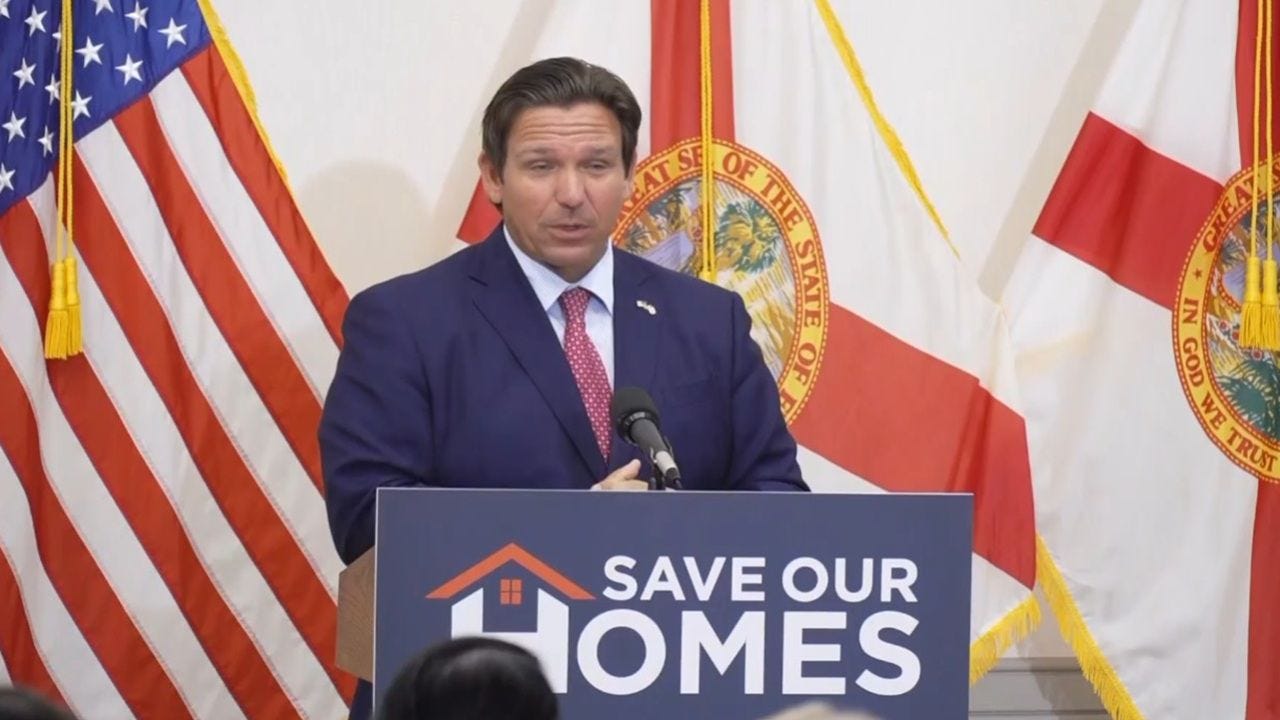
The gist
Florida is on the brink of a property tax revolution as Governor DeSantis’s plan to nearly wipe out non-school property taxes for most homeowners advances—sparking cheers from owners and panic among cities bracing for deep budget cuts.
What to know
- A 2026 ballot measure could boost the homestead exemption from $50,000 to $250,000, cutting non-school property taxes to zero for about 60% of homeowners if 60% of voters approve.
- DeSantis calls property taxes 'modern feudalism' and wants to swap annual bills for a one-time sales tax at home purchase, but local leaders warn of major funding shortfalls for public safety and infrastructure.
- Homeowners could save $1,500–$1,800 a year, but critics say higher home prices and a five-year residency requirement could undercut affordability for new buyers and lock out recent arrivals.
Bipartisan Tax Overhaul Gains Steam
Florida lawmakers are fast-tracking a constitutional amendment to wipe out non-school property taxes for most homeowners, balancing historic relief with a carve-out to protect school funding.
The Florida Legislature has made significant strides toward a landmark property tax reform by advancing House Joint Resolution 1F, which proposes raising the homestead exemption from $50,000 to $150,000 in 2027 and further to $250,000 in 2028. This constitutional amendment, passed with strong bipartisan support—75–26 in the House and 30–9 in the Senate—aims to effectively eliminate non-school property taxes for the majority of primary homeowners, contingent on securing at least 60% voter approval in the November 2026 ballot. This legislative momentum underscores a concerted effort to ease the tax burden on Florida’s homeowners while reshaping local tax structures.
Crucially, the expanded homestead exemption is designed for seamless implementation, automatically applying to existing homestead exemption holders without requiring additional filings. By 2028, this change is projected to reduce non-school property tax bills to zero for approximately 60% of Florida’s homesteaded homeowners, signaling a transformative shift in property tax dynamics. However, a late amendment excluded school district levies from this exemption increase, preserving funding streams for education despite the broader tax relief, which reflects a nuanced balancing act between homeowner benefits and essential public services.

Property Taxes: A Moral Reckoning
Reformers frame the end of annual property taxes as a fight for true homeownership and liberty, arguing that perpetual levies amount to modern-day serfdom and undermine generational wealth.
The ethical critique of property taxes centers on the idea that they reduce homeowners to perpetual renters or serfs on their own land, vulnerable to eviction despite full ownership—a situation deemed immoral, especially for vulnerable populations like elderly widows who have long paid off their homes. Advocates argue that this system undermines true ownership and liberty by imposing an ongoing, coercive tribute to the state, effectively continuing a form of modern feudalism that confiscates inheritance and penalizes home improvements.
Framing the abolition of property taxes as a moral restoration, proponents liken it to completing the American Revolution at the local level by removing perpetual government claims on private property. This vision calls for funding government functions through transparent mechanisms such as sales taxes, trade duties, and tariffs, thereby eliminating hidden and punitive levies. By early 2026, this philosophical stance has gained traction in Florida, positioning the policy shift as a fundamental restoration of liberty rather than a mere fiscal adjustment.
A key element of the ethical argument is the proposal to replace annual property taxes with a one-time, visible sales tax collected at the point of home purchase. This approach simplifies taxation, removes the fear of ongoing assessments or government seizure, and respects the biblical principle of stewardship over servitude, as reflected in Leviticus’ Jubilee. Such a system treats homeownership as a legacy of love and stewardship, not a taxable burden, aligning with moral imperatives against stealing and promoting transparent governance.

Winners and Losers in Tax Shift
While long-term homeowners stand to save thousands, first-time buyers and newcomers may face higher home prices and barriers to entry, complicating the promised affordability boost.
Governor DeSantis's plan to raise Florida’s homestead exemption to $500,000 aims to eliminate property taxes for a significant share of homeowners, but Florida’s own data suggests this benefit will reach about 75% to 80% of homesteaded properties, falling short of the promised 92%. While this expansion could yield meaningful annual savings—estimated around $1,800 in Broward County and $1,500 in Miami-Dade—critics like House Minority Leader Fentrice Driskell caution that the loss of property tax revenue may undermine essential local services, indirectly affecting community quality and housing affordability.
The proposal’s five-year residency requirement for new Florida residents restricts eligibility, favoring long-term homeowners and potentially deepening divides between established owners and newcomers. This residency clause, combined with existing homestead protections that cap assessment increases for longtime owners, may limit the plan’s affordability benefits for first-time buyers and recent arrivals, even as it aims to reduce monthly ownership costs and ease mortgage qualification hurdles.
While lowering or eliminating property taxes could reduce monthly housing costs and improve debt-to-income ratios—thereby enabling buyers to qualify for larger loans and enticing residents and businesses from higher-tax states like New York—these affordability gains may be partially offset by a projected 4% to 9% increase in home prices. Realtor.com estimates this price surge could add $200 billion to $250 billion in aggregate housing value statewide, intensifying market competition and potentially eroding the real affordability for new buyers despite the tax relief.
Florida’s rapid population growth, adding roughly 3 to 3.5 million residents since 2019, has driven property tax bills up by as much as 60%, with metros like Tampa and Jacksonville experiencing median tax bill surges of 57% and 60% respectively. Against this backdrop, the proposed tax relief could provide critical breathing room for homeowners facing volatile mortgage rates and escalating monthly payments, yet the broader implications for local government funding and housing market dynamics remain complex and contested.


Cities Face Budget Squeeze
With property tax revenue on the chopping block, local governments warn of deep cuts to public safety and infrastructure just as Florida’s population boom strains essential services.
Local governments across Florida are sounding alarms that Governor DeSantis’s $250,000 homestead exemption plan could trigger substantial cuts to essential public services. As cities warn of looming service reductions, the loss of property tax revenue threatens funding for schools, public safety, and infrastructure—areas already strained by the state’s rapid population boom of 3 to 3.5 million since 2019. Despite relatively flat tax rates, the surge in residents has escalated demand for public services, making the potential revenue shortfall from this exemption a critical challenge for municipal budgets.
The proposal effectively strips local governments of their most controllable and stable revenue source—homestead property taxes—forcing them to rely solely on remaining property tax dollars earmarked for “core services” like public safety, schools, infrastructure, bonds, and pensions. This shift not only constrains fiscal flexibility but also risks undermining the quality and availability of services that communities depend on. Analysts caution that without this crucial funding stream, local governments may struggle to meet the infrastructural and social demands of Florida’s expanding population, potentially exacerbating affordability and quality-of-life issues.