From AI hype to hard numbers: pharma and healthcare scale agentic AI, but clinical trials remain the $300m bottleneck
The gist
AI is transforming pharma and healthcare from flashy hype to hard results, but the $300M clinical trial bottleneck keeps even the smartest machines in check.
What to know
- Big pharma players like AstraZeneca and Bristol Myers Squibb have certified thousands of employees and scaled AI across R&D, manufacturing, and commercial operations.
- AI-powered multi-agent systems are slashing costs and boosting patient outcomes, with use cases from Stanford’s oncology boards to Novartis’s atomic-level drug models.
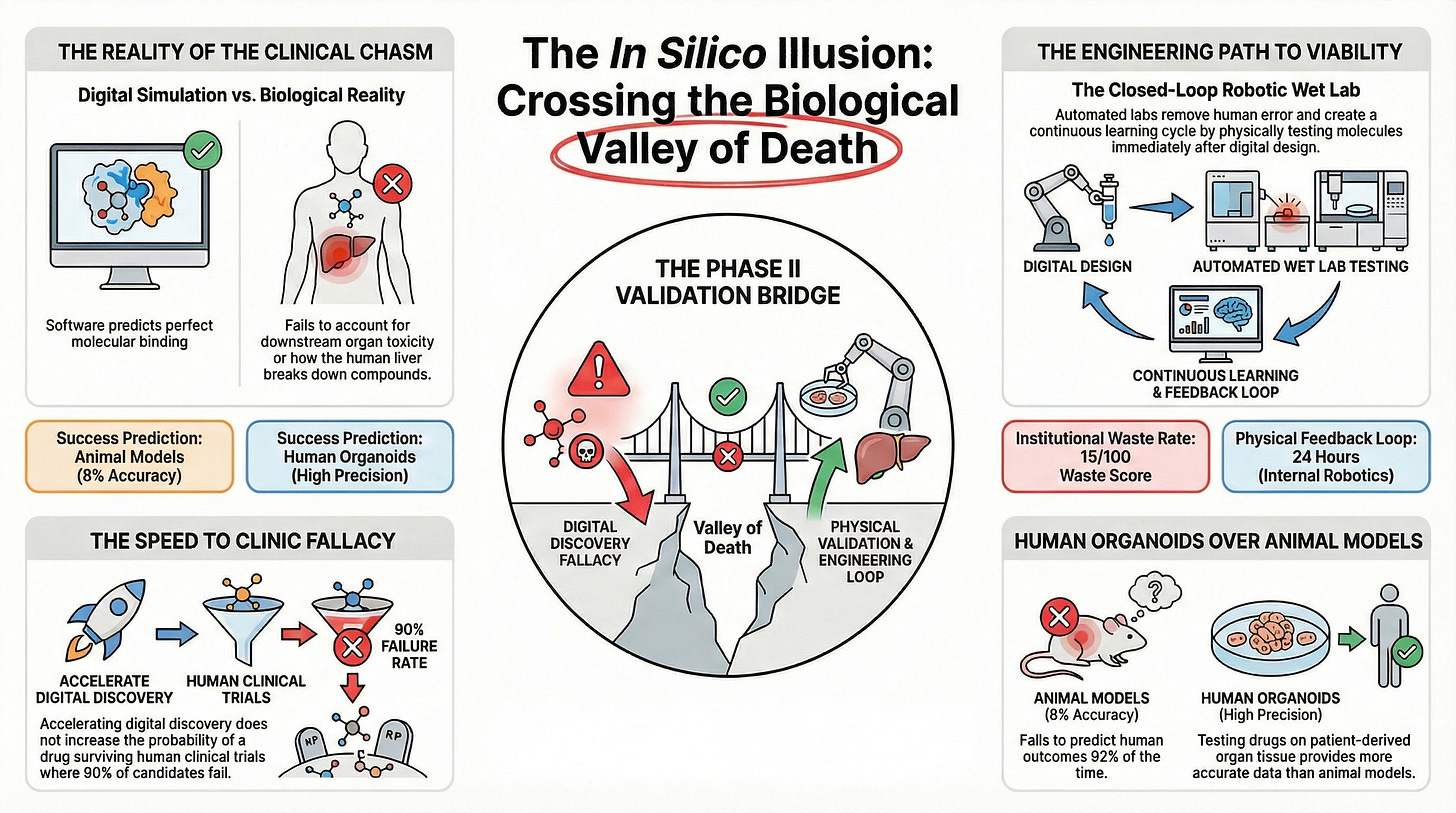
- Despite AI’s early-stage breakthroughs, 90% of drugs still fail Phase II trials, with human testing costs topping $300 million per attempt.
AI’s Next Evolution: Deliberate Reasoning
AI development is shifting from intuitive, data-driven models to collaborative, system two reasoning that pairs human expertise with agentic AI for smarter, more intentional breakthroughs.
By late 2025, AI research had decisively shifted from mass data generation toward accelerating discovery through tightly integrated interdisciplinary teams that identify precise model deficiencies and craft bespoke tools to fill those gaps. This evolution marked a transition from intuitive, system one AI models to more deliberate, system two reasoning capabilities, demanding novel data types and collaborative approaches. As one expert explained, “the era of sort of improving system one is coming to an end and it really has become about ... more intentional deliberate thinking and reasoning,” underscoring a fundamental change in AI development philosophy.
Concurrently, the rise of agentic AI—models capable of executing complex, multi-step tasks autonomously—rendered traditional data vendors obsolete, giving way to platforms that blend elite human expertise with AI to rigorously test and enhance models. This new paradigm, described as the era of research accelerators, demands smart human teams to 'break the models and then generate data to improve the model,' reflecting a strategic pivot from passive data provision to active, iterative model refinement.
By mid-2026, enterprises such as Meta, Uber, and AWS confronted the practical challenges of integrating agentic AI into proprietary workflows, grappling with soaring token costs and ambiguous ROI that forced rationing and optimization of AI usage. Despite these hurdles, the workforce rapidly matured into AI-native users who, aware of tool limitations, strategically prioritized high-impact applications to boost productivity and justify long-term investments, signaling a pragmatic yet optimistic phase in agentic AI adoption.


ROI-Driven AI Reshapes Business
Companies are scaling agentic AI to automate complex workflows and unlock measurable ROI, with smaller firms outpacing giants by rapidly resetting core business processes.
By 2025, enterprises had moved decisively beyond AI pilots, adopting a business-led approach that prioritizes workflow augmentation and workforce supplementation to drive measurable ROI. This evolution reflects a shift from viewing AI as a mere productivity tool to embracing agentic AI architectures that automate complex tasks and create new business models, as seen in diverse sectors from insurance to oil and gas. For example, a US insurance firm cut claim processing times from 27 minutes to 3 minutes using AI agents, while an oil and gas company identified over $350 million in savings within six months by deploying hundreds of AI agents for invoice analysis.
A 2025 Wharton study challenged earlier skepticism by revealing that 74% of businesses measuring generative AI ROI already see positive returns, broadening the definition of ROI to include productivity gains, employee retention, and operational efficiency. However, this optimism varies by industry and company size, with tech, telecom, and finance sectors reporting higher ROI, and smaller companies adapting faster due to their agility. Box CEO Aaron Levie encapsulated this dynamic, noting that AI output correlates directly with how extensively companies reset workflows, a process more feasible for smaller firms.
By early 2026, the operationalization of AI hinged on integrating technical expertise, user experience, and governance to ensure AI augments workflows and delivers measurable business value. Leading organizations transitioned from traditional software systems to interconnected data ecosystems, focusing AI strategy on transforming customer, employee, and partner interactions rather than merely on compute power. This holistic approach enabled enterprises to scale AI across complex workflows, as evidenced by the widespread adoption of AI agents—96% usage reported—with over half employing human-on-the-loop models to balance autonomy and oversight.
Scaling AI for measurable ROI also requires building shared AI infrastructure and a clean, accessible data layer that supports collaboration and workflow augmentation across teams, avoiding siloed or individual setups that limit impact. Platforms like Claude and n8n facilitate evolving AI skills and workflows that capture and refine value-creating processes, generating compounding advantages over time. As one expert cautions, businesses often err by chasing flashy demos instead of focusing on scalable, team-wide AI intelligence that truly drives business outcomes.





Multi-Agent AI Transforms Drug Discovery
Pharma’s new AI ecosystem relies on specialized agents and seamless data integration to accelerate drug development and deliver tangible cost savings, breaking down traditional industry silos.
Vertical AI in pharma and healthcare has evolved into a sophisticated ecosystem of heterogeneous, multi-agent systems that collaboratively address the entire drug discovery and clinical care continuum. Starting from LLM-driven strategic planning and scientific foundation models like AlphaFold for protein folding, to embodied AI agents executing experiments in wet labs, these specialized AI agents collectively tackle complex challenges such as efficacy, cost, compliance, and safety. Platforms that enable seamless collaboration across vendors, clouds, and verticals are critical to this integration, transcending traditional silos to accelerate innovation and commercial viability in drug development.
The integration of multi-omics data with advanced AI computational systems is transforming pharma’s approach from isolated chemical entity identification to a holistic drug development process. By leveraging robust multi-omics measurements alongside established AI networks, companies can now identify optimal drug targets and stratify patient populations with unprecedented precision, shifting the fundamental question from 'can we drug this target?' to 'what is the best target and patient cohort?'. This strategic transformation, anticipated to mature over the next two to three years, promises to enhance translational research and clinical outcomes significantly.
By early 2026, vertical AI applications in healthcare have demonstrated tangible economic value by embedding into specific workflows that yield measurable cost savings, such as Pearl Health’s AI preventing $30,000 hospitalizations. This real-world ROI is essential to sustaining the massive AI infrastructure investments, as industry leaders emphasize that without clear financial impact, AI risks becoming a speculative bubble. Consequently, health systems and vendors are increasingly focused on deploying agentic AI solutions that autonomously execute workflows—exemplified by Epic’s Agent Factory and athenahealth’s athenaConnect—while ensuring rigorous governance and risk management to satisfy cautious CIOs.
Oncology and clinical care are at the forefront of vertical AI innovation, with agentic AI systems now operational in settings like Stanford’s thoracic oncology tumor boards, where multi-agent models analyze radiology and pathology data to inform evidence-based treatment recommendations. Conferences such as AACR 2026 highlight a maturation from proof-of-concept to embedded operational systems featuring multi-omics integration, traceability, and hallucination mitigation, exemplified by MD Anderson’s 'Charles' agent and AstraZeneca’s RNA-seq automation. These advances, coupled with early adoption at major health systems like Mount Sinai and Mayo Clinic, underscore a shift toward hybrid healthcare workforces where AI reduces clinician busywork and enhances patient care without supplanting medical judgment.




AI Accelerates Discovery, Trials Lag
AI is revolutionizing early drug design and safety prediction, but the $300M clinical trial bottleneck persists as human biology remains the ultimate proving ground.
AI has become an indispensable tool in early drug development, revolutionizing molecule design, protein engineering, and risk evaluation well before clinical trials begin. Companies like Novartis leverage AI-driven multifactorial models to analyze chemical changes at the atomic level, enabling precise predictions of safety, pharmacokinetics, and activity, while pioneers such as Xaira invest over $1 billion to develop 'virtual cell' foundation models that simulate biological systems in silico. These advances allow for targeting previously undruggable proteins and optimizing biologics with improved safety and extended half-lives, promising to reshape early pipeline decisions and accelerate candidate generation.
Despite AI’s transformative impact on early discovery, the most persistent bottleneck remains the human clinical trial phase, particularly Phase II efficacy testing, where roughly 90% of drugs fail and costs can exceed $300 million per trial. This reality underscores that while AI accelerates molecule generation—from months to weeks—and enhances early-stage safety and toxicity predictions, it cannot yet overcome the fundamental challenge that safety and efficacy must be proven in living humans. Companies like Recursion Pharmaceuticals and Insilico Medicine have faced high-profile clinical failures, highlighting the gap between computational predictions and complex human biology.
Innovations such as Axiom Bio’s AI-driven toxicity prediction platform demonstrate promising progress by providing mechanistic insights into why molecules might fail, moving beyond simple toxicity flags to explain risks at a molecular level. By integrating extensive proprietary datasets and running industrial-scale biological assays across thousands of molecules, Axiom’s models have successfully identified toxicity mechanisms missed by traditional methods, as evidenced by their blinded simulation of the hepatotoxicity in BMS-986020. Early 2026 blinded studies with major pharma companies aim to validate this approach, potentially reducing costly late-stage failures and improving the predictive power of AI in drug safety.
While AI-driven simulations and digital molecule generation have reached a 'physics floor' in cost and speed, drastically reducing early-stage expenses, the digital-to-physical gap remains a critical hurdle. The FDA’s stringent three-phase clinical trial requirements cannot be bypassed, and accelerating early discovery without improving biological predictive accuracy risks a faster accumulation of costly failures downstream. Regulatory environments vary, with China experimenting with lowered barriers to speed approvals, but overall, the high failure rates and financial burdens of human trials persist, emphasizing that AI’s promise hinges on better integration with real-world validation and regulatory adaptation.





Big Pharma’s AI-First Overhaul
AstraZeneca, BMS, and Formation Bio are embedding AI across their enterprises, pairing massive workforce upskilling and auditable model integration with bold capital investments to drive future growth.
By early 2026, leading pharmaceutical companies such as AstraZeneca and Bristol Myers Squibb had embarked on ambitious enterprise-wide AI integration strategies, emphasizing comprehensive workforce upskilling and forging strategic partnerships to embed AI deeply into their operations. Formation Bio exemplifies this phased approach, initially optimizing clinical trial site startups to realize immediate cost savings, then progressively managing external assets and in-licensing drugs to establish itself as a truly AI-native biopharma company. This evolution underscores the necessity of integrating diverse machine learning models—ranging from knowledge graphs to protein language models—into auditable systems that collectively inform drug asset evaluation and clinical program design, reflecting the complexity of biological systems that no single AI model can address in isolation.
AstraZeneca’s strategic commitment to AI is vividly illustrated by its certification of over 17,000 employees in AI skills and the scaling of roughly 1,000 AI pilots, with finance playing a pivotal role in prioritizing initiatives to maximize value capture. This investment supports a bold growth agenda targeting $80 billion in revenue by 2030, driven by expanding existing products, entering new indications, and launching 25 blockbuster drugs. Complementing this, AstraZeneca’s $50 billion pledge to expand its US R&D and manufacturing footprint—including new sites in Gaithersburg and Kendall Square and multi-billion-dollar investments in biologics and cell therapy facilities—demonstrates how AI integration is tightly coupled with substantial capital deployment to sustain innovation leadership and meet ambitious growth targets.
Bristol Myers Squibb’s large-scale deployment of Anthropic’s Claude AI platform to over 30,000 employees marks a mature phase of AI adoption aimed at dismantling entrenched data silos that have long hindered drug R&D efficiency. This strategic investment, building on more than three years of internal AI development, spans critical functions from research and clinical development to manufacturing and commercial operations, embedding advanced agentic AI capabilities into everyday workflows. As EVP Greg Meyers highlights, unlocking the untapped value trapped behind decades of fragmented data is the ‘real prize,’ reflecting a broader industry trend toward operationalizing AI at scale to drive competitive advantage.
AstraZeneca’s recent three-year partnership with Owkin to develop agentic AI agents for biopharma competitive intelligence exemplifies the next frontier of enterprise AI integration, embedding sophisticated decision-support tools directly into executive workflows and IT infrastructure. Building on prior successes like the BRCAura RUO breast cancer pre-screening tool—which achieved 93% sensitivity and ruled out 40% of unlikely carriers—this collaboration underscores AstraZeneca’s commitment to AI-enabled innovation aligned with its R&D and growth objectives. Owkin’s CEO Thomas Clozel frames agentic AI as a transformative technology poised to become a critical strategic layer in pharmaceutical research and decision-making, signaling a shift toward AI-driven competitive intelligence at the highest organizational levels.




Biotechs Race Ahead, Trials Go Virtual
Agile biotechs are slashing development timelines with AI, while the rise of in silico trials and probability modeling hints at a future where human testing may no longer be the biggest barrier.
AI adoption in pharma and healthcare is accelerating rapidly, driven by smaller biotech firms' agility and the pressing need to reduce drug development timelines and costs. Tencent Healthcare President Alex Ng highlights that smaller biotechs are 'latching onto' AI faster than large pharma due to fewer organizational constraints, enabling them to cut early-stage drug development timelines and costs by up to 50% within three to five years. This momentum is complemented by life sciences enterprises embedding AI across clinical development, compliance, and patient engagement to navigate rising regulatory pressures and operational complexity, as noted in the 2026 ISG Provider Lens® report.
The evolution of AI-driven probability of success modeling and in silico clinical trials is reshaping risk assessment and capital allocation in drug development. Experts foresee that within the next decade, traditional phase 3 clinical trials might be supplanted by refined AI models that integrate cross-functional data to predict outcomes with greater certainty, potentially reducing reliance on costly human and animal testing. This shift, underscored by repeated insights from late 2025 through mid-2026, signals a structural transformation in R&D decision-making frameworks, propelled by the relentless pace of technological advancement aligned with Moore's Law.
Healthcare enterprises and payers are transitioning from AI experimentation to enterprise-wide adoption, focusing on automating high-friction processes such as clinical documentation, prior authorization, and revenue cycle management, yielding measurable outcomes like a 42% reduction in prior authorization time and $15 billion in prevented claim losses. Google Cloud's Gemini-powered agentic AI deployments at organizations including Humana, CVS Health, and Quest Diagnostics exemplify this trend, with CVS launching Health100 to unify healthcare engagement and Quest introducing patient-facing AI tools to enhance lab result comprehension. However, interoperability challenges and legacy system barriers remain significant hurdles, with 86% of payers acknowledging they are not fully ready to operationalize AI at scale.
The maturation of healthcare AI is marked by foundational infrastructure developments and heightened governance focus, as seen at HIMSS26 where athenahealth's MCP server movement established standards for AI access to EHR data, enabling vendor participation in health system workflows. Concurrently, autonomous AI applications have moved from pilots to production with proven ROI, including autonomous robots scaling within hospitals on a 3-5 year horizon. Yet, regulatory risks associated with autonomous AI handling PHI and clinical decisions have elevated governance as a critical factor, with health systems favoring vendors who can demonstrate trustworthy agent behavior, signaling a market dynamic where compliance and interoperability are as pivotal as technological capability.