From cheating crisis to cognitive crossroads: schools rewrite the rules for AI-era learning
The gist
As generative AI shakes the foundations of education, schools are rewriting the rules of learning, integrity, and assessment for a world where proof of knowledge is just a prompt away.
What to know
- By late 2025, AI made memorization-based tests obsolete, forcing schools like Harvard and Princeton to pivot to proctored exams, grade caps, and tough new AI policies.
- AI detection tools are catching more cheaters but often misfire—especially for non-native or neurodivergent students—fueling fairness debates and mental health concerns.
- With AI-generated 'slop' flooding assignments and job losses mounting, schools are scrambling to teach AI literacy and trust new detectors like Pangram Labs’ 99% accurate system.
AI Upends Academic Proof
The shift from knowledge recall to proving independent work has exposed deep flaws in AI detection, disproportionately harming vulnerable students and eroding trust in how learning is measured.
By late 2025, AI had fundamentally disrupted the 200-year-old education paradigm centered on memorization and proof of knowledge, rendering traditional assessments obsolete as AI can instantly fabricate both facts and demonstrations of understanding. This shift forced educators to move the burden of proof from verifying knowledge to proving independent work, a transition complicated by unreliable AI detection tools that generate false positives and disproportionately affect non-native speakers and neurodivergent students, thereby eroding trust and fairness in academic evaluation.
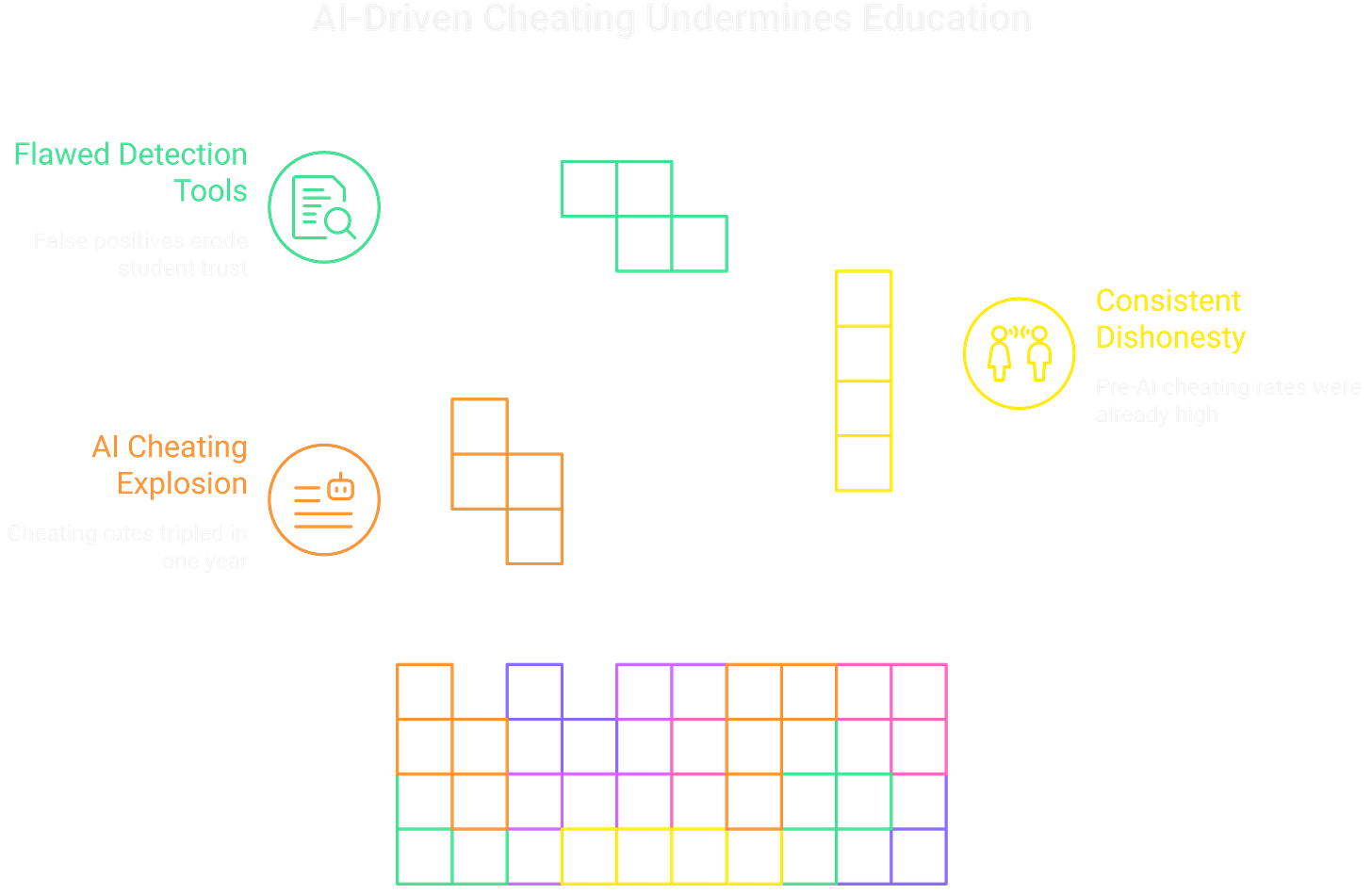
Despite stable cheating rates among high schoolers—hovering between 60-70%—the advent of ChatGPT in late 2022 transformed cheating methods from peer copying to AI assistance, leading to a surge in AI-related disciplinary actions from 48% to 64% between 2022-23 and 2024-25. However, flawed detection practices have had unintended consequences, including student disengagement and deteriorating mental health, highlighting the tension between enforcement and educational well-being.
By early 2026, studies revealed that AI’s rapid adoption in education outpaced understanding of its developmental impact, with experts like Rebecca Winthrop warning of 'cognitive stunting'—where children skip developing essential skills altogether rather than merely offloading effort. A global survey found 65% of students recognized threats to their cognitive development, reporting dependence on AI to initiate thinking, which extended beyond academics into social and romantic domains, creating a pervasive 'flywheel effect' of AI reliance.
Educational research underscored that AI’s benefits manifest when it complements rather than replaces human teachers, as demonstrated by the World Bank’s 2024 Nigerian trial and Stanford’s Tutor CoPilot, which improved learning outcomes significantly at low cost. Conversely, over-reliance on AI as a 'magic box' risks undermining perseverance and problem-solving skills critical for lifelong success. Experts advocate for AI integration that preserves human agency and fosters a meaningful division of cognitive labor, encouraging students to use AI as a tool to get 'unstuck' rather than to complete entire tasks, thus maintaining engagement and critical thinking.
![[ Center for Humane Technology ]](https://substackcdn.com/image/fetch/$s_!uhgK!,w_256,c_limit,f_auto,q_auto:good,fl_progressive:steep/https%3A%2F%2Fsubstack-post-media.s3.amazonaws.com%2Fpublic%2Fimages%2F5f9f5ef8-865a-4eb3-b23e-c8dfdc8401d2_518x518.png)


In-Class Work Replaces Homework
Educators are abandoning traditional homework in favor of real-time, in-class assessments to combat undetectable AI assistance and the growing problem of convincing but shallow AI-generated 'slop.'
By late 2025, educators like Andrej Karpathy recognized that traditional homework was compromised by undetectable AI assistance, prompting a shift toward in-class assessments where teachers can directly observe student understanding. This transition underscores the challenge of 'slop'—AI-generated content that superficially appears correct but lacks genuine insight—highlighting the limitations of quantitative verification and the need to rebuild verification environments that prioritize meaningful comprehension over surface fluency.
The year 2026 marked a pivotal focus on cultivating AI literacy as a critical skill set, with experts emphasizing students’ ability to interrogate AI outputs through targeted questions about sense-making, explanation, counterexamples, and sourcing, as Karpathy advocates. Concurrently, autonomous quality assurance loops—AI agents that rigorously test each other—emerged as a technological complement to human verification, while students were encouraged to protect their attention from misleading AI 'slop,' positioning verification as the new essential literacy for navigating AI-driven environments.
Research from early 2026 reveals that awareness of AI detection tools profoundly influences student behavior: 73% report that knowing about these tools changes how they use AI, with many reducing usage or attempting to avoid detection. Tools like GPTZero, TwainGPT, and GPTinf, trusted by millions of students and professionals, not only deter misuse but also serve as educational aids fostering self-regulation and ethical awareness, especially when paired with transparent institutional policies that 65% of students say shape their AI decisions.
Developing robust AI literacy demands new, multi-level assessment frameworks that transcend traditional metrics to capture complex skills such as ethical decision-making, epistemic understanding, and knowledge transfer across contexts. This high-altitude approach requires significant professional development and cultural shifts in education to avoid equity pitfalls where only easily measurable skills receive attention. Moreover, AI literacy must encompass epistemic literacy—knowing AI’s strengths and limits—and emphasize genuine human judgment in verification, as AI’s fluent but probabilistic outputs can mask uncertainty, necessitating reinvestment of time saved in authentic fact-checking.
Practical challenges in monitoring AI use among teens have led educators to prioritize verifying actual learning outcomes over detecting AI usage per se, recognizing the blurred line between assistance and outsourcing thinking. Building cultures of transparency where students can openly discuss AI use without fear of punishment fosters ethical engagement and skill development. Some schools have adopted proprietary AI-guided platforms to steer responsible use, while parents are encouraged to monitor prompt quality and leverage trusted detection tools, reflecting a nuanced approach that balances oversight with empowerment.
By mid-2026, thought leaders called for rethinking AI literacy beyond treating AI as a mere productivity tool, advocating instead for its use as a mastery aid that supports deeper learning and skill acquisition within students’ 'zone of proximal mastery.' However, current educational AI tools often fail to translate pedagogical research into practice, risking superficial engagement. Intentional instruction is crucial to teach students to use AI ethically and effectively, avoiding uncritical trust in AI-generated answers—a concern highlighted by examples of children blindly accepting predictive search results—thereby reinforcing the imperative to embed verification and critical thinking at the core of AI literacy education.




Elite Schools Rewrite Integrity
Institutions like Harvard and Princeton are dismantling century-old policies and embracing strict new measures—proctored exams, grade caps, and custom AI tools—to defend genuine learning against AI-driven shortcuts.
By mid-2026, leading educational institutions have adopted multifaceted strategies to uphold academic integrity amid AI disruptions. Harvard's CS50 course exemplifies this with its bespoke CS50AI tool, designed to limit AI assistance to tutoring rather than task completion, effectively curbing misuse while maintaining fairness. Despite AI-generated code complicating detection, robust dishonesty detection systems comparing submissions against past work have kept cheating rates stable at 5-10%, underscoring the effectiveness of strong course cultures and clear policy boundaries in fostering ethical student behavior.
Universities like Princeton and Harvard have taken historic steps to counter AI-enabled grade inflation and misconduct by overturning century-old honor codes and instituting proctored exams and grade caps. Princeton’s move to require supervised exams starting July 2024 and Harvard’s proposal to limit A grades to 20% of the class reflect a growing consensus that traditional assessment methods must evolve. This shift away from take-home assignments toward in-class, handwritten, or oral exams signals a broader institutional commitment to preserving skill integrity amid the AI era.
Professional schools, notably UC Berkeley Law, have enacted some of the strictest AI policies to safeguard core cognitive skills essential to their disciplines. Effective summer 2026, Berkeley Law bans generative AI for most student work—including brainstorming, drafting, and exams—emphasizing the irreplaceable value of lawyers’ analytical judgment over AI outputs. While acknowledging the impossibility of completely policing AI use due to its integration in research tools like Lexis and Westlaw, Berkeley Law has increased proctored in-person exams with software restrictions to deter misconduct, illustrating a nuanced yet firm approach to AI governance.
Across the U.S., a patchwork of AI policies reflects varying institutional responses balancing AI literacy and academic integrity. Leading universities such as Harvard, Stanford, and SUNY have adopted restrictive policies mandating AI attribution and treating unauthorized use as academic misconduct, while SUNY integrates AI literacy into general education across its 64 campuses. In contrast, Texas institutions like Texas A&M and Rice grant faculty discretion but enforce honor codes that classify undisclosed AI use as plagiarism or misconduct. This landscape emerges amid widespread faculty concern—92% worry about AI-facilitated plagiarism—and growing student AI use, with 57% engaging AI weekly, highlighting the urgent need for coherent policy frameworks.



AI Reshapes the Education Workforce
Widespread adoption of AI is displacing educators, fueling union pushback, and paradoxically cutting critical AI research even as schools double down on AI-driven teaching tools.
By early 2026, generative AI has profoundly disrupted the educational workforce, leading to widespread deskilling, job losses, and degraded labor conditions as AI tools replace traditional teaching and support roles. Institutions like the California State University system have inked multimillion-dollar contracts with AI companies such as OpenAI, mandating AI fluency for students, which has sparked tension with educators who feel excluded from these top-down decisions. Meanwhile, paradoxically, critical AI research programs face cuts—as seen at UC Irvine where an instructor was laid off while the school promoted its proprietary chatbot ZotGPT—highlighting a troubling disconnect between embracing AI tools and fostering critical inquiry.
The rise of AI in education has triggered a mobilization among education workers and unions, including the American Association of University Professors, demanding faculty governance over AI integration to counter rushed administrative deployments. This pushback reflects broader anxieties about the devaluation of human-driven teaching, as AI-generated student work complicates verification and grading, fostering fears of job replacement among tutors and professors. Such dynamics underscore a systemic crisis where traditional labor roles are undermined, prompting institutions like Princeton and Harvard to reconsider long-standing academic policies, including proctored exams and grade caps, in an effort to preserve academic integrity.
Generative AI’s impact extends beyond education into broader economic and societal shifts, challenging entrenched definitions of intelligence and learning. The traditional emphasis on memorization and visible effort is giving way to new paradigms where intelligence includes listening, experiencing, and cognitive offloading to AI tools, as noted by experts like Emily Bender and Joscha Bach. This evolution complicates perceptions of student effort—what some see as laziness may instead be a reconfiguration of where thinking occurs—while simultaneously fueling grade inflation, with studies showing a 30 percent rise in 'A' grades in AI-exposed courses since ChatGPT’s debut, thereby undermining the value of human-driven academic achievement.
The systemic effects of AI disruption ripple through labor markets and institutional finances, as educational institutions grapple with flat or declining enrollments and significant budget cuts—such as the University of Oregon’s $65 million deficit reduction and Hampshire College’s closure—while tech giants like Meta execute repeated layoffs affecting thousands of employees. These trends reflect a broader shift toward AI-driven automation that reduces reliance on human capital, with economists like Tyler Cowen advising workers to 'work harder now' before AI further diminishes wage value. This convergence of educational upheaval and labor market realignment signals a profound transformation in how intelligence, work, and economic value are defined in the AI era.



Detection Tech Gets Smarter
Pangram Labs' advanced system analyzes writing style and tone, surpassing human accuracy and restoring trust in authorship as AI-generated content blurs traditional signals of credibility.
By early 2026, Pangram Labs had pioneered an AI writing detection system boasting a remarkable false positive rate of just 1 in 10,000 and a false negative rate near 1%, achieving around 99% accuracy. This performance notably surpasses human baseline detection accuracy, which Max Spiro identified at approximately 90%, underscoring the superiority of AI-driven models in discerning machine-generated text from human writing.
Pangram Labs’ detection technology delves beyond superficial grammar or syntax checks, instead analyzing stylistic nuances and word choice patterns that subtly betray AI-generated content—often characterized by an overly earnest or saccharine tone. This approach addresses the erosion of traditional heuristics, such as flawless grammar signaling author credibility, a link severed by the ease of AI content generation, thereby necessitating more sophisticated tools to maintain trust in written work.

Teaching for Agency, Not Automation
Forward-thinking educators are designing AI-integrated instruction that preserves student agency and cognitive growth, using AI for scaffolding mastery rather than replacing meaningful effort.
By early 2026, experts emphasized a critical shift from merely documenting AI over-reliance toward developing actionable instructional strategies that empower students to critically engage with AI tools. While studies like the one showing doubled override rates on faulty AI advice offer promising glimpses, they fall short of providing comprehensive curricula that teachers can readily implement, underscoring the urgent need for practical, empirically grounded pedagogical frameworks rather than isolated experimental manipulations.
Innovative educators like Principal Traci Walker Griffith are pioneering classroom practices that position AI as a supportive tutor rather than a shortcut, reflecting a forward-looking approach that adapts alongside advancing large language models. This evolution aligns with calls to integrate AI as a tool for mastery—helping students reach incremental learning goals faster—rather than mere production, thereby fostering deeper skill development through intentional instructional design inspired by concepts like the 'zone of proximal mastery.'
The integration of AI into education must carefully preserve human agency and foundational cognitive skills to avoid stunting intellectual growth. As research warns, routine reliance on generative AI risks diminishing students' willingness to engage in effortful thinking, potentially leaving them ill-prepared for professional challenges. Effective strategies involve using AI to help students get 'unstuck'—providing scaffolding without replacing problem-solving—thereby maintaining perseverance and critical judgment essential for lifelong learning.
Educators face a nuanced balancing act: outright banning AI signals distrust, yet uncritical AI use can undermine essential manual learning and cognitive development. As market research education illustrates, students need to experience struggle and failure firsthand before synthesizing knowledge, ensuring they develop sound decision-making skills that AI cannot replicate. This ongoing debate highlights that while some advanced learners might skip foundational steps, the majority require deliberate, scaffolded learning processes to cultivate critical thinking and logical reasoning in an AI-augmented environment.

