From hype to hardware: AI investment mania shifts to trillion-dollar infrastructure race
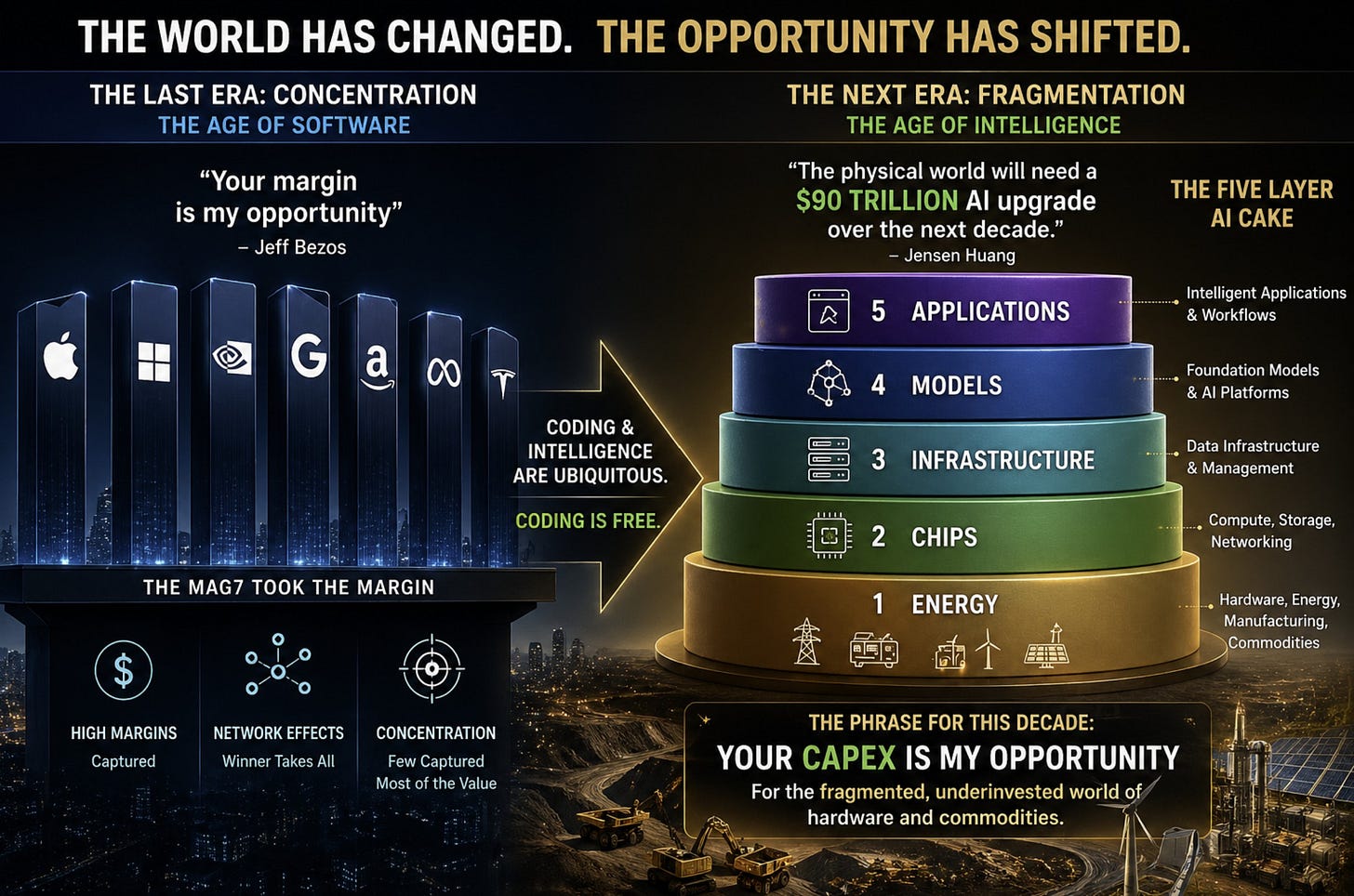
The gist
AI investing has rocketed from software hype to a trillion-dollar, power-hungry infrastructure race, forcing Wall Street to rethink where—and how—real gains are made.
What to know
- Over $1 trillion in AI infrastructure spending is set for 2025-2026, with power grids and data centers at the heart of the action.
- Nvidia dominates the AI chip market with a staggering 97% share, while private giants like OpenAI ($500B) and Anthropic ($380B) delay IPOs to maintain their edge.
- Institutional investors are shifting to 'total portfolio' strategies—spanning equity, debt, and infrastructure—to manage concentration risk and catch AI's next wave.
AI Funding Gets Sophisticated
AI investment strategies have shifted from equity hype to nuanced funding mixes, with scrutiny on debt, productivity gains, and security spend revealing the real levers and risks behind the trillion-dollar buildout.
By early 2026, capital market narratives around AI had begun to pivot from a simplistic focus on equity upside to a more nuanced appreciation of funding dynamics, particularly investment-grade (IG) debt supply, spreads, and rate sensitivity. Analysts emphasized that the pace and discipline of AI buildouts hinge critically on the mix of funding sources—whether companies rely on debt or internal cash—challenging the prevailing notion that balance sheets can effortlessly absorb AI investments. Concurrently, AI-driven productivity improvements were increasingly framed as margin levers through organizational delayering and restructuring, yet skepticism lingered about the timing and tangible realization of these gains, prompting calls for rigorous efficiency audits rather than accepting optimistic corporate slogans at face value.
Investors began to recognize a fundamental shift in software valuation models as AI redefined value creation from traditional seat licenses toward outcome-based and embedded capabilities. While some authoritative voices highlighted this transition as structurally transformative, critics cautioned that incumbents still control critical assets like distribution channels, data, and workflows, suggesting AI acts more as an additive enhancement than a wholesale substitution. This evolving landscape put a premium on companies’ ability to repackage pricing around usage and outcomes without eroding margins, signaling a strategic battleground over sustainable monetization in the AI era.
The rollout of AI agents introduced a notable shift in capital expenditure priorities, with spending increasingly directed toward identity management, governance, and fraud defense as essential prerequisites for integrating AI into systems of record. Market watchers argued that security budgets offer a more reliable barometer of genuine AI deployment than the often-hyped proliferation of pilot projects, even as some critics dismissed these investments as mere rebranding of existing identity and access management (IAM) tools. This focus on security underscores the operational complexities and risk mitigation imperatives that accompany AI’s deeper embedding in enterprise infrastructure.
An emerging trend in AI deployment favored smaller models positioned closer to the edge to optimize latency, privacy, and cost efficiencies, reflecting a strategic move away from exclusively centralized architectures. However, this fragmentation introduced complexity in managing diverse models across hybrid environments, with centralized models still prevailing in terms of breadth and quality. Consequently, procurement strategies began shifting from simply acquiring model access toward investing in tooling capable of orchestrating multiple models across varied deployment contexts, highlighting the evolving sophistication of AI infrastructure management.

Physical Infrastructure Takes Center Stage
AI’s economic engine now runs on data centers, power grids, and chip factories, with massive capital flows exposing physical bottlenecks as the new chokepoints in the race for dominance.
By 2026, the AI investment landscape has decisively shifted from a software-centric model to a capital-intensive physical infrastructure buildout, marking a fundamental transformation in the AI economy. This new era prioritizes the construction, powering, cooling, and connectivity of data centers and manufacturing facilities, as reflected in the mantra shift from 'your margin is my opportunity' to 'your CapEx is my opportunity.' Industry leaders like NVIDIA’s Jensen Huang emphasize that AI’s next phase involves physical action—factories, autonomous vehicles, and drones—underscoring the critical role of chips, power, and advanced packaging in scaling intelligence across sectors.
The scale and cost of this infrastructure buildout are staggering, with over $1 trillion in capital expenditures anticipated in 2025-2026 alone to support hyperscale data centers, semiconductor manufacturing, and related physical layers. This investment surge spans multiple industries beyond tech, including industrials, real estate, utilities, and energy grids, driving a multiplier effect that contributed to 26-27% earnings growth in the recent cycle. However, physical bottlenecks such as power grid connections and permitting delays have emerged as critical constraints, delaying more than 25% of data center projects slated for 2025 and highlighting the complexity of this industrial AI renaissance.
This capital-intensive shift reverses a two-decade trend favoring asset-light cloud and SaaS businesses, redirecting massive private capital back into semiconductors, data platforms, and physical infrastructure layers that now capture roughly half of AI hardware value. Hyperscalers alone are spending over $500 billion annually on capex, projected to exceed $600 billion in 2026, creating durable moats driven by capital intensity, physical bottlenecks, and high switching costs. Goldman Sachs projects a $7.6 trillion global investment in AI infrastructure from 2026 to 2031, signaling that the next AI boom is firmly rooted in the physical economy where technology and industrial sectors increasingly converge.
The urgency to invest in physical AI infrastructure is palpable among corporate boards and investors, as evidenced by soaring tech M&A activity reaching $566 billion in 2026, up from $334 billion in 2025. This rush is driven by fears of being left behind in the AI industrial transformation, with capital availability emerging as a critical determinant of which sectors will thrive. Notable strategic bets, such as Jeff Bezos’s $12 billion investment, underscore that AI-driven physical infrastructure is not a distant prospect but an immediate reality reshaping industries amid labor shortages and the need for automation in construction, energy, and manufacturing.






Conviction Investing Amid Concentration
The AI gold rush has narrowed to a handful of dominant players and infrastructure bottlenecks, raising both the stakes and the risks as investors chase growth beyond software.
By mid-2026, AI investment strategies have matured from the broad enthusiasm of 2021, which was predominantly software-driven, to a more concentrated focus on breakout AI-native companies and capital-intensive bottlenecks such as data center cooling and electrification. Sebastian Page of T. Rowe Price encapsulates this shift, noting a strategic pivot toward infrastructure investments that 'have legs,' reflecting a nuanced understanding of the AI ecosystem's foundational needs beyond just software innovation. This evolution signifies a deliberate move from exuberance to targeted conviction, where capital flows heavily into leaders with proven potential.
Concurrently, the AI investment landscape has broadened significantly, encompassing sectors like energy, physical AI, semiconductors, robotics, and manufacturing, thereby fostering a more diversified and healthier ecosystem. This expansion beyond software indicates that AI's transformative impact is permeating multiple layers of the economy, from chipmakers to industrial automation, which in turn attracts a wider array of investors seeking exposure to the AI revolution's varied facets.
However, this maturation has brought heightened concerns about market concentration and valuation risks. The top 10 stocks in the S&P 500 now command about 40% of the index, surpassing the 27% peak during the dot-com bubble, with Nvidia alone controlling 97% of the AI data center chip market. Despite strong AI demand, capital-intensive sectors like memory chips have seen sharp share declines—Micron, SK Hynix, and Samsung all dropped over 20% from recent highs—reflecting investor apprehension about peaking growth and rising costs. Page’s observation that 'end user demand is getting a little bit fragile' and companies are 'rationing spending on AI' underscores the emerging caution amid escalating costs and concentrated bets.



Private Markets Drive the AI Edge
Private equity and institutional investors are orchestrating portfolio-wide AI transformations and diversifying into private and infrastructure assets, as public markets struggle to keep pace with the scale and secrecy of AI’s leaders.
By mid-2026, private equity firms have shifted from tentative AI experiments to rigorous, portfolio-wide AI transformations driven by board-level demands for rapid, measurable ROI. IBM’s Neil Dhar highlights that firms face pressure to deliver results within quarters, not years, and warns that undisciplined adoption risks entire portfolios, making disciplined AI integration a critical competitive differentiator. IBM’s $4.5 billion productivity gains from hybrid AI architectures—blending custom, foundation, and specialized models—exemplify the sophisticated strategies now productized to supercharge private equity portfolios.
AI’s explosive growth is increasingly rooted in private markets, where titans like Anthropic and OpenAI command valuations of $380 billion and $500 billion respectively, dwarfing many public companies and delaying IPOs to preserve strategic secrecy. This private market dominance compels investors to broaden their AI exposure beyond public equities, incorporating private equity, infrastructure, and debt instruments such as the Canada Pension Plan Investment Board’s $700 million data center investment and SpaceX’s $25 billion bond sale. Despite lofty valuations, the AI sector avoids bubble territory due to solid earnings and low leverage, though portfolios remain sensitive to infrastructure costs and earnings shifts.
The adoption of total portfolio approaches (TPA), exemplified by CalPERS’ 2023 shift, marks a paradigm change in managing AI exposure across diverse asset classes. This framework transcends traditional silos by evaluating AI investments through liquidity and strategic fit rather than asset class labels, enabling more disciplined and flexible portfolio construction. However, as Mercer’s Andrew McDougall notes, conventional sector lenses fail to capture AI’s thematic overlaps, necessitating new measurement frameworks and standardized metrics to unify capital flows and enhance transparency across public and private markets.
Private market AI investments are converging across equity, credit, and hybrid vehicles, with increased collaboration between LPs and GPs and a push for greater sophistication to serve both institutional and retail investors. Organizations that translate complex AI expertise into data products and infrastructure are pivotal in bridging these investment frameworks. LACERA’s case study illustrates the measurement challenges, estimating AI exposure between 8% and 19% of its $93.9 billion portfolio using a four-step framework combining bottom-up and top-down analyses. The absence of standardized AI definitions complicates precise measurement, while AI’s reach extends into unexpected sectors like John Deere, underscoring the evolving and broad nature of AI-related investments.



Total Portfolio: New Diversification Rules
Investors are adopting multi-asset, holistic strategies to balance AI exposure, confronting hidden concentration risks and seeking resilience beyond traditional index approaches.
By mid-2026, a disciplined AI-era portfolio construction framework had crystallized around four pillars—AI infrastructure, AI-native software, disruption-resistant compounders, and adjacent winners—enabling investors to manage concentration risks and avoid the pitfalls of index long-tail losers. This approach, championed by active managers, emphasizes high-conviction ownership of AI winners through volatility rather than proportional index replication, while diversifying across sectors resilient or adjacent to AI innovation, such as regulated infrastructure, digital payments, and cybersecurity. The strategy reflects a total portfolio mindset that balances direct AI exposure with disruption-resistant assets, creating a more robust and nuanced portfolio construction paradigm. [1, 3]
Recognizing the high valuations and limited public market opportunities in direct AI investments, investors like Christian Munafo advocate for exposure through the broader AI and robotics ecosystem, including infrastructure and enterprise software sectors, to mitigate concentration risks. This total portfolio approach, increasingly adopted by large investors such as CalPERS and highlighted by Anshul Sharma, allows for holistic AI exposure management by tilting allocations toward secondary beneficiaries of AI growth, thereby capturing upside without excessive risk. This shift also extends AI investments beyond equities into debt and infrastructure, exemplified by the Canada Pension Plan Investment Board’s $700 million data center investment and SpaceX’s $25 billion bond issuance, underscoring the need for innovative portfolio construction strategies. [4, 5, 10, 11]
The AI boom has introduced hidden concentration and correlation risks that challenge traditional diversification, particularly for insurers and pension funds. Experts like Neil Sun and Mike Siegel warn that AI-related investments across utilities, data centers, and infrastructure may converge into a 'lump of sensitivity,' undermining the foundational premise of diversification. In response, large asset owners are intensifying holistic risk assessments and embracing total portfolio approaches to avoid overexposure, even as regulatory frameworks vary internationally—with European and Asian insurers benefiting from capital charges that account for correlation risk, unlike their U.S. counterparts. This evolving risk landscape demands sophisticated portfolio management to navigate AI’s pervasive impact. [6, 7, 8, 9]
Pension funds like LACERA exemplify advanced AI exposure measurement through a rigorous four-step framework combining bottom-up asset team analyses with top-down MSCI risk analytics, revealing AI-related holdings ranging from 8% to 19%. This dual-method approach addresses the absence of standardized definitions for 'AI-related' investments, a challenge underscored by Quoc Nguyen, who notes the variability in data provider conclusions. LACERA’s integration of private market data into its total portfolio assessment, as Kathryn Ton describes, enables a comprehensive and nuanced understanding of AI-driven concentration risks across asset classes, reinforcing the critical role of holistic portfolio construction in the AI era. [14, 15, 16]
Industrial AI and Quantum Leap
AI’s industrial revolution is unleashing trillions in infrastructure and quantum investments, as physical automation and government-backed quantum ventures redefine the next decade’s economic landscape.
By mid-2026, AI has decisively moved beyond predictive analytics to actively driving physical actions across industries, marking a transformative industrial shift. Jensen Huang’s 2026 GTC keynote underscored this evolution, highlighting AI’s role in factories, roads, and airspace, exemplified by Waymo’s autonomous vehicles, Hyundai’s robot-powered Metaplant, and Tesla’s AI-driven fleet. This physical AI revolution has created a broad investable ecosystem spanning humanoid robotics, drones, autonomous mobility, and enabling chip platforms, with funds like WisdomTree’s WDRN strategically positioned to capture diversified exposure as this theme matures.
The U.S. government’s strategic pivot in 2026 to invest $2 billion for minority equity stakes in nine quantum computing firms signals a new era where quantum technology is commercialized rather than confined to research labs. This approach, following Intel’s $8.9 billion government-backed equity deal in 2025, reflects a broader trend of public-private partnerships fueling AI’s next frontier, integrating quantum computing as a critical enabler for sustainable value creation in AI-driven industries.
AI’s rapid industrialization is catalyzing an unprecedented economic expansion, with companies scaling faster than ever and investing trillions in infrastructure to harness productivity gains across diverse sectors. Entrepreneurs like Scott and Russell at Cognition, JD Ross in insurance and finance, and Joe Ben in aerospace illustrate AI’s deepening integration into traditional and emerging industries, driving evolving investment paradigms that emphasize broad, sustained value creation over the next decade.
