From mega-models to smart systems: AI’s next leap leaves scale behind
The gist
The AI arms race is over: scale is out, smart, efficient, and self-improving systems are in.
What to know
- By late 2025, OpenAI’s multipart GPT-5 and Samsung’s 7M-parameter TRM set a new bar for beating bigger models with architectural efficiency and system integration.
- Agentic AI matured fast, with platforms like OpenAI Frontier and AWS Strands powering autonomous, multi-step workflows and even self-improving code.
- Despite $30–40B invested, 95% of enterprises saw little GenAI ROI—while edge deployment, open-source agents, and context engineering are now driving the next AI leap.
Efficiency Outpaces Scale
Architectural breakthroughs and system integration have eclipsed brute-force scaling, with tiny, specialized models now outperforming giant LLMs at a fraction of the cost.
By late 2025, the AI industry decisively moved away from the arms race of sheer model size toward prioritizing architectural innovations, efficiency, and specialization. This transition was exemplified by OpenAI’s GPT-5 multipart system, which combined fast and reasoning models with a real-time router, and Samsung’s tiny recursive model (TRM) that outperformed much larger LLMs with only 7 million parameters. As Nir Diamant observed, improvements from scaling alone had diminished, shifting the focus to connecting models with external data sources and breaking down complex problems rather than simply increasing parameter counts.
Industry leaders like Andrew Ng acknowledged that while some gains remain in scaling, the 'scalability lemon' is nearly squeezed dry, prompting a pivot to multiple vectors of progress including mixture-of-experts architectures, inference-time compute optimization, and specialized agentic workflows. This nuanced shift was reinforced by Hugging Face CEO Clem Delangue’s prediction of an imminent 'LLM bubble' burst, forecasting a market correction toward smaller, task-specific models that are cheaper to train and easier to deploy in enterprise environments.
Late 2025 saw a proliferation of architectural breakthroughs that redefined efficiency benchmarks, such as Nvidia’s Nemotron 3 family optimizing long-sequence modeling with up to 4× higher token throughput, Moonshot AI’s trillion-parameter Kimi K2 Thinking model with quantization-aware training, and Mistral AI’s DeepSeek V3 architecture powering their flagship Mistral 3. These innovations enabled models to achieve frontier-level performance at a fraction of the computational cost, facilitating deployment on private infrastructure and edge devices, and signaling a new era where inference-time compute and system design trump raw parameter scale.
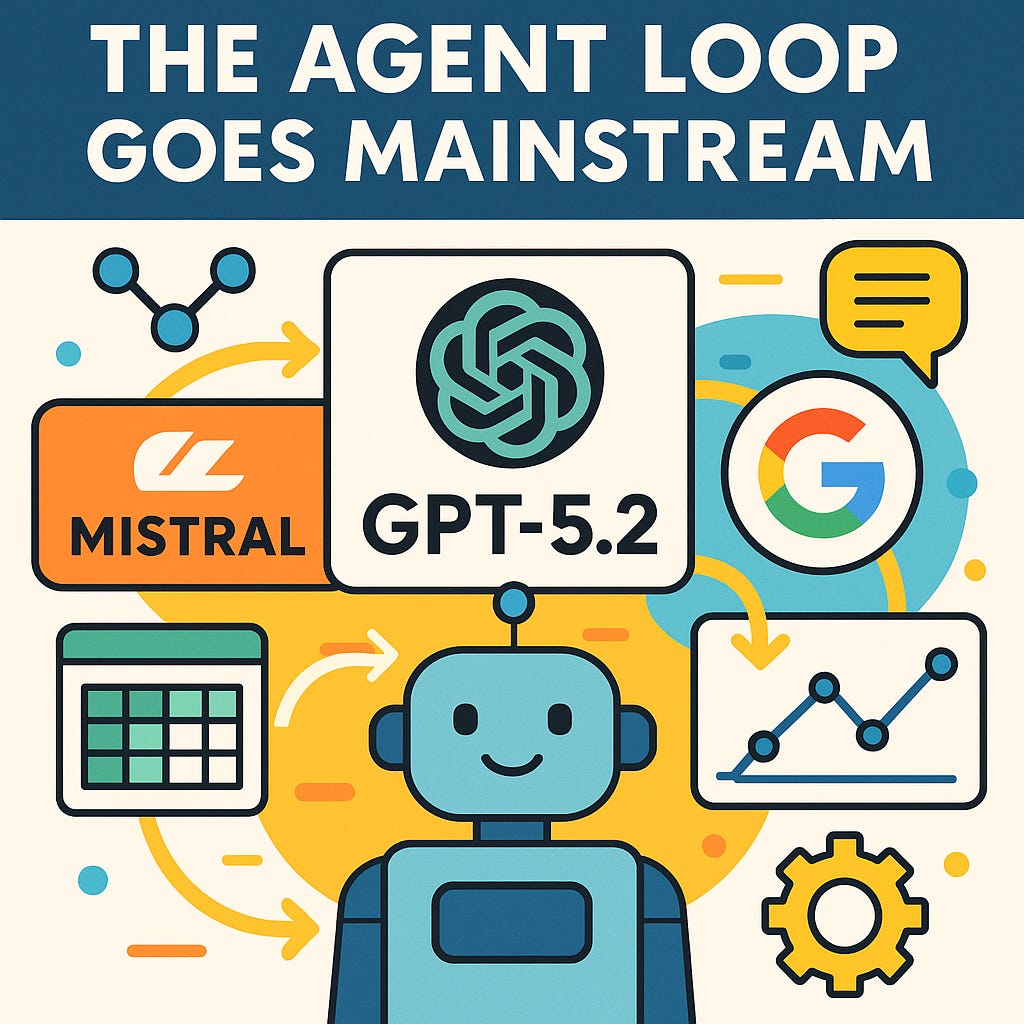
This architectural efficiency paradigm shift also transformed AI product design into integrated systems rather than monolithic models. OpenAI’s GPT-5.2 and GPT-5.4 exemplify this by focusing on multi-step knowledge work, agent-style tool use, and extended context windows up to one million tokens, while Google’s Interactions API standardized long-running agent workflows. As Google DeepMind’s Sebastian Borgeaud put it, 'We’re not really building a model anymore. We’re building a system,' reflecting the industry-wide recognition that future AI progress depends on specialized, composable architectures optimized for practical deployment and real-world utility.






Agentic AI Comes of Age
Autonomous, multi-step AI agents are now orchestrating complex workflows and self-improving code, signaling a shift from isolated models to interconnected, enterprise-ready systems.
By mid-2025, the concept of agentic AI surged into prominence as a pivotal frontier beyond mere scaling, with pioneers like Andrew Ng highlighting its potential to enable AI systems that autonomously plan, decide, and execute complex workflows. This shift marked a transition from traditional model scaling challenges toward architectural innovations and integrated workflows, where small, skilled teams and coding literacy across organizations became critical. Vendors such as OpenAI and Gemini launched deep research agents employing reinforcement learning to optimize tool use, while modular, ensemble-based architectures emerged to give enterprises customizable control without requiring direct model tuning, underscoring a maturing ecosystem focused on practical deployment and ROI.
Throughout late 2025 and into 2026, major AI vendors accelerated the maturation of agentic AI by introducing advanced orchestration layers and efficient agent models designed for enterprise integration. Salesforce’s Agentforce Observability, AWS’s Kiro CLI, and Microsoft’s Fara-7B exemplify efforts to enhance agent reasoning, testing, and deployment, while Stack Overflow and Amazon pioneered real-world applications like clean data provisioning and autonomous cybersecurity testing. Concurrently, open-source frameworks such as AWS’s Strands rapidly gained adoption, simplifying agent construction and heralding a future where 'every app by next year is going to be agentic,' reflecting a broad industry consensus on the centrality of agentic systems in AI product innovation.
The latter half of 2025 and early 2026 witnessed a leap in agentic AI capabilities with releases like OpenAI’s GPT-5.2 and Anthropic’s Claude 4.6, which drastically improved hallucination reduction, instruction following, and multi-step tool orchestration. These models enabled autonomous agents to succeed flawlessly in complex tasks without detailed step-by-step guidance, emphasizing strategic context over micromanagement. Simultaneously, orchestration innovations such as Google’s Interactions API and startup-driven AI application layers emerged, enabling seamless model swapping and recursive self-improvement workflows. This period also saw the rise of centralized agent management platforms like OpenAI Frontier, facilitating fine-grained control over vast agent networks and signaling a shift from isolated agents to interconnected, scalable systems.
By early 2026, recursive self-improvement became a tangible reality as models like Anthropic’s Claude autonomously wrote and refined large portions of their own code, running massively parallel experiments to accelerate development cycles. This evolution was bolstered by open-source contributions such as OpenClaw, which popularized local agentic AI capable of managing daily tasks, and enterprise-grade orchestration frameworks that supported trillions of agents with robust security and governance. Industry leaders forecast a transformative era from 2026 onward, where agentic AI systems not only reshape software delivery—accelerating it out of 'pilot purgatory'—but also redefine enterprise workflows, security paradigms, and hardware innovation, including the rise of specialized AS6 chips and the diversification of AI ecosystems beyond dominant foundation models.


System Integration Redefines AI
AI product value now hinges on seamless context management, memory, and rigorous evaluation pipelines—transforming models into reliable, long-running agents embedded in real-world workflows.
The evolution of AI product innovation in 2025 and early 2026 marks a decisive shift from raw model scaling to sophisticated system integration, where managing context, memory, and personalization takes center stage. OpenAI’s GPT-5 exemplifies this trend by operating as a multipart system combining fast and reasoning models with real-time routing, while Claude Sonnet 4’s unprecedented 1 million token context window enables handling entire codebases or multiple research papers in a single request, underscoring the critical role of context engineering in practical usability. This system-level focus is further reflected in hybrid architectures like OWhisper, which balances lightweight local models for prototyping with larger production models, highlighting adaptability as a key design principle for real-world applications.
Rigorous evaluation pipelines have become indispensable for delivering reliable AI products, moving beyond static benchmarks to continuous, automated testing frameworks that treat prompt and model changes like production code. Dropbox’s structured evaluation for Dropbox Dash, incorporating curated benchmarks, regression gates, and live-traffic scoring, exemplifies this new standard, while Hugging Face’s Retrieval Embedding Benchmark (RTEB) addresses real-world multilingual and domain-specific retrieval challenges to prevent overfitting. Industry leaders like OpenAI emphasize 'golden' datasets and feedback loops from production logs to bridge the gap between vague business goals and measurable AI performance, reflecting a maturation of evaluation practices essential for trustworthy deployment.
The rise of centralized system integration and agent orchestration is transforming AI products into reliable, long-running agents capable of managing complex workflows with dependable tool use and minimal supervision. OpenAI’s GPT-5.2 and Google’s Interactions API illustrate this trend by embedding agents as composable components that handle memory, retries, and long-horizon tasks, while Cursor’s shift from decentralized agents to a central Planner achieving ~1000 commits per hour highlights the scalability benefits of centralized control. These innovations, supported by heartbeating mechanisms and dashboards from platforms like OpenAI Frontier and Moltbook, demonstrate a broader industry pivot toward systems engineering and product usability over mere model capability.
Despite impressive advances, challenges in memory management and personalization remain a bottleneck for AI product usability and user retention, as current implementations often struggle with scaling and reliability. Real-world constraints are evident in cases like the limited ability to transfer large volumes of ChatGPT memory to Gemini, and users’ preference for faster response times and tactile feedback in GPT over slower alternatives. This underscores the complexity of integrating memory systems into products, where the user experience becomes a hybrid of human and AI memory, complicating debugging and reliability. Looking ahead, personalization and continual learning are poised to drive the 'consumerization' of AI in 2026, demanding more sophisticated context and memory engineering to sustain engagement and deliver tailored experiences.



The GenAI Divide Widens
Despite massive investment, most enterprises flounder on AI ROI due to integration failures, while edge-first and open-source deployments are reshaping the competitive landscape.
By late 2025, enterprise AI adoption revealed a stark 'GenAI Divide' where despite $30–40 billion in investments, 95% of organizations failed to see meaningful ROI, largely due to integration challenges rather than model quality. Employees circumvented official channels by heavily relying on consumer AI tools, with 90% personal usage contrasting sharply with only 40% of firms licensing enterprise solutions. Successful enterprises overcame these hurdles through external vendor partnerships and bottom-up adoption strategies that emphasized tools capable of learning, retaining context, and embedding deeply into workflows, highlighting that the real barrier was operational integration rather than technology itself.
Simultaneously, AI deployment paradigms shifted toward efficient, edge-capable models exemplified by Samsung’s 7-million-parameter tiny recursive model (TRM), which outperformed vastly larger models by leveraging recursive reasoning. This efficiency enabled billions of edge devices—modern smartphones and IoT hardware—to run sophisticated AI locally, reducing reliance on memory-constrained data centers and reshaping deployment economics around compute efficiency rather than sheer scale. By early 2026, open-source agentic AI like OpenClaw further underscored this trend, running autonomously on local systems and signaling a broader move toward decentralized, edge-first AI applications.
The competitive landscape among tech giants evolved beyond raw model performance to focus intensely on infrastructure control, ecosystem integration, and differentiated services. Despite similar benchmark scores across models like OpenAI’s GPT series, Anthropic’s Claude, and Google’s Gemini, consumer adoption remained uneven, driven more by brand strength and default positioning than technical superiority. Strategic moves such as Nvidia’s acquisition of Groq to maintain CUDA compatibility with emerging AS6 chips, Meta’s pivot away from Nvidia toward AS6 hardware, and the co-founding of neutral foundations by OpenAI, Anthropic, and Block to foster agent-to-agent interoperability illustrate how infrastructure and ecosystem orchestration have become the new battlegrounds for sustainable AI business value.
Startups have capitalized on the commoditization of AI models by building sophisticated orchestration layers that dynamically route tasks across multiple LLMs—mixing proprietary giants like Claude with open-source alternatives such as Deep Seek and Llama 3—to optimize cost and performance for regulated verticals. This model-agnostic approach, combined with proprietary evaluation datasets, has allowed newer entrants like Anthropic to dramatically increase enterprise market share at the expense of incumbents like OpenAI. Meanwhile, enterprises continue to grapple with compute constraints that throttle next-generation model availability and performance, underscoring the critical need for efficiency-first architectures and agent-centric workflows to break free from the 'pilot purgatory' bottleneck and accelerate AI integration at scale.




Workforce and Governance Transformed
AI-driven automation is forcing every employee to upskill in coding and adapt to new governance challenges as agentic systems become central to daily operations and security.
The rapid evolution of AI systems is fundamentally reshaping organizational roles and leadership profiles, demanding that employees across all functions—not just engineers—acquire coding skills to remain effective. Andrew Ng emphasizes this shift, noting that agility and small team dynamics have become critical for founders and leaders navigating AI-driven automation and agentic AI systems, which accelerate project management and alter traditional startup workflows. This transformation underscores a broader workforce metamorphosis where AI integration is no longer peripheral but central to daily operations.
Despite massive enterprise investments totaling $30–40 billion, a striking 'GenAI Divide' persists, with 95% of organizations failing to realize meaningful ROI from generative AI initiatives. The MIT AI Report reveals that while over 80% of firms have piloted tools like ChatGPT and Copilot, only about 5% have successfully deployed enterprise-grade AI systems that integrate learning, memory, and workflows. Notably, a 'shadow AI economy' thrives as 90% of employees use consumer AI tools independently, delivering more practical value than official corporate efforts, which are often hampered by superficial integrations and misallocated budgets favoring sales and marketing over high-ROI back-office functions.
As AI systems become deeply embedded within workflows—transitioning from flashy benchmarks to indispensable plugins across terminals, editors, and operating systems—organizations face escalating governance, security, and ethical challenges. Privacy emerges as 'the most expensive luxury,' forcing companies to balance automation efficiency with data control, exemplified by varied strategies from Apple’s mature automation tools to ByteDance’s aggressive system-level control and Huawei’s agent-to-agent orchestration. Concurrently, autonomous AI agents are revolutionizing cybersecurity practices, as seen with Amazon’s automated red-team/blue-team testing, while the rise of centralized management layers like OpenAI Frontier reflects the urgent need for granular oversight amid complex, high-volume agent deployments.
Startups and incumbents alike grapple with organizational strains stemming from AI’s accelerating pace, infrastructure demands, and shifting competitive dynamics. The transition from large, generalized models to smaller, specialized ones—championed by Hugging Face’s Clem Delangue—aims to curb capital burn amid Google’s staggering $100–250 billion annual AI capex. Yet, balancing rapid innovation with risk remains fraught, as highlighted by Anthropic’s critique of OpenAI’s ad monetization and the security concerns raised by AI skill extension platforms like OpenClaw. Moreover, the scaling of AI agents as coordinated workforces necessitates new accountability frameworks, since intelligence may be scalable but human oversight is not, making governance and ethical stewardship paramount to prevent systemic operational risks.



AI Systems Enter a New Era
Recursive agent networks, embodied intelligence, and system-level integration are driving AI toward autonomous, invisible software and real-world impact far beyond traditional model scaling.
As AI advances into 2026 and beyond, the trajectory of product innovation is shifting decisively from mere scale to sophisticated system integration and architectural efficiency. Andrew Ng highlighted that while scalability still holds some untapped potential, the future vectors of progress lie in agentic workflows, multimodal models, and emerging technologies like diffusion models, with companies such as Gemini poised to lead industry-scale diffusion deployments. This systemic evolution is echoed by Sebastian Borgeaud’s assertion that AI development is no longer about building isolated models but about constructing integrated systems that optimize inference-time scaling, tool integration, and reasoning capabilities, thereby overcoming hardware and economic constraints through architectural innovation rather than brute force scaling alone.
The maturation of autonomous agent networks marks a pivotal next phase, where AI systems increasingly manage and recursively improve other AI agents, transitioning from human-controlled tools to AI-controlled ecosystems. By early 2026, large language models like Anthropic’s Claude are autonomously writing up to 90% of their own code, with recursive self-improvement becoming a present reality rather than a distant prospect. This recursive organization, described as an 'assembly line for code,' dramatically reduces software creation costs toward zero, enabling disposable, highly personalized software that often remains invisible to end users, as exemplified by Amp’s insights on the obsolescence of traditional coding agents.
Integration of AI into physical systems is accelerating rapidly, redefining intelligence through continuous, data-driven feedback loops that blend robotics, autonomous science, and advanced human-machine interfaces. Meta’s $2 billion acquisition of Manus underscores this trend, enabling agents to control computer tools and perform real-world tasks beyond raw model power. Frontier AI systems in 2026 leverage multimodal world models, synthetic data, and continuous learning to power autonomous agents across research, robotics, and enterprise workflows, mirroring the trajectory of autonomous vehicle development led by Waymo, Tesla, and NVIDIA, and signaling a profound shift toward embodied AI applications.
World models and neurosymbolic AI are resurging as foundational pillars for the next generation of AI systems, especially in domains requiring physics-based reasoning like life and molecular sciences. These models enable seamless routing of multimodal data within foundation models, allowing users to interact with complex environments without explicit awareness, as seen in Gemini’s architecture. Neurosymbolic approaches, which combine neural networks with symbolic reasoning and leverage existing simulators, offer a pragmatic path forward by accelerating development and reducing reinvention. However, challenges remain in ensuring coherent multimodal streams, interactivity, and robustness against adversarial inputs, positioning world models as a critical but still evolving frontier in AI research and productization.