Fuel shock, merger block: how spirit’s ‘racecar’ model skidded into bankruptcy
The gist
Spirit Airlines’ ‘racecar’ low-cost model crashed and burned after a jet fuel price shock, failed bailouts, and a blocked JetBlue merger exposed fatal flaws in its business.
What to know
- The 2026 Hormuz crisis doubled jet fuel prices to $4.51 per gallon, turning every Spirit flight into a money-loser and gutting its cost structure.
- Legacy carriers’ Basic Economy fares and a 2023 engine recall shattered Spirit’s efficiency edge, with costs outpacing revenue by 40% and half its fleet grounded.
- Bondholders killed a $500M rescue, regulators blocked a $3.8B JetBlue merger, and Spirit’s 2024 bankruptcy fix proved a mere pit stop before total collapse.
Fuel Shock Exposes Fragility
The Hormuz crisis sent jet fuel costs soaring, instantly turning Spirit’s razor-thin business model into a money-losing machine and revealing how a single supply shock can topple the weakest players.
The 2026 Hormuz crisis, ignited by U.S. and Israeli strikes on Iran, disrupted roughly 20% of the world's oil supply through the Strait of Hormuz, causing jet fuel prices to more than double from $2.30 to $4.51 per gallon by April 2026. This surge devastated Spirit Airlines’ cost structure, as fuel accounts for 20-30% of operating expenses, and the airline’s ultra-low-cost model, which relied on pre-sold tickets at stable prices, became financially unsustainable with every flight losing money once variable costs exceeded ticket revenue.
Spirit’s collapse underscored the vulnerability of ultra-low-cost carriers operating on razor-thin margins, as the sudden fuel price shock exposed their lack of financial resilience. Despite efforts by the Association of Value Airlines, including Spirit, to secure a $2.5 billion bailout to offset soaring fuel costs, legal and regulatory hurdles blocked government relief, leaving Spirit without a lifeline and illustrating how quickly cost spikes and cash shortages can topple fragile carriers.
The jet fuel crisis also highlighted geographic disparities in supply that further strained airlines dependent on imported fuel. While U.S.-based carriers like Delta, which owns refineries, managed to outperform peers, Spirit and other ultra-low-cost carriers reliant on imported fuel faced disproportionate pressure amid a 15% global shortfall in crude supply. This imbalance contributed to widespread flight cancellations—13,000 in May alone—and raised the specter of broader industry bankruptcies if ticket prices cannot rise without destroying demand.



Racecar Model Hits a Wall
Spirit’s obsession with ultra-low costs left it brittle and unable to adapt, as legacy carriers copied its pricing and a single engine recall triggered a cascade of operational and financial failures.
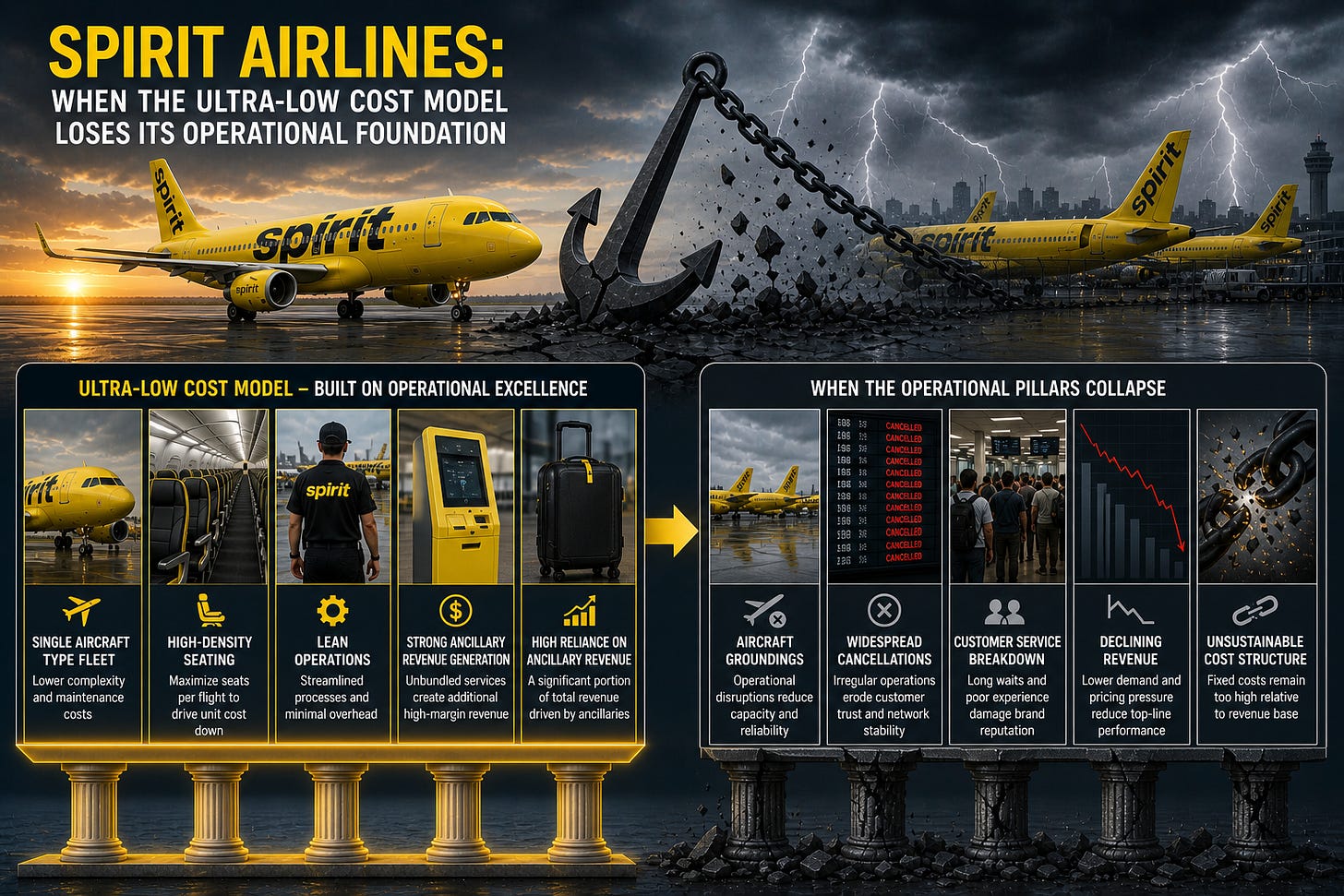
Spirit Airlines’ ultra-low-cost carrier model, meticulously engineered around minimizing Cost per Available Seat Mile (CASM) through fleet commonality with Airbus A320 family aircraft, rapid turnarounds, and a point-to-point network, achieved industry-leading operational efficiency but at the expense of systemic resilience. This hyper-optimization, focused almost exclusively on unit cost reduction, left Spirit vulnerable to external shocks, as the airline’s operational health deteriorated under rising CASM that outpaced revenue growth—CASM rose nearly 40% from 5.67 to 7.97 cents between 2019 and 2024 while RASM grew only 8%, culminating in Spirit spending more than it earned per seat mile by 2024. The fragility was further exposed by the 2023 Pratt & Whitney GTF engine recall that grounded over half its fleet, slashing aircraft utilization from 11.1 to 9.9 hours daily and triggering cascading operational and financial setbacks.
The erosion of Spirit’s ultra-low-cost advantage was accelerated by legacy carriers like Delta, American, and United introducing Basic Economy fares that mirrored Spirit’s stripped-down service but combined it with broader networks and stronger loyalty programs. This 'reverse commoditization' undermined Spirit’s pricing power, leaving RASM stagnant despite rising costs and ancillary revenues ballooning to nearly 60% of total revenue by 2024. As passengers increasingly favored the slightly higher-priced but more reliable and connected Basic Economy options, Spirit’s pure ULCC model lost its competitive moat, exposing the inherent vulnerability of relying on a single, highly price-sensitive customer segment.
Spirit’s operational model was a precision-calibrated machine optimized for a narrow set of stable conditions—low to mid-range fuel prices, strong demand from price-sensitive travelers, and limited direct competition from legacy carriers. However, this single-variable optimization created a rigid system with no capacity reserves or adaptability, akin to a race car tuned for perfect weather suddenly caught in a storm. When multiple foundational assumptions broke simultaneously—including rising fuel costs, market volatility, and the GTF engine crisis—Spirit’s closed intervention window prevented effective strategic pivots, trapping the airline in a downward spiral from which it could not recover.

Failed Lifelines, Fatal Collapse
Bondholder revolt, a blocked JetBlue merger, and superficial restructuring left Spirit stranded, proving that financial engineering alone can’t rescue an airline crippled by structural weaknesses.
Spirit Airlines' financial restructuring efforts unraveled largely due to bondholder rejection of a $500 million bailout, which was insufficient to cover a staggering $360 million overshoot in jet fuel costs caused by prices soaring from $2.24 to $4.51 per gallon. The bailout terms, which would have granted the government up to a 90% equity stake ahead of existing lenders, fueled fierce opposition among bondholders who feared severe dilution of their recovery prospects, ultimately dooming the rescue plan despite urgent talks involving Commerce Secretary Howard Lutnick. This financial impasse was exacerbated by weekly operating cost increases of $10 to $15 million, overwhelming Spirit's ultra-low-cost carrier model and forcing the airline to cease operations.
Spirit’s strategic bet on a merger with JetBlue as its lifeline backfired spectacularly when the deal was blocked by judicial and political opposition, including key figures like President Biden and Secretary Buttigieg. The planned $3.8 billion capital infusion from JetBlue was seen as essential for Spirit’s survival, with the airline itself warning that failure to merge would lead to bankruptcy. This merger blockade not only stripped Spirit of its primary financial rescue but also forced the carrier to confront unresolved operational inefficiencies and a weakened market position with depleted resources, hastening its collapse and triggering significant job losses and consumer price hikes.
Spirit’s initial Chapter 11 restructuring in late 2024 was largely a superficial balance sheet exercise that failed to tackle the airline’s core operational challenges, resulting in continued losses of $257 million within just three months post-bankruptcy. This narrow focus on financial engineering, combined with the subsequent blockage of the JetBlue merger and refusal of government bailout under terms unfavorable to bondholders, left Spirit financially vulnerable amid soaring fuel costs and market pressures. The airline’s inability to stabilize its business model or secure a viable capital injection sealed its fate, illustrating the pitfalls of relying on short-term fixes without addressing fundamental operational weaknesses.