Gen z goes all-in: the 'casino economy' fuels high-stakes bets and demands for change
The gist
Gen Z and Millennials are doubling down on high-stakes speculation—from crypto to sports betting—as America’s ‘casino economy’ widens the gap between the asset-rich and everyone else.
What to know
- Nearly half of young adults are investing in volatile assets like crypto and sports bets, even as credit card delinquencies hit highs not seen since 1929.
- The top 10% of households now control almost half of all consumer spending and 87% of stocks, while lower and middle-income families struggle with record debt and eroding purchasing power.
- Gen Z is demanding real-world financial literacy and systemic change, as traditional paths to prosperity slip further out of reach.
Risk Fever in the Digital Age
Gen Z is embracing high-stakes speculation as AI-fueled markets and crumbling real-world opportunities make gambling-like risk-taking the new normal for those boxed out of stability.
The emergence of the 'casino economy' is rooted in the rapid financialization of markets and the AI investment boom, both of which have been fueled by unprecedented levels of debt and global competition. In late 2025, the Financial Times highlighted that OpenAI’s partners had amassed $100 billion in debt to expand AI compute capacity, a move that underscores the fragility of this high-stakes environment. As the U.S. and China vie for dominance over AI chips and energy resources—what the Department of Justice described as a contest to 'control the future'—the resulting volatility amplifies economic risk, making the entire system feel less like a stable marketplace and more like a high-rolling casino where the odds are increasingly opaque.
This casino mentality is exacerbated by a widening disconnect between over-optimized digital markets and deteriorating physical infrastructure, leaving younger generations especially vulnerable to speculative behaviors. While AI-driven advances and algorithmic trading create dazzling opportunities in digital finance, the reality on the ground—crumbling bridges, failing schools, and stagnant labor markets—renders traditional paths to prosperity nearly inaccessible. As a result, young people, boxed out of homeownership and stable careers, are increasingly turning to high-risk bets in both formal and informal channels, from meme stocks and crypto to Pokémon cards and sports betting, in a desperate bid to leapfrog economic stagnation.
Psychologically, economic insecurity has triggered a profound shift in risk tolerance, as described by Daniel Kahneman’s 'loss domain' theory: when people lose faith in incremental progress, they become willing to gamble everything for a shot at recovery. This is visible in the explosion of speculative investments, such as prediction markets (which saw over $10 billion in volume in November 2025) and the meteoric rise of legal sports betting revenue to $13.7 billion in 2024, with Gen Z and Millennials making up 76% of participants. The normalization of gambling-like behavior in mainstream financial activities signals not just a late-stage bubble, but a generational recalibration of what it means to take risks in pursuit of a viable future.
By early 2026, the casino economy’s grip on young Americans is evident in both their conflicted attitudes and addictive behaviors toward risk. Nearly half of Gen Z now invest in the stock market, but with average Robinhood balances under $250 and 30% of portfolios in crypto, these are not the moves of confident investors but of those seeking outsized, rapid returns. Despite 31% of 18- to 34-year-olds holding sports betting accounts and 32% betting multiple times a week, over 40% of young adults now view legalized sports betting negatively—a jump from 34% in 2022—reflecting a growing awareness of the psychological toll and addictive nature of these behaviors, even as economic pressures make them hard to resist.




The Two-Tier Wealth Trap
A historic gulf between asset-rich elites and debt-burdened households is hardwiring inequality, as the middle class is squeezed out by policy failures and runaway asset inflation.
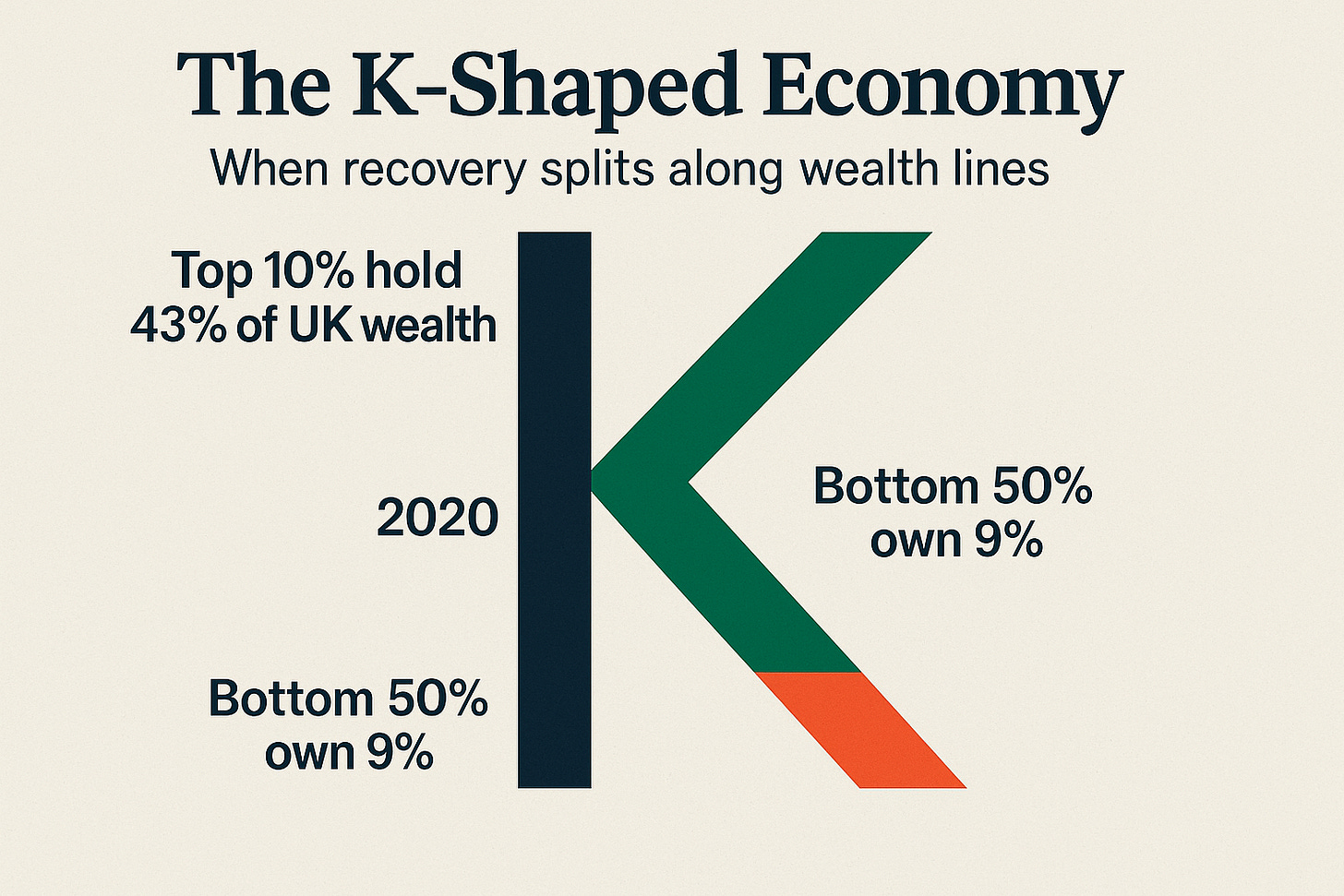
The K-shaped economic recovery has sharply divided American households, with affluent groups benefiting from soaring asset values and continued discretionary spending, while lower and middle-income families face mounting financial distress. As the bull market increasingly becomes 'the haves versus the haves,' retail investors and struggling households are left behind, evidenced by credit card delinquencies reaching levels not seen since 1929 and mortgage distress surpassing the 2008 crisis. This polarization underscores how economic gains are concentrated at the top, deepening inequality and leaving the majority vulnerable to economic shocks.
The divergence is further entrenched by structural forces: tech giants like Microsoft, Google, Amazon, and Meta are projected to spend nearly $500 billion annually on AI infrastructure by 2026, fueling asset bubbles and capital gains for the wealthy while automating jobs away from the middle class. Meanwhile, consumer brands such as Kraft Heinz and Chipotle report plummeting sales among customers earning under $100,000, and companies like Simply Good Foods and CAVA have seen double-digit stock drops, highlighting how wage stagnation and declining purchasing power are squeezing the middle and lower tiers. Visa’s strongest growth is now among the highest spend bands, while McDonald’s and Coca-Cola report that lower-income consumers are skipping meals or trading down, painting a vivid picture of a two-tier economy.
At the heart of this divide lies the concentration of wealth in financial and housing assets, a phenomenon exacerbated by decades of flawed policy and passive investment flows that inflated asset prices and distorted risk. Analysts like Mike Green argue that a single broken benchmark rewired incentives, leading to asset inflation that eroded the middle class and collapsed housing affordability, while policymakers failed to intervene. As a result, the top 10% of households now control nearly half of all consumer spending in the US, and the wealthiest 20% own 87% of all stocks, reinforcing a cycle where capital is rewarded and labor is left behind.
This economic bifurcation is not just a matter of numbers—it is reshaping the lived experience and psychology of American households. While a small cohort enjoys 'intense certainty paired with relentless power control,' as Peter Atwater notes, the majority face a 'sea of despair,' with half of Americans now living paycheck to paycheck and many families earning six figures still feeling poor due to hidden costs like the 'Vampire Tax.' The erosion of the middle class and the rise of economic insecurity are fueling political discontent, as affordability of essentials—housing, healthcare, food, and fuel—becomes the central concern for voters heading into 2026.





Speculation as Survival
Facing stagnant wages and vanishing job security, young adults are redefining financial agency by betting big on volatile markets and alternative assets in a bid for upward mobility.
For Gen Z and Millennials, economic anxiety is no longer a background hum but a defining feature of adulthood, fueled by mounting student debt, soaring housing costs, and a labor market increasingly shaped by AI-driven hiring freezes. Recent college graduates, in particular, are squeezed between high financial obligations and a job market that is slow to absorb young talent, with experts warning that the true impact—such as rising student loan delinquencies—may not become fully visible until well into 2026. This delayed reckoning underscores the precariousness of early-career workers, whose struggles are often masked by headline labor data that fails to capture the depth of generational financial stress.
The traditional social contract—work hard, stay loyal, and reap stable rewards—has unraveled for younger generations, replaced by a landscape where wage growth lags far behind the doubling of housing costs and a 33% surge in debt payments. Social media amplifies this sense of inadequacy, with constant exposure to wealthier peers shifting the baseline for 'enough' ever higher; as one analysis notes, many now see the poverty line at $150,000. In this climate, Gen Z and Millennials increasingly view long-term tenure as a liability rather than a path to security, recalibrating their financial expectations and fueling a pervasive sense that stability is out of reach without taking on greater risk.
Locked out of traditional wealth-building avenues, younger cohorts are gravitating toward high-variance financial behaviors—embracing prediction markets, sports betting, and crypto trading as alternative paths to agency and potential windfalls. Platforms like Polymarket and Kalshi saw over $10 billion in volume in November 2025 alone, while legal sports betting revenue soared to $13.7 billion in 2024, with 76% of activity coming from Gen Z and Millennials. This shift has led to a new archetype: the 'speculator,' typically an urban renter and heavy user of mobile trading apps, who seeks outsized returns in a world where stable, incremental growth feels unattainable.
By early 2026, the 'no-hire' labor market has hit young and low-income workers especially hard, with unemployment rates for teenagers rising by 2.9 percentage points and for recent college graduates by 1.6 points—far outpacing increases among older workers. Wage growth for the lowest-paid has stalled, reversing earlier gains and creating the widest gap in wage growth favoring high earners since the early 2010s. This confluence of stagnant wages and limited job mobility compounds financial stress, leaving many young adults feeling trapped in a cycle of economic insecurity.
The psychological toll of these economic headwinds is profound: financial independence has become the fastest-growing unmet need, with 41% of respondents citing it as a source of anxiety—up from 32% in 2022—and the pressure to make money to feel successful has nearly doubled in the same period. Younger generations are not only turning to AI for workplace and health decisions, but are also urgently seeking financial literacy and independence, as evidenced by the surge in interest in the FIRE (Financial Independence, Retire Early) movement from 24% to 37%. The pursuit of fulfillment at work has also intensified, with dissatisfaction with leadership models rising nearly 60% since 2023, signaling a broader generational demand for meaning and agency amid economic uncertainty.



Investing or Just Gambling?
Market volatility is blurring the line between sound investing and reckless betting for a generation shaped by crisis, driving both sophisticated hedging and risky short-term plays.
By early 2026, investors are increasingly turning to sophisticated hedging strategies to protect gains and manage concentrated risks, especially in high-flying stocks like the 'Mag 7.' The launch of new ETFs that allow investors to capture upside while cushioning downside reflects a market wary of having 'gone too far too fast.' Yet, this appetite for risk management is juxtaposed with a concerning trend among younger investors, who, conditioned by stimulus-driven rebounds, sometimes blur the line between investing and gambling—a distinction Schwab underscores with the reminder that 'investing is owning, gambling is hoping.'
The post-pandemic era has prompted a generational awakening among Gen Z and young millennials, who, despite their limited experience with severe downturns, are growing skeptical of traditional safety nets like Social Security. This has led to a shift from the 'buy the dip and just keep holding on' mentality toward a more intentional approach to retirement planning, with younger investors increasingly prioritizing long-term security over short-term speculation.
As market dynamics evolve beyond the dominance of mega-cap stocks, financial planning in 2026 demands a more nuanced approach to diversification and risk. After years of double-digit returns concentrated in a handful of companies, opportunities are now emerging across the market cap spectrum, requiring investors to adapt their portfolios to rotational trends and muted index-level gains. This shift underscores the importance of broad-based diversification and a willingness to seek value beyond the usual suspects.

Financial Literacy: The New Urgency
Demand for real-world financial education is surging as Gen Z rejects outdated curricula, fueling a movement for practical skills and systemic change amid economic uncertainty.
By early 2026, the call for a new approach to financial literacy education has become urgent, with experts like Scott and Kyla arguing that lessons must be grounded in real-world events and made engaging to resonate with Gen Z and beyond. Anchoring abstract economic concepts in current news—such as CPI inflation reports—not only demystifies the data but also demonstrates its direct impact on students’ lives and financial futures. As Kyla points out, making financial literacy 'fun' and clearly explaining 'why you should care' are crucial for motivating students, a connection too often missing from traditional curricula.
The gap in practical financial knowledge has sparked a renewed push for 'adulting' classes in schools, as highlighted by Kyla’s observation that 'half of us don't know what affects a credit score.' With many students unaware of how credit influences interest rates and even job prospects, this lack of foundational skills leaves young people ill-equipped to navigate increasingly complex financial landscapes. The movement toward embedding real-life financial decision-making into education reflects a recognition that traditional approaches have failed to prepare students for the economic realities they now face.
This educational shortfall is mirrored in broader societal trends: according to a 2026 Oliver Wyman Forum report, financial literacy has surged to become the top skill people wish they’d learned earlier, with the unmet need for financial independence climbing from 32% to 41% since 2022. The resulting anxiety is fueling interest in movements like FIRE (Financial Independence, Retire Early), which has seen support jump from 24% to 37% in just two years, as individuals seek proactive strategies to regain control in an unpredictable economy. The pressure to achieve financial security—and the sense that traditional pathways are no longer sufficient—has nearly doubled since 2022, underscoring the urgency for both personal and systemic solutions.
However, improving individual financial literacy is only part of the solution; the Oliver Wyman Forum also highlights the need for systemic change, as economic uncertainty and shifting workplace expectations render many leadership models obsolete. With 51% of respondents viewing current leadership as outdated and complaints about 'subpar leadership' up nearly 60% since 2023, there is a growing demand for new strategies that align with a more independent and demanding workforce. This shift signals that empowering individuals must go hand-in-hand with reimagining the structures and policies that shape the broader economic landscape.