Gold overtakes treasuries in reserve shift
The gist
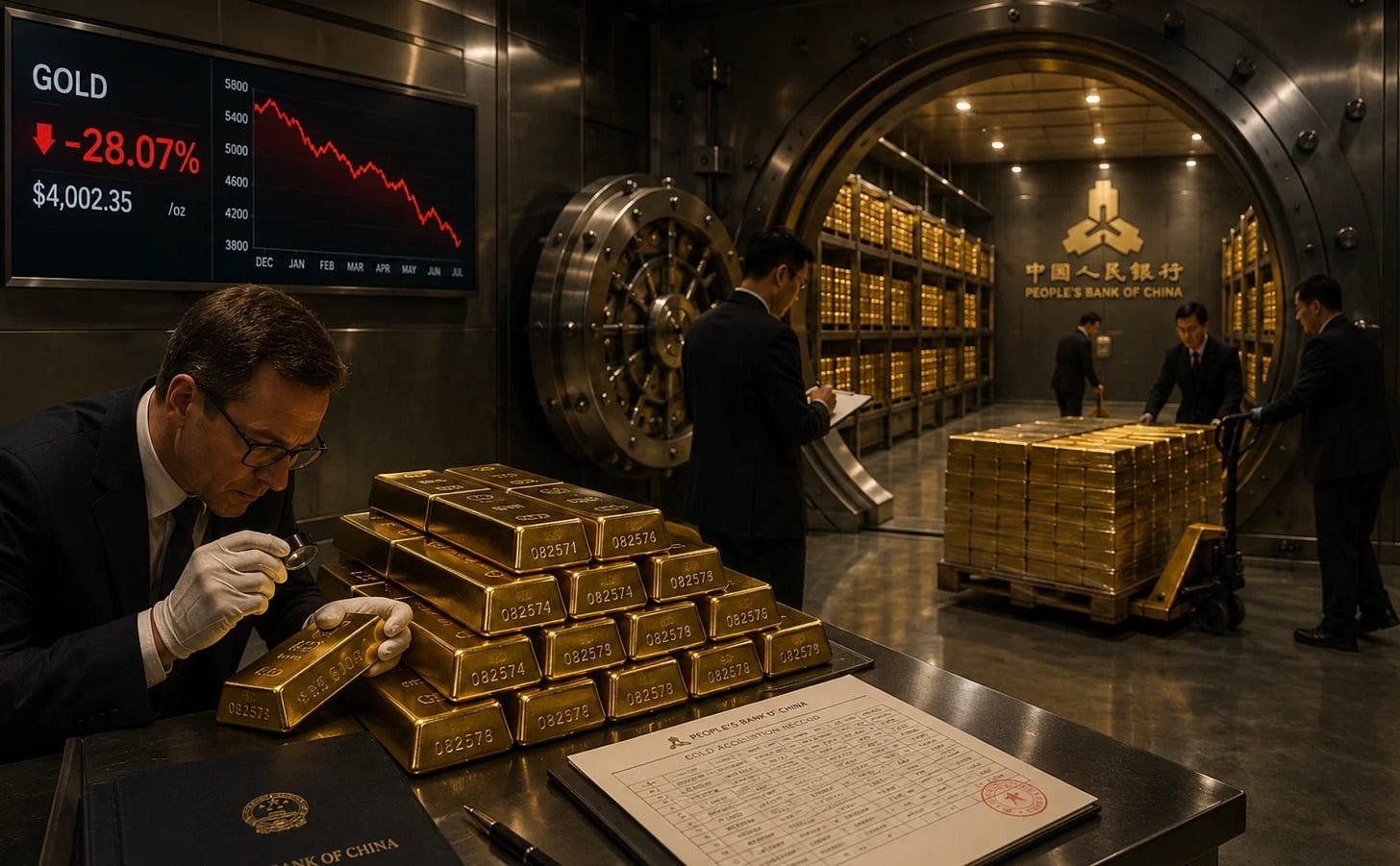
For the first time ever, central banks have made gold the world’s top reserve asset, dethroning U.S. Treasuries as global trust in the dollar unravels.
What to know
- By mid-2026, gold accounts for 27% of global official reserves, overtaking Treasuries at 22% after record central bank purchases of 863 tons in 2025.
- China slashed its U.S. Treasury holdings from $1.10 trillion in 2021 to $682.6 billion in 2026 while ramping up gold reserves to 2,308 tonnes to back the yuan.
- Countries are racing to build alternative payment systems and gold stockpiles as the weaponization of the dollar—especially via sanctions—shatters its former neutrality.
Gold’s Secret Surge
China and Russia quietly amassed vast gold reserves through opaque purchases, signaling an early and deliberate break from dollar dependence long before official figures revealed the scale.
The early phase of the global financial realignment was marked by a dramatic surge in gold prices beginning in early 2024, with gold breaking all-time highs as China and Russia covertly amassed significant gold reserves while simultaneously reducing their U.S. Treasury holdings. This strategic pivot away from dollar reliance was underscored by China’s clandestine gold purchases, estimated by traders to be around 250 tons annually—far exceeding official reports—and possibly totaling 5,000 tons, double what Beijing disclosed to the IMF. The opacity of gold transactions allowed China to build these reserves discreetly, avoiding market panic or political backlash, signaling early cracks in the dollar’s hegemony.
Central banks’ gold reserves remain disproportionately low compared to their currency reserves—currently six times smaller—highlighting a vast potential for further accumulation that could propel gold prices beyond $20,000 an ounce. This imbalance echoes the 1970 scenario when gold and currency reserves were roughly equal, suggesting that a strategic rebalancing is underway. The trend toward secrecy is also evident globally, with only one third of central bank gold purchases reported last quarter, down sharply from 90% four years prior, reflecting a broader move by emerging markets to quietly fortify their gold holdings.
By early 2026, China’s shift from covert gold accumulation to more overt financial maneuvers became apparent as regulators instructed major banks to limit and reduce their U.S. Treasury holdings, which had plummeted from $1.10 trillion in 2021 to $682.6 billion—the lowest since 2008. Motivated by concerns over concentration risk, market volatility, and the threat of asset freezes reminiscent of Russia’s 2022 experience, China’s divestment from U.S. debt inversely correlated with its rising gold reserves, marking a clear strategic pivot to reduce dependence on the dollar and diversify its reserve assets.
This early realignment reflects a broader economic strategy wherein central banks, especially China’s, are not merely chasing short-term gains but making a calculated bet that the U.S. dollar will depreciate significantly over the next decade. China’s move away from U.S. debt toward physical gold coincides with deliberate U.S. policies aimed at weakening the dollar through tariffs targeting China, signaling early fractures in dollar dominance and a reindustrialization push. As one analyst noted, 'Every single central bank that is loading up on gold right now is essentially making a bet that the dollar will be worth less in 10 years than it is today.'




Dollar Weaponization Fallout
Sanctions and the politicization of the U.S. dollar shattered global trust, forcing nations to abandon seamless capital flows and fragment the financial system into competing blocs.
By early 2026, the weaponization of the U.S. dollar through sanctions—most notably against Russia—had irrevocably shattered the dollar's status as a neutral global currency, a role it had held for over 80 years. This erosion of trust has led to a dramatic decline in global dollar demand, constraining the U.S. government's ability to finance its soaring national debt, which by mid-2026 exceeded $39 trillion with a net international investment position of -$27.5 trillion. As a result, the U.S. faces mounting pressure to realign government spending radically, underscoring the financial and geopolitical costs of leveraging the dollar as a weapon rather than a common medium of exchange.
In response to the dollar's weaponization and the resulting financial fragmentation, countries have accelerated the development of alternative payment systems such as BRICS Pay and China's digital yuan (eCNY), designed to bypass U.S.-controlled networks like SWIFT. This shift is part of a broader 'bulcanization' trend, where global finance fractures into smaller, less cooperative blocs, forcing nations and investors to prioritize security and resilience over the efficiency that once characterized the globalist era. As one analysis put it, the era of seamless capital flow is giving way to a landscape rife with friction and strategic realignment.
The sanctions imposed on Russia, particularly the exclusion from the SWIFT network and freezing of assets, served as a stark demonstration of the vulnerabilities inherent in reliance on dollar-based assets, prompting China to significantly increase its gold reserves. This move is not merely reactive but strategic: China aims to back its yuan with gold to elevate it as a credible global reserve currency, thereby reducing dependence on the dollar and mitigating the risk of future financial coercion. As one expert noted, 'We're going to make the yuan the global reserve currency. And the only way that we're going to be able to do that is to back it by gold.'
The broader geopolitical tensions, including conflicts involving Iran and the strategic importance of chokepoints like the Strait of Hormuz, have intensified the weaponization of the dollar and heightened global financial fragmentation. This dynamic threatens the longstanding petrodollar system that underpins U.S. financial dominance, as major commodity-producing nations increasingly seek to trade outside the dollar framework, accelerating the global pivot toward alternatives such as gold and digital currencies. The unraveling of this system signals a profound shift in the international monetary order with far-reaching implications.


China’s Gold Power Play
China is systematically dismantling Western control over gold markets by repatriating bullion and making Shanghai the world’s new gold pricing hub, while still grappling with dollar-based energy trade.
China’s gold accumulation strategy is a multifaceted, long-term geopolitical maneuver aimed at reducing reliance on the U.S. dollar and insulating itself from potential sanctions. By early 2026, the People's Bank of China had increased its official gold reserves to 2,308 tonnes, adding USD 51 billion in January alone, signaling a deliberate pivot away from U.S. Treasuries—which it slashed from USD 1.32 trillion to USD 683 billion—and toward gold as a bearer asset immune to credit risk and sanctions. This physical gold hoarding is complemented by strong domestic demand and repatriation efforts, with gold imports funneled primarily through the Shanghai Gold Exchange, which has traded at a premium to London prices, underscoring China's intent to anchor its financial system in tangible assets amid global uncertainty.
China is actively dismantling Western dominance over gold markets by siphoning physical gold from major financial hubs like London and New York’s COMEX, thereby undermining the fractional reserve system that underpins Western paper gold trading. This strategy includes shutting down domestic paper gold markets to compel citizens to hold physical gold, effectively creating a one-way flow of bullion into China. By establishing the Shanghai Gold Exchange as the new epicenter for gold price discovery, China aims to wrest control of gold pricing from Western institutions, as declared publicly since 2014, thereby enhancing the yuan’s credibility and challenging the U.S. dollar’s reserve currency status.
Despite its aggressive gold accumulation and ambitions to back the yuan with gold, China remains entangled in the dollar-dependent global energy market, with nearly all crude oil and LNG imports invoiced in U.S. dollars. This paradox highlights the complexity of fully displacing the dollar, as China’s energy transition and economic operations still necessitate dollar transactions. Nonetheless, China’s construction of massive domestic gold storage facilities—akin to its own Fort Knox—and plans to distribute gold reserves across trusted partner jurisdictions reflect a sophisticated, multi-layered approach to bolster yuan internationalization and reduce dollar dominance over time.
China’s strategic gold buying is deeply intertwined with its broader geopolitical and economic ascent, which began decades ago with the hollowing out of U.S. manufacturing and capitalizing on America’s post-1971 financialization. Triggered in part by the sanctions on Russia, China’s surge in gold purchases is not merely reactive but a calculated move to establish the yuan as a global reserve currency backed by gold. This approach reflects a comprehensive vision to supplant the dollar’s hegemony by combining manufacturing prowess, debt reduction, and tangible asset accumulation, signaling a profound shift in the global financial order.

Energy Leverage Redefined
China’s strategic oil stockpiles, electrification drive, and drastic import cuts have shifted global energy power, allowing Beijing to influence oil prices more than Saudi Arabia or the U.S.
Despite China's heavy reliance on U.S. dollar-denominated energy imports—consuming about 11 million barrels daily and paying in dollars for crude from Saudi Arabia, Iraq, Angola, and LNG from the U.S., Qatar, and Australia—its reduction in U.S. Treasury holdings reflects liquidity management rather than a weakening of dollar dominance in energy trade. The U.S. maintains control over global energy flows through its energy abundance, military power, and financial markets, reinforcing the petrodollar system even as China pursues yuan-denominated trade deals and gold accumulation.
China's strategic stockpiling of approximately 1.2 billion barrels of crude, sufficient for over 100 days of zero imports, combined with diversified supply lines away from the Strait of Hormuz toward Russia and Central Asia, enabled it to weather the 2026 global energy shock with remarkable resilience. This preparedness, coupled with a significant transition to electrification—where the electric vehicle fleet alone displaces over 1 million barrels per day of oil demand—has insulated China from price shocks and reframed the energy transition as a security imperative rather than solely a climate issue.
Since early 2026, China has drastically cut its oil imports by nearly one-third to over 40% year-over-year, a move that has prevented global oil prices from soaring amid geopolitical tensions such as the Iran war and Strait of Hormuz closure. By strategically drawing down vast oil reserves and leveraging alternative energy sources—including coal, renewables, and the world’s largest electric vehicle market—China has exercised unprecedented market power, with analysts like Gregory Brew noting it now wields more influence over oil prices than Saudi Arabia or the U.S.
China’s deliberate reduction in oil imports—dropping by about 5 million barrels per day—and refinery runs, alongside the strategic release of refined product stockpiles from underground SPRs estimated at 131 million barrels capacity, has stabilized domestic fuel supply and limited pump price inflation to just 30% despite global fuel prices doubling. This opaque management of reserves and demand, coupled with a fundamental demand problem linked to broader economic weaknesses such as a housing slowdown or recession, has transformed China into a 'volatility arbiter' that dampens global hydrocarbon price swings and challenges traditional oil market assumptions.




Central Banks Go All-In on Gold
A historic wave of gold buying—led by China, India, and Poland—has transformed gold into the world’s top reserve asset, as Treasuries lose their appeal amid geopolitical risk.
By mid-2026, central banks have decisively shifted their reserve preferences, with gold surpassing U.S. Treasuries as the largest reserve asset, accounting for 27% of global official reserves compared to Treasuries at 22%. This historic realignment is underscored by record gold purchases—863 tons in 2025 alone, far exceeding the prior decade's annual average—and sustained buying momentum into 2026 despite soaring prices above $5,500 per ounce. Poland’s central bank exemplifies this trend, increasing gold reserves to 700 tonnes for national security reasons, while major economies like China, India, Saudi Arabia, and the UAE drive the accumulation, reflecting a broad, strategic commitment to gold as a sovereignty asset amid geopolitical tensions.
China’s aggressive divestment from U.S. Treasuries, with holdings plunging from $1.10 trillion in 2021 to $682.6 billion by early 2026, reveals a strategic pivot away from dollar-denominated assets to mitigate risks highlighted by Russia’s 2022 asset freezes. Simultaneously, China has ramped up gold reserves, with gold’s share of its foreign reserves surging from under 2% a decade ago, actively siphoning physical gold from Western markets like London and New York to back the yuan and challenge Western financial dominance. This dual approach signals a deliberate geopolitical effort to reduce dollar dependence and establish a more multipolar financial system anchored by tangible assets.
The unprecedented surge in central bank gold buying—more than doubling annual purchases since early 2022 to over 1,000 tonnes per year—defies traditional economic logic, as institutions willingly exchange interest-bearing U.S. Treasuries for non-yielding gold. This shift reflects deep mistrust in the U.S. government's fiscal stability and the weaponization of the dollar, with central banks prioritizing gold's role as a secure, real asset hedge against geopolitical risks and sanction vulnerabilities. The World Gold Council notes that much of this buying is undisclosed, suggesting actual gold accumulation is even higher, reinforcing the narrative that central banks are quietly but decisively hoarding gold as a cornerstone of future monetary stability.
Looking ahead, central banks are making a calculated bet on the long-term decline of the U.S. dollar, accelerating gold purchases as a strategic hedge against anticipated dollar weakness and global economic realignment. This trend is intertwined with U.S. policy moves to weaken the dollar through tariffs and reindustrialization efforts, particularly targeting China, signaling a broader empire restructuring reminiscent of historical monetary transitions. Surveys show that 74% of central banks expect the dollar’s share of global reserves to fall over the next five years, highlighting a sustained and deliberate shift toward gold as a stabilizing reserve asset amid rising geopolitical uncertainty.



Gold’s Quiet Revolution
Central banks are trading yield for security, doubling down on undisclosed gold hoarding as faith in U.S. fiscal stability and the neutrality of the dollar collapses.
Central banks are trading yield for security, doubling down on undisclosed gold hoarding as faith in U.S. fiscal stability and the neutrality of the dollar collapses.