Gold rush redux: china’s bullion binge spurs U.S. to rethink dollar dominance
The gist
China’s record-breaking gold binge is forcing the U.S. to rethink the dollar’s supremacy, setting the stage for a global showdown over who controls the world’s reserve currency.
What to know
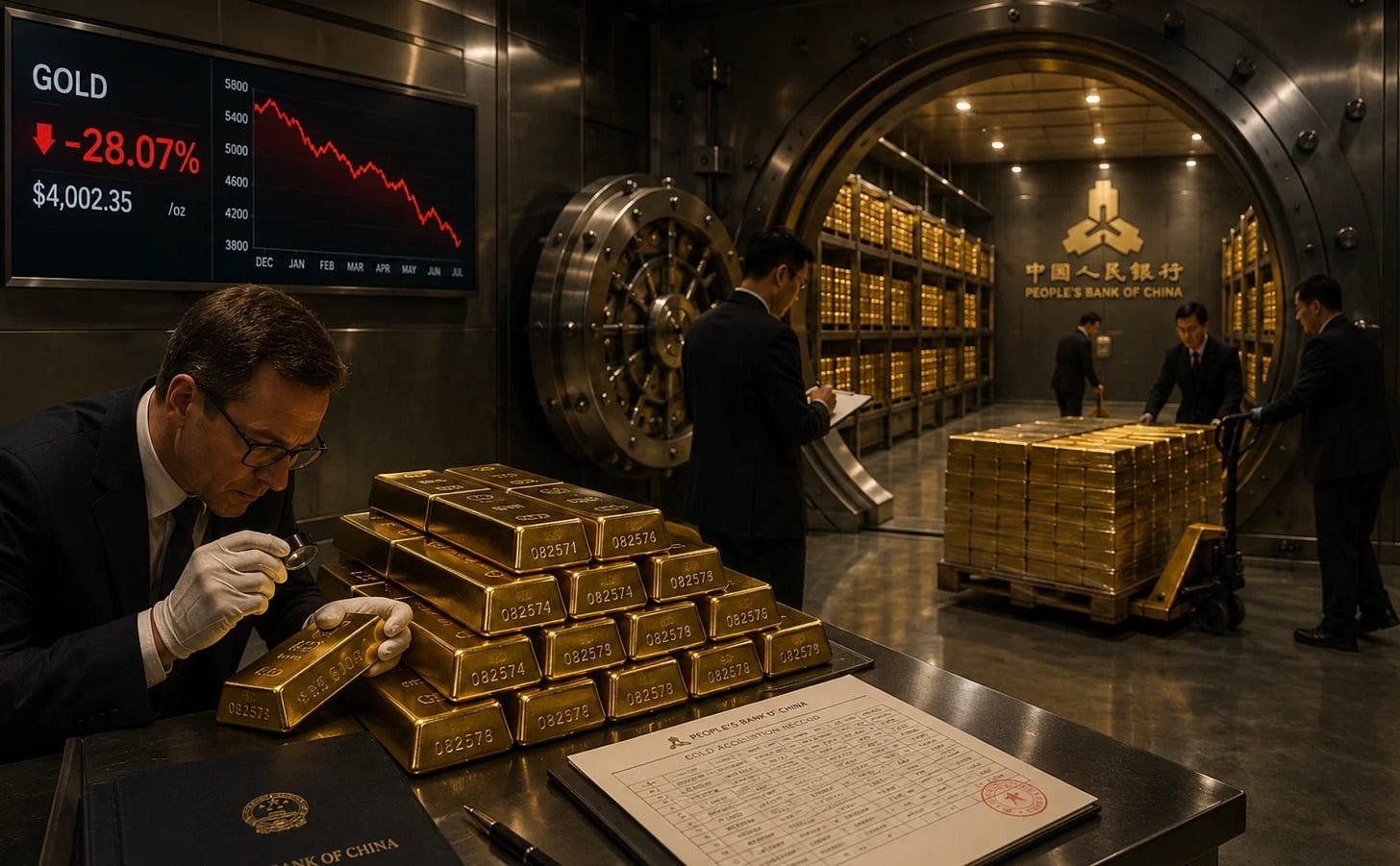
- China has quietly amassed over 14,000 tons of physical gold since 2015, shutting down paper gold trading to undermine Western markets and boost the yuan’s credibility.
- The U.S. is considering revaluing its gold reserves to market prices and issuing 50-year gold-backed Treasury bonds—a dramatic pivot to counter China’s gold-linked strategy.
- Global central banks are dumping U.S. Treasuries and snapped up a record 244 tons of gold in Q1 2026, signaling a seismic shift away from dollar dominance amid mounting geopolitical tensions.
China’s Gold Power Play
By draining Western gold markets and shutting down paper gold trading, China is weaponizing physical bullion to erode Western financial leverage and anchor the yuan’s credibility in real assets.
China has embarked on an aggressive campaign to accumulate physical gold, siphoning vast quantities from Western markets such as London and New York's COMEX to undermine the West's fractional reserve gold trading system. By physically repatriating gold bars and shutting down domestic paper gold trading—exemplified by ICBC and other major banks ceasing leveraged paper gold transactions—China creates a one-way flow of gold into the country, effectively eroding Western financialized gold markets and strengthening its monetary sovereignty. This strategy is not merely about hoarding metal but about strategically weakening Western leverage on gold while bolstering the yuan's credibility through tangible reserves.
Central to China's vision is establishing a new gold pricing system through the Shanghai Gold Exchange and its partner in Hong Kong, aiming to replace Western-dominated paper gold benchmarks with a pricing mechanism grounded in physical gold. As the former head of the Shanghai exchange asserted in 2014, this shift will reveal the 'true price' of gold, offering a fairer and potentially higher valuation that reflects real market fundamentals rather than speculative paper claims. This move not only challenges the dominance of London and New York as gold price setters but also underpins China's broader ambition to anchor the yuan to physical gold, thereby positioning it as a credible rival to the US dollar.
China’s relentless physical gold accumulation, including importing over 14,000 tons since 2015 and maintaining a 20-month streak of net purchases—with a notable 480,000-ounce buy in June 2026—signals a long-term, price-insensitive strategy to reduce reliance on paper gold and fiat currencies. This accumulation is coupled with building massive domestic storage facilities akin to a Chinese Fort Knox, reflecting a broader loss of trust in Western financial systems and the US dollar, especially after events like asset confiscations of Russian holdings. By forcing citizens to buy and hold physical gold while restricting paper trading, China not only consolidates control over its gold reserves but also positions itself to defend economically against potential future conflicts, including the possibility of gold confiscation mirroring historical US policies.




America’s Gold Revaluation Gambit
The U.S. is weighing a historic gold price reset and the creation of gold-backed Treasury bonds, aiming to unlock hidden trillions and reclaim monetary leadership as China challenges dollar supremacy.
Despite officially valuing its gold reserves at the outdated price of $42 per ounce—a figure frozen since 1973—the US government actually holds about 8,000 tons of gold worth close to a trillion dollars at current market prices near $4,000 per ounce. This vast discrepancy reveals a hidden asset gap that the Treasury and Federal Reserve are actively considering monetizing to strengthen the nation's balance sheet. Economist Judy Shelton has proposed issuing a 50-year US Treasury bond redeemable in either dollars or physical gold, a strategic move designed to counter China's gold-linked yuan by effectively reintroducing gold-backed securities into the American financial system.
Within the Federal Reserve and Treasury, discussions are intensifying around revaluing the official gold price to align with market realities, which would unlock over a trillion dollars in latent assets and provide a powerful monetary tool. The Treasury Secretary has publicly indicated plans to leverage these assets within the next 12 months, signaling a potential paradigm shift in US monetary strategy. Speculation is rife that this revaluation, possibly coupled with the launch of gold-backed bonds, could be timed symbolically for July 4th, 2026—America’s 250th anniversary—marking a historic monetary declaration of independence since Nixon severed gold convertibility in 1971, though the timing remains uncertain.
Central Banks’ Global Gold Exodus
A worldwide shift from U.S. Treasuries to physical gold—often through secretive, undisclosed purchases—signals a coordinated move by major economies to abandon the dollar’s ‘paper promise’ for tangible reserves.
Central banks worldwide are decisively shifting their reserve strategies by drastically reducing US Treasury holdings while accelerating physical gold acquisitions, reflecting a profound loss of trust in US debt and the dollar's stability. In the first quarter of 2026 alone, they purchased a record net 244 tons of gold, marking the strongest quarterly buying spree ever, with major holders like China strategically offloading hundreds of billions in US debt to rotate into gold without destabilizing bond prices. This trend underscores a deliberate, calculated move away from paper assets toward tangible reserves amid growing geopolitical tensions and concerns over US fiscal policies.
A significant portion of these gold acquisitions remains undisclosed, suggesting a shadow accumulation that far exceeds official reports, particularly by China, whose covert buying could be up to ten times higher than publicly acknowledged. This clandestine buildup highlights central banks' cautious approach to signaling their true gold reserves while reinforcing their hedging against the declining trust in paper gold markets and the US dollar's dominance. The World Gold Council’s inclusion of estimated undisclosed purchases reveals a hidden layer of strategic positioning since 2022.
The global nature of this shift is unmistakable, with a bipartisan coalition of countries—including Japan, Taiwan, Saudi Arabia, India, UAE, Norway, and Singapore—actively selling US Treasuries to fund gold purchases, signaling a collective move toward a multipolar monetary system. This broad-based divestment from the dollar reflects a rejection of the 'paper promise' of US debt in favor of 'real money,' as geopolitical rivalries and the weaponization of the dollar erode confidence in US financial hegemony. The world is increasingly demanding physical gold delivery, marking a fundamental transition in reserve management philosophy.
Beyond accumulation, central banks are also repatriating gold reserves to assert greater control over these strategic assets, exemplified by France’s recent swap of 129 metric tons of aging gold bars from New York for newer bullion stored in Paris, yielding a $15 billion windfall. This repatriation trend complements the broader diversification away from US-based holdings and underscores gold’s role as a hedge against inflation, geopolitical uncertainty, and financial instability. With 89% of reserve managers expecting official gold holdings to grow and 45% planning increases, the momentum toward physical gold as a cornerstone of global reserves is unmistakable.