Gold tops treasuries in reserve shift
The gist
Gold has toppled US Treasuries as the world’s top reserve asset, igniting a global financial shift fueled by de-dollarization and central bank gold buying frenzies.
What to know
- By early 2026, gold accounted for 27% of central bank reserves—surpassing Treasuries’ 22% for the first time in decades.
- China’s stealth gold hoard is estimated at 5,000 tonnes, over ten times its official reports, revealing a strategic retreat from the US dollar.
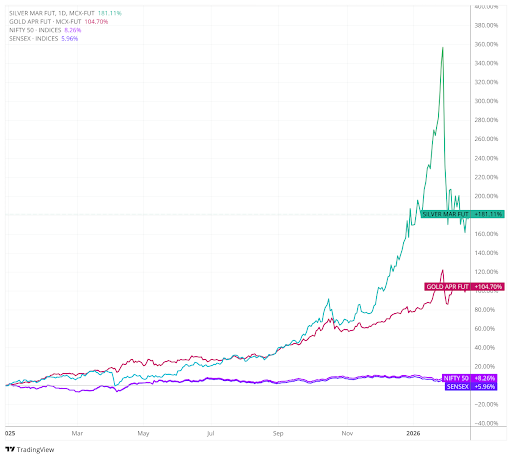
- Gold prices hit a record $5,589 per ounce in January 2026, with forecasts pointing toward $6,000–$6,300 as central banks and investors pile in.
End of Dollar Supremacy
Decades of U.S. Treasury dominance are collapsing as rising debt and fading global trust trigger a historic pivot back to gold as the cornerstone of central bank reserves.
Since the late 1990s, US Treasuries reigned supreme as the global reserve asset, buoyed by policies favoring offshoring and the dollar’s dual role in trade and finance. This dominance, lasting roughly three decades, was underpinned by post-Cold War triumphalism and America's perceived geopolitical and economic supremacy, as reflected in Fukuyama’s 'End of History' narrative. However, this regime is now unraveling amid rising US debt and declining foreign appetite for Treasuries, setting the stage for a seismic shift in reserve preferences.
Historically, gold was the cornerstone of monetary systems, exemplified by the Gold Standard Act of 1900 which fixed the dollar’s value to gold and established a framework that endured much of the 20th century. Central banks once held gold as a 'hard asset' and 'sound money,' but many, including Canada, divested heavily during the Treasury-dominated era. Now, as currency reserves outpace gold reserves sixfold—contrasting with parity in 1970—central banks are poised for a major gold-buying spree that could catapult prices beyond $20,000 per ounce.
By 2025, gold overtook US Treasuries as the dominant reserve asset in foreign central bank holdings, marking a historic reversal after 30 years of Treasury supremacy. This shift reflects broader geopolitical realignments, particularly the reluctance of China and Russia to return to Treasury holdings amid rising skepticism about US economic leadership. Gold’s rally, surging past $5,000 per ounce by early 2026 despite Federal Reserve balance sheet reductions, underscores central banks’ growing preference for gold as a hedge against fiscal deficits and geopolitical uncertainty.
The current global monetary landscape is characterized by what economists Hélène Rey and Ludovic Subran term a 'Kindleberger gap,' where the US hesitates to provide the global public goods—such as open trade and lender-of-last-resort functions—that sustain monetary hegemony. Coupled with the dollar’s sharp 8% decline in early 2025 and interest payments surpassing defense spending, these dynamics erode confidence in the dollar’s primacy. This environment creates fertile ground for gold’s ascendancy as central banks seek stable, non-sovereign reserve assets amid shifting geopolitical tides.



China’s Gold Playbook
China’s massive, covert gold accumulation and aggressive Treasury selloff reveal a calculated strategy to insulate its reserves from U.S. financial power and sanctions risk.
China's covert accumulation of gold, estimated at around 250 tons in 2025—over ten times its official reports—and possibly totaling near 5,000 tons, reveals a strategic effort to quietly diversify away from the US dollar. By dispersing purchases across entities like its sovereign wealth fund and military, China exploits the opaque nature of gold markets to avoid triggering political backlash or market panic, a tactic mirrored by other emerging economies as formal reporting of central bank gold purchases has plummeted from 90% to just one third in recent years.
The weaponization of the US dollar has fractured global trust, compelling nations to erect alternative financial infrastructures such as China’s digital yuan and the BRICS Pay system, which bypass US-controlled networks like SWIFT. This erosion of dollar dominance constrains the US government's ability to finance its ballooning debt—now exceeding $36 trillion—forcing a reckoning with fiscal sustainability amid constitutional gridlock on budget balancing, and driving central banks to repatriate gold and diversify into hard assets to mitigate counterparty and sanction risks.
By early 2026, China’s public directive to major banks to limit and reduce US Treasury holdings, which have fallen to $682.6 billion—the lowest since 2008—signals a deliberate pivot away from dollar exposure to shield against risks like asset freezes experienced by Russia in 2022. This selloff runs inversely to China’s rising gold purchases and exemplifies a broader de-dollarization trend, underscored by experts like Gareth Berry who view these structural outflows from the dollar as a tangible geopolitical realignment rather than a fleeting phenomenon.
Central banks worldwide, led by countries such as Poland which explicitly brands gold its 'primary alternative' to the dollar, have nearly doubled annual gold purchases since 2022, with over 863 tonnes acquired in 2025 alone and 95% of central banks planning further increases in 2026. This surge, coupled with the dollar’s share of global reserves dropping to about 56%—its lowest in three decades—and the rise of BRICS nations boosting local currency trade to 50%, reflects a seismic shift toward a fragmented global financial architecture prioritizing resilience over efficiency amid intensifying geopolitical and fiscal uncertainties.






Central Banks Go All-In
Relentless gold buying by central banks—often through opaque, underreported channels—is reshaping the global reserve landscape and fueling a new era of financial realignment.
Throughout 2025 and into 2026, central bank gold buying surged to unprecedented levels, with total purchases reaching 863.3 tonnes in 2025—nearly double the pre-2022 average—and projections for 2026 remaining robust at around 755 tonnes despite a brief slowdown in January. This sustained accumulation reflects a strategic shift by sovereign and institutional investors, including emerging economies like China and Poland, who are aggressively diversifying reserves away from US Treasuries amid geopolitical tensions and concerns over dollar dominance. Notably, China’s actual gold purchases are estimated to be over ten times its official figures, potentially amounting to 250 tonnes monthly, pushing its true holdings to approximately 5,000 tonnes and underscoring a covert but decisive de-dollarization effort reshaping global reserve compositions.
The gold market dynamics in 2025-2026 have been increasingly dominated by opaque central bank demand rather than traditional investor sentiment, creating a unique price environment where gold prices soared to record highs—peaking at $5,589.38 per ounce in January 2026 and surging over 64% in 2025 alone. Institutional forecasts from J.P. Morgan and Bank of America anticipate further gains to $6,000-$6,300 per ounce within the year, driven by strategic reserve diversification amid rising inflation expectations and political uncertainties surrounding US monetary policy. This structural bid is further supported by ETF flows and physical demand, exemplified by defensive moves from institutional actors during geopolitical instability, reinforcing gold’s role as a 'peace of mind' asset in turbulent times.
By the end of 2025, gold surpassed US Treasuries as the largest global reserve asset, accounting for 27% of central bank reserves compared to Treasuries’ 22%, marking a historic realignment in reserve management since 1971. This shift is propelled by central banks’ strategic motivations to reduce dollar concentration, manage sanction risks, and anchor monetary policy in tangible assets, even as dollar-denominated assets still comprise 42% of global reserves. The rise of alternative payment systems and digital currencies, including China’s CIPS and emerging CBDCs among BRICS nations, alongside growing stablecoin adoption, further underscores a decoupling of reserve assets from reserve currencies, signaling a multifaceted transformation in global financial architecture.


U.S. Eyes Gold Revaluation
Washington is quietly considering revaluing its gold reserves and integrating hard assets into fiscal policy, signaling a dramatic shift in how America manages monetary credibility.
By early 2026, under the leadership of Treasury official Bessent, the U.S. has begun seriously exploring gold’s strategic role as a form of 'soft discipline' in monetary policy that enhances fiscal credibility without reverting to a formal gold standard. This approach aligns with global trends, as major economies like China and Russia have aggressively expanded their gold reserves to reduce reliance on dollar assets, signaling a broader shift toward integrating hard assets to stabilize currency and bolster fiscal trust.
Bessent advocates for revaluing the U.S. Treasury’s gold holdings—currently recorded at the statutory price of $42.22 per ounce despite a market value exceeding $700 billion—to better reflect their true monetary significance. Such a revaluation could generate substantial paper gains, potentially leveraged to reduce the national debt and improve fiscal signaling, marking a significant departure from treating gold as a mere historical artifact and instead recognizing it as a vital monetary asset.
The emerging policy considerations include not only revaluing gold reserves but also increasing transparency about gold’s monetary role, possibly acquiring additional gold to strengthen fiscal backing ratios, and integrating hard asset valuations into broader fiscal sustainability assessments. While these measures may not create new wealth outright, their serious contemplation at the Treasury level under Bessent’s influence reflects a notable shift in U.S. fiscal and monetary strategy amid rising national debt and evolving global monetary dynamics.
Investors Flock to Hard Assets
A surge in gold ETF inflows and Gold IRA adoption shows investors are abandoning passive strategies for tangible assets, betting on gold as both a safe haven and inflation shield.
Investor enthusiasm, particularly through gold ETFs, has been a dominant force driving the current gold bull market, with inflows in 2025 swinging dramatically from a negative 2.9 tonnes in 2024 to a record positive 801.2 tonnes. This surge, which even outpaced equity mutual fund inflows in January 2026 (₹24,040 crore vs. less for equities), signals a shift where gold is increasingly viewed less as a commodity and more as portfolio insurance amid geopolitical tensions and inflation fears. However, this enthusiasm has also raised concerns about overexposure risks, as ETF flows exhibit higher cyclical amplitudes than central bank purchases, creating a speculative bubble reminiscent of the 1980 gold surge. Gold’s price remains anchored by production costs, but investor demand can temporarily push prices well above these fundamentals, especially when inflation worries mount.
In response to global financial fragmentation and rising volatility, investors are abandoning passive, index-based strategies in favor of resilience and optionality, prioritizing hard assets like gold and oil to hedge against trust-dependent financial systems and sanctions risks. This behavioral shift is underscored by central banks and sovereign reserve managers repatriating gold and increasing allocations, with gold reserves surpassing US Treasuries at 27% in 2025, reflecting a structural repositioning amid de-dollarization and geopolitical disruptions. Emerging markets, wary of sanctions as seen in Russia’s case, have notably increased gold purchases since 2022, while new platforms such as I Trust Capital are innovating by blending crypto and precious metals investing within tax-advantaged IRAs, catering to investors seeking secure, diversified exposure in a fragmented monetary landscape.
Retail investors are increasingly turning to Gold IRAs as a strategic response to persistent inflation, market volatility, and geopolitical uncertainty, seeking tangible assets to protect purchasing power and diversify retirement portfolios. Companies like Noble Gold Investments, celebrating a decade of educating over 10,000 families, emphasize simplifying the investment process and secure storage, while providers such as Goldco lead in facilitating 401(k) rollovers, highlighting the maturation of the precious metals IRA market. Financial advisors, however, caution that while Gold IRAs offer valuable diversification, they should complement rather than replace balanced retirement strategies due to their unique cost structures and lack of yield.
Investor sentiment toward gold remains sensitive to interest rate expectations and political influences on monetary policy, with recent fluctuations in gold ETF holdings reflecting shifts in perceived opportunity costs. As real yields fall amid rising inflation expectations—exacerbated by concerns over politically influenced rate cuts—gold’s appeal as a non-yielding asset strengthens, supporting higher prices. Despite short-term tactical headwinds from hawkish Fed signals and a strong dollar, long-term structural demand from central banks and sovereign entities continues robustly, as evidenced by China’s PBOC accumulating gold for 18 consecutive months and Goldman Sachs projecting central bank purchases rising to 60 tonnes monthly through 2026. This dynamic interplay between macroeconomic factors and geopolitical risks keeps gold central to diversified investment strategies.



Gold’s Price Path Divides
Major banks are split on gold’s near-term trajectory, with forecasts oscillating between caution and optimism as shifting macro forces and investor sentiment battle for control.
Despite J.P. Morgan's recent downward revision of the 2026 gold price forecast to $5,243 amid a 'trickle' of investor demand and subdued trading activity, the bank remains cautiously optimistic about a medium-term rebound toward $6,000 by late 2026. This tempered near-term outlook reflects tactical investor caution driven by cooling inflation, higher yields, and a stronger U.S. dollar—factors that have collectively dampened COMEX futures open interest and ETF flows, as also noted by ANZ's lowered year-end target. However, as energy and inflation uncertainties begin to ease, major financial institutions anticipate a structural shift that could restore gold's appeal as a hedge, underscoring its evolving role amid global monetary realignment.